
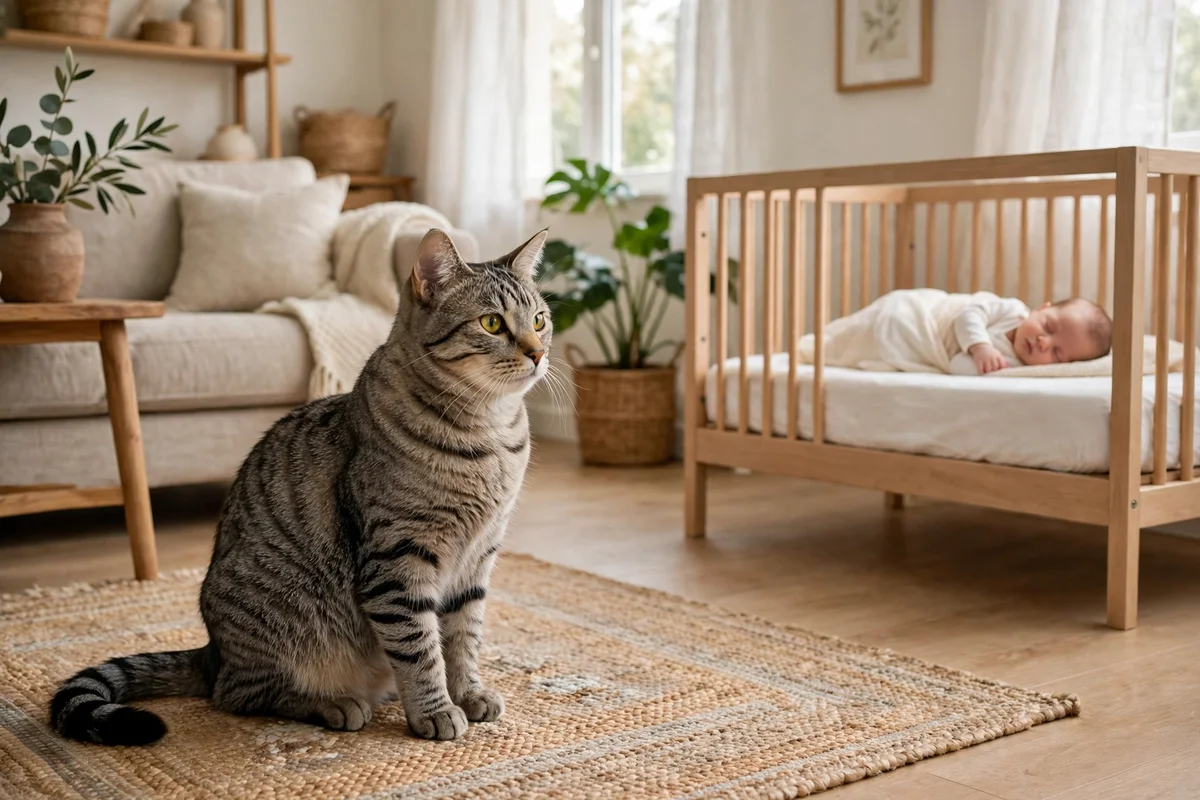
Cats and Kids: Bringing Home a Baby
Bringing a baby home changes your cat’s world overnight. New sounds, new smells, new furniture, new routines, and a small human who cries at 3 a.m. and cannot be reasoned with. Most cats adjust well, and many become devoted companions to the children they grow up with. The ones that struggle usually struggle because everything changed at once, with no safe retreat and no warning. This guide works through the change in order: prepare the cat before the baby arrives, keep the crib and the baby’s sleep space safe, manage the first meeting, hold the cat’s routine steady through the first weeks, and teach gentle hands as your baby becomes a toddler. Nothing here asks you to choose between your cat and your baby. Both can thrive in the same home when the adults plan for both.
The Short Answer
Prepare the cat weeks before the baby arrives: set up the nursery early, let the cat explore it, then make the crib off limits with a closed door or a screen door on the nursery. Never leave a baby alone with a cat, and keep the cat out of the crib and bassinet at all times. Introduce scent first, then a short supervised meeting with the cat free to walk away. Keep the cat’s food, water, litter and play routine as steady as you can, and give the cat a retreat children cannot reach. Teach children gentle hands from the start: flat palm, no chasing, no grabbing, no waking a sleeping cat.
Two Changes Are Happening at Once
It helps to see the arrival from both sides. For you, the baby is the event. For your cat, the event is everything around the baby: the nursery door that used to stay open, the furniture that moved, the visitors, the crying, the feeding schedule that now runs the house, and the lap that used to be free. Cats are creatures of routine and territory, and a sudden overhaul of both is one of the most reliable triggers for stress behaviour in cats: hiding, overgrooming, appetite changes, spraying, or avoiding the litter box. None of that means your cat dislikes the baby. It usually means the cat’s world changed faster than the cat could adjust to it.
The second change is the baby’s arrival itself. A newborn is small, warm, noisy, and smelly in ways cats notice. Milk scent, new laundry products, and the sound of crying are all new information. Most cats respond with curiosity first: a cautious sniff from a distance, then a retreat to think about it. A minority respond with fear, and a fearful cat needs distance and time, not forced closeness. Your job in the first weeks is to control the pace so curiosity wins and fear never gets a foothold. That is a management job, not a training job, and it is mostly done before the baby ever comes home.
Before the Baby Arrives: Prepare the Cat
Start at least a month before the due date, while you still have spare attention. Set up the nursery early and let the cat explore it freely. New furniture, a crib, a changing table, and new smells are much less interesting after three weeks than on day one, and the ASPCA recommends exactly this order: curiosity first, boundaries second. Let the cat sniff the crib, sit in the chair, and investigate the new room while nothing in it is precious yet. Once the cat has filed the nursery under familiar, you can start teaching the one rule that matters: the crib itself is off limits.
Make the routine changes early too. If feeding times will shift, shift them now. If the cat’s favourite sleeping spot is about to become the nursery, move the bed now and reward the cat for using the new spot. If someone else will do the morning play session for a while, hand it over now so the change is not tied to the baby. Cats cope with one change at a time; they struggle when five changes arrive on the same day. The same logic applies to sounds: playing recordings of baby crying at low volume, paired with treats, is a common behaviourist suggestion for helping a sound sensitive cat get used to the noise before it is real and constant.
Two practical jobs belong on the pre-baby list. First, the litter box. If anyone in the household is pregnant, that person should hand litter box duty to someone else for the pregnancy, because cat faeces can carry toxoplasmosis, an infection that is rare in indoor cats but serious in pregnancy. The San Francisco SPCA guidance on preparing a cat for a new baby makes this point plainly, and it is one of the few cat and baby rules that is not negotiable. Second, a vet check. A healthy cat with up to date vaccinations and flea control is a safer housemate for a newborn, and a vet visit before the baby arrives is far easier than one after.
The Nursery and the Crib: Keeping Sleep Safe
The old story that a cat steals a baby’s breath is a myth with no medical basis, and it is worth saying so plainly because it still frightens new parents. Cats do not set out to harm babies. What is real, and smaller, is this: a newborn cannot lift or turn its head, so a warm cat that curls up against the baby’s face could block the baby’s breathing. The risk is not malice. It is weight and warmth in the wrong place. That is why the rule is simple and absolute: the cat stays out of the crib and the bassinet, every time, without exception.
The American Academy of Pediatrics recommends that a baby sleep alone, on its back, on a firm flat mattress with nothing else in the sleep space, in the parents’ room for at least the first six months. A cat in the crib is exactly the extra body that rule already rules out. The reliable ways to enforce it are physical, not hopeful. The ASPCA recommends shutting the nursery door or fitting a sturdy screen door so air and sound pass but the cat does not, and keeping the door closed whenever the baby sleeps. A baby monitor in the room lets you hear the baby without leaving the door open. A cat tree or a comfortable bed on the opposite side of the nursery gives the cat a better perch than the crib, which is the same redirect logic that works everywhere else in cat behaviour: do not just forbid the spot, offer a better one.
Two shortcuts should be skipped. Crib tents and mesh nets sold to cover the top of a crib were recalled after entrapment and strangulation failures, including a death and a case of catastrophic brain injury in the 2012 recall of Tots in Mind tents, and they are not a safe substitute for a closed door. Essential oil sprays and diffusers marketed as cat repellents are also out: several common oils are toxic to cats, and a diffuser beside a crib puts droplets where both the cat and the baby breathe them. Low tech deterrents used before the baby arrives are safer: foil or double sided tape on the mattress, or a row of empty cans in the crib for a few weeks, teach most cats that the crib is an unappealing place to settle, and the lesson is learned before any baby is in it.
Bringing Baby Home: The First Meeting
On arrival day, greet your cat first, without the baby in your arms. You have been away, the house smells different, and your cat needs a minute of normal attention before the new arrival is presented. Let the cat sniff a blanket the baby has used, so the new scent arrives before the new person does. Then hold the baby and let the cat approach on its own terms, from a distance it chooses. Reward calm behaviour with treats, and let the cat walk away whenever it wants. A cat that leaves is not rejecting the baby. It is managing its own stress well, and it will come back sooner next time if leaving was allowed.
Keep the first meeting short and calm. One adult holds the baby, the other watches the cat and offers treats for calm curiosity. Do not carry the baby toward the cat, do not hold the cat up to the baby, and do not force the cat to stay in the room. Watch for stress signals: flattened ears, a low crouch, large pupils, a lashing tail, or growling. Any of those means the meeting is over for now, calmly and without fuss. The Toronto Humane Society’s guidance on babies and pets makes the same point: if the cat shows fear, let it observe from a distance it finds safe, reward the calm, and end the interaction before it escalates. Most cats need only a few such meetings before the baby becomes ordinary background.
In the first days, supervise every moment the cat and baby share a room, and never leave them alone together, even for a minute. This is not because your cat is dangerous. It is because a newborn cannot move away, and a startled cat can scratch without meaning to. Supervision also protects the cat: a baby’s sudden cry or flail can frighten a cat badly enough to make it avoid the baby for weeks. Short, calm, supervised contact builds a better relationship than long unsupervised exposure ever will.
The First Weeks: Routines That Keep the Peace
The first weeks with a newborn are exhausting, and the cat’s routine is usually the first thing to slip. That is exactly when it matters most. A cat whose feeding times, play sessions, and quiet hours keep running is a cat with something predictable to hold on to while the rest of the house is chaos. If you cannot do the play session yourself, ask someone else in the household to take it on, even for ten minutes a day. A short interactive play session before the evening feed burns off the energy that would otherwise go into 2 a.m. zoomies past the nursery door.
Protect the cat’s essentials from the new traffic. Food, water, and the litter box should sit away from busy areas, where the cat does not have to cross a crowd of visitors to reach them. If the litter box used to live in what is now the nursery, move it well before the baby arrives, not after. Give the cat retreats that children cannot follow it into: a high perch, a covered bed, a quiet room with a baby gate the cat can jump but a toddler cannot climb. The Purina guidance on cats and children makes the point that a cat’s private sanctuary matters most when the household is at its busiest, and baby gates are a practical way to protect it once the baby starts moving.
Expect some grumbling. A cat may sulk, hide more than usual, or mark a new item such as a high chair with urine in the first weeks. Marking is usually stress, not spite, and the fix is management rather than punishment: more retreats, more play, pheromone diffusers in the cat’s core area if your vet suggests them, and a vet check if the behaviour persists, since stress can trigger urinary problems. Do not comfort a cat that is actively anxious about the baby, which can reinforce the anxiety; wait for calm, then reward the calm. And keep the cat part of family life rather than banishing it to one room. A cat shut away from the family it used to live with is a cat with one more reason to be stressed.
Toddlers and Crawlers: Teaching Gentle Hands
The relationship changes again when the baby starts to move. A crawling baby is a new kind of event for a cat: low, fast, noisy, and persistent. Toddlers grab because grabbing is how they explore, and a cat’s tail, ears, and belly are exactly the parts a toddler reaches for. This is the stage where supervision becomes constant, because a toddler cannot be trusted to remember rules and a cat cannot be expected to tolerate being grabbed. The two should never be alone together, and the cat should always have an escape route that does not require passing the child.
Teach gentle hands the way you teach anything to a small child: by showing, not by lecturing. Show the open palm technique, stroking the cat’s back or shoulders with a flat hand, and the one finger greeting, where the child holds out a finger for the cat to sniff and the cat chooses whether to rub against it. Practise on a stuffed animal first, and on your own arm, so the child learns the movement before touching the real cat. The rules are short and concrete: no chasing, no grabbing, no pulling the tail or ears, no waking a sleeping cat, and never pick the cat up until the child is strong enough to hold it properly with one hand under the chest and the other supporting the hindquarters. A cat that is eating, toileting, or sleeping is left alone, every time.
Give the child jobs that build the bond safely. A four year old can scatter treats, refill the water bowl with help, or dangle a wand toy while an adult holds the other end. These jobs teach responsibility and give the cat good reasons to like the child. Keep small toys, hair ties, and other swallowable objects off the floor, since cats will bat them under furniture and babies will put them in their mouths. And keep teaching body language as the child grows: a cat that walks away is saying no, a cat that rubs against a hand is saying yes, and a cat with flattened ears and a lashing tail is saying leave me alone right now. Children who can read those signals rarely get scratched.
When Things Go Wrong: Stress Signals and Fixes
Most problems in a cat and baby household are stress problems with management fixes. A cat that hides all day may need more retreats or a quieter room. A cat that stops eating or overgrooms may need a vet check first, since illness and stress look alike, and a vet visit rules out the medical causes before you work on the behavioural ones. A cat that sprays new baby items is usually marking a changed territory, and the response is more resources, more play, and cleaning marked spots with an enzymatic cleaner rather than punishment, which only adds stress to stress.
Know the lines that mean professional help. Persistent litter box avoidance, repeated spraying, aggression toward the baby or the adults, or a cat that will not eat for more than a day are all reasons to call your vet promptly, and a certified cat behaviourist can help with a plan if the vet finds no medical cause. Rehoming is sometimes raised in these conversations, and it is worth being honest about: if the household genuinely cannot keep both the baby and the cat safe and cared for, a planned rehoming through a rescue is kinder than months of escalating stress for everyone. But that is a last resort, not a first step. Most families never reach it, because the fixes are ordinary ones: retreats, routine, supervision, and time.
If the cat in question is a new arrival rather than a resident, the same rules apply in a different order. Our new cat owner starter kit covers the first year basics, from supplies to the first vet visit, and our kitten names list is the enjoyable part of the research once the introductions are done. And if you are still choosing the cat, our guide to how to choose a cat name is a useful place to start the family conversation. Prepare early, keep the crib safe, supervise every meeting, and let the cat set the pace. Most cats and babies end up friends, and the ones that do were given time to get there.
Frequently Asked Questions
Can cats and newborn babies live together safely?
Yes, when two conditions hold: an adult supervises whenever the cat and baby share a space, and the cat is kept out of the crib and bassinet at all times. The old story about cats stealing a baby’s breath is a myth, but a warm cat settling against a newborn’s face is a real suffocation risk because a newborn cannot move away. A closed nursery door or a screen door, plus a baby monitor, enforces the rule reliably.
How do I keep my cat out of the baby’s crib?
Start before the baby arrives. Let the cat explore the nursery and the crib, then make the crib unappealing with foil or double sided tape on the mattress for a few weeks, and give the cat a better perch, such as a cat tree, on the other side of the room. Once the baby is home, keep the nursery door closed or fit a sturdy screen door whenever the baby sleeps. Skip crib tents and nets, which were recalled for entrapment and strangulation risk.
Should the pregnant person clean the litter box?
No. If anyone in the household is pregnant, someone else should handle litter box duty for the pregnancy, because cat faeces can carry toxoplasmosis, which is rare in indoor cats but serious in pregnancy. The box should still be scooped daily and kept in a quiet spot away from the baby’s areas. This is one of the few cat and baby rules that is not negotiable.
How should I introduce my cat to my baby for the first time?
Greet the cat first without the baby, then let the cat sniff a blanket the baby has used. Hold the baby and let the cat approach on its own terms, rewarding calm curiosity with treats and letting the cat leave whenever it wants. Keep it short, keep it calm, and end the meeting if the cat shows stress signals such as flattened ears, a low crouch, or growling. Never force the interaction or carry the baby toward the cat.
What age can a child be left alone with a cat?
There is no fixed age, and the honest answer is later than most parents guess. A child should not be left unsupervised with a cat until the child is old enough to read the cat’s signals, handle the cat gently without prompting, and walk away when the cat says no, which for most children is well into the school years. Until then, supervise every interaction and keep the cat’s retreats out of the child’s reach.
My cat is spraying the baby’s things. What should I do?
Spraying new baby items is usually stress marking, not spite. Do not punish the cat. Add retreats and play sessions, keep the cat’s routine steady, clean marked spots with an enzymatic cleaner, and ask your vet about pheromone diffusers. If spraying persists, or the cat stops eating or avoids the litter box, call your vet promptly to rule out a medical cause before working on the behaviour.