Toxins & Poisons: Household Dangers for Cats
Your home is full of things that are safe for you and dangerous for your cat. A lily on the table, a painkiller in the bathroom cabinet, a piece of chocolate on the counter, a drop of antifreeze in the garage: none of these look threatening, and all of them can make a cat seriously ill. Cats are more vulnerable than dogs to many household poisons, because their livers lack some of the enzymes that break these substances down.
If you think your cat has eaten, licked, or walked through something toxic, call your vet at once. If your vet is closed, call the Pet Poison Helpline at 855-764-7661 or the ASPCA Animal Poison Control Center at 888-426-4435. Some of the most dangerous poisons, including lilies and antifreeze, show few signs at first and cause serious damage while the cat still looks fine.
The information here is general information only and is not veterinary advice. If your cat may have been poisoned, contact your vet or a poison helpline at once.
Key Takeaways
- Call for help first, not last. Do not wait for signs, and do not try to make your cat vomit unless a vet or poison helpline tells you to.
- Lilies are the most dangerous common house plant for cats. Even a small amount of petal, leaf, pollen, or vase water can cause kidney failure.
- Human medicines are the most common cause of cat poisoning. Never give a cat a painkiller made for people.
- Never use a flea or tick product made for dogs on a cat.
- Keep the packaging of anything your cat may have eaten. The vet or helpline will ask what it was, how much, and when.
- Save both poison helpline numbers in your phone now: Pet Poison Helpline 855-764-7661 and ASPCA Animal Poison Control 888-426-4435.
What to Do First If You Think Your Cat Ate Something Toxic
Stay calm and act fast. Move the cat away from the substance so it cannot eat or lick more of it. If the substance is on the fur or paws, stop the cat from grooming it off, because grooming is how many poisons get swallowed. Do not give milk, food, or water to dilute the poison, and do not try to make the cat vomit. The American Red Cross advises that you should not induce vomiting until you speak with a vet or the ASPCA Animal Poison Control Center, because vomiting can cause more harm with some substances, including cleaners and corrosive products.
Call your vet or a poison helpline and be ready to answer four questions: what was it, how much did the cat take, when did it happen, and how much does the cat weigh. Keep the packaging or a photo of the label with you when you call.
If the cat is having trouble breathing, is having seizures, is limp or unresponsive, or has collapsed, go to an emergency vet at once and call on the way. The helpline can talk you through what to do while you travel, but a cat in that state needs hands on care.
Signs of Poisoning to Watch For
Poisoning does not always look dramatic. The early signs are often small: drooling, pawing at the mouth, vomiting, diarrhoea, loss of appetite, lethargy, or hiding. Later signs depend on the poison: wobbliness or poor coordination, tremors, seizures, rapid breathing, pale gums, weakness, or trouble passing urine. Vitamin D3 rat baits, for example, can cause kidney failure after 2 to 3 days, and lily poisoning can cause kidney failure even when the cat seems fine at first.
That delay is what makes poisoning so dangerous. An owner who waits for clear signs may miss the window when treatment works best. If you know your cat was exposed to something on the lists below, treat it as urgent even if the cat looks normal.
The Call Now Group: Poisons That Need a Vet at Once
Some poisons are so dangerous that there is no safe amount and no safe wait. If your cat was exposed to anything in this group, call your vet or a poison helpline at once, even if the cat looks fine.
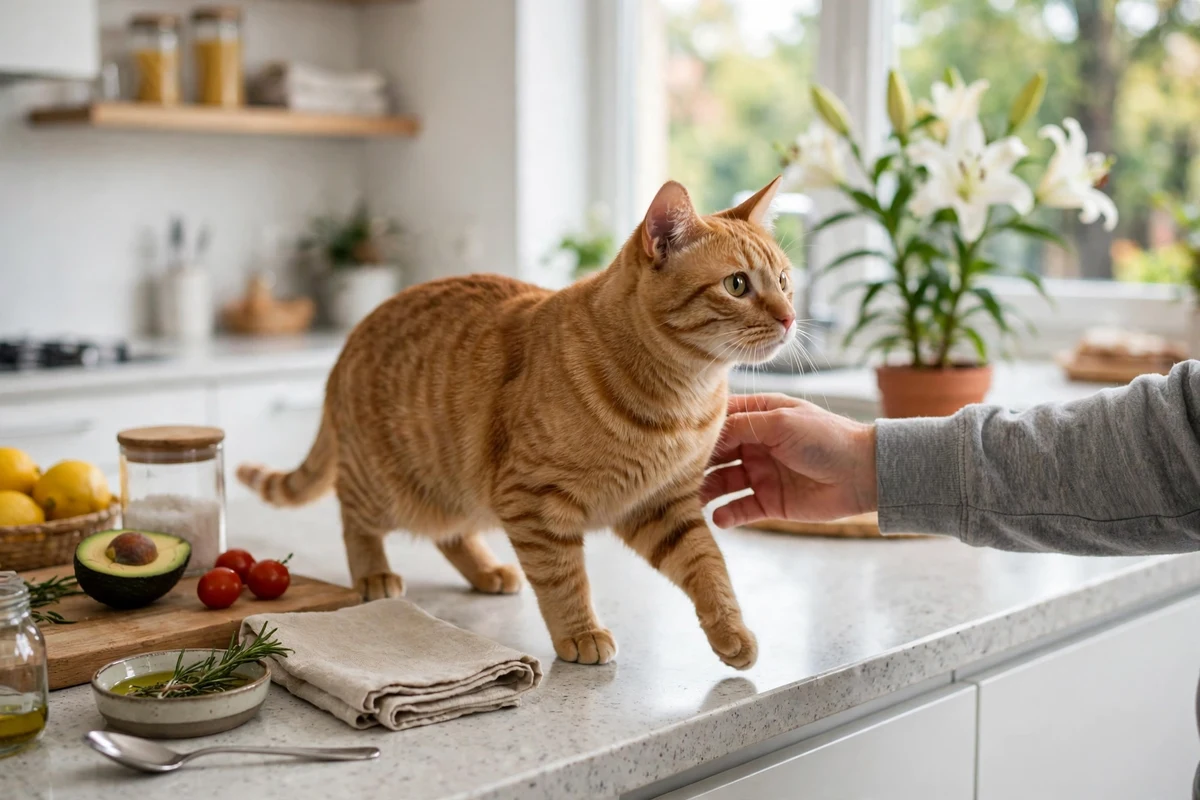
True lilies and daylilies are the most dangerous common plant for cats. Every part is toxic, including the flower, leaf, stem, pollen, and even the water in the vase. Lilies in this group include Easter lilies, tiger lilies, Asiatic lilies, and daylilies. Our guide on lilies that can kill your cat covers them in detail.
Sago palm is another emergency plant. All parts are toxic, and the seeds are the worst, because they carry the highest dose of the poison cycasin. Eating sago palm can cause vomiting, then liver failure. Oleander is toxic in all parts and contains cardiac glycosides that can cause vomiting and abnormal heart rhythm. Azaleas and rhododendrons contain grayanotoxin, and the ASPCA warns that a few leaves can be life threatening. Autumn crocus contains colchicine, which can cause bloody vomiting, multi-organ damage, and bone marrow suppression. Yew, foxglove, and lily of the valley are also in the emergency group: yew and foxglove affect the heart, and lily of the valley contains cardiac glycosides too.
Antifreeze is one of the most dangerous household chemicals for cats. It contains ethylene glycol, a sweet tasting chemical that cats may lick up from a puddle in the garage or driveway. Even a small amount can cause kidney failure and death. Clean up any spill at once and store antifreeze in sealed containers out of reach. If your cat may have licked antifreeze, call a vet at once. This is a poisoning where minutes matter.
Rat and mouse poisons are dangerous in two ways: a cat can eat the bait directly, or it can eat a poisoned rodent. Different baits work differently. Some cause internal bleeding, some cause seizures, and some, including vitamin D3 baits that contain cholecalciferol, cause kidney failure after 2 to 3 days. Use tamper resistant stations, keep them where cats cannot reach them, and keep the packaging so the vet knows which type it was.
Poisonous Plants in Your Home
Many of the most popular houseplants are toxic to cats. Most of them cause mouth pain and stomach upset rather than organ failure, and a cat that takes one bite usually learns to leave the plant alone. The bad news is that a determined chewer, a kitten, or a bored indoor cat can eat enough to need a vet.
The calcium oxalate group is the most common. Pothos, philodendron, monstera, peace lily, and dieffenbachia all carry insoluble calcium oxalate crystals in their leaves and sap. A cat that chews a leaf gets immediate mouth pain, drooling, and pawing at the mouth. The ASPCA lists all of them as toxic to cats. Keep them out of reach or out of the house, especially if your cat is a chewer.
Tulips, daffodils, narcissus, and hyacinths are toxic too, and the bulbs carry the highest dose. A cat that digs up a bulb in the garden or chews a cut flower can become seriously ill. Amaryllis bulbs are also toxic and arrive gift wrapped in December, which is when many cats meet them. Aloe, jade plant, chrysanthemum, English ivy, and cyclamen are all listed as toxic to cats by the ASPCA and VCA, usually causing vomiting, diarrhoea, and lethargy.
Poinsettias deserve a special note, because the myth is worse than the reality. Poinsettias are mildly toxic to cats and usually cause only drooling and stomach upset, not the severe poisoning many people fear. That does not make them safe, and a cat should not eat them, but they are not in the same group as lilies. When in doubt about any plant, check the ASPCA toxic and non-toxic plant database before you buy it.
Toxic Foods in Your Kitchen
Chocolate is the food most owners know about, and the rule is simple: the darker and more bitter the chocolate, the more dangerous it is. Baker’s chocolate and baking cocoa carry the highest dose of theobromine and caffeine. Signs include vomiting, diarrhoea, restlessness, tremors, abnormal heart rhythm, and seizures. Milk chocolate is less dangerous than dark chocolate, but no chocolate is safe for a cat, and a small cat can be harmed by a small amount.
Onions, garlic, chives, leeks, and shallots are all toxic to cats. They damage red blood cells and can cause anaemia. Cats are particularly sensitive, and garlic is about five times more toxic than onions. The danger includes cooked onion and garlic powder, not only raw bulbs. Signs include weakness, pale gums, vomiting, reduced appetite, and rapid breathing, and they may not appear for a day or two.
Grapes, raisins, and currants can cause severe acute kidney failure. The exact chemical responsible is not known, but the effect is real, and it applies to any product containing grapes or raisins, including some baked goods and trail mix. Xylitol is a sugar substitute found in sugar free gum, candy, baked goods, peanut butter, supplements, and vitamins. It is listed as toxic to cats, so keep xylitol products away from cats. Alcohol is toxic to cats in any form, including beer, wine, spirits, and food cooked with alcohol. Caffeine is found in coffee, tea, energy drinks, and some supplements, and it can cause restlessness, tremors, and abnormal heart rhythm.
Raw bread dough is a danger many owners miss. When a cat eats unbaked dough, the yeast ferments inside the stomach, the dough expands, and it produces alcohol. The result can be a bloated stomach, a twisted stomach, and alcohol poisoning. Keep rising dough covered and out of reach.
Avocado deserves a careful note, because it is often listed as toxic when the truth is narrower. The fruit itself is not harmful to cats and dogs. The real danger is the large pit, which is a choking and intestinal obstruction hazard. Do not give a cat avocado with the pit in it, and keep pits out of the bin where a cat can reach them.
Medicines: The Most Common Cause of Cat Poisoning
Human medicines are the most common cause of cat poisoning, and the most common mistake is giving a cat a painkiller made for people. Acetaminophen, the drug in Tylenol and paracetamol, is extremely toxic to cats. Cats do not have the enzyme needed to break it down, and even a small dose can cause fatal red blood cell and liver damage. Ibuprofen and aspirin are also toxic, and anti-inflammatory drugs can cause severe kidney failure and stomach ulcers. Antidepressants and cold medicines are also dangerous. Never give your cat any human medicine.
Keep all medicines in closed containers in a cupboard a cat cannot open. Cats can chew through blister packs and push bottles off counters. If a pill drops on the floor, pick it up before the cat finds it. If your cat takes a pill, call your vet or a poison helpline at once and tell them the drug name, the dose, and the time.
Dog flea and tick products are a separate and serious risk. Some products made for dogs contain chemicals that are toxic to cats, and a cat can become severely ill and even die if a dog product is applied to it, or if it snuggles with a dog before the dog’s treatment has dried. Always read the label, use only products made for cats, and keep a treated dog away from cats until the product has dried.
Cleaners, Chemicals, and the Garage
Household cleaners are a common cause of poisoning, and cats are exposed in a way dogs are not: they walk through a spill and then groom it off their paws. Bleach, detergents, disinfectants, toilet cleaners, and carpet cleaners can cause drooling, vomiting, mouth pain, and breathing trouble. Clean up spills at once, rinse a cat’s paws if it has walked through a cleaner, and keep cleaning products in closed cupboards. Never use a strong cleaner on a surface your cat walks on and then leave it wet.
Liquid potpourri and wax melts are a danger many owners do not expect. A simmer pot or a burner heats scented liquid that smells interesting to a cat, and a couple of licks can cause severe chemical burns in the mouth, oesophagus, and stomach. Keep liquid potpourri and wax melts out of reach, and do not use a simmer pot in a room where a cat can reach it.
Essential oils are toxic to cats through the mouth and through the skin, because cats lack the liver enzyme needed to break them down. The most toxic essential oils for cats include tea tree, peppermint, wintergreen, sweet birch, cinnamon, citrus, pine, clove, eucalyptus, and ylang-ylang. Do not apply essential oils to a cat, and be careful with diffusers in a small room. A cat that cannot leave a room with a running diffuser is a cat that cannot escape the exposure.
The garage holds some of the worst poisons in the house. Antifreeze is covered above, but also keep paint removers, glues, rust removers, and varnish removers sealed and out of reach. Diisocyanate glues, sold under brand names like Gorilla Glue, expand inside the stomach if swallowed and can cause a blockage. Fertilisers, pesticides, and herbicides can cause stomach upset and, in larger amounts, more serious illness, and a cat can pick them up on its paws from a treated lawn and then groom them off. Keep cats off a treated lawn until it is dry, and store garden chemicals in sealed containers. Two more dangers are worth a line: string, yarn, and tinsel can cause a serious intestinal blockage if swallowed, and loose change can be a risk, because zinc from pennies minted after 1982 can cause anaemia and kidney failure if swallowed.
Room by Room Safety Sweep
Walk through your home once with a cat’s eye view and fix what you find.
In the laundry room, keep detergent pods, bleach, and fabric softener sealed and high up. A detergent pod looks like a toy, and a cat that bites one can suffer burns to the mouth and stomach. In the garage, clean up any antifreeze spill at once and store paint, glue, and garden chemicals sealed and out of reach. In the living room, check every plant against the ASPCA list, move toxic plants out of reach or out of the house, and keep string, yarn, and tinsel put away. In the garden, keep cats off treated lawns until dry, and do not plant lilies, sago palm, oleander, or foxglove where a cat can reach them.
Cat Safe Plants and Swaps
A home without plants is not the answer. Plenty of plants are safe for cats, and swapping a toxic plant for a safe one keeps the home green without the risk. Plants the ASPCA lists as non-toxic to cats include spider plants, Boston ferns, African violets, orchids, and cat grass. Cat grass and catnip give a cat something safe to chew, which can reduce the urge to chew other plants.
When you swap a plant, do not simply move the toxic one to a high shelf and hope for the best. A cat that wants a leaf will climb, and a hanging planter can still drop leaves a cat can eat. Give the toxic plant away or put it in a room the cat never enters. When you buy a new plant, check the ASPCA toxic and non-toxic plant database first, and keep the label until you have checked.
Myths and Mistakes
Three mistakes make poisoning worse. The first is waiting to see what happens. Some poisons show few signs at first and cause serious damage while the cat still looks fine, so waiting wastes the window when treatment works best. The second is trying to make the cat vomit. Vomiting can cause more harm with some substances, and it should only be done when a vet or poison helpline tells you to. The third is giving milk. Milk does not neutralise poison, and it can make some poisons absorb faster.
Another common mistake is assuming a small amount is safe. For some poisons, there is no safe amount. A single lily leaf, a lick of antifreeze, or one acetaminophen tablet can be enough to cause serious harm. The dose matters, but the only person who can judge it is the vet or the helpline.
Frequently Asked Questions
What should I do first if my cat eats something toxic?
Move the cat away from the substance, stop it from grooming the substance off its fur, and call your vet or a poison helpline at once. Do not make the cat vomit and do not give milk unless the vet or helpline tells you to. Keep the packaging and note the time.
Are lilies really that dangerous to cats?
Yes. True lilies and daylilies are among the most dangerous plants for cats. All parts are toxic, including the flower, leaf, pollen, and vase water, and even a small amount can cause life threatening kidney failure. If your cat was near a lily, call a vet at once.
Can I give my cat a painkiller made for people?
No. Acetaminophen, ibuprofen, and aspirin are all toxic to cats. Cats do not have the enzyme needed to break acetaminophen down, and even a small dose can cause fatal liver and red blood cell damage. Only give a cat medicine your vet has prescribed for that cat.
Are essential oils safe for cats?
No, many essential oils are toxic to cats, including tea tree, peppermint, wintergreen, and eucalyptus. Cats lack the liver enzyme needed to break them down. Do not apply essential oils to a cat, and use diffusers only in a room the cat can leave.
What numbers should I save in my phone?
Save your vet’s number, the Pet Poison Helpline at 855-764-7661, and the ASPCA Animal Poison Control Center at 888-426-4435. Both helplines answer 24 hours a day and both charge a consultation fee.