
Bengal Cats: The Leopard of the Living Room
A Bengal walks into a room and the room adjusts. This is a cat with actual wild blood in its veins, a coat that shimmers in sunlight, and the athletic confidence of an animal that has never once doubted itself. Bengals look like they wandered off a nature documentary, and they act like it too: they climb high, run hard, learn the rules so they can negotiate around them, and keep their people on a very short leash of affection.
The honest version first: a Bengal is not a lap cat. It is a devoted, interactive, extremely smart athlete that needs engagement the way other cats need naps. If you want a decoration, admire Bengals from afar. If you want a partner in crime who will learn to open your cabinets, join your shower routine, and play fetch until your arm gives out, welcome home.
History
📖 Breed History
The Bengal began in the 1960s with California breeder Jean Mill, who crossed the small wild Asian Leopard Cat (Prionailurus bengalensis) with domestic cats to capture the leopard look in a fully domestic animal. The goal was never to keep a wild cat as a pet; it was to give the wild look a domestic temperament. Modern Bengals are many generations removed from that wild ancestor (most family pets are F4 or later, meaning four or more generations of domestic-to-domestic breeding), and the breed was accepted by The International Cat Association in 1991. It is now TICA's most-registered breed, with more than 60,000 Bengals on the books, a number that tells you exactly how magnetic the combination of wild looks and tame heart has proven to be. The Savannah is the Bengal’s fellow hybrid, bred from the African serval rather than the Asian Leopard Cat. The Bengal’s fellow hybrid is the Chausie, bred from the jungle cat rather than the Asian leopard cat. The other great spotted breed is entirely domestic: the Ocicat, an Abyssinian-Siamese cross bred to look like a miniature ocelot. Breeders later crossed Bengals with Oriental Shorthairs to create the Serengeti, a fully domestic cat bred to mimic the tall, spotted serval. Bengal blood also flows in the Toyger, the striped breed created by Judy Sugden, daughter of Bengal founder Jean Mill, to mimic a miniature tiger. Another Bengal descendant is the Cheetoh, a cross between the Bengal and the Ocicat bred for a larger spotted companion.
Appearance
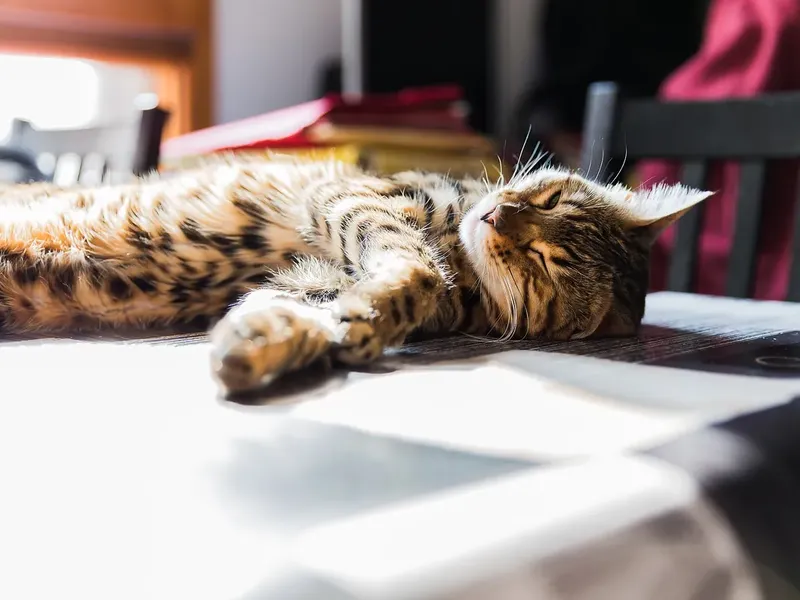
Everything about a Bengal is built for prowling. The body is sleek and muscular with a distinctive prowling walk, because the hind legs are slightly longer than the front. The head is a broad, rounded wedge with high cheekbones, prominent whisker pads, a wide nose, and large, bright eyes. Ears are medium to small with rounded tips. But the coat is the whole point. Bengals wear either spots and rosettes (two-toned spots like a jaguar's or leopard's) or marbling (bold, random swirls of color flowing across the body), over backgrounds from cool grey to vibrant gold, bronze, copper, and mahogany. Some Bengals carry a trait called glitter: each hair has a translucent, iridescent tip that makes the coat shimmer in sunlight. Add silver backgrounds, snow (ivory with blue-to-aqua eyes), and nearly white undersides, and you have the most dramatic coat in the domestic cat world. If you love the spotted look but want no wild ancestry at all, the Egyptian Mau is the only naturally spotted domestic breed.
Temperament & Personality
Active, confident, curious, devoted: the v3 sheet has it exactly right, but the words undersell the intensity. Bengals are extremely alert and learn by watching, which is how they figure out doors, cabinets, and faucets. They love heights and will claim the top of the refrigerator as a surveying station. They are demanding about interaction and can be vocal about what they want, including, in some cases, growling over their dinner. What surprises most owners is the devotion: a Bengal chooses its people and sticks to them, following you around, joining your activities, and playing with an enthusiasm that borders on athletic obsession. Experienced owners do best, because a bored Bengal does not sulk. It redecorates.
Care & Grooming
The short, dense coat is gloriously low-maintenance: a quick weekly brushing keeps it gleaming and cuts shedding down. Everything else about Bengal care is higher-octane than average. This breed needs daily vigorous play, climbing trees that can survive a muscular cat at full speed, puzzle feeders, and novelty on a rotating schedule. Many Bengals love water and will supervise dishwashing or join you near the sink. Indoor life is strongly advised: their boldness plus their beauty makes unsupervised roaming a bad combination. They mature slowly, taking up to two years to reach full physical development, so enjoy the extra-long kitten chaos. Feeding is standard quality cat nutrition; the exercise is the real dietary plan. If you want a badass cat name to match, this breed has earned one.
Health Notes
Bengals are generally a robust, athletic breed. Responsible breeders screen their lines for the breed's known inherited conditions: hypertrophic cardiomyopathy (HCM), the most common heart disease in cats; progressive retinal atrophy (PRA), which causes blindness and has no cure; and pyruvate kinase deficiency, a genetic cause of anaemia, with DNA screening available, though PetMD notes testing cannot catch every form of HCM, so routine veterinary checks still matter. Bengals are also prone to patellar luxation (slipping kneecaps), intestinal lymphoma, and sensitive digestion (PetMD). Choosing a breeder who tests and raises kittens in the home is the single best health decision you can make. Keep them lean and muscular rather than soft, keep up with routine veterinary care and dental checks, and give their cleverness safe outlets. A well-bred, well-exercised Bengal is a hardy companion.
Best Names for a Bengal
Wild roots, spotted coats, and golden glow: nineteen names that can keep up with this breed. Every meaning below is real.
Frequently Asked Questions
Are Bengal cats part wild?
Their ancestry includes the Asian Leopard Cat, but modern Bengals are many generations (F4 and beyond) removed and fully domestic in temperament. They look wild; they love like house cats with ambition. The F number counts the generations from the wild ancestor: F1 is the first cross, and pet Bengals are typically F4 or later. Note that early-generation hybrids (F1 to F3) face ownership restrictions in some places, so check local regulations before you commit (PetMD).
Do Bengals like water?
Many do. Bengals are famously fascinated by running water, and plenty will dip paws, supervise the sink, or join shower routines.
Are Bengals good lap cats?
Not typically. They are devoted and affectionate, but they express it through play, proximity, and interaction rather than long lap sessions. They prefer to be near you, doing things.
How much exercise does a Bengal need?
A lot. Daily vigorous interactive play, tall sturdy climbing structures, and puzzle feeders are the baseline. A bored Bengal invents its own entertainment, usually at your expense.
Do Bengal coats really glitter?
Yes, some do. Glitter is a real trait: translucent tips on each hair that make the coat shimmer in sunlight. Not every Bengal has it, but the ones that do look lit from within.
Are Bengals hard to groom?
No, grooming is the easy part. The short, dense coat needs only a quick weekly brushing. The demanding part is everything else: the energy, the intelligence, and the attention.
What breeds make up a Bengal cat?
Not two pedigree breeds. The Bengal is a hybrid: the small wild Asian Leopard Cat crossed with domestic shorthairs, beginning with Jean Mill's program in the 1960s and refined through decades of selective breeding (TICA). Today's pet Bengals are F4 or later, many generations of domestic-to-domestic breeding.
Are Bengal cats hypoallergenic?
No. No cat breed is truly hypoallergenic: the main allergen is in saliva and skin glands, not fur. A Bengal's short coat sheds less than many breeds', which can help, but it will still trigger susceptible people (PetMD).
Are Bengal cats aggressive?
No, but they are intense. Bengals play hard, vocalise their demands, and can be territorial, and early generations (F1 to F3) are more strong-willed than later ones. What reads as aggression is usually under-exercised energy or poor socialisation: a well-socialised, well-exercised Bengal is an attentive, devoted companion (PetMD, TICA).
By Brianna Baxter
Featured photo: Photo: William Crochot (Medium69), CC BY-SA 4.0, via Wikimedia Commons.
Bengal owners often ask how the breed stacks up against the other big hybrid: see Bengal vs Savannah for the full comparison.