
Sphynx Cats: The Warm-Hearted Aliens of the Cat World
The Sphynx looks like a creature that arrived by spacecraft and acts like a golden retriever that got shrunk in the wash. Hairless, wrinkled, huge-eared, and warm to the touch as a fresh-baked loaf, this is the most surprising cat in the world: people expect aloof weirdness and get the clown prince of neediness instead. A Sphynx greets you at the door, supervises your entire evening, perches on your shoulder, and slides under your blanket like it pays rent.
One correction before we go on: the Sphynx is not Egyptian. The breed was born in Canada in the 1960s and named for the Great Sphinx of Giza, whose weathered statues the cats supposedly resemble. What they actually resemble is nothing on earth, and that is exactly the point. If you want a cat with the volume turned all the way up: affection, energy, mischief, warmth, and maintenance, the Sphynx delivers all of it at once.
Quick Facts
- Origin: Canada
- Coat: hairless; fine downy fuzz
- Temperament: extroverted, energetic, affectionate, intelligent
- Weight: 6-12 lb
- Lifespan: 8-15 years
History
The story starts in 1966 in Toronto, when a domestic shorthair cat gave birth to a hairless kitten, later named Prune. Breeders recognized the mutation's potential and developed it through selective breeding, with early programs sometimes outcrossing to Devon Rex lines. The new breed was first known as the Canadian Hairless and the Moonstone Cat before settling on Sphynx, for the Egyptian Sphinx. Despite the ancient-sounding name, the breed is thoroughly modern: a 1960s Canadian creation, built kitten by kitten into the extroverted, warm-skinned companion the world knows today. It took a while for registries and the public to take the hairless cat seriously; the personality did the convincing. CFA accepted the Sphynx for registration in 1998 and advanced it to Championship status in 2002. Another sparse-coated breed is the Lykoi, the werewolf cat, though DNA evidence shows it is unrelated to the Sphynx, its patchy roan coat coming from a different mutation entirely.
Appearance
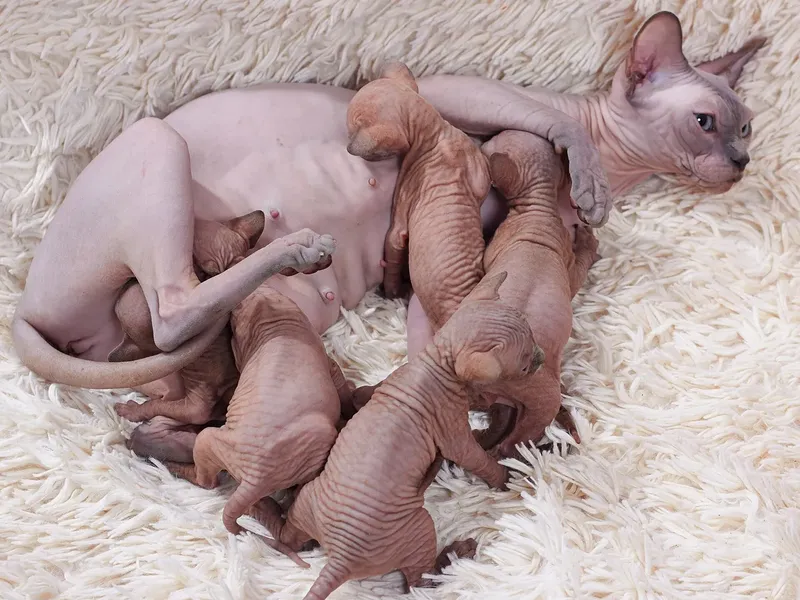
There is nothing else like it. The Sphynx is a medium-sized, muscular cat with a broad, barrel-like chest and a surprisingly solid, dense feel in the hand: heavier than the hairless frame suggests. The skin is the headline: hairless to the eye, but covered in a fine downy fuzz that feels like warm suede or peach skin, gathered into expressive wrinkles on the head, neck, and legs. The head is a modified wedge with prominent cheekbones, huge wide-set lemon-shaped eyes, and enormous open bat-like ears. There are few or no whiskers and no eyelashes. Color and pattern live in the skin's pigmentation, so Sphynx come in solids, tabby, tortoiseshell, pointed, and bicolor, in pinks, creams, greys, blacks, and whites. The tail is long, slender, and whip-like. It is an acquired look that, once acquired, ruins all other cats for you.
Temperament & Personality
Extroverted, energetic, affectionate, intelligent: the four words are doing heavy lifting. Sphynx are famously dog-like: they follow their people from room to room, greet them at the door, demand to be involved in everything, and perform for attention with an acrobat's energy and a comedian's timing. They are curious, clever, and vocal about their wants. They get along well with children, other cats, and friendly dogs, mostly because more warm bodies means more cuddles, though CFA cautions that children should be old enough to understand that the Sphynx's delicate skin is not suited to rough play. The affection is partly thermostatic: with no fur, a Sphynx seeks heat, and you are the furnace. Expect a cat on your lap, on your shoulder, and under your blanket. They do not do well left alone for long stretches, and a second pet is often the kindest choice for a working household.
Care & Grooming
Here is the twist nobody expects: the hairless cat is HIGH maintenance. With no fur to absorb them, skin oils build up on the body, so Sphynx need regular baths (weekly for many) plus routine ear cleaning, since the big open ears collect wax fast, regular nail care, and a daily wipe of the eyes, which tend to water (PetMD). They sunburn and get cold: indoor-only living is mandatory, with sweaters, heated beds, and warm sleeping spots in winter, and shade from direct sun. Their metabolism runs hot to keep that naked body warm, so they typically need more calories than a furred cat of the same size: quality high-protein food in the right amounts. The unique cat names page suits a cat this unmistakable, and the funny cat names page suits a cat this ridiculous. What they need most is presence: this breed's care is measured in hours of company, not minutes of brushing.
Health Notes
Sphynx are generally sturdy, active cats, with the breed's known concerns well documented by veterinary sources: The breed-specific issues to be aware of are hypertrophic cardiomyopathy (HCM), a form of heart disease; hereditary myopathy, which affects muscle function; sensitive digestive systems; and skin conditions such as urticaria pigmentosa, alongside periodontal disease (CFA). Heart screening, including DNA testing of breeding stock, is a standard part of responsible breeding (PetMD), so ask whether the parents were tested, and the skin, ears, and eyes need the routine attention described above. Choose breeders who test their lines and raise kittens in the home, keep up with regular veterinary and dental care, and protect that bare skin from sun and cold. A well-bred, well-kept Sphynx is a robust, long-enjoyed companion.
Best Names for a Sphynx
Egyptian gods (the namesake), sun and warmth (the lifestyle), and suede-soft texture: eighteen names with real meanings.
| Name | Meaning | Good for | |
|---|---|---|---|
| Bastet | cat goddess | The Egyptian cat goddess herself: the single most perfect name for a Sphynx. | |
| Anubis | jackal god | Dark, striking, and ancient for the dramatic boy. | |
| Ra | sun god | Short and blazing for the cat who runs at furnace temperature. | |
| Isis | queen of the throne | Regal and powerful for the girl who owns the heated bed. | |
| Nefertiti | a beautiful woman has come | For the beauty with the cheekbones to match the queen's. | |
| Horus | falcon-headed sun god | Sharp-eyed and solar for the lemon-eyed hunter. | |
| Hathor | Goddess of love and music | Joyful and warm for the affectionate girl. | |
| Thoth | ibis god of wisdom | For the clever one who has learned to open the treat cupboard. | |
| Khonsu | moon god | For the night-cuddler who glows pale in the dark. | |
| Khepri | morning sun; scarab god | The sunrise scarab: warm and ancient at once. | |
| Aten | sun disk | A single syllable of pure solar power. | |
| Ahmose | born of the moon | Egyptian and lyrical for the moon-pale boy. | |
| Scarab | Sacred beetle of rebirth | The ancient Egyptian symbol of renewal: quirky and perfect. | |
| Elio | sun | Italian sunshine for the warmth-seeking boy. | |
| Aine | radiance, goddess of summer and the sun | Irish radiance for the glowing girl. | |
| Pumehana | warmth and warm-heartedness | Hawaiian for exactly what this breed is. | |
| Apricity | The warmth of the sun in winter | Latin and lovely: the feeling of a Sphynx on your lap in January. | |
| Velours | velvet (French 'velours') | For the suede-soft skin: the texture as a name. |
For more ideas, browse our unique cat names, our funny cat names, or let the cat name generator suggest something stranger. The full breed lineup lives at our cat breeds hub.
Frequently Asked Questions
Are Sphynx cats really from Egypt?
No. The breed originated in Canada in 1966 and was named for the Great Sphinx of Giza. The Egyptian connection is the name only.
Are Sphynx cats natural or bred?
Both. The hairlessness began as a spontaneous natural mutation, a recessive gene that appeared in a Toronto kitten in 1966, but today's Sphynx is the product of more than 30 years of selective breeding, outcrossing hairless cats to American Shorthairs, Devon Rex, and other normal-coated cats to build a diverse, healthy gene pool (CFA). No two pedigree breeds 'make' a Sphynx.
Are Sphynx cats hypoallergenic?
Not truly. Cat allergies are mostly triggered by an allergen in saliva, not fur, so hairless cats can still cause reactions. Some allergy sufferers do better with them, but it is not guaranteed.
Do Sphynx cats need baths?
Yes, regularly. Without fur to absorb skin oils, the oils build up on the skin, so most Sphynx need bathing about weekly, plus routine ear cleaning.
Do Sphynx cats get cold?
Easily. With no coat, they lose heat fast and seek warmth constantly: laps, blankets, heated beds, and sweaters in winter. They are strictly indoor cats.
Are Sphynx cats affectionate?
Extremely. They are among the most people-oriented breeds: they follow their owners, greet them at the door, and burrow under blankets. The cuddling is partly for warmth and entirely for love.
Do Sphynx cats eat more than other cats?
Often, yes. Their metabolism runs higher to maintain body temperature without fur, so they typically need more calories than a furred cat of similar size. Feed quality food and watch the waistline.
The Sphynx has shaped several newer hairless and near-hairless breeds, among them the Dwelf, the Minskin, Russia’s Peterbald and the fold-eared Ukrainian Levkoy.
By Brianna Baxter
Featured photo: Photo: Dmitry Makeev, CC BY-SA 4.0, via Wikimedia Commons.