
Black Cats: Genetics, Myths & Why They Are Special
The black cat is the most misunderstood cat in the shelter and the most mythologized cat in history. Worshipped as a god in ancient Egypt, burned at the stake by association in medieval Europe, considered lucky in Japan and Scotland, and overlooked in adoption centers today: no coat colour carries more baggage, or deserves less of it.
Here is the truth, stripped of superstition: black is a coat colour, not a breed. Behind every midnight coat is fascinating genetics, a cat like any other, and, very often, the last cat in the shelter still waiting for a home.
Black Is a Color, Not a Breed
This is the single most common misunderstanding about black cats, so let us settle it first. A black cat can be a Maine Coon, a Persian, a British Shorthair, an Oriental Shorthair, a Scottish Fold, a Sphynx, or a plain wonderful domestic shorthair. The Cat Fanciers' Association permits solid black as a colour in more than twenty breeds. Colour is a coat; breed is the whole cat.
The one exception proves the rule: the Bombay. Developed in the United States in the 1950s and 60s, the Bombay was deliberately created to look like a miniature black panther: a glossy, jet-black coat like patent leather, muscular body, and vivid copper or gold eyes. If someone says "black cat breed," they almost always mean the Bombay. Every other black cat is a black-coated member of whatever breed (or mix) it actually is.
The Genetics of the Midnight Coat
The black coat comes from eumelanin, the dark pigment, produced in abundance. But the more interesting gene is the one you cannot see: nearly all solid black cats carry a recessive version of the agouti gene that suppresses the tabby pattern. Underneath that sleek black surface, the stripes are still there in the DNA.
That is why black kittens often show faint "ghost" tabby markings that fade as they grow, and why many adult black cats reveal whisper-faint stripes in bright sunlight. A black cat with white roots under the black tips is called a black smoke, a striking variant all its own.
Black coats can also "rust." Eumelanin is a somewhat fragile pigment, and UV light breaks it down, turning a jet-black coat reddish-brown at the tips, especially in cats who sunbathe for hours. (A rarer dietary cause is a shortage of tyrosine, an amino acid needed to make eumelanin.) A rusting black cat is not sick; it is sun-bleached, like a surfer's hair.
One more genetic footnote researchers find intriguing: the genes behind black coats sit near genes involved in immune function, and early research has explored whether black cats carry some disease-resistance advantages. The science is preliminary, not proven, but it is a fun "what if" for the most stigmatized coat in the shelter. Black is also the commonest feline coat colour: the gene driving eumelanin production (the B allele) is dominant, so it spreads easily from one generation to the next, and a dark coat is useful camouflage for a small nocturnal hunter (PetMD, 2025). Paradoxically, a truly all-black cat is rare: most carry a few stray white hairs, pale whiskers, or paw pads of a different colour.
A Brief History of Black Cat Superstition
📖 Breed History
Before the fear came the worship. In ancient Egypt, cats were sacred, and black cats were revered alongside all the rest. The bad-luck reputation was manufactured in medieval Europe, when black cats were associated with witchcraft and suffered terribly for it. That stain lingered for centuries in parts of the Western world.
But the story was never one-sided. In Scotland, a black cat arriving at your door means prosperity. In Japan, black cats are considered good luck, and there are cat cafes dedicated to them. Thailand has its own black cat tradition in the Korn Ja, an ancient Thai breed whose black coat was long considered lucky. British sailors once prized ship's cats that were black. The "unlucky" black cat is a regional superstition, not a universal truth, and it says everything about human folklore and nothing about the cat.
Why Black Cats Are Special (and Overlooked)
Here is the part that matters. Black cats are adopted at lower rates than cats of other colors, a documented phenomenon sometimes called black cat bias. The reasons are painfully mundane: old superstitions, dark fur that photographs poorly in shelter lighting, and black cats simply not standing out in a row of kennels. In 2014, the UK's RSPCA reported that 70% of the abandoned cats in its care were black.
The UK even has a Black Cat Day on October 27, created to celebrate them and boost adoptions. Shelter workers will tell you the secret: meet a black cat in person and the bias evaporates. The sleek coat, the glowing eyes, the way they seem to absorb light and give back affection: photographs do them no justice.
As for personality, let us be blunt: there is no evidence that coat color determines temperament. Black cats are individuals, shaped by genetics, early life, and environment like every cat. That said, ask around and you will hear a theme from black-cat owners: loyal, playful, a little bit clownish, and deeply bonded. Take it as anecdote, not science, but it is a lovely anecdote.
Living With a Black Cat
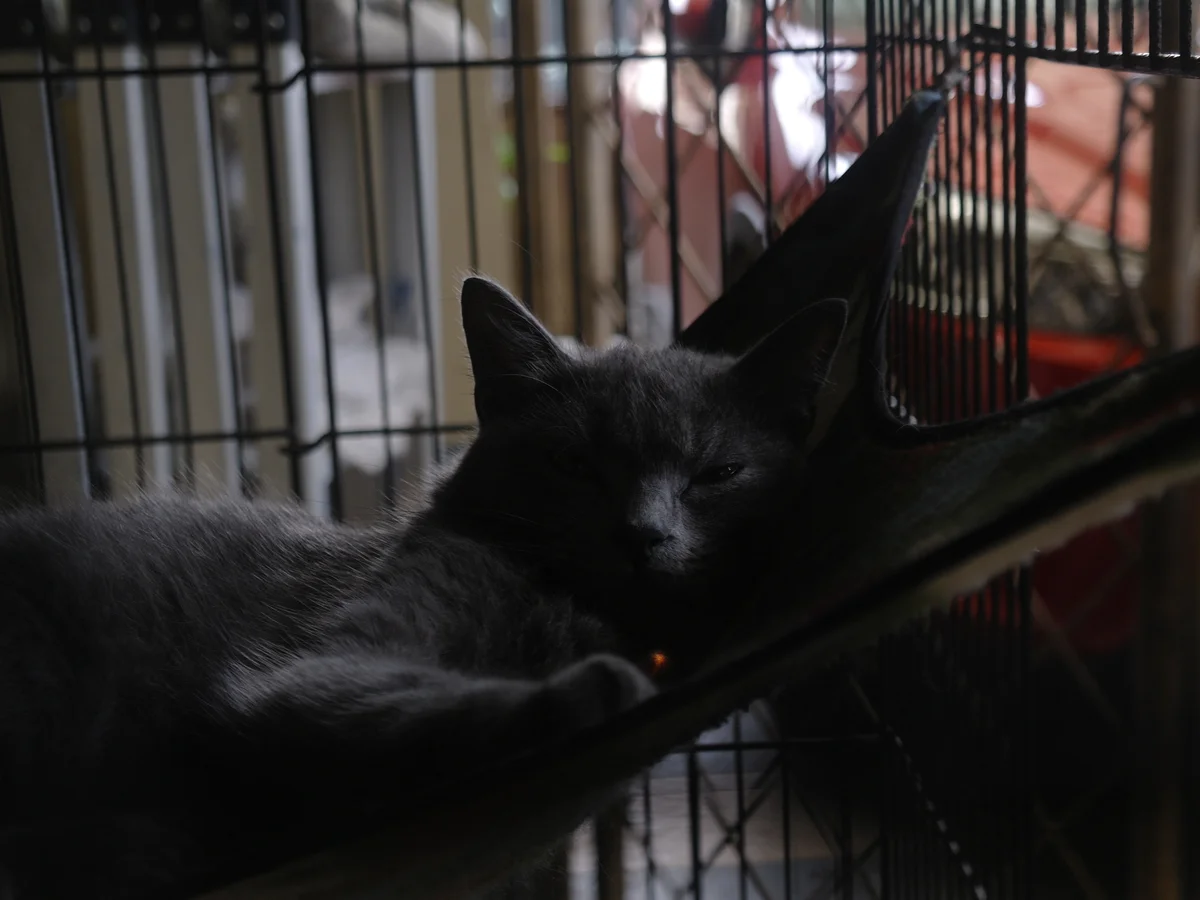
Care is standard cat care, with two black-coat footnotes. First, the rusting: if your jet-black cat is developing a reddish tinge, check how many hours it spends in the sunniest window in the house. Second, photography. Black cats are notoriously hard to photograph: use natural light from the side, skip the flash, focus on the eyes, and shoot against a light background. Your black cat is photogenic; your lighting is the problem.
Otherwise, a black cat needs what every cat needs: good food, clean water, a clean box, scratching posts, daily play, and a human who understands that the cat on the black cushion is, in fact, a cat.
Best Names for a Black Cat
Midnight words, panther energy, and a little gothic glamour: black cats carry dramatic names better than any other coat.
Frequently Asked Questions
Is a black cat a breed?
No. Black is a coat colour found in dozens of breeds and in mixed-breed cats. The Bombay is the only breed developed to be exclusively black.
Are black cats unlucky?
No. It is a superstition with roots in medieval European witchcraft fears. In Japan, Scotland, and among British sailors, black cats are considered lucky.
Why is my black cat turning brown?
Sunlight. UV breaks down eumelanin, the black pigment, giving the coat a reddish-brown "rusted" look, especially at the tips. It is cosmetic, not a health problem.
Do black cats have different personalities?
There is no scientific evidence linking coat color to personality. Each black cat is an individual; the "affectionate clown" reputation is owner anecdote, not data.
What is the Bombay cat?
A pedigreed breed developed in the US in the 1950s-60s to resemble a miniature black panther: solid glossy black coat, muscular build, and copper or gold eyes.
Why are black cats harder to adopt out?
Documented "black cat bias": superstition, poor shelter photography of dark fur, and black cats standing out less in kennels. Meeting them in person fixes it fast, which is why Black Cat Day (October 27, UK) exists.
By Brianna Baxter
Featured photo: Photo: Minimaxima, CC BY 2.0, via Wikimedia Commons.