
Oriental Shorthair Cat: The Talkative Beauty, Full Breed Guide
Take the Siamese body, that long, elegant, tubular athlete, and paint it in more than 300 colours and patterns. That is the Oriental: the most colourful cat in the fancy and, by a wide margin, the most talkative. An Oriental Shorthair does not simply live in your house. It narrates it, comments on your choices, and follows you from room to room delivering a running monologue.
This one profile covers the whole Oriental family: the Shorthair, the long-coated Oriental Longhair, and the two-toned Oriental Bicolor. Same cat, same spectacular personality, three wardrobe options. The Oriental also gave its elegance to a newer spotted breed: the Serengeti, created by crossing Bengals with Oriental Shorthairs to capture the serval look in a fully domestic cat.
The Three Orientals
Oriental Shorthair
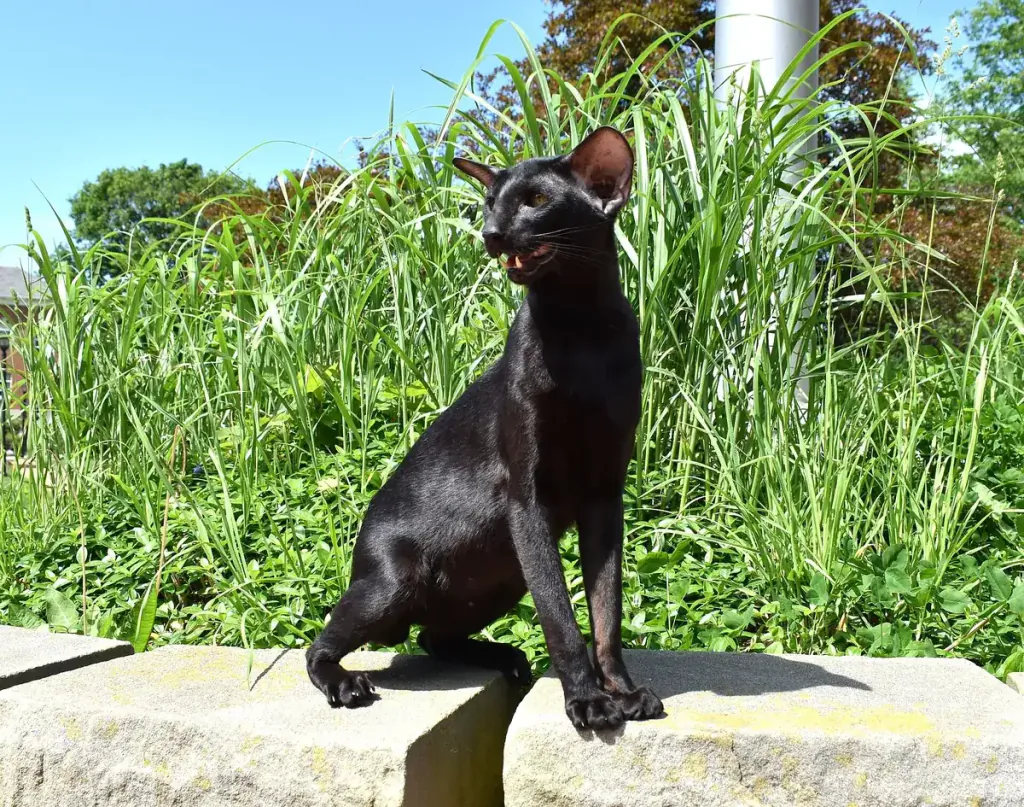
The original and the icon. A medium-sized cat with a long, slim, fine-boned body, a wedge-shaped head, almond eyes, and enormous flaring ears, all wrapped in a coat so short and close-lying it looks painted on. The palette is the breed's party trick: more than 300 recognised colour and pattern combinations, from solid ebony and snow white to smoke, shaded, tabby, tortoiseshell, and pointed. Eyes are usually green, with blue or odd-colored eyes in whites.
Oriental Longhair
Exactly the same cat, wearing a long, silky coat. The longhair keeps the Siamese-type body and the full 300-color range, but trades the painted-on look for flowing elegance. It needs more grooming than the shorthair (plan on several brushings a week), but many owners find the longhair slightly less relentlessly energetic, as if the coat came with a touch of extra composure. Same voice, same devotion, more drama in the silhouette. The Siamese side of the family has its own longhair: the Balinese.
Oriental Bicolor
The two-toned Oriental: white paired with any Oriental colour, in patterns from a white locket to dramatic piebald markings. Bicolors were developed later than the solids and remain one of the most eye-catching variants in the show hall. Personality is pure Oriental, the coat is just wearing a tuxedo of its own design.
History
📖 Breed History
The Oriental story begins in England in the 1950s and 60s, when breeders crossed Siamese with solid-colored domestic shorthairs (and later Russian Blues and Abyssinians) to create a Siamese-type cat in colours beyond the pointed pattern. One solid color from those same English crosses took a different path: the chocolate cat became the Havana Brown, kept as a variety of the Oriental in Britain but developed as its own breed in America. The breed took off on both sides of the Atlantic, with strong American development programs, and quickly became a show-ring favorite thanks to that impossible color range.
Cat registries embraced the family as it grew: the long-coated variant earned recognition, and the bicolor pattern followed. Through it all, the Siamese personality remained the non-negotiable core. Breeders will tell you they were selecting for colour, but the voice came along for the ride and never left.
Appearance
Picture a ballet dancer crossed with a greyhound: long neck, long legs, long whip-like tail, fine bones, and a wedge head that tapers to a fine muzzle. The ears are the exclamation point, large, wide-set, and flaring. The Shorthair's coat is very short, fine, and glossy, lying so close to the body that you can see every ripple of muscle. The Longhair adds a silky, flowing coat with a soft plume of a tail. The Bicolor adds white in crisp, clean patches over any base color.
Temperament & Personality
Here is the honest pitch: an Oriental is not a cat for someone who wants a quiet, independent pet. Orientals are famously, gloriously vocal. They meow, yowl, chirp, and trill, and they expect answers. This is not misbehaviour; it is the breed's love language, inherited straight from their Siamese ancestors. An Oriental in conversation with its person is one of the great sights in cat ownership.
They are intensely social and form ferocious bonds, usually with one favorite human, whom they will follow everywhere, including places you would rather they did not go. They are brilliant, athletic, and playful well into adulthood: fetch, leash walks, puzzle toys, and climbing to the highest point in the house are all standard. Left alone and under-stimulated, a bored Oriental will redecorate. Owners who work long hours do well to adopt a pair. They are excellent with children and other pets, especially other cats, because more company means more audience.
Care & Grooming
Grooming is the easy part. The Shorthair's coat needs a weekly brushing at most; a soft cloth rub keeps it gleaming. The Longhair needs several sessions a week to prevent tangles. Those spectacular ears collect debris, so check and clean them regularly, and stay on top of dental care, since Oriental lines can be prone to dental issues. Nail trims as usual.
The real care is enrichment. Plan on 30 to 60 minutes of active play daily, plus puzzle feeders, cat trees, and ideally a feline companion. A high-protein diet supports the lean, muscular build. These are indoor cats, not because they are fragile, but because an Oriental allowed to roam will attempt to befriend the entire neighborhood, loudly.
Health Notes
Orientals are generally healthy, long-lived cats, typically reaching 12 to 15 years of age (PetMD, 2023), but they share some predispositions with their Siamese relatives: dental disease, progressive retinal atrophy (an eye condition), respiratory sensitivity, and amyloidosis (a liver/kidney condition) are the ones breeders screen for. Regular veterinary checkups, dental care, and buying from breeders who health-test keep the odds in your favor. (General information only, not veterinary advice.)
Best Names for an Oriental
Sleek, vocal, dramatic, and elegant: an Oriental's name should have some music in it.
Frequently Asked Questions
Are Oriental Shorthairs really that vocal?
Yes. It is the breed's defining trait. They hold full conversations, comment on household events, and greet you at the door with opinions. If you want a quiet cat, this is not your breed.
What is the difference between an Oriental Shorthair and a Siamese?
Body type and personality are nearly identical; the difference is color. Siamese are pointed (darker face, ears, paws, tail on a lighter body) with blue eyes, while Orientals come in 300+ solid and patterned colours with usually green eyes.
Are Oriental Longhairs a separate breed?
No, the Longhair is a coat variant of the Oriental, the same cat in a long silky coat. (Some registries have used the name Javanese for related longhaired Siamese-type cats, which is a separate naming tangle; the Oriental Longhair itself is simply the long-coated Oriental.)
Do Oriental cats get along with other pets?
Very well. They are social, playful, and usually delighted by other cats and cat-friendly dogs. A second cat is often recommended if you are away during the day.
How much exercise does an Oriental need?
A lot. Expect 30 to 60 minutes of active play daily plus climbing structures and puzzle toys. A bored Oriental is a destructive Oriental.
Are Oriental Bicolors rare?
They are less common than the solids, since the bicolor pattern was developed later, but they are fully recognized and increasingly popular, especially in show lines.
By Brianna Baxter
Featured photo: Photo: Felinlove, CC BY-SA 4.0, via Wikimedia Commons.
The Oriental family is bigger than it looks: it includes the white-spotted Oriental Bicolor, and its body type was also used in developing Russia’s Peterbald.