
Peterbald Cat: Breed Profile, Coat Types & Best Names
The Peterbald is Russia’s elegant answer to the hairless cat, and it is not a Sphynx in disguise. Built like an Oriental, all long legs, oversized ears and whip-thin tail, it can be born completely bald, wearing a whisper of down, covered in wiry brush, or, the plot twist, carrying an ordinary fur coat. Created in St Petersburg in 1994, it carries a dominant hair-losing gene inherited from the Donskoy, and beneath the looks sits one of the most devoted temperaments in the cat world.
TICA’s breed portrait reads less like a standard and more like a warning: this cat will meet your visitors at the door, occupy your lap for as many hours as you allow, sit beside your morning coffee and crawl under the covers at night. Many are highly vocal and will talk back when spoken to. If you want a cat who treats you as the centre of the universe, the Peterbald has been auditioning for the role since 1994.
Below: the single experimental litter that started the breed, the six coat types explained (including the straight-coated Peterbalds who never lost their hair), how the Peterbald differs from its Donskoy parent breed, skin care by coat type, the honest health picture, and names with a Russian accent.
History
📖 Breed History
The Peterbald began with a deliberate experiment. In 1994, in St Petersburg, Russian felinologist Olga S. Mironova mated a Don Sphynx (Donskoy) male named Afinogen Myth with a World Champion Oriental Shorthair female named Radma von Jagerhov. The first two litters produced four kittens, Mandarin iz Murino, Muscat iz Murino, Nezhenka iz Murino and Nocturne iz Murino, the foundation stock of the breed. TICA notes that Nocturne iz Murino became the foundation stud and appears in every Peterbald pedigree.
The cross was designed, not accidental. The Donskoy side contributed the dominant hair-losing gene, the mutation that had surfaced in Rostov-on-Don in the late 1980s and produced Russia’s first hairless breed. The Oriental side contributed everything else: the long, tubular body, the wedge-shaped head, the huge ears and the intensely social, talkative character. Where the Donskoy is a medium, muscular cat of more rounded type, Mironova’s kittens were unmistakably Oriental in build, a hairless cat drawn with a finer pen.
Recognition followed quickly. The Russian Selectional Feline Federation adopted the breed in 1996, TICA in 1997 (championship competition from 2005), and the World Cat Federation in 2003. The brush coat was recognised for TICA championship from May 2008, and the ACFA granted championship status effective 2009. Its standards still encourage outcrosses to Oriental Shorthairs and Siamese to keep the elegant Oriental frame. The breed remains rare, with most breeders in Russia and Eastern Europe.
Appearance: One Breed, Six Coats
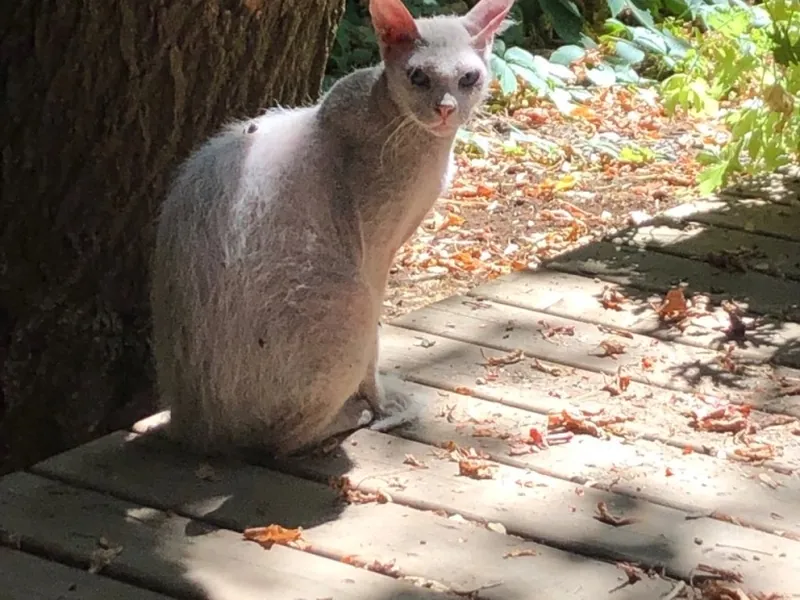
Start with the cat underneath, because every Peterbald, bald or fully coated, shares the same Oriental architecture. The body is medium-sized, long and tubular, with a tight, muscular abdomen; TICA describes a cat smaller than a domestic shorthair but heavier than an Oriental Shorthair. The head is a triangular wedge with a straight profile, a blunt muzzle and a well-developed chin. The ears are very large and set apart, in the standard they extend below the line of the jaw’s angle. The eyes are large and almost almond-shaped. Legs are long and straight, ending in small oval paws with long, agile toes; Peterbalds have webbed feet and are famous for grasping objects and opening lever-handled doors. The tail is long and whip-like. Then comes the variable: the coat, in six recognised types.
Naked (ultra bald). Born completely hairless and stays that way. The skin is warm and soft, sometimes described as slightly sticky or suede-like to the touch, and whiskers and eyebrows may be absent altogether, the fullest expression of the hair-losing gene.
Flock. Roughly ninety per cent hairless, covered in an almost invisible down. There is no visible coat and no resistance when you stroke the cat, it simply feels smooth, like warm silk. Kinked or curled whiskers are typical.
Chamois. The texture TICA describes as “a coat like a peach or a piece of suede leather”: an ultra-short, fine covering that offers slight resistance to the hand. From a distance the cat still reads as hairless.
Velour. A short coat made entirely of soft, downy hair without waves, curling or gloss, from a dense plush of a few millimetres to a sparser covering through which skin shows. A dense velour can shine, and it may thin toward flock with age.
Brush. The coat type unique to this breed: wiry, kinky guard hair of varying length, with a distinctly crimped texture. Brush is a full championship coat in TICA, a fine-boned Oriental in a slightly rumpled wire jacket.
Straight. The Peterbalds who never got the memo: a straight coat is an ordinary cat coat, because that kitten did not inherit the hair-losing gene at all. Straight-coated cats are genuine, pedigree Peterbalds, breeders may register and breed them, though TICA does not allow them to compete for championship titles.
One more quirk: the coat is not necessarily settled at birth. Kittens born with hair, except the straight coats, can lose it over time, often across the first two years. Colours and markings are unrestricted, including colourpoint; in rare bicolour cats the white areas may grow soft down while the coloured areas grow wiry brush, with a sharp line between the two.
Peterbald vs Donskoy
The Peterbald is, genetically, half Donskoy, its hair-losing gene came straight from the Don Sphynx side of the 1994 litter. That shared gene is the whole relationship; almost everything visible differs.
| Donskoy | Peterbald | |
|---|---|---|
| Origin | Rostov-on-Don, Russia, hairless mutation found in the late 1980s | St Petersburg, Russia, deliberately created in 1994 (Donskoy × Oriental Shorthair) |
| Build | Medium, muscular and more rounded, with heavy wrinkling | Elegant Oriental type: long, tubular body on long legs, fine-boned but muscular |
| Head & ears | Wedge head with prominent cheekbones; medium, wide-based ears | Triangular wedge with blunt muzzle; very large, oversized ears; almost almond-shaped eyes |
| The gene | Dominant hair-loss gene, the original mutation | The same dominant gene, inherited from the Donskoy parent |
| Coats | Bald (rubber bald), flocked, velour and brush types | Six types: naked, flock, chamois, velour, brush, plus straight, an ordinary coat |
Temperament & Personality
Peterbalds are sweet-tempered, affectionate, peaceful, curious, smart and energetic, and that list, from the breed references, undersells the intensity. This is a cat that follows its people from room to room, supervises every activity, greets guests at the door like a host, and settles in laps, beside chairs and under bedcovers as a matter of policy. TICA calls the breed “aggressively affectionate,” and owners agree: there will not be a minute of the day your Peterbald does not want to spend with you.
They are medium-to-highly vocal, in the Oriental tradition, and many will hold an actual exchange, talk to a Peterbald and it talks back. They are clever with their paws, too: those long, agile toes open lever doors and retrieve objects, and the breed learns routines, names and games such as fetch quickly. They typically live in harmony with other cats, dogs and children.
The flip side of devotion is need. A Peterbald left alone for long, empty days is a cat whose best quality has nowhere to go; this breed suits homes where someone is around much of the time, or where a second pet provides company.
Care & Grooming
Care depends entirely on which of the six coats your Peterbald wears, the grooming conversation starts with “which version did you get?”
For naked, flock and chamois cats, think skin care rather than coat care. Without fur to absorb them, skin oils sit on the surface, so a gentle bath or wipe-down roughly weekly keeps skin clean and prevents oil marks on bedding and clothes. Bare skin also sunburns: a Peterbald who loves a sunny windowsill needs shade options, and cat-safe sun protection is worth discussing with your vet. In cold weather these cats feel the chill, warm rooms, heated beds and, for cats who tolerate them, soft sweaters are standard equipment. Ears should be checked and cleaned as needed, since there is no coat filtering the world out.
Velour and brush cats need a lighter version of the same routine: an occasional bath and a soft brush or grooming mitt now and then. Straight-coated Peterbalds need nothing special, ordinary short-coat grooming and the usual nail and dental care. Across all six coats: an indoor life, a measured diet, daily play (this is an active, athletic cat) and routine vet checks complete the picture.
Health
The Peterbald is regarded as a generally healthy breed, with no breed-specific inherited disease panel recorded in the registry literature. Its foundation is recent and documented, and Oriental and Siamese outcrosses continue to widen the gene pool.
The honest caveats concern the hair-loss trait itself rather than hidden disease. It is a dominant gene: one copy changes the coat, and TICA notes the genetics are still being studied, researchers have not yet settled whether one gene or several are involved, or whether two copies of the trait are what produce total baldness from birth. Responsible breeders plan matings with that uncertainty in mind. Hairless skin is also simply more exposed than furred skin: sunburn and chill are management issues, handled in the care routine above, rather than illnesses. One policy note: the Netherlands has banned breeding from cats whose mutations, including the lack of protective fur in hairless breeds, are judged to harm offspring welfare, a position owners will encounter in European discussions of the breed. None of this replaces your vet: any skin change, sore or persistent irritation on a hairless cat deserves a professional look. These are general breed notes, not medical advice.
Living With a Peterbald
The ideal Peterbald home is an indoor home with people in it. Families with children, multi-pet households and first-time owners who want a truly interactive cat all fit the breed, it greets strangers, befriends dogs and plays host with rare enthusiasm. First-timers may also want our new cat owner starter kit for the setup list.
Plan around two things. First, company: long daily absences are the one lifestyle this breed handles badly, so pair it with a companion animal or choose a more independent breed. Second, skin practicalities, warm rooms, shade from strong sun, and a bathing routine for the hairless coat types. Readers who fall for Russian breeds may also enjoy the Peterbald’s coated compatriot, the Russian Blue: the two could hardly look more different, but both reward devoted homes.
Best Names for a Peterbald
A breed born in St Petersburg, with a coat TICA itself compares to peach and suede, deserves names with Russian music and a little texture. Every meaning below comes from our name database; the two texture picks are inspiration-only and are described honestly, with no invented translations. For more, browse royal cat names, cat names from around the world and unique cat names, or try the cat name generator.
Olga, “holy; blessed” (Russian); also the name of the breed’s creator, Olga Mironova, a fitting tribute. Anastasia, “resurrection” (Greek, as recorded in our database); imperial Russian grandeur for the grandest kitten in the litter. Tatiana, our database lists this one for Pushkin’s heroine in Eugene Onegin; no translation claimed, just pedigree. Katya, “pure” (Russian); a sweet diminutive for a pure-hearted cat. Vera, “faith” (Russian); crisp, chic and quietly devoted, like the breed. Boris, “fighter; wolf” (Russian). Ivan, “God is gracious” (Russian); a regal Russian classic, strong and calm. Dmitri, “devoted to Demeter” (Russian); a classic for a loyal cat, and devotion is this breed’s whole personality. Nikolai, “victory of the people” (Russian); stately, for a noble-looking cat. Tsar, “emperor” (Slavic); for the cat who rules the household and knows it. Suede, an inspiration pick, recorded in our database for suede-soft skin; TICA itself describes one Peterbald coat as feeling like suede leather. Velvet, an inspiration pick for the velour coat’s soft down; our database’s note for it is simply “soft black velvet.”
Frequently Asked Questions
What is a Peterbald cat?
The Peterbald is a Russian breed created in St Petersburg in 1994 by crossing a Donskoy (Don Sphynx) male with an Oriental Shorthair female. It has an elegant Oriental build and a dominant hair-losing gene that produces six coat types, from completely naked to an ordinary straight coat. TICA accepted it into championship competition in 2005.
Is a Peterbald hypoallergenic?
No. No cat is truly hypoallergenic, and the Peterbald is no exception: the main cat allergen, Fel d 1, is produced in saliva and skin glands, and a hairless cat still grooms itself and sheds skin. Less hair may mean less allergen spread around the home, but breed references list the Peterbald as not hypoallergenic, allergy sufferers should spend time with the breed before committing.
What is the difference between a Peterbald and a Sphynx?
The genes are unrelated. The Peterbald’s hairlessness comes from a dominant hair-losing gene inherited from the Donskoy; the Sphynx‘s comes from a different, recessive gene. They look different, too: the Peterbald is a fine-boned, long-legged Oriental type with very large ears; the Sphynx is a heavier, more rounded cat. One is Russian, the other Canadian.
Why do some Peterbalds have fur?
Because the hair-losing gene is dominant but not universal. Kittens who inherit it are born naked or with a partial coat (flock, chamois, velour or brush) and may lose more hair as they mature. Kittens who do not inherit it grow a straight coat, an ordinary fur coat. They are full pedigree members of the breed and are used in breeding programmes, though they cannot compete for championship titles.
Do Peterbalds need special skin care?
The hairless and short-coated types do: regular gentle bathing or wipe-downs to manage skin oils, protection from strong sun, warmth in cold weather, and routine ear cleaning. Velour and brush coats need much less, and a straight-coated Peterbald needs only ordinary grooming. The care scales with the coat.
How long do Peterbald cats live?
Breed references typically give around 12 to 15 years. Indoor living, a measured diet, skin care and routine vet visits give a Peterbald the best chance of reaching the top of that range.
By Brianna Baxter
Featured photo: Photo: Acracrabe, CC BY-SA 4.0, via Wikimedia Commons.