
Types of Cats: The Complete Guide to Cat Breeds & Categories
Ask "what type of cat is that?" at a cat cafe and you will hear a dozen confident answers and at least two arguments. Here is the honest answer first: most cats in the world are not any breed at all. They are domestic shorthairs and longhairs, the random-bred majority, and they are wonderful.
That said, the cat world does have real categories, and they are worth knowing. Breed registries classify cats by pedigree, coat, size, and temperament. Whether you are adopting, buying, or just trying to figure out what your own cat technically is, this guide walks through every meaningful way to classify a cat, with no jargon and no snobbery.
Key Takeaways
- The vast majority of pet cats are random-bred domestic shorthairs or longhairs, not pedigreed breeds. That is normal, healthy, and nothing to apologize for.
- Registries disagree on numbers: TICA recognizes 70+ breeds, the CFA around 45. Both counts are real; they just measure different things.
- Coat length is the most practical classification for everyday owners: shorthair, longhair, curly/wire, and hairless each come with different care.
- Size and energy matter more than breed prestige when choosing a cat. A calm home wants a calm cat, whatever the pedigree says.
- Scroll down for names matched to each type, from regal pedigree picks to wild-spirit and mellow-moggy names.
The Honest Answer First: Your Cat Is Probably a Domestic Shorthair
Walk into any shelter and look at the cage cards. Nine out of ten will read "Domestic Shorthair" or "Domestic Longhair." These are not breeds. They are the official terms for random-bred cats: cats whose parentage is unknown, unrecorded, or simply ordinary.
This is the global majority, and genetically it is the healthiest group of cats. A wide gene pool means fewer inherited problems than in tightly bred lines. A domestic shorthair with a tabby coat and a normal face is the original cat, the one that sat in granaries ten thousand years ago, and it has needed no upgrades since.
If your cat was not bought from a registered breeder with papers, it is almost certainly a domestic shorthair, mediumhair, or longhair. That is a type, and it is the most common type on earth.
Pedigreed vs. Mixed-Breed: What a "Breed" Actually Means
A breed is a population of cats selected over generations for specific traits: looks, coat, temperament. A pedigree is the paper trail proving it. No papers, no pedigree; it really is that simple.
Pedigreed cats make up a small slice of the pet population. They exist because breeders wanted predictable traits: the Siamese's voice, the Maine Coon's size, the Persian's coat. Predictability is the whole product.
Mixed-breed (random-bred) cats are everyone else. "Moggy" is the affectionate British term. They are less predictable in looks and temperament, more variable in health, and typically far cheaper to acquire. For most households, a moggy is the right cat.
Neither category is better. They are just different answers to the question "what do I know about this cat before I bring it home?"
Types of Cats by Coat
Coat is the classification you will actually live with, because it sets your grooming schedule.
Shorthair. The default. Short, low-maintenance fur that sheds year-round but rarely mats. Most domestic shorthairs, plus breeds like the British Shorthair, American Shorthair, and Siamese. Weekly brushing keeps things tidy.
Medium and longhair. Flowing coats that demand real maintenance: regular brushing, sometimes daily during shedding season. Maine Coons, Persians, Ragdolls, and the longhaired half of the random-bred population. Beautiful, and a genuine time commitment.
Curly and wire coats. Genetic mutations give some breeds crimped or wiry fur: the Cornish Rex and Devon Rex (soft curls), the American Wirehair (springy wire). They shed less visibly but still need care, and their skin can be sensitive.
Hairless. The Sphynx, Peterbald, and Donskoy carry a gene that leaves them with fine down instead of fur. They feel like warm suede. The trade-off for no shedding: oily skin that needs regular bathing, and a cat that will steal your warmest blanket.
Types of Cats by Size
Size classes are rough, but they help set expectations.
Small (under 10 pounds). Singapura, Munchkin, Devon Rex. Compact cats built for apartments and laps. Small does not mean low-energy; some of the liveliest cats alive weigh seven pounds.
Medium (10-15 pounds). The great middle: British Shorthair, Siamese, most domestic shorthairs. This is the standard cat, and the standard is excellent.
Large and giant (15 pounds and up). Maine Coons (12-22 pounds), Ragdolls, Norwegian Forest Cats. Big frames, big appetites, and often famously gentle temperaments. A large cat is a furniture decision as much as a pet decision.
Types of Cats by Energy and Temperament
Forget breed prestige for a moment. The question that decides your happiness is: how much cat can your household handle?
High-energy and interactive. Bengal, Siamese, Abyssinian, Oriental. These cats are athletes and conversationalists. They need vertical space, puzzle toys, and daily play. Without it, they will invent their own entertainment, and you will not enjoy the genre.
Calm and companionable. British Shorthair, Ragdoll, Persian, Scottish Fold. Lower baseline arousal, happy to be near you rather than on a mission. They still need play, but in civilized doses.
Independent and low-maintenance. Russian Blue, American Shorthair, many random-bred adults. Affectionate on their own schedule, fine with working owners, self-entertaining. Independence is not coldness; it is confidence.
Hybrid Cats: The Wild Crosses
A small group of breeds comes from crossing domestic cats with wild species. The Bengal descends from the Asian leopard cat, the Savannah from the serval, the Chausie from the jungle cat. They are striking, athletic, and demanding.
Hybrids are not beginner cats. They need experienced owners, serious enrichment, and in some places, permits. They also sit at the center of an ethical debate about breeding wild animals into pets. Know all of that before you fall for the spots.
What Type Is My Cat? A Quick Method
You do not need a DNA test to classify your cat for everyday purposes. Work through these three questions.
How long is the coat? Short, medium, or long. That single answer puts your cat in the right grooming category immediately.
What is the pattern? Solid (one color), tabby (stripes, spots, or swirls), bicolor/tuxedo (white plus one color), tricolor (calico or tortoiseshell), or colorpoint (pale body, dark ears/face/paws/tail, like a Siamese). Pattern is not breed, but it is the language shelters and vets use.
What is the build? Cobby and round (British Shorthair style), long and slender (Siamese style), or somewhere in between. Build hints at ancestry the way an accent hints at a hometown.
If the answers are "short, tabby, medium build" and there were no papers, congratulations: you have a classic domestic shorthair, the most successful cat in history.
Cat Names by Type
Names that fit the category, drawn from our name database. Every meaning below is verified; entries without a listed meaning are inspiration picks with no invented translation.
For the regal pedigreed cat
| Name | Meaning | Good for | |
|---|---|---|---|
| Theodore | gift of God | A presidential classic, dignified and warm, for the cat with papers and posture. | |
| Guinevere | white phantom, fair one | Arthurian queen energy for the elegant girl who holds court from the sofa. | |
| Sebastian | revered | Old-world polish for the distinguished gentleman of the household. | |
| Beatrix | traveller; voyager | Vintage charm with a literary wink, for the refined explorer. | |
| Odin | frenzy, inspiration | King of the Norse gods for the cat who clearly believes they rule the realm. | |
| Cleopatra | glory of the father | Last queen of ancient Egypt, for the girl who is worshipped and knows it. | |
| Athena | The Greek goddess of wisdom | for the clever, watchful cat who studies you back. | |
| Napoleon | The French emperor | for the small cat with enormous imperial ambitions. |
For the wild-spirited cat
| Name | Meaning | Good for | |
|---|---|---|---|
| Tiger | The big cat | for the striped tabby whose markings say jungle. | |
| Jaguar | beast | a sleek, powerful pick for the athletic hunter. | |
| Panther | Built like a big black cat | for the dark, muscular prowler of the hallway. | |
| Sahara | The desert queen | for the golden cat with a faraway look in her eyes. | |
| Zorro | fox | masked and dashing, for the cat with a bandit-marked face. | |
| Hunter | hunter | the stealthy stalker, for the cat who treats toy mice as serious business. |
For the mellow moggy
| Name | Meaning | Good for | |
|---|---|---|---|
| Muffin | The small cake | soft and sweet, for the round, cuddly companion. | |
| Biscuit | The baked treat | golden and warm, for the easygoing charmer. | |
| Marmalade | Orange marmalade | the classic name for the orange cat with a sunny soul. | |
| Miso | Japanese fermented soybean paste | savory and cute, for the small cat with big comfort. | |
| Pepper | The spice | lively and bold, for the small cat with extra seasoning. | |
| Smokey | Grey smoke color | for the grey cat who drifts through rooms like weather. | |
| Willow | The willow tree | graceful and calm, for the gentle, swaying soul. | |
| Sunny | Bright like sunshine | for the cat who naps in every sunbeam in the house. |
Tips for Choosing a Cat by Type
- Match energy first, looks second. A gorgeous high-energy breed in a quiet apartment is a mismatch no one enjoys. Start with the temperament buckets above.
- Count the grooming hours honestly. A longhair is a weekly commitment for fifteen years. If that sounds like a chore, it will feel like one by year three.
- Size is a space question. Giant breeds need sturdy furniture, big litter boxes, and room to be large. Measure before you fall in love.
- Shelter cats are mostly one type. If you are adopting, you are choosing among domestic shorthairs and longhairs. That simplifies everything: pick by personality, not pedigree.
- "Hypoallergenic" is a spectrum, not a promise. No cat is truly allergen-free. Spend time with the breed before committing if allergies are in the picture.
- Let the name match the reality. A tiny rescue named Napoleon is funnier and truer than a forced fancy name. The type section above is a starting point, not a rulebook.
Our Pick
If we had to name one type as the best all-rounder, it is the domestic shorthair: healthy, adaptable, available everywhere, and free of the health baggage some extreme breeds carry. For a name, we would pick Marmalade for an orange moggy and Theodore for a pedigreed gentleman. Both wear well for fifteen years, and both suit the cat in front of you rather than the fantasy.
More Names You'll Love
- Browse the full collection in our cat names hub, or filter by male and female picks.
- Coat-inspired ideas: grey cat names, black cat names, orange cat names, white cat names, tabby cat names, tuxedo cat names, calico cat names, and tortoiseshell cat names.
- Meet the breeds properly in our cat breeds guide.
- Still deciding? Our cat name generator deals fresh ideas by gender and style.
Frequently Asked Questions
How many types of cats are there?
It depends on who counts. TICA recognizes more than 70 breeds; the CFA recognizes around 45 championship breeds. But the vast majority of pet cats worldwide are random-bred domestic shorthairs and longhairs, not pedigreed breeds at all.
What is the difference between a breed and a type?
A breed is a selectively bred population with a written standard and (usually) a pedigree. A type is a looser category: coat length, size, pattern, or energy level. Domestic shorthair is a type, not a breed.
What type of cat is best for apartments?
Small to medium, calm-to-moderate energy types: British Shorthair, Russian Blue, or any mellow adult domestic shorthair. High-energy breeds like Bengals and Siamese can work in apartments only with serious vertical space and daily play.
Are mixed-breed cats healthier than pedigreed cats?
Often, yes. Random-bred cats have wider gene pools, which means fewer inherited disorders. That is a population trend, not a guarantee; individual health depends on the individual cat.
What does "domestic shorthair" mean on a shelter card?
It means a random-bred cat with short fur and no known pedigree. It is the most common cat in shelters and in the world, and it covers every color and pattern.
Do hypoallergenic cat breeds really exist?
No cat is truly allergen-free. Some breeds, like the Siberian, Balinese, and Russian Blue, tend to produce less of the Fel d 1 protein that triggers allergies, so sensitive people sometimes tolerate them better. Always spend time with the cat first.
What is the most common type of house cat?
The domestic shorthair: a random-bred cat with a short coat and no pedigree. Most pet cats in the world are domestic shorthairs or their longhaired counterparts, the domestic longhairs. They are not a breed, just the natural cat population, which is why they come in every colour, pattern and personality. Pedigreed cats are a small minority by comparison, which is why shelter cards almost always read domestic shorthair or domestic longhair.
What are the most popular cat breeds?
Popularity rankings vary by registry and by year, but recent CFA registration lists are usually topped by the Ragdoll and the Maine Coon, with the Persian, British Shorthair, Siamese, Bengal, Sphynx, Scottish Fold, Devon Rex and Abyssinian also near the top. Popularity is not the same as suitability, though: the calm breeds on that list suit quiet homes, while the Bengal, Siamese and Abyssinian need owners ready for a high-energy, talkative cat.
By Brianna Baxter
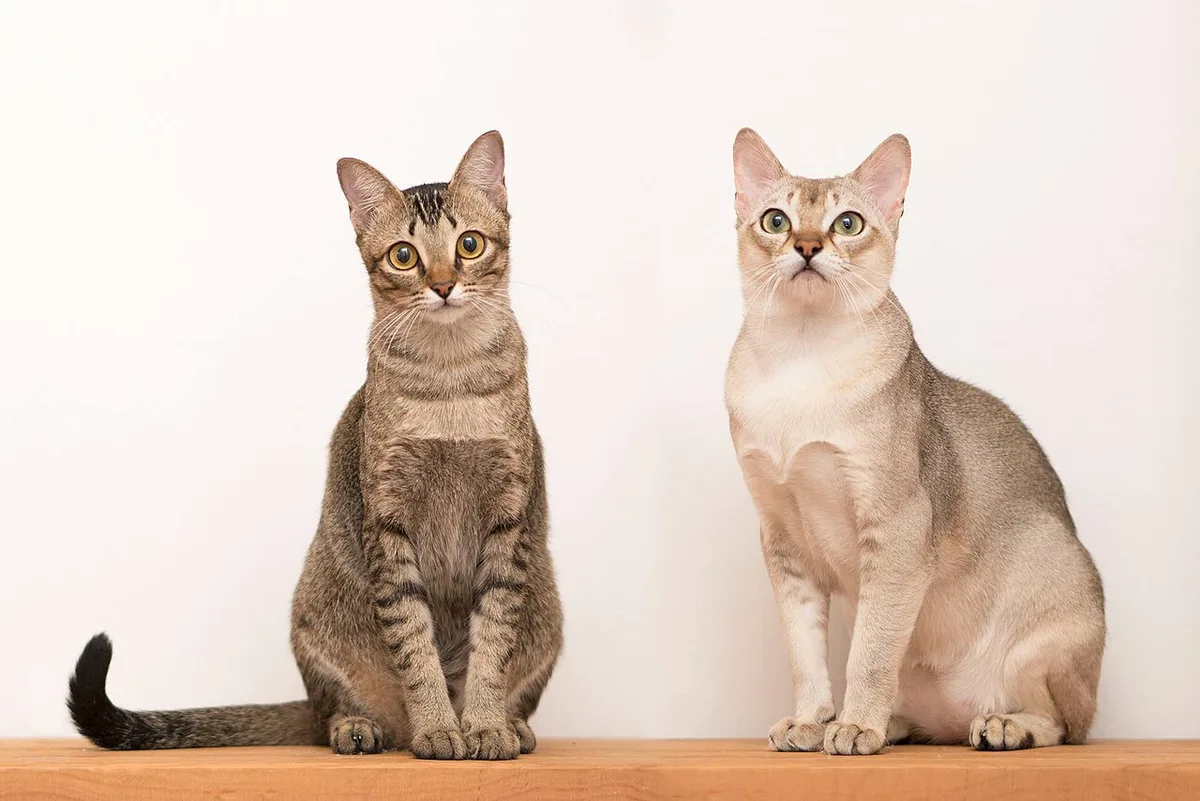
Featured photo: Photo: Straits Singapuras, CC BY-SA 4.0, via Wikimedia Commons.