
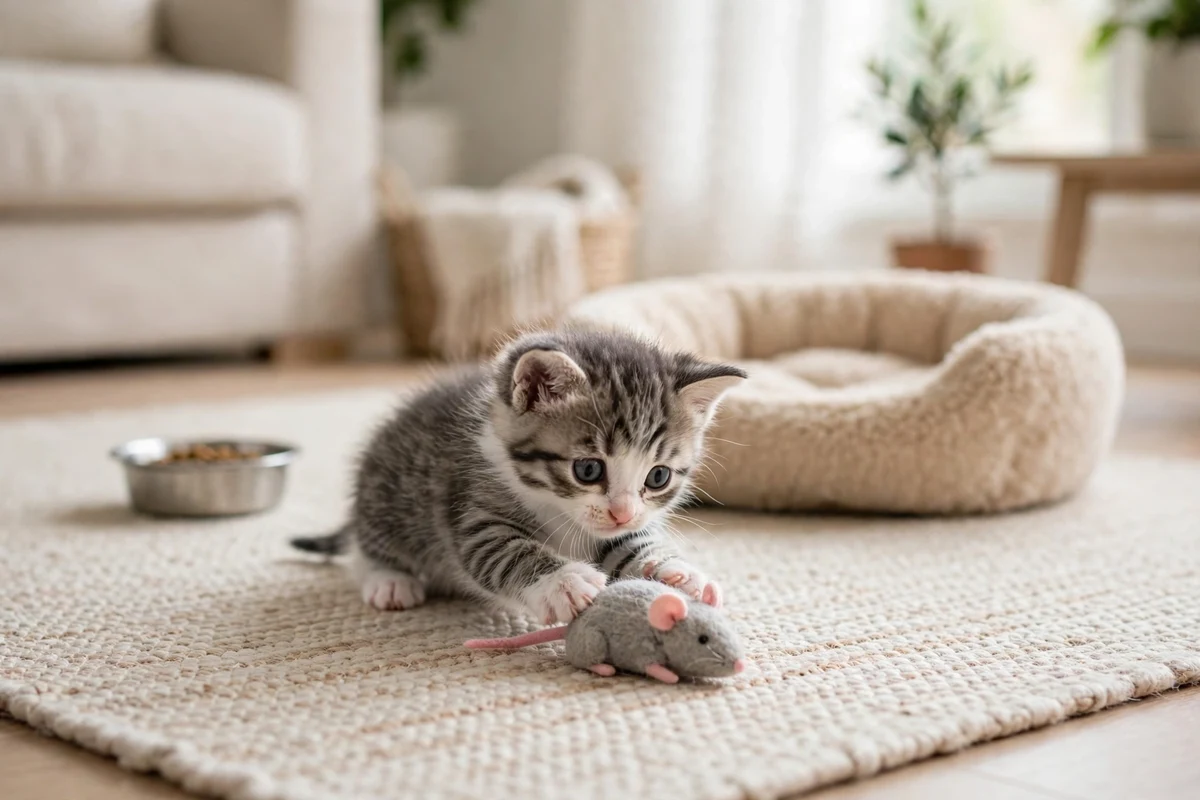
Your Kitten’s First Year: Month-by-Month Guide
A kitten changes faster in its first year than at any other time in its life. In twelve months it goes from a blind, deaf newborn that cannot regulate its own body temperature to a confident young adult with adult teeth, adult coordination and, in many cases, adult size. The year is also the busiest for an owner: first vet visits and vaccines, weaning, litter training, socialisation, spaying or neutering, and the slow shift from kitten food to adult food. This month-by-month guide tells you what to expect at each stage, what to feed, what to teach, and when to ask a vet, so you can enjoy the year instead of worrying through it.
The Short Answer
Keep the kitten with its mother until at least eight weeks old, then bring it home to a safe room with food, water, a litter tray and a hiding place. Feed kitten food until about twelve months, follow the usual vaccine course your vet recommends, usually starting at six to eight weeks with boosters every three to four weeks until at least sixteen weeks, and plan spaying or neutering at about five months. Socialise gently during the first few months, play daily, and weigh the kitten weekly. Confirm every health timing with your own vet, because the exact schedule depends on the kitten’s age, health and lifestyle. This article is general information only and is not veterinary advice.
Before the Kitten Comes Home
Good kitten care starts before the kitten arrives. Choose a small, quiet room as the kitten’s base, with a door you can close. Put a litter tray in one corner, food and water in another, a bed or box with a blanket in a third, and a scratching post nearby. A kitten that starts in one room learns where everything is, feels safe, and settles faster than a kitten turned loose in a whole house on day one. You can open up the rest of the home gradually over the first week or two.
Buy the basics before the kitten arrives: kitten food, both wet and dry if you plan to feed both, a shallow food bowl and a separate water bowl, a litter tray with low sides and unscented litter, a scratching post, a few toys, a soft brush, and a carrier. A carrier is not optional: the kitten will need it for vet visits, and a cat that is used to its carrier travels far more calmly than one that meets it for the first time on a vet day. Leave the carrier open in the room with a blanket inside, so the kitten can explore it on its own terms. Our new cat owner starter kit lists the full first-week shopping list, and our best cat food guide explains how to judge a food.
Month 1: Birth to 4 Weeks, Fragile Beginnings
Most owners never see this stage, because kittens should stay with their mother and littermates until at least eight weeks old. A newborn kitten is born blind and deaf, weighs about 100 to 120 grams, and cannot regulate its own body temperature. Its eyes open at about seven to ten days, its ears open at about two weeks, and it starts to crawl, then walk, in the third and fourth weeks. It gains roughly 10 to 20 grams a day, and by four weeks it is beginning to show curiosity about the world beyond the nest.
If you are caring for an orphaned kitten, this stage needs round the clock care: a commercial kitten milk replacer fed every two to three hours, including overnight, using a specialised kitten nursing bottle, and never cow’s milk, which causes diarrhoea. The kitten also needs warmth, gentle stimulation to pass urine and stool, and weekly weighing. This is specialist care, and a vet should be involved from the start. For most owners, the useful lesson from month one is simpler: do not take a kitten home before eight weeks. Those early weeks with the mother and littermates teach the kitten how to be a cat, including bite inhibition and social skills that are hard to teach later.
Month 2: Weeks 4 to 8, Weaning and First Steps
Between four and eight weeks, the kitten changes fast. Baby teeth emerge, balance improves, and curiosity takes off. Weaning begins: the kitten starts to show interest in solid food, usually at about four weeks, and by six to eight weeks most kittens are fully weaned onto soft kitten food. Offer a gruel made by mixing high quality kitten wet food with a little warm water or kitten milk replacer, four to five times a day, and let the kitten eat at its own pace. Do not rush weaning, and do not offer cow’s milk.
This is also the start of the critical socialisation window, which runs from about two to seven weeks of age. During this window the kitten learns what is normal: human hands, voices, household sounds, other pets, and being handled. Gentle handling every day, short play sessions, and calm exposure to everyday sounds all help. A kitten that is well socialised in this window is far more likely to grow into a confident adult. Litter training usually clicks at this stage too: kittens learn by watching their mother, and a low sided tray with unscented litter in a quiet corner is usually enough. Keep the tray clean, because a dirty tray is the most common reason a kitten avoids it.
Month 3: Weeks 8 to 12, Coming Home
Eight weeks is the earliest a kitten should leave its mother, and it is the age most kittens come home. The first week home is about safety and settling in. Keep the kitten in its base room, keep the routine calm, and let it come to you rather than chasing it. Expect some hiding, some night time activity, and a lot of sleeping: kittens sleep for most of the day at this age, and that is normal.
The first vet visit usually happens at about eight to ten weeks. The vet will do a full health check, weigh the kitten, check for fleas and worms, and talk through the vaccine course. The commonly recommended framework is a series of FVRCP vaccines, which protect against feline viral rhinotracheitis, calicivirus and panleukopenia, starting at six to eight weeks and repeated every three to four weeks until at least sixteen weeks of age. A faecal exam and deworming are usually part of the first visit, and a test for feline leukaemia and feline immunodeficiency virus is often done at about twelve weeks. Rabies vaccination is usually given at about twelve to sixteen weeks, depending on local law and your vet’s advice. Confirm the exact timing with your own vet, because it depends on the kitten’s age, health and lifestyle. At this age the kitten should be eating solid kitten food three to four times a day, playing a lot, and exploring with growing confidence. Introduce grooming now, with a soft brush for a minute or two, so the kitten learns that brushing is normal.
Month 4: Weeks 13 to 16, The Playful Prodigy
By three to four months, the kitten is a confident explorer with sharp balance, defined muscles and a mischievous streak. Play becomes more intense, and the kitten starts to test boundaries: climbing, pouncing, and biting during play. This is the time to teach the rules. Never play with your hands as a toy, because a kitten that learns hands are toys becomes a cat that bites hands. Use wand toys and balls instead, and end a play session calmly if the kitten gets overexcited.
Teething begins at about three to four months, when the baby teeth start to fall out and the adult teeth come through. The kitten may chew more, drool a little, or be fussier with food. Offer safe chew toys and keep small objects, string and hair ties out of reach, because kittens swallow things. The second and third vaccine boosters usually fall in this period, following the every three to four weeks pattern until at least sixteen weeks. Keep feeding kitten food three to four times a day, and keep weighing the kitten weekly: steady weight gain of about 100 grams a week until six months is a useful rough guide, though it varies by breed and size.
Months 5 to 6: The Teenager Emerges
At five to six months, the kitten enters adolescence. Growth is still rapid, but it starts to slow, and the kitten looks lanky and awkward, like a teenager in a growth spurt. Many kittens reach about 60 to 70 percent of their adult size by four months, and by six months they are well on the way to adult size, though large breeds such as Maine Coons keep growing for much longer. Behaviour changes too: the kitten may become more independent, more vocal, and more interested in the world outside the window.
This is the usual window for spaying or neutering. The AAHA guidance known as Fix Felines by Five recommends sterilising kittens by about five months of age, which helps prevent unwanted litters and lowers certain health and behaviour risks. Many shelters spay or neuter before adoption, sometimes as early as eight weeks. Talk to your vet about the right timing for your kitten, and book the appointment before the kitten reaches sexual maturity, which can happen from about five to six months. After the procedure, keep the kitten calm and indoors for the recovery period your vet advises, and watch the wound site. Feeding stays on kitten food at this stage, three times a day, because the kitten is still growing fast and needs the higher protein and calories.
Months 7 to 9: Settling Into Adolescence
Between seven and nine months, the kitten’s growth slows further and its personality settles. It sleeps more deeply during the day, plays more calmly, and becomes more confident with other pets in the home. The adult teeth should all be through by now, and the kitten’s coordination is sharp. This is a good time to build the adult routine: regular play sessions, a stable feeding schedule, and a scratching post that is tall enough for a full stretch.
Keep up the training, gently. A kitten that has learned to use a scratching post, to come when called, and to accept handling will be a much easier adult. If the kitten has started to spray, yowl at night, or try to get outside, talk to your vet, because those behaviours are often linked to sexual maturity and may need the spaying or neutering to be brought forward. Keep the kitten indoors or supervised outdoors, and make sure its identification is in place: a microchip and, if the kitten goes outside, a breakaway collar with an ID tag. Our guide to cat age calculator helps you work out where your kitten sits on the road to adulthood, and the kitten cat names list is the fun part of the first year if you are still choosing a name.
Months 10 to 12: Almost a Cat
By ten to twelve months, most kittens are essentially adult in size and behaviour, though they may still act like goofy teenagers. The last kitten wellness exam usually happens at about twelve months, before the switch to adult care. This is the time to talk to your vet about the adult vaccine schedule, the adult food transition, and any behaviour or health questions that have come up during the year.
The food transition should be gradual: mix adult food into the kitten food over seven to ten days, increasing the adult share each day, and watch the stool and appetite. Most kittens stay on kitten food until twelve months, then move to adult food, though large breeds may stay on kitten food longer on vet advice. Keep feeding twice a day as an adult, and keep the play routine going, because a young adult cat that stops playing is often a bored cat. By the first birthday, your kitten is officially an adult, though the playfulness, the curiosity, and the habit of following you from room to room are likely to stay for years.
Feeding, Play and Health: The Year at a Glance
The table below summarises the year, so you can check where you are at any point. It is a general framework, not a prescription, and your vet’s advice for your individual kitten comes first.
- Birth to 4 weeks: nursing only, or kitten milk replacer if orphaned. Warmth, weighing, vet help from the start.
- 4 to 8 weeks: weaning onto soft kitten food, four to five small meals a day. Socialisation window opens, litter training begins.
- 8 to 12 weeks: solid kitten food, three to four meals a day. First vet visit, vaccine course begins, usually FVRCP every three to four weeks until at least sixteen weeks. Grooming introduced.
- 3 to 6 months: kitten food, three to four meals a day. Teething, vaccine boosters, play and boundary training, rapid growth.
- 5 to 6 months: spaying or neutering usually discussed or done. Feeding three times a day.
- 6 to 12 months: kitten food, two to three meals a day. Growth slows, adult routine builds, final kitten wellness exam at twelve months.
- 12 months: gradual switch to adult food over seven to ten days, adult vet schedule begins.
Weigh the kitten weekly during the first few months, and keep a note of the weight, the food, and any vet visits. A steady weight gain is reassuring, and a sudden plateau or loss is worth mentioning to your vet. Watch the stool, the appetite, the energy and the coat: a kitten that eats well, plays hard, sleeps soundly and has a glossy coat is usually thriving. A kitten that stops eating, becomes lethargic, has diarrhoea for more than a day, or stops using the litter tray needs a vet visit sooner rather than later.
Frequently Asked Questions
When can a kitten leave its mother?
Not before eight weeks old, and longer is better if it is possible. Kittens learn vital social skills from their mother and littermates in the first eight weeks, including bite inhibition and how to interact with other cats. A kitten taken home too early is more likely to be fearful or to bite during play.
What should I feed a kitten in its first year?
Feed a complete and balanced kitten food, wet or dry or both, until about twelve months of age. Young kittens need three to four small meals a day, dropping to two to three meals a day after six months. Do not give cow’s milk, which causes diarrhoea. Switch to adult food gradually over seven to ten days at about twelve months, on your vet’s advice.
When do kittens get their first vaccines?
The commonly recommended framework starts the FVRCP vaccine course at six to eight weeks, with boosters every three to four weeks until at least sixteen weeks of age, and a rabies vaccine at about twelve to sixteen weeks depending on local rules. Confirm the exact timing with your own vet, because it depends on the kitten’s age, health and lifestyle.
When should I spay or neuter my kitten?
Many vets recommend spaying or neutering by about five months of age, following the AAHA Fix Felines by Five guidance, and many shelters do it before adoption. Talk to your vet about the right timing for your kitten, and book before the kitten reaches sexual maturity, which can happen from about five to six months.
How much should a kitten sleep?
A lot. Kittens sleep for most of the day, especially in the first few months, and that is normal: sleep is when they grow. A kitten that sleeps soundly, wakes up to eat and play with energy, and then sleeps again is thriving. A kitten that is lethargic when awake, or that stops eating, needs a vet visit.
When is a kitten fully grown?
Most cats reach adult size by about twelve months, though large breeds such as Maine Coons can take eighteen months or longer. Behaviourally, many cats stay kittenish well into their second year. The first birthday is the usual point to switch to adult food and adult vet care, on your vet’s advice.