
What Are Cat Zoomies? (The Midnight Crazies)
Your cat does not own a clock. It owns a hunting schedule, and that schedule does not care whether it is 3 a.m., 11 p.m., or 1 a.m.
One minute your cat is curled into a tight ball on the sofa, fast asleep. The next minute it is tearing down the hallway and skidding around a corner with wide eyes and a puffed tail.
That sudden sprint is the zoomies. The proper name is frenetic random activity periods, usually shortened to FRAPs: short bursts of running, jumping, and pouncing that release stored energy in one fast rush.
What Are Cat Zoomies?
Cat zoomies are short, intense bursts that seem to come out of nowhere. A cat may sprint from room to room, leap onto furniture, run laps around a table, or do the sideways crab run with a bottlebrush tail.
How long does an episode last? Usually a few minutes, and then it is over. Sources disagree on the exact length, with some putting typical episodes at 1 to 2 minutes and others at 5 to 10 minutes.
Why Do Cats Get the Zoomies?
There is rarely a single reason. Most episodes come from several causes stacking together: a body built to hunt, a day spent mostly asleep, and a house with little to chase.
Your Cat Is Crepuscular, Not Nocturnal
Cats are not nocturnal. They are crepuscular, which means their natural peaks of activity fall at dawn and dusk, the hours when their wild prey is most active. For the fuller explanation, read our guide on whether cats are nocturnal or crepuscular.
Pent-Up Energy From a Day of Naps
Cats sleep for 12 to 16 hours a day, and that long rest stores up a lot of energy. When the house goes quiet and the cat wakes, that stored energy often comes out in one fast burst.
The Hunting Instinct Has Nowhere to Go
A cat is a predator even when it has never caught anything bigger than a toy mouse. The instinct to stalk, chase, pounce, and catch is wired in. Play that mimics hunting gives this instinct a better place to go than your hallway at midnight.
Boredom and an Under-Stimulating Day
A day with nothing to watch, climb, scratch, or chase builds pressure. Cats that spend long hours alone in a quiet room often save all their energy for the evening, when their person comes home and the house comes alive.
The Post-Litter-Box Sprint
Many owners know this one as the poop zoomies. A cat uses the litter box, then tears out of the room at full speed. The most likely explanations are relief after going, and a quick move away from the scent and the vulnerable position of the litter box.
Some experts think stimulation of the vagus nerve during a bowel movement may also play a part, a feeling some writers call poo-phoria, but that idea is a theory, not a proven fact. If the cat cries, strains, or has blood, diarrhea, or constipation, call a vet.
Excitement, Stress, or Overstimulation
Big feelings can trigger a zoomie in either direction. A good play session, a new toy, or a favorite person coming home can tip a cat into a burst of running. So can stress: a loud noise, a change in the house, or tension with another cat can leave a cat wound up.
Attention and Learned Behavior
Cats learn fast, and they learn from us. A cat that races across the bed at night and gets a laugh, a shout, a chase, or a midnight snack has learned that the race gets a reaction. Any attention can be enough, and the cat will try it again the next night.
Hunger and Feeding Timing
An empty stomach can send a cat searching. A hungry cat in the evening or early hours may prowl, meow, and then break into a sprint as it looks for food. Meal timing matters here, but diet itself does not: no reliable source says a particular food type causes zoomies.
Age and Breed
Age shapes zoomies more than almost anything else. Kittens and adolescents get them most often, and theirs are the most frequent and dramatic. Adults settle into a steadier pattern, and seniors tend to zoom less, partly because arthritis can slow them down. Breed plays a smaller part: Bengal, Siamese, and Abyssinian cats are often named as high-energy examples, but that is a tendency, not a rule.
Why Night Zoomies Happen at ANY Hour, Not Just 3 A.M.
3 a.m. is a meme, not a rule. Cats can get the zoomies at any time of the day or night, and the behaviorists who study them say so plainly.
The 3 a.m. sprint feels universal because three things overlap at that hour:
- The crepuscular rhythm stirs before dawn.
- The cat has spent the day asleep.
- The house is dark and quiet, so every footstep sounds louder.
Blaming one hour misses the real pattern: a hunter waking up, a body full of stored energy, and a quiet house with room to run.
The fix is about the whole evening, not one magic hour. For the broader picture of restless nights, our night behavior guide covers the other causes. Cats also see well in low light, as explained in our guide to whether cats can see in the dark.
Are Cat Zoomies Normal?
Yes, in most cases. Zoomies are a normal part of being a cat. A healthy cat with a normal routine will have bursts of energy, a sign the cat feels safe and comfortable enough to play.
The rule that matters is the pattern rule: does this fit your cat? A cat that has always zoomed after dinner and settles quickly is doing its usual thing. A cat that has never zoomed before and suddenly sprints every night is a cat whose pattern has changed.
When Zoomies Mean a Vet Visit
Most zoomies need nothing more than a clear hallway and a patient owner. Some need a vet. If any sign below shows up, call your vet and describe what you saw, when it started, and how it differs from your cat’s usual pattern. This section is general information, not veterinary advice.
VET CHECK
When to call the vet
- A sudden change: a calm cat starts zooming out of nowhere, or frequency or intensity climbs sharply.
- Disorientation, stumbling, or wobbliness during or after an episode, or staring at nothing for a long time.
- Aggression or unusual vocalizing during an episode, beyond the normal chirps and squeaks of play.
- Excessive scratching or licking with the zoomies, which can point to fleas, skin trouble, or pain.
- Weight loss with increased appetite and restlessness, especially in a middle-aged or senior cat, which can be a sign of hyperthyroidism.
- Straining in the litter box, crying while going, blood, diarrhea, or constipation, especially with frantic running after using the box.
- Staring at walls, house accidents, panting, or confusion, especially in an older cat.
- Restlessness that comes with other signs of illness. High blood pressure, kidney disease, arthritis, and feline hyperesthesia syndrome can all cause restlessness, so tell your vet about any other changes you have noticed.
There is also a counterintuitive flag most articles miss: zoomies going away can matter too. A cat that used to zoom every evening and suddenly stops may be dealing with osteoarthritis pain. When you call, bring details: when the change started, and whether eating, drinking, litter box habits, weight, or mood have changed too.
How to Stop Cat Zoomies at Night
You cannot stop zoomies entirely, and you should not try to. They are a normal outlet for a normal instinct. What you can do is move them earlier and make the night quieter, by giving the hunting instinct an outlet before bed.
The Pre-Bed Routine That Actually Works
Try it for 7 to 10 nights, changing one thing at a time.
Step 1
Stop rough play
Stop rough play 45 to 60 minutes before bed. No wild wrestling, no chasing the cat, and no high-energy games that leave the cat more wired.
Step 2
Play, then tire out
Play for 10 to 15 minutes about 20 minutes before bed, with a wand toy, until the cat is lightly panting. End with a catch, so the hunt feels finished.
Step 3
Feed a small snack
Right after play, offer a small high-protein snack or meal, taken from the cat’s daily food allowance rather than added on top of it.
Step 4
Settle in for sleep
Spend the last 10 to 15 minutes before bed settling the cat in a cozy sleep spot, with dim light and a warm bed, then keep the house calm.
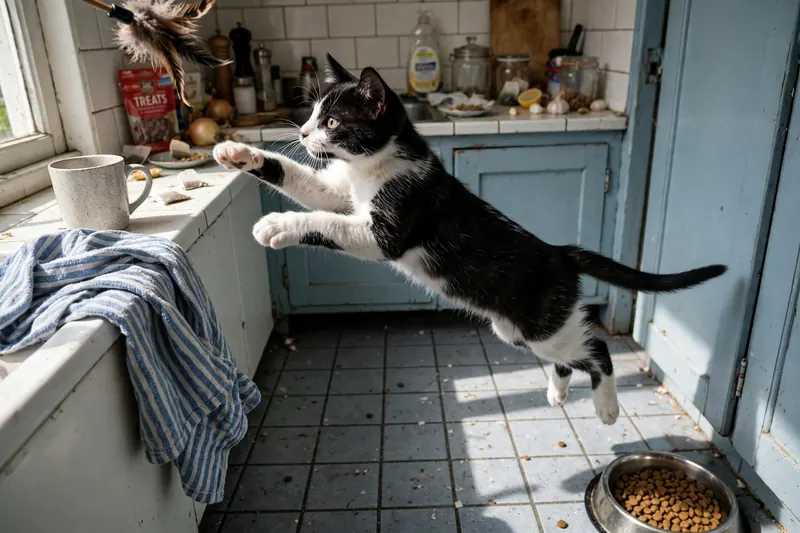
A 10 to 15 minute wand toy session before bed lets the cat end the hunt with a catch, which is what makes the routine work.
Burn Energy During the Day
A cat that does nothing all day will do everything at night. 2 to 3 short play sessions during the day, spread out rather than crammed into one long session, beat a single marathon. Rotate toys weekly so they stay interesting.
Food can be part of the daytime work too. Puzzle feeders, treat balls, and treasure hunts, where you hide small portions of food for the cat to find, make a cat work for its meal as a hunter works for prey. Vertical space helps too: cat trees, wall shelves, and window perches give a cat places to climb and rest.
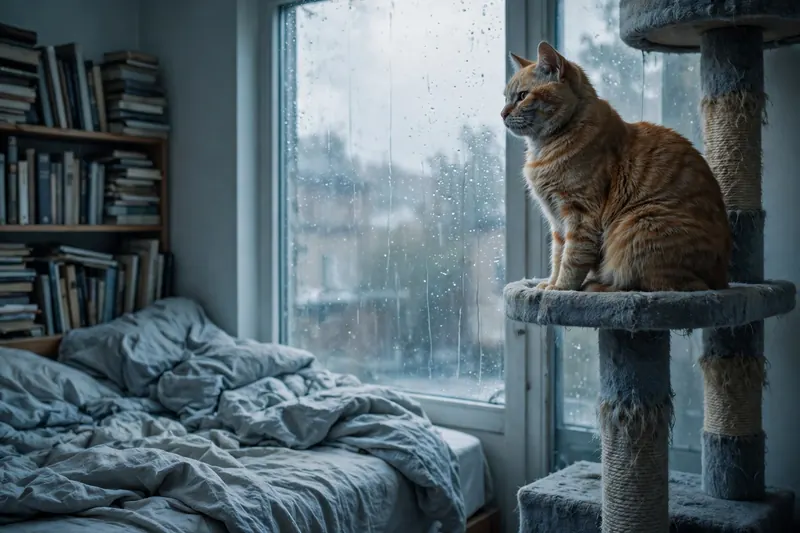
Vertical space and a window view give a cat something to climb and watch during the day, so less energy is left for the night.
What to Do When Your Cat Is Already Zooming
Sometimes the routine works and the cat still zooms. Stay calm and stay safe. Do not chase the cat, do not shout, and do not try to grab a cat mid-run. A cat in full sprint is not listening, and a grab can turn a playful burst into a scared bite or scratch. Offer a toy once the cat slows.
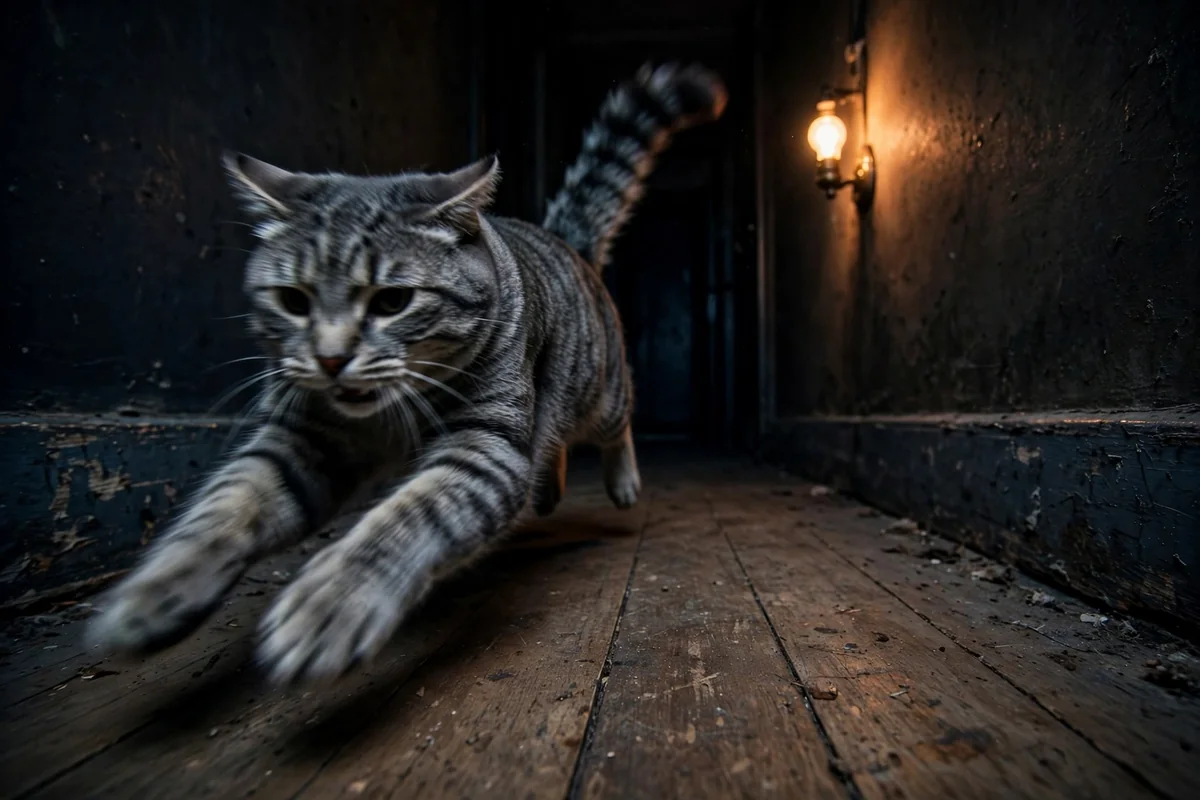
A zoomie in full flow: a sprint down a dark hallway, paws stretched and tail up.
NEVER DO THIS
What never to do
Some responses feel natural and make the problem worse. Do not punish a cat for zooming. Do not feed the cat, start a play session, or give the cat a big reaction at 3 a.m., even a loving one. Every one of those is a reward, and rewards build habits.
Kitten Zoomies: A Special Case
Kittens get zoomies more than any other age group, and theirs are the wildest: laps around the room, leaps off the sofa, and a sudden stop followed by a nap mid-floor. Use several short play sessions through the day instead of one long one, end every session with a catch, and keep hands and feet out of the game, so the kitten learns people are not toys.
How to Zoomie-Proof Your Home
- Secure rugs and runners so they do not slide under fast paws, and move fragile items off low shelves along the usual racing route.
- Put looped-handle shopping bags away, because a cat can get a handle around its neck in a sprint, and tie up blind cords and curtain cords out of reach.
- Keep toxic foods, medicines, pills, and small chewable objects off counters and tables, and close doors to rooms with hazards like laundry, cleaning supplies, or open water.
- Check the racing route for sharp corners, wobbly furniture, and heavy objects that could fall if a cat launches off them, and give the cat a clear path.
- Make sure windows and balconies are secure, because a cat mid-zoomie is not judging distances carefully, and a screen that looks solid may not hold a running cat.
FAQ
What are cat zoomies?
Cat zoomies, also called frenetic random activity periods or FRAPs, are sudden bursts of running, jumping, and pouncing that usually last a few minutes. They are a normal way for cats to release stored energy, and they can happen at any time of day or night.
Why does my cat get zoomies at 3 a.m.?
The 3 a.m. burst is common because a cat’s crepuscular rhythm stirs before dawn, the cat has slept most of the day, and the house is quiet, so the sprint stands out. But zoomies are not limited to 3 a.m. They can happen at any hour of the night.
Are zoomies a sign my cat is happy?
Not exactly. Zoomies usually mean the cat feels safe and comfortable enough to play and spend energy, which is a good sign. But a cat can also zoom when excited, stressed, bored, or overstimulated, so a burst on its own is not a simple happiness score.
Why does my cat zoom after pooping?
The most likely reasons are relief after going and a quick move away from the scent and the vulnerable position of the litter box. Some experts think stimulation of the vagus nerve may also play a part, but that is a theory, not a proven fact. If the cat cries, strains, or has blood, diarrhea, or constipation, call a vet.
How long do zoomies last?
Usually a few minutes. Sources disagree on the exact length, so an exact number would be misleading. What matters more is the pattern: a normal episode ends on its own.
Do kittens get zoomies more than adult cats?
Yes. Kittens and adolescent cats get zoomies most often, and theirs are the most frequent and dramatic. Senior cats tend to zoom less, and a sudden drop in zoomies in an older cat can be worth mentioning to a vet.
How do I stop my cat zooming at night?
Play with your cat for 10 to 15 minutes in the evening, then offer a small meal or snack, then settle the cat in a cozy spot before bed. Add daytime play, puzzle feeders, and vertical space, and do not reward night zoomies with food, play, or a big reaction.
When should I call the vet about zoomies?
Call your vet if the pattern changes suddenly, if the cat stumbles, seems disoriented, or stares at nothing, if there is aggression or unusual vocalizing, if there is weight loss with increased appetite and restlessness, or if there are litter box problems or signs of pain.