
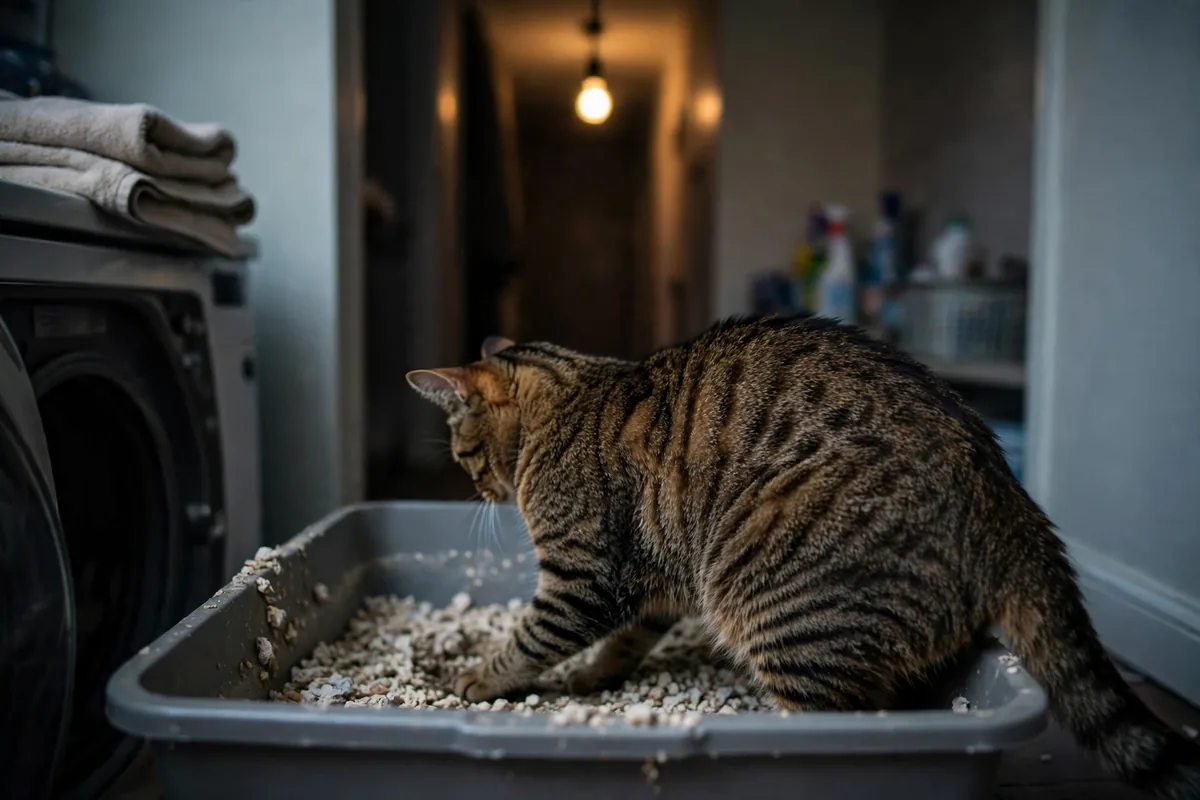
Why Do Cats Bury Their Poop?
Cats bury their poop to hide its scent and its sight. A pile of droppings is a strong smelling, highly visible sign that a cat has been in a place. In the wild that sign can draw a larger predator, a rival cat, or a prey animal that then stays away. Covering the pile breaks the scent trail and makes the cat harder to find.
The information here is general information only and is not veterinary advice. If your cat suddenly stops burying, or the change comes with straining, hiding, appetite change, or toileting outside the box, contact your vet.
Key Takeaways
- Cats bury poop mainly to hide scent and sight, which helped wild ancestors avoid predators and rivals.
- Burying is instinctive, but kittens also learn it by watching their mother, usually from around 3 to 4 weeks.
- An uncovered pile left deliberately in a visible place is called middening, a scent message, not ordinary toileting.
- Uncovered poop inside a litter box is rarely a dominance display. The box, the litter, stress, or pain explains most cases.
- Common fixable causes are a box that is too small, litter that is too shallow or unpleasant, a dirty box, or a noisy spot.
- Pain, arthritis, sore paws, and illness can stop a cat from covering, especially in older cats.
- A sudden stop in a cat that always buried matters far more than a cat that never buried.
- Never punish a cat for not covering, and never move its paws through the litter.
The Short Answer: Survival, Not Politeness
It is tempting to read burying as good manners, but cats are not trying to be polite, and they are not embarrassed. Droppings carry a strong smell and chemical information, including pheromones that other cats can read. A pile left in the open tells any animal with a good nose that a cat was here. For a small animal that hunts alone and can also be hunted, that is a lot of information to give away for free.
A Habit Older Than the Litter Box
The litter box is a new invention on top of a very old behaviour. Cat World puts the modern box at barely 80 years old, popularised in 1947 when Ed Lowe began selling absorbent clay as Kitty Litter. The scratching motion your cat uses in that box is far older. Wild ancestors used the same paw movement to shift sand and soil over waste.
Domestic cats are close to their wild ancestors. Cats.com notes that domestic cats belong to the Felidae family, with 37 recognised species from a common ancestor in Asia 10 to 12 million years ago. Reader’s Digest vet Jordan Cassidy puts it plainly: cats have an inherent desire to bury waste to cover scent, and from about 4 weeks of age they are drawn to the box.
What Burying Actually Does
| What burying does | Evidence | What you see at home |
|---|---|---|
| Lowers scent so predators and rivals are less likely to find the cat | Strong, the leading explanation | Careful covering after most visits |
| Removes the visual clue of droppings | Strong | The pile disappears under litter |
| Keeps the core living area cleaner | Good, a likely benefit | Cats toilet away from food and sleeping spots |
| May reduce disease and parasite spread | Plausible, Beaver 2003 | Less exposed waste in a shared area |
| Leaves paw scent while scratching | Good, scent glands in paw pads | Scratching that marks familiar ground |
Purina notes that cats have scent glands in their paw pads, so scratching lays down the cat’s own scent while hiding the waste scent. Cats also prefer to toilet away from their core living area. That is why a litter box next to the food bowls so often fails.
The Full Visit: Dig, Turn, Cover, Leave
| Step | What the cat does | What can go wrong |
|---|---|---|
| Approach and sniff | Walks to the box, sniffs the litter | Turns away if the box is dirty or blocked |
| Dig a hollow | Scratches litter aside | Skips digging if litter is too shallow or coarse |
| Turn and squat | Turns around, squats over the hollow | Cannot turn if the box is too small |
| Cover | Scratches litter over the pile | Scratches the wall, or leaves without covering |
| Sniff and leave | Sniffs the covered spot, steps out calmly | Bolts if startled, cornered, or in pain |
Read the sequence as a whole. A cat that digs for a long time may be searching for a clean patch in a box that needs scooping. Chewy notes that cats can cover urine and not faeces, or the reverse, and the split usually points to the box or to how the cat feels on that visit.
Scent, Territory, and the Middening Exception
Field studies of free roaming and feral cats have found a clear pattern. Cats tend to bury their droppings near the centre of their home range, close to where they sleep, eat, and raise kittens, and they often leave droppings uncovered further out, toward the edges of the range.
Near home a pile is a liability, a signpost pointing at the nest, so it gets buried. At the edge of the range it is a message, a scent post that says another cat lives here. The deliberate uncovered pile has a name: middening. A pile left in the middle of a room or near a door is a candidate for a scent message. A pile left uncovered inside a litter box is usually not.
Dominance and Submission: What the Evidence Actually Supports
No part of this topic is repeated more confidently, or supported more thinly, than the dominance story. It usually goes like this: a lower ranking cat buries its poop as a sign of submission, a dominant cat leaves its poop uncovered to show it is in charge, and therefore an uncovered pile in your home means your cat is asserting dominance.
The field evidence is narrower. In feral colonies, burying tracks with social position: lower ranking cats bury meticulously, while the most dominant cat sometimes leaves droppings uncovered in a prominent spot. But the step from a feral colony to a living room is a long one. The Oscillot page is clearest here: there is very little direct evidence for dominance in household cats, and most behaviourists now prefer tension and competition for resources.
Dominance fails indoors for three reasons. The first is place: a litter box is the core, not the edge. The second is that simpler explanations fit better: the box is too small, the litter hurts its paws, the box is dirty, another cat blocked the hallway, or the cat is in pain. The third is that cats that do not get along are usually competing for resources, a box or a resting spot, not staging a contest for a title.
Why Some Cats Do Not Bury Their Poop
The reasons fall into three different types, and the fix is different for each type. A cat that never learned needs teaching and patience. A cat that cannot do it comfortably needs a vet or a different box. A cat that will not do it here needs a change to the setup.
Never Learned It
Kittens start digging and covering at around 3 to 4 weeks of age, partly by instinct and partly by watching their mother. If the mother did not teach the behaviour, the need can be weaker, especially indoors. A kitten orphaned young may reach adulthood without a reliable covering habit.
For this type, patience and encouragement are the only honest tools. A kitten or young cat under 2 years old may still learn from other cats in the household, as PetMD notes. Clicker training, described by Adopt a Pet, works in small steps: reward any pawing at litter, then reward closer approximations until covering happens reliably. That takes weeks.
Cannot Do It Comfortably
Digging and covering takes a squat, a twist, and a fair amount of paw work, and any pain in that chain can cut the sequence short. Arthritis is the most common cause in older cats. The Oscillot page cites a 2002 study in the Journal of the American Veterinary Medical Association, by Hardie and colleagues, which found X-ray evidence of degenerative joint disease in 90 percent of cats over 12 years old, most of whom had never been diagnosed.
Other pain has the same effect. A paw or nail injury, a sore pad, or a recent declawing can make scratching litter genuinely uncomfortable. Digestive trouble can do it too: constipation, diarrhea, or anal gland discomfort make a cat want to leave the box as fast as possible. The fix for this type starts with the vet, not with a new litter brand.
Will Not Do It Here
The third type is a cat that can bury and knows how, but will not do it in this box, with this litter, in this spot. Start with size. The American Association of Feline Practitioners says a litter box should be at least 1.5 times the length of the cat, nose to base of tail. Most boxes sold as standard are smaller than that for an adult cat.
Then look at litter depth, because the sources disagree here. Chewy and Purina say 3 to 4 inches. Rover says 2 to 4 inches. Cat World and Cats.com say 2 to 3 inches. No single number is right for every cat. Start at 2 to 3 inches of soft litter, then try a deeper fill for a week.
Texture and scent come next. Across the sources the preference is consistent: soft, fine grained, sand like, unscented, clumping litter. Rover is blunt about what fails: rocky, hard, and jagged edged litter is unappealing. Cleanliness matters too. The Vet Desk is direct: wet, dirty litter is hard and uncomfortable to dig in.
Finally, look at the box and where it sits. Covered boxes trap smell, feel cramped, and leave a cat with one exit. Rover notes that covered boxes can cause cats to dump and dash. A box in a closet, next to a rumbling washing machine, or in a high traffic hallway all make a cat want to leave fast. See our guides to cat litter box problems and the best cat litter.
Kittens: How the Habit Is Learned
Until they are around 4 weeks of age, kittens need their mother to stimulate them to pass urine and faeces. From about 3 to 4 weeks they begin digging and covering, partly by instinct and partly by watching their mother.
It is normal for kittens not to cover well. If your kitten scratches at the litter, misses the pile, or walks away mid job, that is learning in progress, not a problem. Give the kitten a shallow, low sided tray with soft, fine litter, keep it clean, and do not move its paws for it. Our new cat owner starter kit covers the first week routine.
The Wall Scratchers and the Over Diggers
Two variations confuse owners most. The wall scratcher finishes, then scratches at the sides of the box, the floor, or the air, without moving litter over the pile. The over digger scratches for minutes and flings litter across the room.
Wall scratching is the covering motion without the covering result. CatTree describes it exactly: some cats perform the covering motion without actually moving much litter. If the cat otherwise toilets normally, this can simply be that cat’s routine. But check the setup first: tray size, litter amount, litter texture, and cleanliness.
Over digging is the opposite end of the same range. Rover suggests some cats simply enjoy digging around in sandy material and find it fun. But Purina adds the other half: scratching that goes on and on after covering can be the cat telling you something about the box, such as its cleanliness or size. Check the box first, then accept the scatter if the cat is calm.
How to Read One Visit to the Litter Box
| What you see | Most likely cause | Check first |
|---|---|---|
| Covers carefully every time, calm body | Normal behaviour | Keep the routine as it is |
| Never covers, never has, otherwise healthy | Never learned it well as a kitten | Patience, praise for covering |
| Used to cover, suddenly stopped | Pain, illness, or stressful change | Vet first, then box |
| Bolts from the box without covering | Feels unsafe, startled, or in pain | Location, cover, other cat, vet |
| Toilets outside the box as well | Box aversion, stress, or medical problem | Vet first, then box count and size |
A Litter Box Setup That Helps Your Cat Bury
| Setup point | What to aim for |
|---|---|
| Box size | At least 1.5 times the length of your cat, nose to base of tail |
| Box count | One box per cat plus one extra, in separate locations |
| Box style | Open, uncovered, low sided, easy entry |
| Litter type | Soft, fine grained, sand like, unscented, clumping |
| Litter depth | Start at 2 to 3 inches, try 3 to 4 inches if covering is thin |
| Cleanliness | Scoop at least once a day, wash pan weekly with mild soap |
| Location | Quiet, low traffic, clear view, two ways out, away from food and water |
| Changes | One change at a time, test new litter in a second box |
The last row is the one owners skip most often. Cats do not like abrupt changes, and an abrupt change can cause litter rejection on its own. Daily Paws behaviour consultant Pam Johnson-Bennett is explicit: offer the cat a choice and do not just change. Put the new litter in a second box and keep the old litter in the first.
What to Try, and What Not to Do
- Step 1, vet first if the change is sudden. If your cat always buried and has stopped, book a vet visit before any litter experiment.
- Step 2, check the box size. Measure your cat from nose to base of tail, multiply by 1.5, and compare it with the box.
- Step 3, check cleanliness. Scoop daily, wash weekly, replace a pan that holds odour.
- Step 4, test the litter. Offer a second box with soft, fine grained, unscented, clumping litter at 2 to 3 inches.
- Step 5, test the depth. Try 3 to 4 inches in one box and keep the other at the old depth.
- Step 6, test the location. Move one box to a quiet, low traffic spot with a clear view and two ways out.
- Step 7, add a box if you have more than one cat. One box per cat plus one extra, in separate places.
- Step 8, reduce conflict and stress. Separate feeding spots, resting spots, and scratching posts. If your cat hides a lot alongside the covering change, read our guide on why cats hide before deciding the cause is the box alone.
What not to do is just as important. Do not punish a cat for not covering. The ASPCA advice quoted by Daily Paws is clear that a cat is unlikely to connect human frustration with its toileting habits. Do not move the cat’s paws through the litter. PetMD warns that this can cause stress and fear around the box.
When Not Burying Is a Worry
| Situation | What to do |
|---|---|
| Cat never buried well, healthy, uses the box | Watch and wait, improve the setup |
| Cat always buried, suddenly stopped | Book a vet visit |
| Stopped covering plus hiding, eating less, or vomiting | Book a vet visit soon |
| Straining to pee with little or no urine, especially a male cat | Emergency vet visit at once, possible blocked bladder |
Frequently Asked Questions
Why does my cat bury its poop but not its pee?
Some cats cover one type of waste more thoroughly than the other, and Chewy notes that cats can cover urine and not faeces, or the reverse. It is usually a box or comfort issue on that visit, not a fixed rule.
Why does my cat scratch the sides of the litter box instead of the litter?
The cat is doing the covering motion without moving litter. It can be a harmless habit, or it can mean the box is too small, the litter is too shallow, the texture is unpleasant, or the box is dirty. Check box size, litter depth, texture, and cleanliness first.
Is it normal for a cat to never bury its poop?
Yes, for some cats it is normal. A cat that never learned the habit well as a kitten, often because it was orphaned or separated very early, may never cover reliably. If the cat is healthy and has always been this way, it is usually fine.
Does an uncovered pile mean my cat is being dominant?
Not usually, and not on the evidence for indoor cats. A deliberately placed pile in a visible open place can be a scent message, called middening, but an uncovered pile inside a litter box is far more likely to be about the box, the litter, stress, or pain.
How deep should cat litter be for burying?
Start at 2 to 3 inches of soft, fine grained, unscented, clumping litter. If covering is thin, try 3 to 4 inches in one box and keep the other at the old depth. The sources disagree, with Chewy and Purina at 3 to 4 inches and Cat World and Cats.com at 2 to 3 inches, so depth is a variable to test.
Can I train my cat to cover its poop?
Sometimes, and only with patience. Kittens and young cats under 2 years old may learn from other cats in the house, and gentle reinforcement helps: praise or a treat when the cat covers. Never punish the cat, and never move its paws through the litter.
When should I call the vet about my cat not burying its poop?
Call the vet if your cat always buried and has suddenly stopped, or if the change comes with straining, crying, hiding, eating less, vomiting, diarrhea, or toileting outside the box. Call at once as an emergency if your cat is straining to pee and producing little or no urine, especially a male cat.