
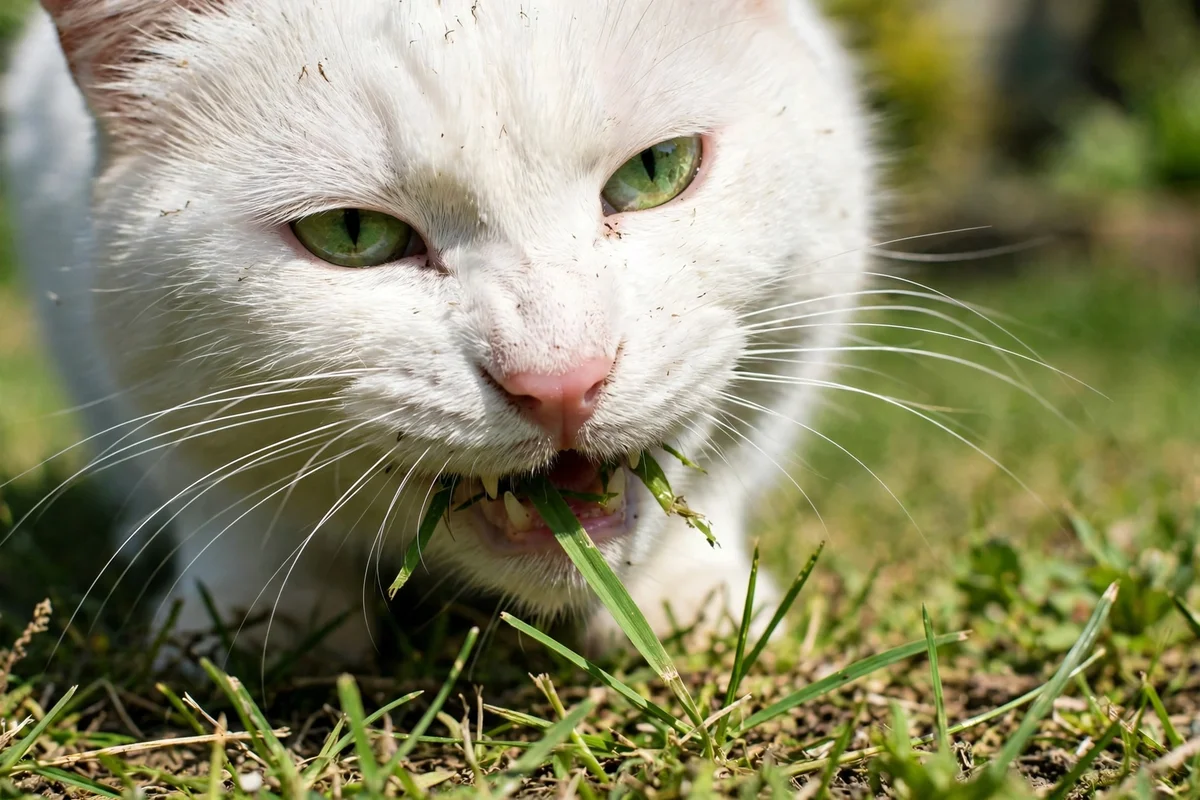
Why Do Cats Eat Grass? Is It Safe and When to Worry
Your cat walks past a full food bowl, goes outside, and starts chewing grass like it is a treat. Then it comes back inside and throws up on the rug. If that sounds familiar, you have probably wondered why cats eat grass, and whether it is safe. Grass eating is normal, most cats are not sick when they do it, and the vomiting that sometimes follows is usually a side effect. The best evidence comes from a survey of 1,021 cat owners at the University of California, Davis.
The information here is general information only and is not veterinary advice. If your cat vomits often, or may have eaten a toxic plant, contact your vet at once.
Key Takeaways
- Grass eating is normal. In a UC Davis survey of 1,021 owners, about 71 percent had seen their cat eat plants at least 6 times.
- Most cats are not sick when they eat grass. About 91 percent appeared normal before eating plants.
- Vomiting is a consequence, not the proven goal. Only about 27 percent vomited frequently.
- Clean, untreated grass is generally safe in small amounts.
- Cat grass is young wheat, oat, barley, or rye grass, not lawn grass and not catnip.
- True lilies can kill a cat. Every part is toxic.
- Cornell advises a vet check for any cat vomiting more often than about once a week.
- You can grow cat grass indoors in about 7 to 14 days.
The Short Answer
Cats eat grass because it is an old instinct, not because they are sick. Researchers at UC Davis think the habit comes from wild ancestors that ate plant material to help clear parasites from the gut. That is the leading theory, but no single proven reason exists. Grass eating is common, usually harmless, and not a sign your cat is trying to make itself sick. Clean grass in small amounts is fine for most healthy cats. The real risks are treated lawns, toxic plants, and eating so much grass that it causes a blockage.
What the UC Davis Study Actually Found
The numbers below come from two surveys by Hart, Hart, and Thigpen, published in 2021 and reported by Smithsonian Magazine in 2019. The second survey covered 1,021 cat owners who could watch their cat for at least 3 hours a day.
| What the survey asked | What owners reported |
|---|---|
| Cats seen eating plants at least 6 times | About 71 percent |
| Cats never seen eating plants | About 11 percent |
| Cats that appeared normal before eating plants | About 91 percent |
| Cats that vomited frequently after eating plants | About 27 percent |
| Young cats under 3 that ate plants daily | About 39 percent |
| Older cats aged 4 and over that ate plants daily | About 27 percent |
| Older cats that vomited frequently | About 30 percent |
Read the table in one line: most cats eat plants, most look fine before they do it, and most do not vomit after. Young cats ate plants more often and vomited less, which also fits an instinct rather than a sickness. Do not use the 89 percent figure on some pages.
The researchers concluded that grass eating is likely an inherited instinct from wild ancestors, possibly to help expel intestinal parasites. The study shows a pattern, not a proof, but it does prove the sick cat story does not fit the data.
Why Do Cats Eat Grass? The 6 Theories, Ranked by Evidence
No single proven reason exists. The six theories below run from the best supported to the most speculative.
1. An inherited instinct to help clear gut parasites
This is the leading theory, and it comes from the UC Davis researchers themselves. Wild carnivores eat plant material to help expel intestinal worms, and domestic cats may have kept the instinct. Grass is high in insoluble fibre, which stimulates gut muscle activity. The theory fits the study numbers, but it is still unproven.
2. To help move hair and indigestible material through the gut
Cats swallow hair when they groom, and fur and feathers when they eat prey. Grass fibre may help move that material through the gut, or help the cat bring it back up. One finding weakens it: the 2021 study found no difference in grass eating between long haired and short haired cats. A small 2025 study of only 2 cats suggested leaf structures might help catch swallowed hair. Treat the hair theory as possible, not proven.
3. To ease constipation and gut movement
Grass that is not vomited can end up in stool unchanged, and the fibre may help colon movement in a mildly constipated cat. This theory has no direct proof. If your cat is constipated, grass is not a treatment. A vet should check the cause first.
4. For trace nutrients such as folic acid
Grass juice contains folic acid, plus trace amounts of vitamins A and D and niacin. Some experts think cats eat grass to top up nutrients they miss from processed food. This is a theory only. A cat on a complete commercial food should not need grass to fix a nutrient gap.
5. Because they enjoy the taste, texture, and chewing
Some cats simply like grass. Young shoots have an interesting texture, and chewing can be calming, a bit like chewing gum for people. This may explain the cats that graze every day without ever vomiting. Watch your own cat: a cat that nibbles a few blades, walks away, and carries on with its day is probably just enjoying it.
6. For comfort, stress relief, and boredom
Anxious cats may find that chomping on grass calms their nerves. Indoor cats with little enrichment may chew plants more. A pot of cat grass, a window perch, and a daily play session give an indoor cat something better to do.
Do Cats Eat Grass to Make Themselves Vomit?
No, not as a rule. The study found that about 91 percent of cats looked normal before eating plants, and only about 27 percent vomited frequently after. That is not what the data shows. Vomiting after grass is usually a consequence, not the goal. Cats lack the enzymes to digest grass, so blades often pass through whole or come back up.
The myth versus what the study found
| The myth | What the study found |
|---|---|
| Cats eat grass because they feel sick | About 91 percent looked normal before eating |
| Cats eat grass to make themselves vomit | Only about 27 percent vomited frequently after |
| Only sick cats eat grass | About 71 percent of cats had eaten plants at least 6 times |
| Vomiting after grass means the cat is ill | Occasional vomiting of grass alone, with the cat acting normal after, is common |
Vomiting versus regurgitation: how to tell the difference
Vomiting is active: the cat heaves, its belly contracts, and food or grass comes up from the stomach, often with bile. Regurgitation is passive: food comes back up from the throat with little effort, usually soon after eating. Grass that comes back up quickly, with no heaving and no distress, is often regurgitation. A grass blade stuck in the throat can cause retching and pawing at the mouth. If the retching does not stop, call your vet.
Is It Safe for Cats to Eat Grass?
Yes, for most healthy cats, in small amounts, as long as the grass is clean and untreated. The bigger risks are what is on it: pesticides, herbicides, fertilizers, slug bait, weed killer, and snail bait. Do not let a cat graze on a lawn unless you know what was applied to it. Chemicals can also be licked off paws and fur during grooming. Eating large amounts or very long pieces can risk a gut blockage, so trim cat grass back when blades pass 4 to 5 inches. Cats are obligate carnivores, so grass is a snack, never a meal and never a replacement for complete cat food.
What Is Cat Grass?
Cat grass is not one plant. It is a general name for young cereal grasses grown for cats to nibble, usually wheat, oat, barley, or rye. It is not lawn grass, which is often treated with chemicals, and it is not catnip. Catnip is Nepeta cataria, a mint family herb that causes play or rolling in many cats. Use untreated seed sold for cat grass or sprouting, not lawn seed coated with fungicide, and not garden soil with added fertilizer.
| Grass | Latin name | Texture | Best for | Watch out for |
|---|---|---|---|---|
| Wheatgrass | Triticum aestivum | Fine, fast growing | The classic first pot | Grows fast, goes yellow quickly |
| Oat grass | Avena sativa | Softest and mildest | Picky cats, kittens, sensitive stomachs | Needs steady watering |
| Barley grass | Hordeum vulgare | Fine and mild | Delicate chewers | Slower to sprout than wheat |
| Rye grass | Secale cereale | Coarser | Cats that like a firm chew | Never let it flower or go to seed |
Start with oat grass if your cat is new to cat grass, picky, or young. It is the softest and mildest. Wheatgrass is the classic fast option. Barley suits delicate chewers. Rye must never be allowed to flower or go to seed.
How to Grow Cat Grass Indoors, Step by Step
Growing cat grass indoors takes about 7 to 14 days from seed, and a batch lasts about 1 to 3 weeks. You need a shallow pot with drainage holes, untreated seed, plain potting soil with no added fertilizer, and a bright windowsill. Seed amounts: 2 to 3 tablespoons for a 4 inch pot, about one third cup for a 6 inch pot.
Day 0: Soak the seed
Soak the seed in clean water first: wheat 8 to 12 hours, oats 4 to 8 hours, barley and rye 6 to 12 hours. Soaking speeds sprouting by a day or two. Drain well before sowing.
Day 1: Sow the seed
Fill the pot with damp soil to about an inch below the rim. Scatter the seed thickly across the surface, press it into the soil, and cover with a thin layer of soil. Mist until damp but not soaking.
Day 1 to Day 3: Cover and keep dark and damp
Cover the pot loosely to keep it dark and damp. Check once a day and mist if it looks dry. The seed should sprout in 2 to 3 days. Do not overwater: soggy soil causes mold.
Day 3 to Day 7: Move to bright light
Once sprouted, remove the cover and move the pot to a bright windowsill. Keep the soil damp, not soggy. The grass should reach 2 to 3 inches by day 7. Pale, leggy shoots need more light.
Day 7 to Day 10: Offer it to your cat
Offer the grass when it is about 3 to 4 inches tall. Put the pot where your cat already spends time. Most cats start nibbling within a day.
How to keep a fresh pot ready every week
Sow a new pot every 7 to 14 days, and use 2 to 3 pots in rotation. Trim blades back when they pass 4 to 5 inches. Compost the old batch and start again.
Mold, yellow leaves, and other problems: what to do
Mold is the main growing risk, caused by overwatering, poor drainage, and still air. Discard a moldy batch entirely. Do not trim around mold. White fuzz on roots only can be normal root hairs, which vanish when misted. Grey or black fuzz is mold. Yellow leaves usually mean the batch is old or too dry.
How Much Cat Grass Can a Cat Eat?
There is no set amount, and most cats regulate themselves. A grazer takes a few blades and walks away. A gulper eats a lot at once and is more likely to vomit. If your cat gulps, offer the pot for short sessions, or trim the blades shorter.
Kittens can nibble cat grass, but they need supervision, because they pull up whole clumps and eat soil. Senior cats, cats with gut disease, kidney disease, or diabetes, and cats on a prescription diet should check with a vet first. Cats that eat non food items, a condition called pica, need a vet check too.
Is Outdoor Grass Safe?
Outdoor grass is safe only if you know what is on it. Ask yourself: has the lawn been sprayed, fertilised, or treated with slug bait in the last few weeks? Has a neighbour sprayed near the fence? Are there snail pellets or weed killer granules on the ground? If the answer to any of these is yes or unknown, keep the cat off that grass. Roadside grass is not safe, because it collects exhaust, oil, and litter. If your cat does graze outside, rinse its paws when it comes in, and keep it away from lawn clippings, which ferment quickly. A pot of cat grass indoors is always the safer option.
Toxic Plants That Look Like Grass or Sit Next to It
The most dangerous mistake is to confuse a toxic plant with a safe one. True lilies can kill a cat. Our guide on are lilies toxic to cats covers them in full: every part is toxic, including pollen and vase water, and even a small exposure can cause kidney failure or death. If your cat may have touched or eaten any part of a lily, call your vet at once, even if the cat seems well.
| Plant | Is it a true lily? | Risk to cats | What to do |
|---|---|---|---|
| True lily (Lilium), daylily (Hemerocallis) | Yes | Lethal, kidney failure | Keep out of the house, vet at once if eaten |
| Peace lily, calla lily | No | Mouth irritation | Keep out of reach, vet if drooling or in pain |
| Peruvian lily | No | Listed non toxic by ASPCA | Safe, but keep plants out of the food area |
| Lily of the valley | No | Toxic, heart effects | Keep out of the house, vet at once if eaten |
| Lemongrass, Dracaena grass palm | No | Toxic, vomiting and stomach upset | Keep away, do not grow as cat grass |
Other toxic plants include sago palm, oleander, azalea and rhododendron, autumn crocus, tulips, iris, daffodils, amaryllis, aloe vera, dieffenbachia, philodendron, pothos, and monstera. Our guide on is aloe vera toxic to cats explains the risk from that common houseplant. If you are not sure a plant is safe, keep it out of reach, and check the ASPCA toxic plant list before buying a new houseplant. Cat grass helps redirect a cat away from houseplants, but it does not make toxic plants safe.
When Grass Eating Means a Vet Visit
Most grass eating is normal. The table below uses the Cornell once a week rule as the line.
| Normal | Call the vet |
|---|---|
| Nibbles grass a few times a week, acts normal after | Vomits more often than about once a week |
| Vomits grass alone once in a while, then eats and plays normally | Vomits with lethargy, weakness, poor appetite, blood, or diarrhea |
| Grazes on clean grass, then settles | Eats grass every day and vomits every time, or the habit is new and increasing |
| Young cat eats plants daily and rarely vomits | Cat has not eaten for 24 hours, or may have eaten a toxic plant or chemical |
Cornell Feline Health Center advises a prompt vet check for any cat vomiting more often than about once a week, or vomiting with lethargy, weakness, poor appetite, blood, diarrhea, or changes in drinking or urination. PetMD warns that frequent grass eating followed by vomiting can point to gut disease such as inflammatory bowel disease or parasites, especially if the habit is new or increasing. Keep a simple 7 day watch log: date, grass eaten, vomit or not, appetite, energy, and stool.
If your cat may have eaten a toxic plant or licked a chemical, act in the first hour. Keep the cat calm and indoors. Do not try to make the cat vomit unless a vet specifically tells you to. Call your vet, or call the ASPCA Animal Poison Control Center on (888) 426-4435, open 24 hours. The Pet Poison Helpline is (855) 764-7661, and a fee applies. Do not wait to see if the cat gets sick, because some poisons act slowly and treatment works best early.
Frequently Asked Questions
Is it normal for cats to eat grass every day?
Yes, for many cats. About 39 percent of young cats under 3 ate plants daily in the UC Davis survey. Daily grazing is normal if the cat acts well and vomits rarely. If daily eating comes with daily vomiting, call your vet.
Why does my cat eat grass and then throw up?
Because cats lack the enzymes to digest grass, so blades often come back up. Occasional vomiting of grass alone is common. Frequent vomiting is not, and needs a vet check.
Can kittens eat cat grass?
Yes, with supervision. Kittens pull up whole clumps and eat soil, so offer short sessions. Start with soft oat grass, the mildest option.
Do indoor cats need grass?
No, they do not need it. Grass is enrichment, not a medical necessity for a cat on a complete diet. But a pot of cat grass gives an indoor cat a safe green to chew instead of your houseplants.
Is wheatgrass safe for cats?
Yes. Wheatgrass is young wheat, Triticum aestivum, and it is one of the standard cat grasses. Offer it at about 3 to 4 inches tall, and replace it when it yellows, usually after 1 to 3 weeks.
Should I stop my cat eating grass?
No, do not ban it. Redirect it instead. Give the cat a pot of its own, keep toxic plants out of reach, and supervise outdoor grazing. If the habit is new, increasing, or comes with frequent vomiting, call your vet.
The Bottom Line
Cats eat grass because it is an old instinct, not because they are sick. Most cats look fine before they eat it, and most do not vomit after. Clean grass in small amounts is safe for most healthy cats. Grow a pot indoors, keep toxic plants out of the house, and watch the vomiting frequency. More than about once a week means a vet visit.