Why Does My Cat Slow Blink at Me?
You are sitting on the sofa, and your cat is watching you from across the room. Then its eyelids start to droop. Not a fast blink, and not sleep. The lids lower slowly, pause half closed, close all the way for a second, and then open again just as slowly. If you have seen it once, you have probably wondered what it means, and whether you are supposed to do anything back.
Your cat is telling you it feels safe with you. Cat lovers call it a cat kiss, and researchers call it a slow blink sequence. It is one of the clearest friendly signals a cat has, and also one of the easiest to misread, because a narrowed eye can mean trust, and it can also mean pain.
The information here is general information only and is not veterinary advice. If your cat is squinting, pawing at its eye, or showing discharge, redness, or swelling, contact your vet.
Key Takeaways
- A slow blink is a series of soft half-blinks ending in a long eye narrowing or a full eye closure. It is deliberate and gradual, and different from a normal fast blink.
- It is popularly called a cat kiss, and best read as a friendly relaxed signal: trust, contentment, and “I am not a threat”.
- A 2020 study in Scientific Reports tested it properly: 21 cats in Experiment 1 slow blinked back more at owners who slow blinked at them, and 24 cats in Experiment 2 approached a stranger who had slow blinked at them more often.
- The study was small: only 18 cats from each experiment were included in the final analysis, so treat the slow blink as a friendly signal, not proof of love.
- A hard unblinking stare is the opposite signal and can read as a threat or a challenge.
- You can slow blink back: wait for eye contact, soften your gaze, close your eyes slowly, hold them shut for 1 to 2 seconds, open slowly, then look away briefly.
- Not all cats slow blink on cue, and that is normal. A cat that never blinks back is not rejecting you.
- Rapid blinking, squinting, one eye held partly closed, discharge, redness, swelling, or pawing at the eye are not slow blinks. They can mean an eye problem and need a vet check.
The Short Answer: Why Does My Cat Slow Blink at Me?
Your cat slow blinks at you because it feels relaxed and safe in your presence, and because it is telling you that you are not a threat. Cats are both hunters and hunted animals, so closing their eyes near another living thing is a real risk, and a cat only does it with company it trusts.
The popular version says the slow blink means “I love you”, and many owners feel that way. Science cannot measure love in a cat, and the one proper experiment on this behavior did not try to. What it showed is simpler and still meaningful: cats slow blink back more when people slow blink at them, and they walk toward people who have slow blinked at them.
What a Slow Blink Looks Like, Step by Step
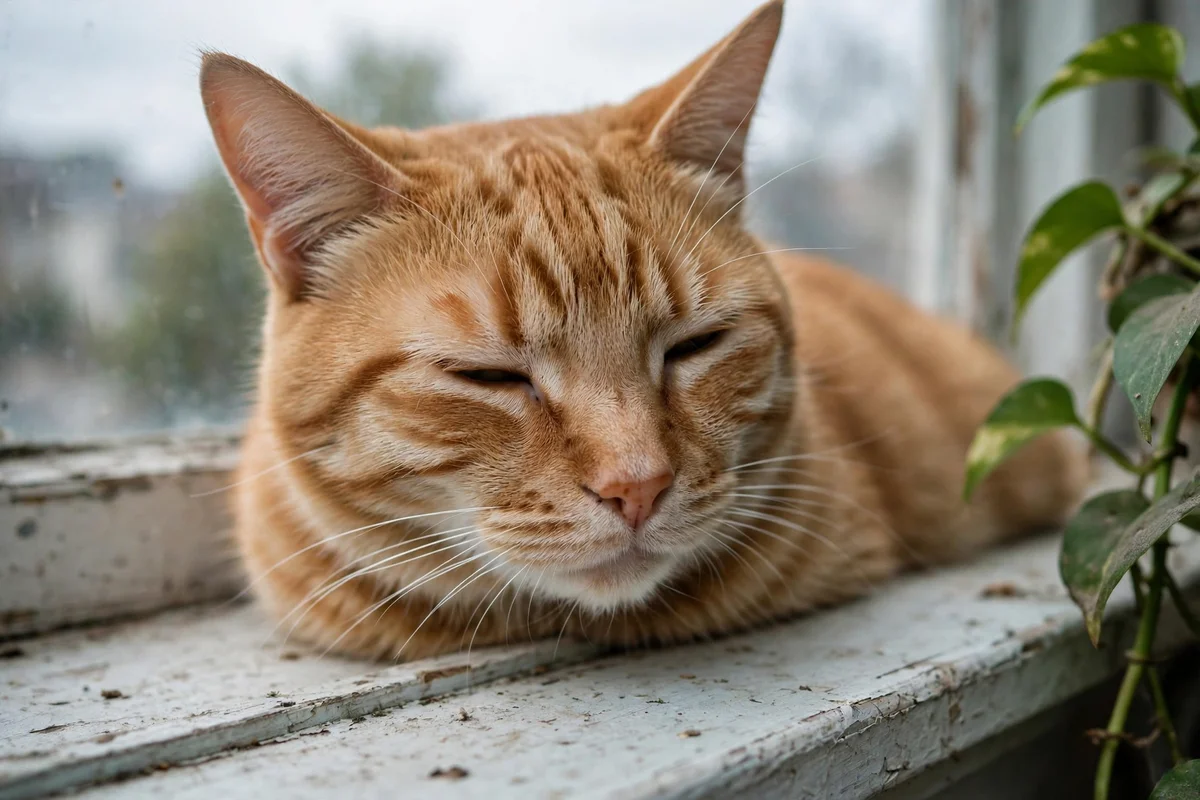
A slow blink is easy to miss if you are not looking for it. A normal blink is fast and reflexive, takes a fraction of a second, and keeps the eye moist and protected. A slow blink takes around 5 seconds from start to finish, and looks deliberate throughout.
Here is the sequence, as researchers described it in the 2020 study:
- Your cat makes eye contact with you. The gaze is soft, not fixed and hard, and the body is loose.
- The eyelids lower in a series of half-blinks, moving toward each other without fully meeting, so the eyes narrow to slits.
- The narrowing deepens, or the eyes close all the way, and the cat holds this for 1 to 2 seconds.
- The eyes open again, slowly. The cat may then look away, or hold your gaze and do it again.
Read the whole cat, not just the eyes. A real slow blink comes with a relaxed body: loose posture, ears forward or neutral, whiskers relaxed, tail still or gentle. If the body is stiff, the ears are flat, and the tail is lashing, the narrowed eyes mean something else, and the table further down the page will help you tell which is which.
A sleepy cat can look similar, but it will not be holding your gaze first, and it will usually curl up and stay closed. A slow blink starts with eye contact, happens while the cat is awake, and ends with the eyes opening again.
Sometimes only one eye closes. A single slow wink can be normal, and it can also be dust, bright light, or mild irritation. If it happens once, the eye looks normal, and the cat is relaxed, do not worry. If one eye stays partly closed, read the health section near the end of the page.
The 2020 Study, Explained in Plain Language
Before 2020, the slow blink was folk knowledge, talked about by owners and behaviorists but never tested in a proper experiment. That changed with a study by Tasmin Humphrey, Leanne Proops, Jemma Forman, Rebecca Spooner, and Karen McComb, from the University of Sussex and the University of Portsmouth, published in Scientific Reports on 5 October 2020. You can read the full paper at Nature, Scientific Reports.
Experiment 1 asked whether cats slow blink back at their owners. It included 21 cats from 14 different households, 10 male and 11 female, aged from 0.45 to 16 years. The owners were taught the slow blink technique, then each cat was tested at home in two conditions: one where the owner slow blinked at the cat, and one control with no interaction. The cats produced significantly more half-blinks and eye narrowing in the slow blink condition. The final analysis included 18 cats after 3 outlier exclusions.
Experiment 2 asked whether a slow blink makes a stranger more approachable. It included 24 additional cats from 8 households, 12 male and 12 female, aged from 1 to 17 years. A stranger either slow blinked at the cat or showed a neutral face, then held out a hand. The cats were more likely to approach the outstretched hand after the stranger had slow blinked. The final analysis included 18 cats after 6 outlier exclusions.
The study is peer reviewed and well designed, with a proper control in each experiment. It is also small: 18 cats in each final analysis, all pet cats in homes in one part of England. The finding is best read as “slow blinking is a friendly signal that cats respond to”, not as proof of love.
Two extra details come with a caution. A secondary look at the data found male cats roughly doubled their half-blink rate between the control and the slow blink condition, while female cats barely changed, but that is a secondary analysis of a small sample, not a rule about your cat. A companion shelter study filmed 18 shelter cats being slow blinked at through pen glass, and the authors called that finding tentative.
Within its limits, the study proves the slow blink is a two way signal: cats do it back when people do it first, and walk toward people who do it.
Why Closing Its Eyes Means Trust
Cats live in the middle of the food chain. They are skilled hunters, and they are also prey for larger animals. Their eyes are their early warning system, and closing them stops a cat watching for danger. Doing that on purpose, in front of another living thing, is a real act of trust.
There is a second idea that may be part of the explanation. A direct stare can read as a threat to a cat, so a slow blink breaks the stare. By narrowing its eyes and looking away for a moment, the cat is saying, in effect, “I am not a threat, and I do not see you as one.” Researchers do not know exactly why slow blinking works, so treat this as one theory, not a proven mechanism.
Slow Blink vs Stare vs Squint vs Rapid Blink
Four eye movements get confused with each other, and only one of them is a cat kiss. Read the speed and the body before you decide what you are seeing.
| Eye movement | What it looks like | Body language | What it usually means |
|---|---|---|---|
| Slow blink | Slow half-blinks, long narrowing, eyes close for 1 to 2 seconds, open slowly | Relaxed body, soft ears, loose posture | Trust, contentment, friendly greeting |
| Hard stare | Eyes wide open, fixed, unblinking, pupils often dilated | Stiff body, flat ears, tense tail | Threat, challenge, fear, or warning to back off |
| Pain squint | One or both eyes held partly closed, often for a long time | Tense face, pawing at the eye, hiding, less active | Eye pain or irritation, needs a vet check |
| Rapid blink | Fast repeated blinking, much more often than usual | Watery eyes, redness, or discharge may be present | Irritation, foreign material, or infection |
The hard stare is the exact opposite of the slow blink. Between cats, a fixed unblinking stare is a direct challenge, often used before a fight over territory. Toward people, a hard stare with a stiff body usually means the cat feels cornered, annoyed, or afraid, and wants space. If your cat stares at you that way, do not stare back. Look away slowly and let the cat decide when to come back.
What a Slow Blink Means in Different Moments
The same eye movement can mean slightly different things depending on when it happens, so read the context and the body.
A greeting when you come home
Many cats slow blink when their owner walks into the room, especially after time apart. The cat looks up, meets your eyes, and blinks slowly, sometimes with a chirp or a raised tail. That is a greeting, the cat version of a nod, and a check that the person who just walked in is familiar and safe. Cats look to their owners in new situations to judge safety, a habit called social referencing.
Contentment on your lap
The slow blink most owners know best is the lap blink. The cat is warm, full, and settled, often purring or kneading on your legs, and it opens its eyes just enough to look at you and blink slowly. That is contentment, and the closest the slow blink gets to affection in the everyday sense. A cat that has just eaten well is the cat most likely to slow blink, and our guide to the best cat food covers what a good diet looks like in practice.
Appeasement after something stressful
Sometimes a cat slow blinks after a fright, a loud noise, or a visit from a stranger. The body is not fully relaxed yet, and the blink looks like an attempt to calm things down rather than settled contentment. Behaviorists read this as appeasement: the cat is signaling that it is not a threat and hoping the other side feels the same. If your cat does this, give it space and a quiet room, and let it come to you when it is ready.
How to Slow Blink Back at Your Cat
Slow blinking back is simple, and the study suggests it works. Be slow, soft, and brief, and stop if your cat looks away or tenses up.
- Wait until your cat is already looking at you, and do not lean in close.
- Soften your eyes. Relax your face and let your eyelids drop a little.
- Close your eyes slowly, over about a second, until they are shut or nearly shut.
- Hold them closed for 1 to 2 seconds.
- Open them slowly, then look away briefly to the side.
- Wait. If your cat answers, it will usually do so within a few seconds. If it does not, try once more later.
Do not stare while you do it, do not lean over the cat, and do not do it when the cat is tense, eating, or hiding. A cat that has just burned off a burst of energy is often more settled and more likely to answer, and our guide on why cats get the zoomies explains that dawn and dusk energy burst. The best time to try is when your cat is already relaxed.
What to Do If Your Cat Does Not Blink Back
Nothing is wrong. Not all cats slow blink on cue, and that is normal. Some cats rarely slow blink at all, and some only do it with one person, or only when they are very relaxed. A shy cat, a newly adopted cat, or a cat that has had a rough start may take weeks or months to offer a slow blink, and may never do it on request. That is not rejection. Stay calm and predictable, keep slow blinking occasionally without expecting an answer, and let the cat set the pace.
Do Cats Slow Blink at Other Cats?
Yes. Cats slow blink at each other too, as a friendly signal: a cat that narrows its eyes at another cat is saying it is not a threat. You may see it between cats that live together, often when one walks into a room where the other is resting. A slow blink with relaxed ears and a loose body is a friendly greeting. A fixed stare with a stiff body, flat ears, and a puffed tail is the opposite, and it can come before a fight. If two cats stare hard at each other, give them space and do not step between them.
Slow Blinks at Strangers and Visitors
The second experiment in the 2020 study is the useful one here: cats were more likely to approach a stranger who had slow blinked at them. So if a visitor wants to make friends with your cat, the slow blink is their best opening move. Tell them to sit down so they are not towering over the cat, keep their hands still, slow blink once, and then look away and wait. If the cat approaches, the visitor can offer a hand to sniff. If it leaves the room, that is the cat saying not yet. Never pick a cat up to force a greeting.
When a Narrowed Eye Is a Warning Sign, Not a Cat Kiss
A slow blink is slow, deliberate, and brief, with a relaxed body. An eye problem looks different, and cats hide pain well. Call your vet if you notice any of these signs, and call promptly if more than one appears together:
- Rapid or frequent blinking.
- Squinting, or one eye held partly closed.
- Eyelid twitching, or the cat pawing at its eye.
- Discharge, especially yellow or green, or constant watering.
- Redness, swelling, or a cloudy look to the eye.
- The third eyelid showing across the eye when the cat is awake.
- The cat holding the eye shut, hiding, eating less, or flinching near the eye.
Vet reviewed sources list the common causes as conjunctivitis, a corneal scratch or ulcer, foreign material in the eye, allergies, and inflammation inside the eye, with trauma and infection also possible. A corneal ulcer is painful and can get worse fast, so a squint that does not clear in a few hours deserves a vet visit. Do not put drops or ointments in your cat’s eye unless your vet tells you to, and do not try to flush the eye yourself.
Frequently Asked Questions
Does a slow blink mean my cat loves me?
It means your cat feels safe, relaxed, and friendly toward you. The 2020 study supports a friendly relaxed signal, not love as a measured fact, but most owners read it as affection.
Is a slow blink the same as a wink?
Not quite. A wink is one eye closing quickly. A slow blink usually involves both eyes, moves slowly through half-blinks to a long narrowing or full closure, and takes around 5 seconds.
Why does my cat slow blink and then look away?
Looking away is part of the signal. A direct stare can read as a threat, so the cat breaks eye contact to show it means no harm. It is polite, not rude.
Why does my cat stare at me without blinking?
It depends on the body. A soft stare with relaxed ears can mean attention, hunger, or curiosity. A hard stare with a stiff body, flat ears, and dilated pupils means the cat feels threatened or annoyed, and wants space.
Can I slow blink at a cat I just met?
Yes, and it is one of the best ways to greet a new cat. Sit down, keep your hands still, slow blink once, and look away. The 2020 study found cats were more likely to approach a stranger who had slow blinked at them.
Why does my cat close one eye and not the other?
It can be a normal variation, or dust, bright light, or mild irritation. If the eye looks normal and the cat is relaxed, do not worry. If one eye stays partly closed, or the cat paws at it, see the vet section above.
Should I worry if my cat never slow blinks?
No. Some cats rarely slow blink, and some never do it on cue. A cat that never blinks back can still trust you, and may show it by sleeping near you or following you from room to room.
The Bottom Line
When your cat slow blinks at you, it is telling you it feels safe enough to close its eyes in your presence. That is a small gesture with a big meaning, backed by a real study, not just a cute idea. Learn the look, answer it softly when your cat offers it, and do not take it personally if it never comes. If the narrowed eye comes with squinting, discharge, or pawing, skip the cat kiss and call your vet.