
Why Does My Cat Show Me Its Belly?
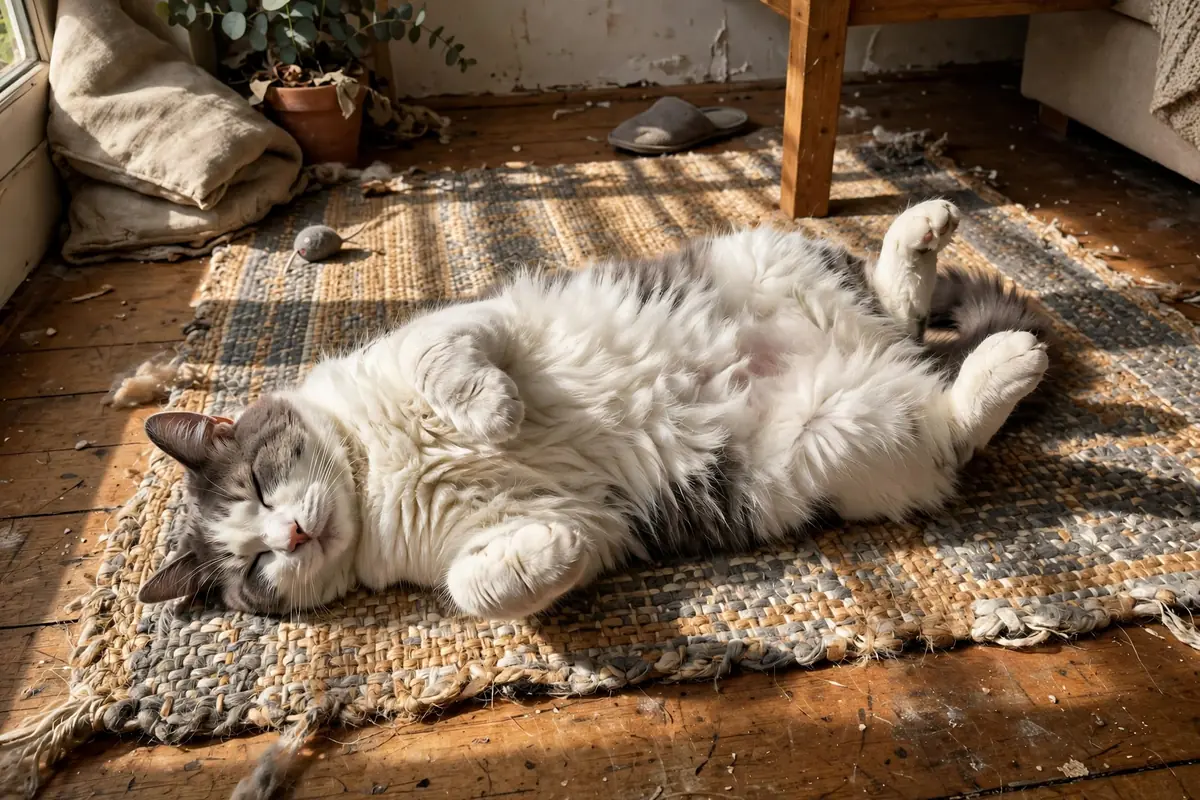
You walk through the door and your cat flops onto the floor, rolls onto its back, and shows you its belly. It looks like an invitation, so your hand moves toward it. Then the paws wrap around your wrist, the teeth close on your hand, and the back legs start kicking.
Most of the time, a cat showing its belly is a compliment: a sign of trust, comfort, and relaxation. It is almost never a request for a belly rub. Showing the belly is a message. Touching the belly is a different question, and for most cats the answer is no.
The information here is general information only and is not veterinary advice. If your cat shows sudden changes in behaviour, seems to be in pain, or has other worrying symptoms, contact your vet.
Key Takeaways
- A cat showing its belly is usually a sign of trust and comfort, not an invitation for a belly rub.
- The belly is the most vulnerable part of a cat: no ribcage protection, and vital organs just under the skin.
- Belly fur is thin and the skin underneath is very sensitive, so touch can quickly turn overwhelming.
- The grab, bite, and bunny kick after a belly rub is usually a defensive reflex or play, not anger.
- Read the whole cat first: soft eyes and a still tail point to trust, while flat ears and a lashing tail point to defence.
- Answer a belly show with a slow blink back, a chin scratch, or a wand toy, not a hand on the belly.
- Some cats do enjoy gentle belly touch. Test it with one finger for 2 seconds, and stop at the first sign of tension.
- A loose flap of skin on the lower belly is usually the primordial pouch, a normal part of cat anatomy, not proof of weight gain.
The Short Answer: Why Does My Cat Show Me Its Belly?
Your cat shows you its belly because it feels safe with you. A cat that rolls onto its back is exposing the softest, least protected part of its body, and a cat only does that when it is relaxed and comfortable. The roll is often a greeting, especially as you come home, or a way of cooling off, stretching, or asking for play. It can also be a defensive posture when a cat feels cornered.
The part owners get wrong is the next step. A belly on show is a visual message, not a request to be touched there. Answer it with a slow blink, a chin scratch, or a toy to chase, and the trust grows. Answer it with a hand on the belly, and you often get the classic belly trap.
Why the Belly Matters: Anatomy of a Vulnerable Spot
The chest is protected by a cage of ribs and a breastbone, which shield the heart and lungs. The belly has no such armour. Under the skin and fur of the abdomen sit the stomach, intestines, liver, spleen, and kidneys, with only muscle and skin between them and the outside world.
That is why cats guard their bellies so carefully. A threatened cat tucks its head toward its belly and curls tight, and a sleeping cat often curls into a ball with the belly hidden. Belly fur makes the area even more sensitive: the fur underneath is thinner, and the skin carries a dense set of nerve endings, so a light touch can feel intense.
The Trust Greeting, Decoded
The most common belly show is the trust greeting, also called the social roll. Your cat sees you, walks a few steps toward you, and flops onto its side or back with a loose, stretched out body. The paws are soft, the eyes are soft or half closed, and the cat may slow blink at you or purr quietly. A wary animal simply does not lie on its back in front of someone it does not trust.
The social roll often happens at greeting time: when you come home, when you walk into the kitchen in the morning, or when you settle down in the evening. It can become part of a daily routine, especially if your return is regularly followed by food, play, or gentle attention. Some cats roll for specific people only. The right answer is small: a slow blink back, and a scratch under the chin if your cat leans in for touch.
The Belly Trap: Why a Trusting Cat Still Grabs and Kicks
If the belly show is a sign of trust, why does touching the belly so often end in claws and teeth? Because trust and touch tolerance are two different things. Your cat can trust you completely and still not want its belly touched, because the belly is wired to react fast. Touch there can flip from pleasant to overwhelming in a second or two.
The sequence is familiar: your hand goes to the belly, the front paws wrap around your wrist, the teeth close on your hand, and the back legs start a fast kicking motion, known as the bunny kick. It takes about two seconds, and it feels like a betrayal. It is not. It is a reflex that protects the most vulnerable part of the body.
Overstimulation is the main driver. Cats have a threshold for touch, and belly skin crosses that threshold quickly because the fur is thin and the nerve endings are dense. The cat cannot say stop in words, so it says stop with its paws and teeth. Owners who miss the early warning signs, a flick of the tail, a ripple of skin along the back, ears turning back, pupils widening, get the bite instead. Play is the second driver: a cat that rolls over with bright eyes, wiggling paws, and a twitching tail may be inviting a game, and your hand becomes the prey. This is the same energy behind the sudden burst of running and pouncing in our guide on why cats get the zoomies. Fear is the third driver: a frightened, cornered cat may roll onto its back to free all four sets of claws and its teeth.
Trust, Play, Defence, Cooling, or Stretching? Read the Table
One posture can mean five different things, so the belly alone never tells the full story. The table below lines up the five common reasons, with the body cues that separate them.
| Reason | Body cues | What it usually means | Best response |
|---|---|---|---|
| Trust greeting | Soft eyes, slow blink, loose paws, still tail | I feel safe with you | Slow blink back, chin scratch |
| Play invitation | Bright eyes, wiggly paws, twitching tail | Play with me, chase something | Offer a wand toy, keep hands away |
| Defensive posture | Flat ears, wide pupils, tense body, lashing tail, claws out | I feel cornered, back off | Give space, do not touch |
| Cooling off | Stretched flat on a cool floor, slow breathing, half closed eyes | I am hot and the floor feels good | Leave the cat alone, offer water nearby |
| Stretching and comfort | Long stretch, arched back, legs extended, then settling down | That stretch felt good | Let the cat settle, no touch needed |
How to Read the Whole Cat Before You Touch
Start with the eyes and ears. A relaxed cat has soft eyes, often half closed, with pupils that are normal size for the light. A slow blink is a strong sign of comfort. Wide, round pupils in normal light, a hard stare, or eyes fixed on your hand are warning signs. Relaxed ears point forward. Ears turned sideways or pinned tight mean the cat is worried or ready to defend itself.
The tail is the third check, and it is often the clearest. A still tail, or a tail with a slow flick at the tip, belongs to a relaxed cat. A tail that is lashing, thumping, or puffed up belongs to a cat that is agitated or frightened. On a cat, fast tail movement is a warning, not a welcome. Then look at the paws: loose, soft paws with claws hidden belong to a trusting cat, while tense legs and claws already out belong to a cat that is ready to react. Skin rippling along the back often appears a second or two before the bite.
What to Do Instead of a Belly Rub
Most cats have a clear ranking of touch, and the belly sits at the bottom of it. The top of the list is the head, chin, cheeks, and the area behind the ears, where scent glands are concentrated. A scratch under the chin is almost always welcome from a trusted person.
A slow blink back is the simplest answer of all, and it works even when the cat does not want to be touched. Look at your cat, close your eyes slowly, hold them closed for a second, and open them again. Many cats will slow blink back. Play is the best answer when the roll is a play invitation: keep a wand toy near the places your cat likes to flop, and offer it when the paws start wiggling. A short play session of 5 to 10 minutes, ending with a small snack, is a good daily routine. Our cat name memes post is a lighter look at the same playful side of cats. When the cat is cooling off or stretching, the best response is no response.
How to Test Gently If Your Cat Is One of the Few Who Likes Belly Touch
A small number of cats genuinely enjoy belly rubs, and they make it obvious: they go limp when you touch the belly, they purr, and they lean into your hand. Most cats do not, and the only way to find out which group your cat is in is a careful, short test, done once, with a clear stop rule.
Wait for a calm moment when your cat is already relaxed and has shown its belly on its own. Do not roll the cat over, do not hold it down, and do not reach for the belly in play mode or defence mode. Touch with one finger only, on the side of the belly rather than the centre, for no more than 2 seconds, then stop and watch. If the cat stays loose or leans into the touch, try again another day. If the ears go back, the tail flicks, the skin ripples, or the cat grabs your hand, stop at once.
Never hold a cat down to rub its belly, and never keep going after the first warning sign. Holding a cat in place turns a mild irritation into fear. Keep sessions short even with a cat that likes belly touch: two or three gentle strokes, then stop while the cat is still happy. If your cat liked it once and dislikes it the next time, believe the latest answer.
Kittens Versus Adults: The Belly Show Changes With Age
Kittens roll onto their backs more often than adult cats, and usually for play. Kittens learn to hunt, fight, and defend themselves through play, and the belly up wrestling position is part of that practice. That is why hands should never be used as toys with kittens: when a kitten grabs your hand, freeze instead of pulling away, then offer a toy when it lets go. Adult cats are usually calmer and clearer in their signals, and older cats may show their bellies less often, because stiffness or aches make rolling over less comfortable. A senior cat that suddenly stops rolling, or cries out when its belly is touched, deserves a vet visit.
Multi Cat Homes and Strangers: When the Belly Means Something Else
The belly show changes meaning when another cat is in the room. Two cats that trust each other may roll and wrestle belly up as part of play. Two cats that do not trust each other may use the same posture as a warning. Watch the ears and tails of both cats, and separate them if the play turns tense.
Strangers get a different version of the belly show. Some cats roll for visitors they like, as a greeting and a sign that they feel safe. Others roll as a form of appeasement, which is closer to saying I am not a threat. The difference is in the rest of the body: a cat that rolls for a welcome visitor looks loose and relaxed, while a cat that rolls to appease a stranger often looks tense, with wide eyes and a body that is ready to move. Visitors should never reach for the belly of a cat they have just met. Children need the same rule: the belly is for looking, not for touching.
The Primordial Pouch: That Loose Flap on the Lower Belly
Many owners first notice the primordial pouch when their cat is lying on its back, because the loose flap of skin and fat along the lower belly hangs down and swings as the cat moves. It looks like a saggy belly, and owners often worry that it means the cat is overweight. In most cases it does not. The primordial pouch is a normal part of cat anatomy, present in all cats including wild cats such as lions and tigers, and it usually becomes noticeable at around 6 months of age.
The pouch is a flap of extra skin and some fatty tissue along the underside, hanging lowest near the back legs. Experts are not fully certain what it is for. The most commonly described functions are protection, flexibility, and food storage: the loose skin may cushion vital organs during fights, the extra skin may give the abdomen room to stretch when a cat sprints, and the fatty tissue may act as an energy store. PetMD notes that the purpose is not settled, so treat these as commonly described explanations, not proven facts.
Do not confuse the pouch with weight gain, and do not use it alone to judge body condition. A slim cat can have a very obvious pouch. Check weight by feeling the ribs gently and looking at the waist from above, or ask your vet to assess body condition. If the pouch changes suddenly, or feels hard or painful to touch, contact your vet.
When a Belly Show Plus Other Signs Needs a Vet
A belly show on its own is normal behaviour, and it is not a symptom. It becomes worth a vet visit when it comes with a sudden change, or with other signs that suggest pain or illness. The list below is a set of triggers for a vet check, not a diagnosis.
- A sudden change in how often your cat shows its belly.
- Pain when the belly is touched, such as crying out, flinching, or hissing.
- A belly that looks swollen or bloated, feels hard or tense, or has changed shape quickly.
- Lethargy, hiding, loss of appetite, vomiting, diarrhoea, or a fever.
- Excessive licking of the belly, or overgrooming that leaves bald patches.
- Difficulty moving, stiffness when rolling over, or a reluctance to jump or climb.
Do not try to diagnose the cause at home. A swollen belly can have many causes, and some need prompt attention. Note when the change started and whether eating, drinking, litter tray use, and energy levels are normal, and give that information to your vet. For general background, the ASPCA page on common cat behavior issues is a useful reference, and it is not a substitute for advice about your own cat.
Frequently Asked Questions
Why does my cat show me its belly and then bite me?
Showing the belly and wanting it touched are two different things. The belly show is usually trust, comfort, or play. The bite is usually overstimulation or a defensive reflex, and it means the touch became too much.
Does my cat want a belly rub when it rolls over?
Usually no. Most cats do not enjoy belly rubs, even when they trust you completely. A small number do, and they show it by staying loose, purring, and leaning into your hand. Test it with one finger for 2 seconds and stop at the first sign of tension.
Why does my cat show its belly when I come home?
It is often a greeting ritual. Your return is linked with food, play, and attention, so the cat has learned to mark the moment with a roll. Answer with a slow blink and a chin scratch.
Is it a good sign if my cat shows me its belly?
Yes, in most cases. A cat that lies on its back in front of you feels safe and relaxed. The only exception is the defensive posture: flat ears, wide pupils, tense body, lashing tail, which means the cat feels cornered.
Why does my cat show its belly to strangers?
Sometimes it is a friendly greeting, and sometimes it is appeasement, which is closer to saying I am not a threat. Loose and relaxed means friendly, tense with wide eyes means unsure. Visitors should never reach for the belly of a cat they have just met.
What is the saggy skin on my cat’s belly?
Usually the primordial pouch, a normal flap of loose skin and fat along the lower belly that all cats have. It is not proof of weight gain. Experts describe its functions as protection, flexibility, and food storage, but the purpose is not fully settled.
Should I punish my cat for biting when I rub its belly?
No. Punishment does not teach a cat to enjoy belly rubs, and it damages trust. Change your response instead: slow blink, chin scratch, or wand toy.
The Bottom Line
Your cat shows you its belly because it feels safe with you, and that is one of the best compliments a cat can give. It is not an invitation to rub the belly. The right answer is small: a slow blink back, a scratch under the chin, or a toy to chase. Read the whole cat before your hand moves.