
Why Are Cats Afraid of Cucumbers?
You have probably seen the video. A cat eats from its bowl, head down, relaxed. Someone places a cucumber on the floor behind it. The cat turns, sees the cucumber, and launches itself into the air, legs everywhere, before sprinting out of the room. It is funny for about three seconds. Then you notice the cat hit the wall, or knocked over a chair, and you wonder whether it was ever a joke at all.
It was not. Cats are not afraid of cucumbers as a food. They are afraid of a silent object appearing behind them in the one place they feel safe. This article explains what really happens in those videos, why the startle reflex fires, whether the snake theory holds up, why the prank can do lasting harm, and what to do if it has already happened to your cat.
The information here is general information only and is not veterinary advice. If your cat hides, stops eating, over grooms, or avoids the litter tray after a fright, contact your vet.
Key Takeaways
- Cats are not afraid of cucumbers as a food. Shown openly from the front, a cucumber gets sniffed or ignored.
- The reaction is a startle reflex: the cat jumps first and identifies the object afterwards.
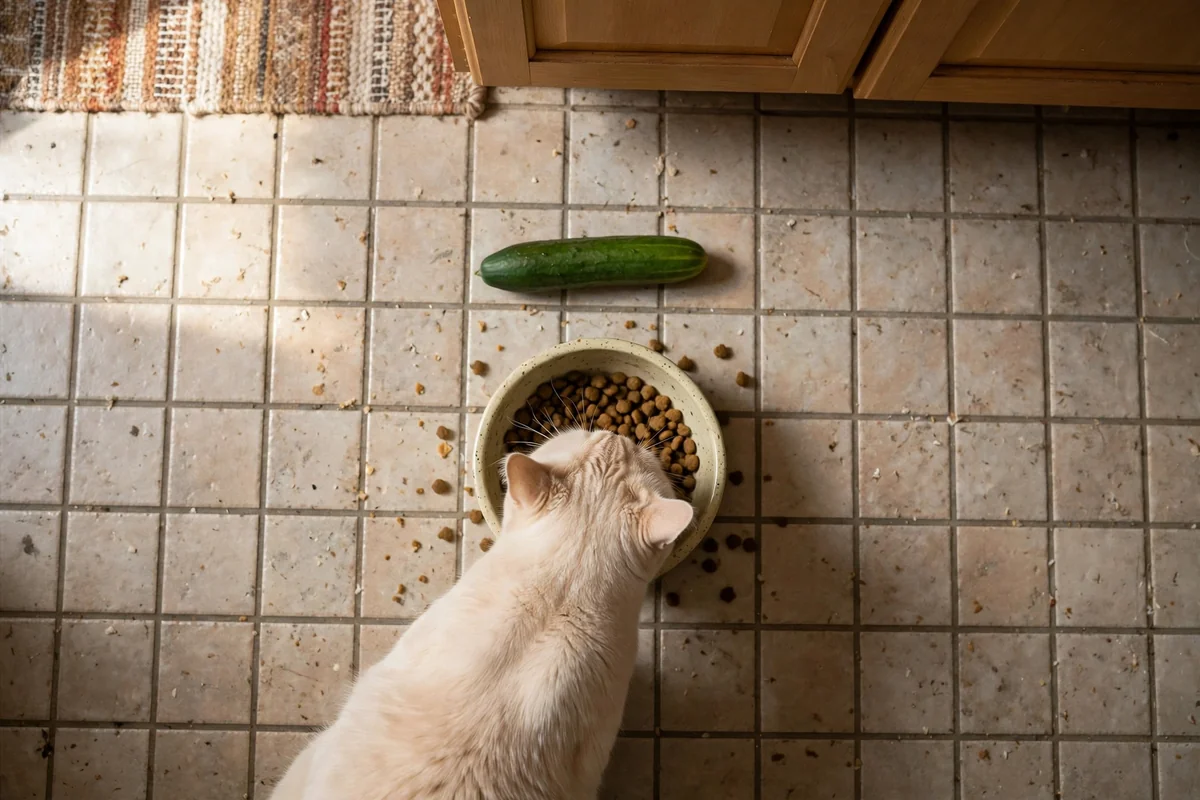
- The setup is always the same: the cat eats head down, the cucumber is placed silently behind it, and the cat turns to find an object that was not there seconds earlier.
- The snake theory is contested. Some experts call it plausible, but Cornell’s Pamela Perry says cats have no natural fear of snakes and many hunt them.
- No controlled study has tested whether cats categorise cucumbers as snakes. Saying so plainly is honest, and no ranking page does it.
- Every vet and behaviourist quoted discourages the prank. Risks include injury, lasting fear, and a cat that fears its owner.
- Cucumbers are safe to eat. The ASPCA lists cucumber as non toxic to cats, in small pieces as an occasional treat, never pickled.
- One scare can leave a lasting mark: a timid cat can link the fright to the food dish, the room, or the owner.
The Short Answer: Why Are Cats Afraid of Cucumbers?
Cats are not afraid of cucumbers. They are afraid of surprise. The viral videos all share the same setup: a cat eats with its head down, feeling safe, while someone silently places a cucumber behind it, out of sight. When the cat turns and finds a long green object that was not there seconds earlier, its startle reflex fires. The cat jumps first and works out what the object is afterwards, because jumping first is how a prey animal survives.
That is the whole trick. It is not the cucumber. It is the sudden appearance of a novel object in a place the cat treats as safe. A banana, a shoe, or a toy would do the same thing, and banana scare videos existed years before the cucumber ones. The snake theory, that cats mistake cucumbers for snakes, is possible but unproven, and one leading expert rejects it outright.
What Actually Happens in the Videos
The first viral clip was posted by YouTuber Doki Doki on 10 May 2015, and it passed 2.2 million views within six months. The clip spread to Reddit in July 2015, then to The Telegraph in October 2015, and National Geographic published an expert warning in November 2015. The pattern in every clip is identical.
- The cat eats or rests, head down, in a place it treats as safe, usually by its food bowl.
- A person places a cucumber on the floor behind the cat, silently, while the cat is not looking.
- The cat finishes eating, turns, and finds a long green object a few inches away that was not there a moment ago.
- The cat launches itself vertically, twists in the air, and bolts from the room.
Notice what the cat does not do. It does not sniff the cucumber, study it, or approach it. It reacts before it identifies the object, because that is what a startle reflex is. The jump is not a decision. It is a reflex, the same one that makes you flinch when something touches your neck unexpectedly. Our guide on why cats get the zoomies covers a different kind of sudden burst, but the same principle applies: a cat’s body reacts first, and its brain catches up later.
The Startle Reflex, Explained
Cats are both predator and prey, so they stay hypervigilant, even at home. A cat that is eating has its head down, its eyes on the bowl, and its guard lowered, which is only possible because it trusts the spot. A sudden change in that spot reads as a possible threat, and the body acts before the brain has time to check.
Cat vision helps explain the reaction. Cats see best at 6 to 20 feet and focus poorly up close, so a cucumber at their feet is a blurry shape until they sniff it. Their field of view is about 200 degrees, so they catch edge movement while the head is down. The cat sees a blur, at close range, where nothing was a moment ago, and the reflex fires. By the time the cat lands, it may already know the object is harmless, but the panic has already happened.
Not all cats react. Fearful cats react most, and confident cats often ignore the cucumber entirely. That matters, because the videos only show the cats that jumped. Nobody knows what share of tested cats reacted, because nobody filmed the ones that sniffed the cucumber and walked away. The videos lie by omission, and only one ranking page, PetMD, asks how many cats were filmed before the ones that jumped were found.
The Snake Theory: Does It Hold Up?
The most popular explanation is that cats mistake cucumbers for snakes. The shape is long, green, and low to the ground, and some snakes prey on cats, so jumping first and identifying later makes survival sense. Here is the honest state of the argument, with both sides.
| For the snake theory | Against the snake theory |
|---|---|
| National Geographic, Reader’s Digest, Daily Paws, Chewy, Purina, and Waggel present it as plausible | Cornell’s Pamela Perry says cats have no natural fear of snakes, and many hunt them |
| The shape is long, green, and low to the ground, like a snake | A cucumber sized snake would be no threat to an adult cat |
| Jump first and identify later makes survival sense | Katenna Jones showed her cat calmly inspecting cucumbers presented from the front |
| Some snakes prey on cats, so caution is sensible | No controlled study has tested whether cats categorise cucumbers as snakes |
The middle position, taken by Catster, The Vet Desk, and others, is that surprise is the main cause, and snake resemblance may add to the alarm for some cats, but it is unproven. This article leads with surprise, and presents the snake idea as contested, because that is what the evidence supports. Any page that states the snake theory as settled fact is overstating what is known.
Why the Feeding Spot Matters Most
The prank works best at the food bowl, and that is not an accident. Cats only eat when they feel safe. The feeding area is the one place in the house where a cat lowers its guard completely. A scare in that spot does more damage than a scare anywhere else, because it breaks the safety of the place the cat needs most.
There is a second problem, and only one ranking page mentions it. Food bowls are usually pushed against a wall, which traps the cat with no escape route behind it. The cat turns, sees the cucumber, and its escape route is blocked by the wall on one side and the strange object on the other. The panic is worse because the cat has nowhere to go. If your cat’s bowl is against a wall, move it out a little, so the cat always has an exit. That is good practice whether or not anyone has ever staged a prank.
Why the Prank Is Harmful, Not Funny
Every vet and behaviourist quoted in the ranking pages discourages the prank, and the reasons are concrete, not sentimental.
- Injury. A panicking cat crashes into furniture, slips on hard floors, knocks over objects, and can break a leg, tear a claw, or injure its spine. A cat that bolts can also scratch or bite a person who reaches for it.
- Lasting fear. One intense scare can create a lasting fear memory. A timid cat can link the fright to the food dish, the room, or the owner, and start avoiding all three. Repeated scares are linked to appetite change, hiding, over grooming, and litter tray avoidance.
- The owner becomes the feared object. Cornell mentions this in one line, and no ranking page gives it a full section. The cat may not fear the cucumber. It may fear the person who staged the prank, because the person was there when the frightening thing appeared. Trust, once broken, takes weeks to rebuild.
- Stress and health. Chronic stress is linked to a higher risk of illness in cats, and a fright that repeats can keep a cat in a stressed state. The exact link between a single scare and long term health needs a vet to confirm, but the direction is clear: scaring a cat for laughs is not harmless.
The expert verdict at the time was blunt. John Bradshaw, a leading cat behaviourist, called the videos despicable. Jill Goldman, an animal behaviourist quoted by National Geographic, said that causing stress for laughs made her question the maker’s humanity. The videos were popular. That does not make them kind.
Can Cats Eat Cucumber?
Yes, and this is the part the prank hides. Cucumbers are safe to eat. The ASPCA lists cucumber as non toxic to cats. A cucumber is about 95 percent water, and small pieces are fine as an occasional treat, washed and cut small. Never give pickled cucumber, because pickles contain salt, vinegar, and spices that do not suit a cat. Keep the amount small, because cats are obligate carnivores, and cucumber is a snack, not a meal.
Presented openly from the front, a cucumber gets sniffed or ignored. That is the control test the videos never show, and it proves the point better than any theory. The fear is not about the vegetable. It is about the surprise.
What to Do If It Already Happened to Your Cat
If someone in your household staged the prank, or your cat was startled by any sudden object, here is how to repair the damage. Only two ranking pages cover recovery steps, so this section is one of the most useful in the article.
- Do not repeat it, and do not laugh about it in front of the cat. The cat reads tone and body language, and laughter after a fright adds confusion.
- Keep the feeding spot unchanged. Do not move the bowl, change the food, or rearrange the room. Familiarity rebuilds safety.
- Rebuild positive links with treats. Place a treat near the bowl, then a little closer each day, so the feeding spot predicts good things again.
- Give escape routes. Move the bowl away from the wall, keep doors open, and make sure the cat always has two ways out of a room.
- Be patient. A confident cat may recover in days. A timid cat may need weeks. If the cat still avoids the bowl, hides, or stops eating after a week, contact your vet.
- Watch for body language changes. A scared cat shows dilated pupils, flattened ears, a puffed tail, a crouched body, freezing, hissing, or bolting. Our guide on why cats show their belly explains the trust signals on the other side: slow blinking, kneading, and a relaxed belly mean the cat feels safe again.
Scared Cat Body Language: A Quick Decoder
Learn to read a frightened cat, so you can spot fear early and stop it getting worse.
| Signal | What it means |
|---|---|
| Dilated pupils | High arousal, fear or excitement |
| Ears flattened sideways or back | Fear or aggression, wants the threat to stop |
| Tail puffed up, or tucked tight | Fear, trying to look bigger or smaller |
| Body crouched low, weight back | Ready to bolt, not relaxed |
| Freezing, then bolting | Startle reflex, fear response |
| Hissing or spitting | Warning, back off |
| Hiding, eating less, over grooming | Lasting stress after a fright |
Frequently Asked Questions
Do cats think cucumbers are snakes?
Possibly, but it is unproven. Some experts call it plausible, but Cornell’s Pamela Perry says cats have no natural fear of snakes and many hunt them. No controlled study has tested it. The main cause is surprise, not snake recognition.
Is it cruel to scare a cat with a cucumber?
Yes. Every vet and behaviourist quoted discourages it. Risks include injury from crashing into furniture, lasting fear linked to the food dish or the owner, appetite change, hiding, over grooming, and litter tray avoidance. It is not a harmless joke.
Can cats eat cucumber?
Yes. The ASPCA lists cucumber as non toxic to cats. Small washed pieces are fine as an occasional treat. Never give pickled cucumber, and keep the amount small, because cats are obligate carnivores.
Why do cats jump so high when startled?
The startle reflex fires before the brain identifies the threat. Cats are built for explosive movement, and a vertical jump puts distance between the cat and the threat in a fraction of a second. The exact jump height figures quoted on some pages are unsourced and should not be repeated as fact.
Why do some cats ignore cucumbers?
Confident cats often sniff a cucumber and walk away. Fearful cats react most. The videos only show the cats that jumped, so they give a false picture of how all cats react. Presentation matters too: a cucumber shown openly from the front gets a calm reaction, while one placed silently behind a feeding cat triggers panic.
What should I do if my cat is scared after a prank?
Do not repeat it. Keep the feeding spot unchanged, rebuild positive links with treats, give escape routes, and be patient. If the cat still avoids the bowl, hides, or stops eating after a week, contact your vet.
The Bottom Line
Cats are not afraid of cucumbers. They are afraid of a silent object appearing behind them in the one place they feel safe, and the startle reflex does the rest. The snake theory is possible but unproven, and no controlled study has tested it. The prank is not harmless: it can injure a cat, leave a lasting fear of the food dish or the owner, and break trust that takes weeks to rebuild. If you want to share a cucumber with your cat, wash it, cut it small, and offer it openly from the front. Your cat will sniff it, maybe eat it, and stay exactly where it is. That is the whole story, and it is a kinder one than the video.