
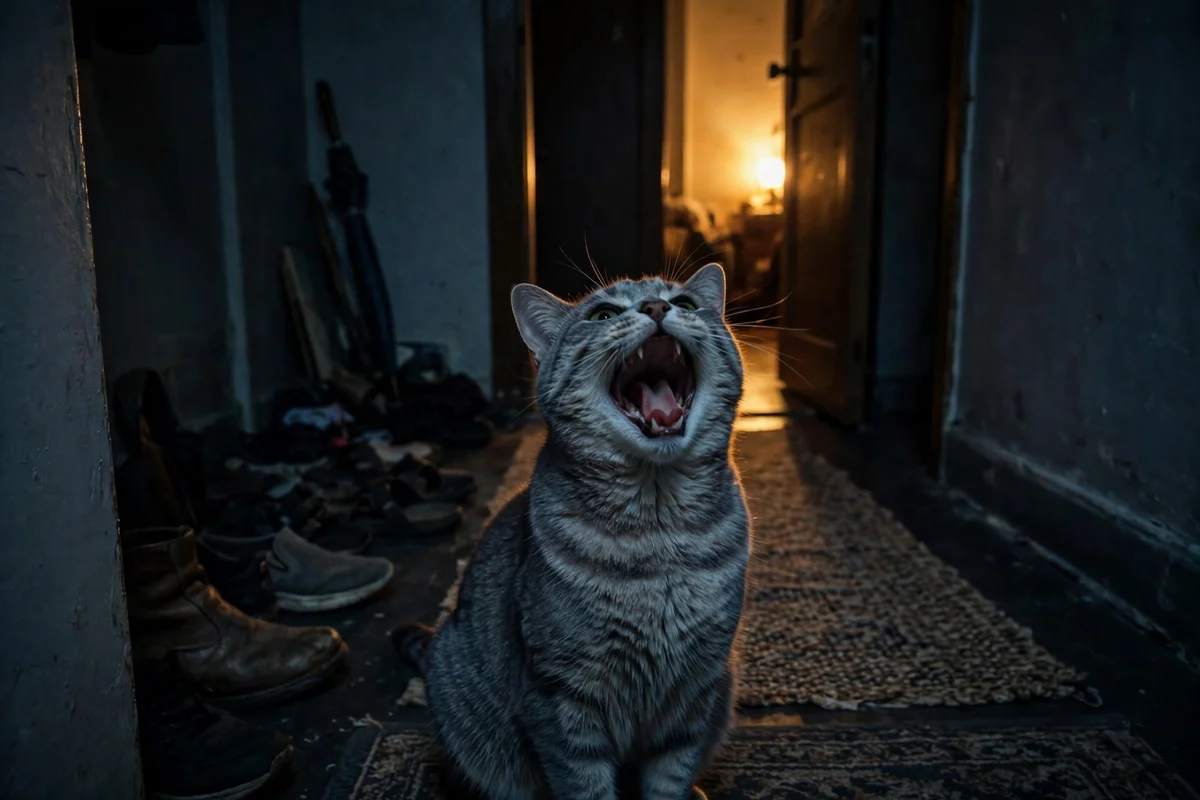
Why Does My Cat Yowl at Night?
Your cat yowls at 3am, and the sound fills a quiet house. It is loud, it is long, and it feels urgent. The short answer is that most night yowling in a young healthy cat comes from the cat being awake when you are asleep, plus hunger, boredom, or a habit you rewarded without meaning to. In a senior cat, or when the yowling is new, the first step is different: rule out a medical cause with your vet before you try any behaviour fix.
Cats are not nocturnal. They are crepuscular, which means they are most active around dawn and dusk. That is why the worst hour is often 3am to 5am, when the cat hits its morning peak and the house is still dark. This guide explains what a yowl is, what to check in the first five minutes at 2am, when it is an emergency, the causes by age, and a seven night reset that actually works.
The information here is general information only and is not veterinary advice. If your cat has suddenly started yowling at night, or the yowling comes with weight loss, thirst, vomiting, or any change in eating or litter habits, contact your vet. A vet check comes first for senior cats and for any sudden change.
Key Takeaways
- Cats are crepuscular, most active at dawn and dusk, so night yowling often peaks between 3am and 5am.
- In a young healthy cat, the usual causes are activity rhythm, hunger, boredom, and learned attention seeking.
- In a cat aged 10 or older, or when yowling is new, a vet check comes first. Hyperthyroidism, kidney disease, high blood pressure, pain, and cognitive dysfunction all cause night vocalizing.
- Never ignore sudden yowling until you have checked safety and health. Ignore only a known attention pattern, after the checks are done.
- Play before bed, then a meal, then sleep, works better than playing at 3am. When you stop rewarding yowling, it often gets louder for two or three nights first, which is called an extinction burst.
- Call an emergency vet at once for straining to urinate with little or no urine, back legs that suddenly drag, a seizure, open mouth breathing, or sudden blindness.
What a Yowl Is, and How It Differs From a Meow
A meow is a short call, usually aimed at a person, and usually asking for something specific. A yowl is longer, louder, and more drawn out. It carries further, and it is used over distance or under strong motivation. When a cat yowls at a closed door, at a window, or from another room, it is calling across a distance, and the volume is part of the message.
Caterwauling is the territorial form of yowling, the long wailing call an unneutered cat makes during mating season or when warning another cat away. If your cat is intact and the yowling comes with restlessness, spraying, or a raised hindquarters posture in a female, mating is a likely cause, and spaying or neutering is the fix.
The sound alone cannot tell you the cause. The pattern around it can: what time it happens, where the cat is, what happened just before, what stops it, and whether it is new.
The 2am Check: Five Minutes Before You Ignore Anything
When your cat wakes you at 2am, do not start by ignoring it, and do not start by feeding it. Run this check first. It takes about five minutes, and it separates a safety problem from a habit.
- Check breathing. Fast breathing or open mouth breathing at rest is an emergency sign.
- Check movement. Back legs that drag, feel cold, or look pale are an emergency.
- Check the litter box. Can your cat reach it, is it clean, and is your cat straining with little or no urine. Straining to urinate, especially in a male cat, can kill in less than a day or two.
- Check food and water. Is the water bowl full, is there food, and has your cat eaten today. A cat that has eaten nothing for a full day needs a vet the same day.
- Check eyes and orientation. Very large pupils, bumping into things, or seeming lost in a familiar room needs urgent vet care.
- Check for pain. Does your cat cry when touched, hide, or refuse to move. Cats rarely limp clearly even with arthritis, so pain is easy to miss.
If any check fails, call your vet or an emergency vet now. If all checks pass, you are dealing with a behaviour or routine problem, or a medical problem that still needs a vet visit in the next few days.
Emergency Triage: When to Act Now, Today, or Within Days
| Timing | Signs | Action |
|---|---|---|
| Emergency vet now | Straining to urinate with little or no urine, especially in a male cat | Emergency vet at once |
| Emergency vet now | Back legs suddenly drag, go cold or pale, or cannot move; seizure, circling, head tilt, or collapse | Emergency vet at once |
| Emergency vet now | Open mouth or fast breathing at rest; sudden blindness, very large pupils, blood in the eye, or bumping into things | Emergency vet at once |
| Emergency vet now | Eating lilies, human medicines, or dog flea products | Emergency vet at once |
| Vet the same day | Not eating for a full day, repeated vomiting, hiding, crying when touched, or sudden disorientation over hours | Vet the same day |
| Vet within a few days | New night yowling in a cat aged 10 or older; yowling plus weight loss, big appetite, or extra thirst | Vet within a few days |
This table is adapted from RexVet and WebVet, the only ranking pages that give a time based split. If you are unsure which row fits, treat it as the more urgent one and call your vet.
Causes by Age: Kitten, Healthy Adult, Senior
| Age group | Most likely causes | First action |
|---|---|---|
| Kitten under 1 year | Loneliness, cold, hunger, a new home, need for warmth and company | Warm bed, soft toy, small meal before lights off, keep the kitten near you at night |
| Healthy adult, 1 to 9 years | Crepuscular rhythm, hunger, boredom, learned attention, territory, mating if intact | Evening play then a meal, timed feeder, enrichment, consistent response |
| Senior, 10 years or older | Hyperthyroidism, kidney disease, high blood pressure, pain and arthritis, cognitive dysfunction, deafness, vision loss | Vet check first, blood work, thyroid test, blood pressure, eye exam |
The senior line is age 10 in the formal guidance from Cornell and the American Association of Feline Practitioners, as cited by RexVet. Some newer guides put the medical first line at about age 7. Treat new night yowling from about age 7 onward as medical first.
The Crepuscular Rhythm: Why Night Is the Worst Time
Cats are crepuscular, most active around dawn and dusk. Purina, Rover, WebVet, Cats.com, and Hills all use this word, and it matters, because the common belief is that cats are nocturnal. They are not. They are dawn and dusk hunters, and a pet cat keeps that rhythm even in a flat with no hunting to do.
That is why the worst hour is often 3am to 5am. The cat is hitting its morning activity peak while the household is asleep. Our guide on why cats get the zoomies explains the same dawn and dusk energy burst. The fix is to move the active peak earlier, with a focused play session in the evening ending with a meal. Playing at 3am teaches the cat that 3am is playtime, which is the opposite of what you want.
Hunger, Boredom, and Feeding Timing
Hunger appears on every ranking list, and it is real, but it is easy to get wrong. A cat that yowls at 5am and eats at once is probably hungry, or has learned that 5am is breakfast time. A cat that yowls at 2am, eats a few bites, and yowls again is probably not hungry. It is bored, or it has learned that yowling brings a person.
Chewy advises an automatic feeder on a timer, so the cat stops linking the owner with food. WebVet and SpectrumCare are stricter: shift part of the normal daily ration later, or use a measured timed meal, and keep total daily calories stable. Purina advises leaving dry food out before bed, but that free feeding advice needs a calorie warning, and a timed feeder is the safer version of the same idea. Our guide on the best cat food explains what a balanced daily ration looks like in practice.
New hunger plus weight loss is a different matter. A cat that eats more yet loses weight, drinks more, and yowls at night may have hyperthyroidism or diabetes, not a feeding schedule problem. That is a vet check, not a feeder problem. Boredom is listed by Rover, Purina, Chewy, Cats.com, Catster, WebVet, and SpectrumCare. An indoor cat with no hunting or climbing will use the night to make its own fun. The fix is daytime enrichment, not night time attention: rotating toys, puzzle feeders, climbing, and window watching.
Attention, Learned Behaviour, and Loneliness
This is the most repeated behavioural cause in the ranking pages, and the one owners create by accident. VCA states it most strongly: many owners unintentionally reward vocalization with food, attention, play, or access, and even a few rewarded episodes can keep the behaviour going. A cat whose 6am wake up call crept earlier to 3am, because the system worked, is a classic example given by Chewy. Any response can be a reward: a glance, a scold, a shoo, a sigh, getting up to check, or a treat to buy quiet all teach the cat that yowling works.
Loneliness sits beside attention. Rover calls separation anxiety the most common form of anxiety in pets, citing Dr Katherine Pankratz. A closed bedroom door is a common trigger, and a cat that yowls when left alone, then purrs and stretches extra hard when the owner returns, may be anxious rather than demanding. Chewy advises practising alone time during the day, rather than introducing a closed door only at night. Grief is a real trigger that almost no ranking page covers: a cat that loses a companion pet may call for hours for a companion that is no longer there.
Territory, Stress, Mating, and the Litter Box
Territorial yowling is listed by Rover, Hepper, WebVet, and SpectrumCare. The triggers are a new pet inside the home, a strange cat seen through a window, and sounds or smells from outside. A cat that yowls at a window at 2am, with its tail lashing and its body tense, is probably answering an outdoor cat, not asking for food. Close the blinds, block visual access, use white noise, and add a retreat. Pheromone products are suggested by Rover and others, but the evidence for them is presented as mixed, not proven.
Stress and household change cause the same pattern. A move, a new pet, a schedule change, or an unfamiliar noise can all start night yowling in a cat that was quiet before. Mating is listed by every general page for intact cats. A female can come into heat as early as 4 months of age, according to Rover, and indoor cats can come into heat year round, according to Hills citing the ASPCA. The fix is spaying or neutering. Hepper adds the honest caveat that mating behaviour can persist for weeks to even years after neutering in males that had experience before surgery, though only a small percentage continue.
The litter box check is buried low in most ranking pages, and it deserves more weight. A dirty box, a box that is hard to enter, a box guarded by another pet, a closed door, or an empty water bowl can all prompt calling at night. Chewy notes that an older cat may struggle to step into a high sided box. In a multi cat home, the fix is a second set of resources in a different place.
Medical Causes in Senior Cats
In a senior cat, or when yowling is new, the ranking pages agree: rule out medical causes first. Purina, Rover, VCA, Chewy, Cornell, Cats.com, Catster, Hills, RexVet, Hepper, WebVet, and SpectrumCare all say this.
Hyperthyroidism
This is the most consistently named medical cause. The sign cluster is restlessness, night vocalization, weight loss despite a good appetite, increased thirst and urination, vomiting or diarrhoea, an unkempt coat, and a racing heart. RexVet calls it the most common hormone disease in older cats, and cites FDA and AAFP senior care guidelines for the figure that about 1 in 10 cats over age 10 has it. Treatment is daily medicine, prescription diet, surgery, or radioactive iodine, started only after blood work confirms the diagnosis.
Kidney disease
The shared cluster is increased thirst, frequent urination, weight loss, reduced appetite, low energy, and poor grooming. Kidney disease is not curable, but progression can be slowed with a low phosphorus wet food diet, plenty of water, and regular vet visits, according to Rover. Hepper notes honestly that the exact mechanism linking kidney disease to vocalization is unclear.
High blood pressure and sudden blindness
High blood pressure is listed by Cornell, RexVet, Hepper, Catster, Cats.com, WebVet, and SpectrumCare, and Cornell links it to retinal detachment and blindness. RexVet, citing ACVIM guidelines from 2018, says a systolic reading of 160 to 179 is moderate risk, and 180 or higher is severe, and a yearly blood pressure check from about age 9 is described as reasonable.
Pain and arthritis
RexVet, citing AAFP senior care guidelines, says joint disease affects up to 74 percent of cats aged 12 or older, and warns that cats with arthritis rarely limp, so pain is easy to miss. Dental disease and abscesses are hidden sources of pain, because a cat can be in pain and still eat and jump. Never give a human pain reliever to a cat. Acetaminophen can damage the liver and red blood cells of cats, according to RexVet.
Cognitive dysfunction
Cornell says signs tend to become clearly noticeable in cats 10 years of age or older, and lists disorientation, wandering, altered sleep and wake cycles, long staring, house soiling, and seemingly unprompted episodes of loud vocalizing, frequently in the middle of the night. RexVet cites an owner survey of 154 cats aged 11 to 21, reported in Landsberg and colleagues in 2010, with about 28 percent of cats aged 11 to 14 and half of cats over 15 showing age related behaviour changes. It is a diagnosis of exclusion: high blood pressure, an overactive thyroid, FIV, and toxoplasmosis can cause identical changes, according to Cerna, Gunn-Moore and colleagues from 2020, a study of 37 cats in which crying split about evenly between mostly at night, mostly by day, or both.
Deafness, vision loss, and diabetes
Chewy notes that an older cat that loses hearing may vocalize louder because it cannot gauge its own volume. RexVet explains that in a dark quiet house a cat has fewer cues about where it is, so calling out may be how it finds the owner. Night lights and keeping resources in the same place help. Diabetes is covered only briefly by RexVet: thirst, hunger, weight loss, and night restlessness together deserve a vet check within days. Our guide on how old your cat is in human years helps you judge whether your cat is a senior, and whether the medical first rule applies.
The Seven Night Reset
WebVet proposes a seven night reset, and Carelogy in search results says to allow two to three weeks for a learned habit to fade. Seven nights is the test period; two to three weeks is the realistic period for the habit to change.
| Night | What to do | What to watch |
|---|---|---|
| Night 1 | Run the 2am check, clean the litter box before bed, fill water, close blinds if outdoor cats are a trigger | Time, place, and duration of each episode |
| Night 2 | Add an evening play session ending with a meal, then no play at night | Does the first episode start later than before |
| Night 3 | Set a timed feeder for a small early morning meal, from the normal daily ration | Does the 5am yowl stop when the feeder, not you, delivers food |
| Night 5 | Keep the response consistent, wait for a pause, then give attention, never during yowling | Does the cat pause sooner |
| Night 7 | Review the log, compare night 1 with night 7, decide whether to call the vet | Shorter episodes, later start, or no change at all |
Keep a short log through the reset: time, place, duration, and what stopped each episode, plus a phone video of one episode for your vet. The play dose is not agreed on by the ranking pages. The range runs from 5 to 10 minutes of hard play, to 10 to 15 minutes a day, to 15 to 20 minutes two hours before bed. A focused evening session that ends with a meal, plus daytime enrichment, and a log to judge whether episodes start later or end sooner, is more honest than presenting one number as proven.
Ignore Versus Respond: The Qualified Rule
The simple slogan is ignore it. The detailed rule in the better pages is check first, then ignore only a known attention pattern. WebVet states it best: ignore demand meowing only after checking safety and health, never instead of checking. SpectrumCare says the same: not until medical problems have been considered, and sudden or worsening yowling should not be ignored.
VCA is the outlier on strictness, saying under no situation should the owner go to the cat if it vocalizes. Purina, WebVet, SpectrumCare, RexVet, and Chewy all qualify this: check needs and health first, ignore only a known attention pattern, and reassure a confused senior. Chewy even allows a low level response, from Dr Ellen Lindell: decide on a low level that you will answer, and stop answering above that level. Reward quiet, not noise, on a predictable schedule when the cat is calm.
The extinction burst
VCA is the only ranking page to name this clearly. When reinforcement stops, the behaviour may at first become more intense as the cat tries harder to get the reward. This is called an extinction burst. Owners often give up on night two or three, exactly when the burst peaks, and then teach the cat that louder works.
The Senior Night Kit and What Not to Do
No ranking page gives a senior home setup checklist in one place. RexVet comes closest. Here is the kit: night lights where the cat sleeps; food, water, and litter kept where they have always been; an extra set on the floor where the cat sleeps if stairs are hard; a low sided litter box; a warm bed and ramps to places the cat wants to reach; a smaller quiet room at night with everything the cat needs.
- Do not punish, spray, yell at, or frighten a cat for vocalizing. VCA, WebVet, RexVet, and SpectrumCare all agree, and Carelogy notes that scolding is interpreted as attention and can intensify the behaviour.
- Do not use a water gun, compressed air, or an ultrasonic alarm. VCA allows these as remote punishment, but WebVet, RexVet, SpectrumCare, and Carelogy reject them.
- Do not shut a confused senior cat out of the bedroom. A healthy young cat that has learned to demand attention is different from a disoriented senior calling for orientation.
- Do not start human sleep aids, pain relievers, or behaviour medications on your own. Never give melatonin, Benadryl, or any human sleep aid without vet approval, and never give a human pain reliever to a cat.
- Do not present CBD as a consensus fix. Rover suggests it, but no other ranking page mentions it, and evidence in cats is limited. Ask your vet first.
- Do not feed at 3am to buy quiet. A cat fed after yowling learns the behaviour pays, and the wake up call creeps earlier.
Frequently Asked Questions
Why does my cat yowl at 3am?
3am is close to the dawn activity peak for a crepuscular cat, and the house is quiet, so the sound feels louder. Hunger, boredom, a learned habit, or an outdoor cat at the window are the usual causes in a young cat. In a senior cat, or when it is new, a vet check comes first.
Should I ignore my cat yowling at night?
Only after the 2am check, and only for a known attention pattern. Check breathing, movement, litter access, food, water, eyes, and pain first. If all checks pass and the pattern is a learned demand, ignore it totally, reward quiet, and expect two or three louder nights first. Never ignore sudden yowling, yowling in a senior cat, or yowling with any other change, without a vet check.
The Bottom Line
Most night yowling in a young healthy cat is a rhythm, hunger, boredom, or learned habit problem, and the fix is an evening play session, a meal, a timed feeder, and a consistent response. In a senior cat, or when the yowling is new, the fix starts at the vet. Run the 2am check, keep a short log, give the seven night reset a real try, and expect two or three louder nights before a learned habit fades.