
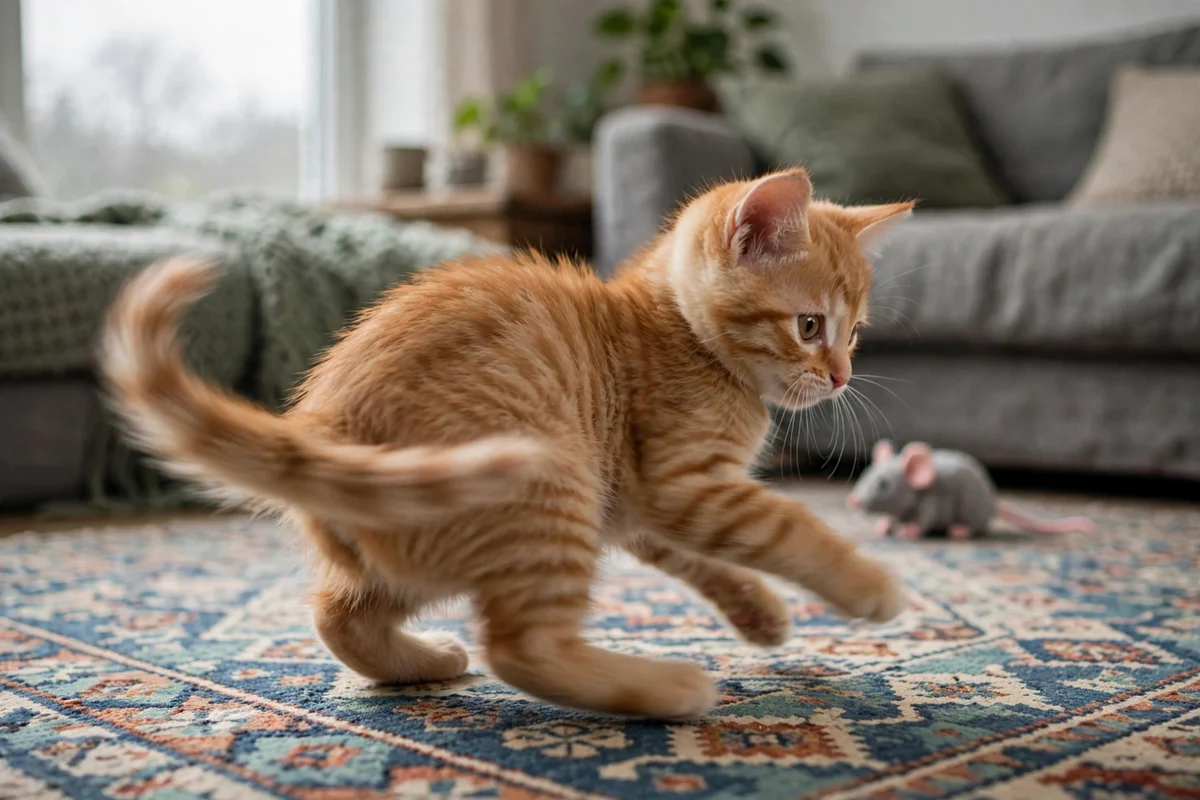
Why Do Cats Chase Their Tails?
Your cat spins in a circle, chasing its own tail, and you wonder whether it is funny or a problem. The short answer has three parts. A kitten that chases its tail briefly in play is normal. An adult cat that chases occasionally is most often bored, stressed, or looking for attention. An adult cat that suddenly starts chasing, chases every day, or bites its tail needs a vet check, because fleas, allergies, pain, anal gland problems, and feline hyperesthesia syndrome can all look like tail chasing.
Tail chasing is one of the most misunderstood cat behaviours, because the same spin can mean four different things: a kitten practising its hunting moves, a bored indoor cat with too much energy, a cat with an itch it cannot reach, and a cat with a neurological problem. The spin looks the same. The timing, the frequency, and what happens after are what tell them apart. This guide gives you the red flag checklist first, so you can triage in thirty seconds, then each cause with its specific signs, a flea check you can do at home, a one week diary, and a plan for a bored cat.
The information here is general information only and is not veterinary advice. If your cat suddenly starts chasing its tail, bites it until it bleeds, or shows skin rippling or distress, contact your vet.
Key Takeaways
- Brief playful tail chasing in a kitten is normal, and most kittens outgrow it.
- Occasional adult tail chasing is most often boredom, excess energy, stress, or attention seeking.
- Sudden onset in an adult cat, daily or obsessive chasing, biting, wounds, or distress needs a vet visit.
- Fleas are the most cited medical cause. Adult fleas favour the base of the tail, so a cat chasing its tail may be trying to reach an itch.
- Feline hyperesthesia syndrome causes skin rippling along the lower back, sudden startle, frantic tail biting, and episodes lasting a few seconds to a few minutes.
- Do not punish tail chasing, and do not use a laser pointer as a test.
- Ignore the spin, and reward calm play at scheduled times. The two are different, and both matter.
The Red Flag Checklist: Thirty Seconds to Triage
Pets4Homes provides the clearest summary table in the ranking set, and Cats.com makes the same point in prose. Here is the checklist, adapted from both, with the three way split no ranking page states cleanly.
| Pattern | What it looks like | Action |
|---|---|---|
| Normal play | Occasional, brief, playful chasing in a kitten or young cat, stops easily with a toy, no biting, no wounds | No vet visit needed, add play |
| Bored adult | Occasional chasing in an adult cat, more when under stimulated, stops with enrichment | Add play, puzzle feeders, climbing space |
| Vet visit | Sudden onset in an adult cat, daily or frequent chasing, chasing that lasts more than a minute or two a couple of times a day | Book a vet exam |
| Vet visit soon | Biting, chewing, or attacking the tail, wounds, hair loss, swelling, redness, scabs, or discharge | Book a vet exam, do not wait |
| Urgent vet visit | Skin rippling, dilated pupils, drooling, vocalising, running in panic, aggression when touched, hiding, appetite change | Vet the same day if possible |
The disagreement in the ranking pages is worth stating plainly. Cats.com is the strictest: tail chasing is not normal behaviour for adult cats. Pets4Homes is the most permissive: occasional adult chasing is boredom or play. Cats Protection says adult cats may still chase occasionally and this is completely normal. The three way split in the table resolves it: a playful adult that has always chased briefly is different from a bored adult, and both are different from an adult with sudden onset, frequent chasing, or biting.
Chase, Catch, Bite, and Lick Are Not the Same Thing
The ranking pages use chase, attack, bite, chew, lick, and groom interchangeably. No page defines them separately, or gives a different action for each. Here is the distinction.
| Behaviour | What it looks like | What it usually means |
|---|---|---|
| Chase | Pursuit without contact, spinning after a moving tail | Play, boredom, or hunting practice |
| Catch and mouth | Brief contact in play, no wound, no repetition | Play, usually harmless |
| Bite | Repeated hard contact that can break skin or remove fur | Itch, pain, allergy, fleas, or a compulsive pattern |
| Lick and overgroom | Repeated licking of the tail base or flank, sometimes to baldness | Skin irritation, pain, stress, or allergy |
The Vet Desk is the strictest on biting: biting the tail is almost always a sign something is not quite right, because it hurts and the cat will usually only do it to address itch, allergy, flea irritation, or a painful wound, or as a stress coping habit. Draw the line here: a brief mouthing during play, with no wound and no repetition, is different from repeated biting, chewing, or attacking that breaks skin or removes fur.
Why Kittens Chase Their Tails
Every ranking page agrees on this core point. Kittens chase their tails as play, as exploration, and as hunting practice. They stalk, pounce, wrestle siblings, and chase anything that moves. The tail is a convenient moving target that is always present.
The mechanism is consistent: cats are wired to react to sudden movement, especially in peripheral vision and in low light. A twitch or flick can trigger a chase before the cat has identified the object. Pets4Homes puts this most clearly, noting that cat vision is tuned to movement more than to still objects. Most pages say kittens usually outgrow the behaviour. Cats.com says it usually fades into adulthood, and The Vet Desk says most cats outgrow it. Whether a cat mistakes its tail for prey is not known. Cats Protection says a cat might mistake it for prey or a toy. The Discerning Cat says most cats are probably very aware that their tails belong to them. The honest position is that the internal experience is not known, and the observable mechanism is movement triggering a chase.
Boredom, Stress, and Attention
Boredom is the second most cited benign cause, and the main explanation offered for adult cats that still chase. Cats.com frames it as under stimulation in indoor cats, especially medium to high energy cats with no outlet for hunting behaviour. Rover names Abyssinians, Siamese, Bengals, and Oriental Shorthairs as especially playful and high energy breeds that can become bored without enough play. Pets4Homes links it to cats sleeping long hours and then releasing energy in short intense bursts.
The shared advice is consistent: redirect to wand toys, puzzle feeders, climbing space, hiding food, and scheduled play. CatWiki is the most specific, recommending four ten minute play sessions a day, citing PetMD for that playtime figure. Our guide on why cats get the zoomies covers the same boredom and night time energy from another angle, including the mad moments with dilated pupils and dashing around the house that Cats.com links to tail chasing.
Stress is treated as both a trigger and a maintainer of tail chasing. Triggers include moving house, new household members or pets, guests, storms, changes in routine, inter cat disputes, and being left alone for long periods. VCA gives it a formal name, displacement behaviour, meaning a normal behaviour shown out of context when a cat is in conflict or highly aroused. Rover, Cats.com, and The Discerning Cat all warn against scolding or punishment, because it adds stress and can make the behaviour worse.
Attention seeking is a smaller but real cause. Pets4Homes, MyWaggle, CatWiki, and Stuff Cats Want all say cats learn that tail chasing gets a reaction. If laughing, talking, approaching, or offering play follows the spin, the cat may repeat it to get attention. Do not react in the moment, and redirect to a toy or a scheduled play session instead.
Fleas, Allergies, and Skin Irritation
Fleas are the most cited medical cause. The detail is consistent: adult fleas favour the base of the tail, so a cat that seems to chase its tail may in fact be trying to reach an itch at the tail base. Associated signs include frequent scratching, restlessness, hair loss, crusting and scabbing, skin redness, flea dirt, and visible fleas. Rover adds mites as a separate parasite cause. The Vet Desk adds that flea saliva allergy can be the driver, not just the bite itself.
Allergies are the next most cited skin cause. Food, environmental, and contact allergies are all named by Rover, Cats.com, CatWiki, and The Vet Desk. Signs include itchy skin, hair loss, reddened or flaking skin, ear infections, vomiting or bowel changes, overgrooming, and inflamed skin. Cats.com advises a vet visit if the cat has suddenly started chasing and itching its tail with inflamed skin.
The flea check you can do at home
No ranking page gives a practical flea check, even though fleas are the top medical cause. Part the fur at the tail base and look for small dark specks that look like coffee grounds. That is flea dirt, which is flea droppings. Check the lower back, the belly, and behind the ears, and check other pets and the bedding. If you find flea dirt, wet it: flea dirt turns reddish brown, because it contains blood, while ordinary dirt does not. If fleas are found, treat all pets in the home, wash bedding on a hot cycle, and vacuum the places the cat sleeps. Ask your vet which flea treatment is safe for your cat, and never use a dog flea product on a cat.
Pain, Injury, and Infection of the Tail
A cat in pain will focus on the painful area by licking, biting, scratching, or chasing it. Causes named include tail injury, bite wounds from another cat, abscess, infection, swelling and discharge, arthritis in older cats, and spinal pain. Signs of pain include dilated pupils, pinned back ears, fur standing on end, hissing or growling while chasing, crying, hiding, and aggression when touched. If your cat has a tail wound from biting, check for bleeding, swelling, and discharge, keep the wound clean, and go to the vet the same day if it is deep, swollen, or not healing. A vet may use an Elizabethan collar to prevent further damage while it heals.
Anal Glands and Stud Tail: Real Causes, Often Overstated
Cats have two anal sacs near the rear that release scented fluid used in marking after toileting. When the sacs become clogged, impacted, or infected, the cat feels pain near the rear and may chase its tail to reach the discomfort. CatWiki, Catster, The Discerning Cat, MyWaggle, and PetsRadar all cover it. Catster adds scooting across the floor and a visibly swollen area. PetsRadar adds that cats have anal gland problems far less often than dogs, and that overweight or less limber cats are more at risk. Rover, Cats.com, Pets4Homes, Petcube, and Cats Protection do not list anal glands at all. Include anal glands, with the rarity note and the scooting sign, rather than listing it as equally likely as fleas.
Stud tail is overactivity of the sebaceous glands at the base of the tail, leading to waxy build up, matted or greasy fur, black specks, itchy bumps, swelling, and sometimes secondary infection. It is compared to chin acne by Rover and CatWiki. The agreed risk group is intact males, especially young males going through puberty. Cats.com says treatment is removal of excess sebum with antibacterial wash in mild cases, and antibiotic therapy where infection is extensive. Catster calls it relatively rare, while CatWiki and Cats.com present it as a standard reason. The safe synthesis is: uncommon, concentrated in intact young males, and not a first explanation for a spayed female or a neutered adult.
Feline Hyperesthesia Syndrome
Every detailed page includes feline hyperesthesia syndrome, often shortened to FHS, and the sign list is stable: rippling skin along the lower back, especially near the tail base; sudden startle, dilated pupils, and agitation; frantic licking, biting, or attacking the tail, flank, or back; running away as if escaping something; sensitivity to touch; episodes that start and end suddenly, with normal behaviour between them.
Cornell is the clearest authority anchor. It says hyperesthesia is extreme sensitivity in an area of skin, almost always on the back and often right in front of the tail, and that some affected cats may chase their own tails. Diagnosis requires ruling out pain causes such as spinal arthritis and skin problems including parasites, allergies, and fungal infections. Cats.com adds that episodes typically occur at dawn or dusk, range from a few seconds to a few minutes, and vary in frequency, and that FHS is not curable but may be managed with medication and behavioural change. The first episode usually appears between ages 1 and 5, with males and females equally affected, and Persian, Siamese, Abyssinian, and Burmese are listed as genetically predisposed. Cornell says Siamese cats seem to have a genetic predisposition.
What FHS actually is remains uncertain, and the better pages say so. Cornell presents both views: some veterinarians feel FHS is related to obsessive compulsive disorders, while Dr Alexander de Lahunta, emeritus professor at Cornell and a pioneer in veterinary neurology, feels it could be a seizure type problem. Cats.com lists four theories: a form of epilepsy, a form of OCD, an underlying genetic disorder, and a symptom of sudden spinal or tail pain. The Discerning Cat collapses this to a single claim, saying FHS is essentially cat obsessive compulsive disorder. That is an oversimplification and should not be repeated. Present FHS as a syndrome with an unknown cause, diagnosed by exclusion. The evidence base is thin: Cats.com cites Batle, Rusbridge, Nuttall, Heath, and Marioni-Henry from 2018, a retrospective study of seven cases. There are currently no FDA approved medications specifically for FHS. All medication decisions belong to the examining vet.
Compulsive Behaviour
The definition is consistent across Cats.com, VCA, Rover, CatWiki, and The Discerning Cat: a normal behaviour performed repetitively, out of context, and in a way that is hard to interrupt, often triggered by stress or anxiety, and interfering with normal function. VCA lists the common compulsive presentations, including excessive sucking and chewing, hunting and pouncing at unseen prey, running and chasing, paw shaking, freezing, excessive vocalisation, self directed aggression such as tail chasing or foot chewing, overgrooming or barbering, and possibly feline hyperesthesia.
Rover gives the only frequency threshold in the set: if a cat consistently chases, bites, or attacks its tail for longer than a minute or two, a couple of times a day, a compulsive disorder may be present, according to Stephen Quandt. That is expert opinion, not a study result. VCA says diagnosis begins by ruling out or treating medical causes. Where the problem is diagnosed as compulsive, drugs that inhibit serotonin reuptake may help, alongside behaviour therapy and environmental change. Cats.com cites Grigg and Kogan from 2022: carers who frequently used laser light pointers described significantly more abnormal repetitive behaviours such as spins, tail chases, and chasing lights or shadows. It is correlational, based on owner reports, and the only peer reviewed study on tail chasing behaviour itself found in the set.
What to Expect at the Vet
No tail chasing page pulls this together, so here it is, drawn from VCA and the Cats.com FHS page. A vet visit usually starts with a history: when it started, how often it happens, how long each episode lasts, whether the cat bites, whether there is skin rippling, and whether the cat seems distressed after. Video evidence can be extremely important, according to Cats.com, so film an episode on your phone before the visit.
The exam usually covers the tail base, the skin, the back, and the spine, plus bloodwork, urinalysis, skin tests, and a neurologic exam. For FHS, the workup can include spinal x rays and a possible MRI referral. For allergy, the vet may try a steroid trial and an 8 week or longer food trial before calling a problem purely behavioural, according to VCA. No page in the set says what any of this costs, so ask your own vet for the local figures.
A One Week Diary for the Vet
No ranking page gives a diary template or guidance on filming an episode for the vet. Here is a diary you can copy, one row per episode.
| Field | What to write |
|---|---|
| Date and time | When the episode happened, and whether it was dawn, dusk, or night |
| Duration | How long the chasing lasted, in seconds |
| What happened just before | Play, a noise, a new person, the cat waking up, nothing obvious |
| Was the cat distracted by a toy | Yes or no, and which toy worked |
| Was there biting | Yes or no, and whether it broke skin or removed fur |
| Was there skin rippling | Yes or no, and where on the back |
| How did the cat seem after | Calm, distressed, hiding, aggressive, or normal |
One week of this diary will tell your vet more than a general description, and fewer episodes per week, shorter episodes, or episodes that stop with a toy are all progress.
An Enrichment Plan for a Bored Indoor Cat
Play advice in the ranking pages is generic: more play, puzzle feeders, climbing space. Only CatWiki gives a time figure, four ten minute sessions a day. No page gives a starter enrichment plan with a daily schedule and a way to tell if it is working. Here is one, built from the consensus across the set.
- Morning: one ten minute wand toy session before breakfast, ending with a catch and the meal.
- Midday: a puzzle feeder or food hidden around the home, using part of the normal daily ration.
- Afternoon: a climbing place, a window perch, and a rotating toy.
- Evening: one ten minute wand toy session before dinner, ending with a catch and the meal.
- Night: a self play toy left out for the night, and no play at 3am.
Judge the plan by the diary, not by the clock. Fewer episodes per week means it is working. No change after two weeks means the cause is probably not boredom, and a vet visit is the next step. Our guide on why cats purr explains more about how cats communicate comfort and stress, which helps you read whether your cat is relaxed or tense during play.
What Not to Do
- Do not punish or scold tail chasing. Rover, Cats.com, The Discerning Cat, and VCA all warn against it, because punishment adds stress and can make the behaviour worse.
- Do not use a laser pointer as a test. CatWiki recommends shining a laser on the ground to see if the cat is distracted, but Cats.com, citing Grigg and Kogan 2022, says frequent laser play is associated with more abnormal repetitive behaviours. Use a wand or a physical toy the cat can catch instead.
- Do not ignore a wound. A tail wound caused by biting needs checking for bleeding, swelling, and discharge, and a vet visit the same day if it is deep, swollen, or not healing.
- Do not use a dog flea product on a cat. Ask your vet which flea treatment is safe for your cat.
- Do not assume tail chasing always means worms, always means FHS, or always means a cat needs its tail amputated. VCA notes that amputation does not address the underlying motivation, and none of those myths holds up as a general rule.
Frequently Asked Questions
Is it normal for adult cats to chase their tails?
Occasionally, yes. Cats Protection says adult cats may still chase occasionally and this is completely normal. Cats.com says tail chasing is not normal behaviour for adult cats, and adult onset should prompt a vet visit. The honest split is in the red flag table: a playful adult that has always chased briefly is different from an adult with sudden onset, frequent chasing, or biting.
How often is too often?
Rover, quoting Stephen Quandt, gives the only threshold in the set: if a cat consistently chases, bites, or attacks its tail for longer than a minute or two, a couple of times a day, a compulsive disorder may be present. That is expert opinion, not a study result. Daily, frequent, or escalating chasing deserves a vet exam, even without a hard number.
Will my cat hurt itself?
It can. Repeated biting can break skin, cause wounds, hair loss, swelling, and infection, and a tail infection can be tricky to treat. A cat that bites its tail until it bleeds needs a vet visit, and an Elizabethan collar may be needed while it heals.
Should I stop my cat chasing its tail?
Do not stop it in the moment with punishment or a reaction, because that can reinforce it or add stress. Redirect before it starts, with scheduled play and enrichment, and ignore the spin itself. If the chasing is frequent, sudden, or involves biting, the answer is a vet visit, not a home fix.
The Bottom Line
Most tail chasing is play or boredom, and the fix is a wand toy, a puzzle feeder, and a routine. But the spin is also the shape that fleas, allergies, pain, anal gland problems, and feline hyperesthesia syndrome all take, so sudden, frequent, or biting chasing is a vet visit, not a joke. Run the red flag checklist, do the flea check, keep a one week diary, and film one episode for your vet.