
Where to Pet a Cat: 9 Zones From Love It to Never Touch
You reach out to pet your cat. It leans into your hand for ten seconds, purrs, and then suddenly bites it. You did nothing different. Or did you? Where you pet a cat matters as much as how long you pet it, and most cats have strong opinions about both. The good news is that their opinions are predictable, and a study has measured them.
The short answer is to pet the head, not the body. Most cats love strokes on the cheeks, chin, base of the ears, and top of the head, where their facial scent glands sit. Most cats dislike the belly, the legs and paws, and the base of the tail, and the tail base is the worst spot of all in the only controlled stroking study. The back and chest sit in the middle: fine for a few short strokes, risky if you keep going.
Let the cat come to you, stroke for a few seconds, pause, and let the cat ask for more.
The information here is general information only and is not veterinary advice. If your cat suddenly starts biting during petting when it never did before, or reacts with pain when touched, contact your vet.
Key Takeaways
- Green zones, pet here first: cheeks, chin, base of the ears, top of the head, and forehead.
- Amber zones, short strokes only: neck and shoulders, chest, and back.
- Red zones, avoid unless your cat clearly asks: belly, legs and paws, tail, and base of the tail.
- The base of the tail produced the most negative responses in the Ellis et al. 2015 stroking study, for both familiar and unfamiliar people.
- Let the cat choose: offer a hand, wait for it to approach, stroke for about 3 seconds, pause, and see if it leans back in.
- Warning signs to stop at once: head turning toward your hand, flattened ears, twitching tail, rippling skin on the back, and dilating pupils.
Why the Head Wins: Scent Glands and the Science
Cats rub their faces on people and objects they feel positive toward, and there is a reason. Facial scent glands sit in the cheeks, chin, lips, and around the ears, and rubbing deposits pheromones that mark something as familiar and safe. When you stroke those same zones, you are doing what the cat already does to itself and to you, so the touch feels natural instead of strange.
The science backs this up. In a study published in Applied Animal Behaviour Science, Ellis and colleagues stroked pet cats at home on different parts of the body and scored their positive and negative responses. Stroking the temporal region of the head, the area between the eye and the ear, was the most likely to produce positive responses.
A second study, Haywood and colleagues in 2021 at Battersea Dogs and Cats Home, tested simple guidance with 100 cats and 120 members of the public: stick to the base of the ears and cheeks, avoid the belly and the base of the tail, and be careful with the back, flanks, legs, and tail. With that guidance, hissing, growling, swiping, or biting fell from 27 percent of interactions to 16 percent. Both studies are small and describe tendencies, not rules, but they agree with what Cats Protection and International Cat Care advise, and they agree with each other.
The 9 Zones, Ranked From Love It to Never Touch
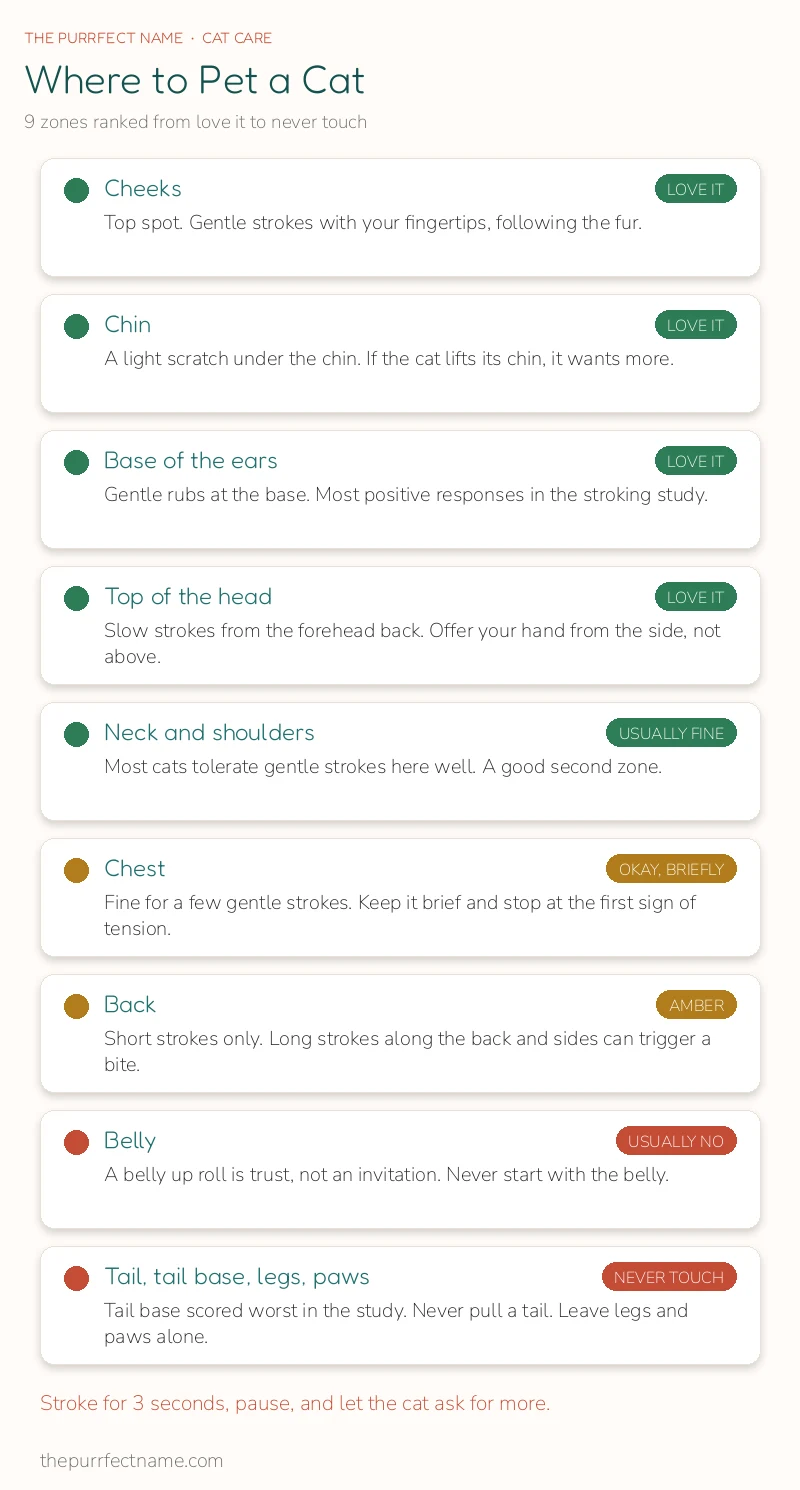
1. Cheeks: Love It
The top spot for most cats. Stroke the cheeks gently with your fingertips, following the direction of the fur. This is where cats rub against you themselves, so it is the safest place to start with any cat, including one you just met. If a cat head bumps your hand, it is asking for exactly this.
2. Chin and Under the Chin: Love It
Right behind the cheeks. A light scratch under the chin is welcome for most friendly cats, and it is another scent gland zone. Use short, gentle strokes and stop while the cat is still leaning in. The chin is also a good test zone: if the cat lifts its chin into your hand, it wants more. If it pulls away, it does not.
3. Base of the Ears: Love It
Gentle rubs at the base of the ears are a favorite for many cats, and the Ellis study found the head region around the ears produced the most positive responses. Keep it light and slow, and do not reach inside the ear. The ears themselves are sensitive, so stay at the base and on the outside.
4. Top of the Head and Forehead: Love It
Slow strokes from the forehead back toward the ears are usually welcome, but approach matters. Do not reach over the cat’s head from above, which can feel threatening. Offer your hand from the side or below, let the cat sniff it, and then stroke the top of the head gently. A cat that ducks or flattens its ears is telling you to stop.
5. Neck and Shoulders: Usually Fine
Cats Protection lists the neck and shoulders among the places cats are most likely to enjoy being stroked, and most cats tolerate gentle strokes here well. It is a good second zone after the head, especially for a cat that is already relaxed with you. Keep strokes short and light, and watch for the same warning signs as anywhere else.
6. Chest: Okay, Briefly
The chest is a middle zone. Many cats accept a few gentle strokes on the chest, especially cats that already trust you. It is not a favorite for most cats, and it is close to the belly, so keep it brief and stop at the first sign of tension. If the cat is standing, the chest is easier to reach safely than if the cat is lying on its back, which is a different message entirely.
7. Back: Amber, Short Strokes Only
This is the zone where most petting goes wrong, and it needs a correction to a common claim. Many lists call the back comfortable, but the research says amber. Many cats tolerate short strokes along the back, but longer strokes along the back and sides are a common trigger for petting induced aggression, according to VCA Animal Hospitals.
The back also sits next to the tail base, the worst zone of all, so strokes that drift toward the rear end a session badly. Rule: a few slow strokes along the back, following the fur, then stop and let the cat ask for more.
8. Belly: Usually No
Some lists suggest gentle belly strokes. Every ranking source puts the belly in the least liked or red zone, and this article rates it red. The belly is the most vulnerable part of a cat’s body, and most cats dislike having it touched, even cats that roll over and show it to you. A belly up roll is a sign of trust, not an invitation.
Never initiate belly petting. The rare exception is a cat that clearly asks for it, rolling over, staying relaxed, and leaning into your hand, and even then keep it to a second or two and stop at the first twitch.
9. Tail, Tail Base, Legs, and Paws: Never Touch Unless Asked
Three zones share the bottom of the list, and the tail base is the worst of all. In the Ellis study, stroking the caudal region, the area toward the tail, produced the most negative responses of any body part, with negative scores of 2.0 against 0.0 to 1.0 for the other regions, and the authors concluded that handling should avoid the caudal region.
The tail itself is sensitive and should never be pulled. The legs and paws are also disliked by most cats: Cats Protection lists them among the least liked zones, and International Cat Care puts legs in the red zone with the belly and the tail base. Thighs sit in the same red group. Leave all of these alone unless your individual cat clearly enjoys it, and never grab or hold them.
How to Pet a Cat, Step by Step
Use the C.A.T. Protocol, developed by Dr. Lauren Finka at Nottingham Trent University: Choice, Attention, Touch. It is the method behind the Battersea study that cut conflict behavior from 27 percent to 16 percent.
Choice first. Let the cat come to you. Hold your hand out slowly and keep it still. If the cat does not approach after a minute or two, it does not want to be touched, and that is a complete answer. Never chase a cat to pet it, and never pick it up to start a petting session.
Attention next. Watch the cat, not your phone. Is it relaxed, with soft eyes and forward ears? Or is it tense, with a swishing tail and flattened ears? Only start if the body language says yes.
Touch last. Gently stroke the cheeks, chin, or head for about 3 seconds, then pause and ask: does the cat move closer or ask for more? If it leans in, head bumps you, or stays relaxed, you can continue for a few more seconds and pause again. If it moves away, stills, or turns its head toward your hand, stop. Short sessions that end well beat long sessions that end in a bite.
Two practical rules sit underneath all of this. Stroke with the fur, never against it, and use gentle strokes, not patting, which Cats Protection warns is too rough. Keep your hand low and from the side, not reaching over the head. And learn your own cat’s number: every cat has a limit, and the limit changes with mood, time of day, and how the day has gone.
Warning Signs: Stop Before the Bite
Petting induced aggression rarely comes out of nowhere. The ASPCA lists the warnings, and they are worth learning by heart: the cat quickly turns its head toward your hand, its body tenses, its ears flatten against its head or rotate forward and back, its tail twitches or it starts fidgeting, and its pupils dilate. Other signs include rippling skin along the back, a sudden stillness, lip licking, or a quick grooming lick in the middle of petting.
If you see any of these, stop at once and take your hand away calmly. Continuing is what turns a warning into a hiss, a growl, a scratch, or a bite. Do not punish the cat, physically or by yelling. The ASPCA is clear that punishment makes the problem worse.
If the bite happens anyway, stay calm, move away, and let the cat settle. Our guide to why cats bite when petted explains petting induced aggression in full, including how to rebuild a cat’s tolerance with short, treat rewarded sessions.
Two body language guides help here. The ears tell you a lot, and our cat ear language guide shows what flattened, rotated, or forward ears mean. The tail tells you the rest, and our cat tail language guide covers twitching, lashing, and puffed tails. Learn both and you will rarely be surprised.
Special Cases: Kittens, New Cats, and Cats That Hate Touch
Kittens need the same method, more gently. Short sessions, head zones only, and plenty of play between petting. A kitten that learns hands are for gentle strokes, not wrestling, becomes an adult that tolerates handling well. Never use your hands as a toy with a kitten, because that lesson lasts.
A new cat in your home needs time before it needs petting. Let it explore, hide, and come to you. The first petting session should be a few seconds on the cheek, then you stop, even if it went well. Ending early builds trust faster than pushing on.
Some cats simply do not like much touch, and that is normal. A cat that prefers to sit near you rather than on you is still showing affection. Respect the limit and enjoy the company on the cat’s terms. Forcing touch on a cat that does not want it does not build a bond. It breaks one.
Frequently Asked Questions
Where do cats like to be petted most?
Most cats prefer the cheeks, chin, base of the ears, and top of the head, where their facial scent glands sit. A controlled study found the head region produced the most positive responses to stroking.
Why does my cat bite me when I pet it?
Usually it is petting induced aggression, also called overstimulation. Repeated stroking builds arousal until the sensation turns unpleasant, and the cat bites to make it stop. Warning signs include a twitching tail, flattened ears, rippling back skin, and the head turning toward your hand. Stop at the first sign.
Is it okay to pet a cat’s belly?
Usually no. Most cats dislike belly touch, and a belly up roll is a sign of trust, not an invitation. Only pet the belly if your individual cat clearly asks for it, and keep it to a second or two.
Why does my cat hate being petted on the tail?
The tail base is the most sensitive zone in the only controlled stroking study, producing the most negative responses of any body part. The area has dense sensory receptors, and touching it can overstimulate a cat quickly. Never pull a cat’s tail.
How long should a petting session last?
There is no fixed number, because every cat has its own limit. Stroke for about 3 seconds, pause, and see if the cat leans back in. Short sessions that end well are better than long sessions that end in a bite.
How do I pet a cat that does not know me?
Let it come to you. Hold your hand out low and still, wait a minute or two, and only stroke the cheeks or chin if the cat approaches and rubs against your hand. If it does not approach, leave it alone.