How to Hold Your Cat Without Stress in 6 Steps (The Two Hand Lift)
Most cats do not like being picked up. That is not a flaw in the cat. A cat feels safest with all four paws on a solid surface, because from there it can leave, and lifting takes that option away. The 2022 AAFP and ISFM Cat Friendly Veterinary Interaction Guidelines put it in one line for veterinary staff: cats feel more secure with all four feet in contact with a solid surface.
So the goal of this guide is not to make your cat love being held. It is to make the times you do need to hold it, for a vet visit, a move, a pill, or a quick rescue from the kitchen counter, as short and as stress free as possible.
The short answer is the two hand lift: one hand under the chest just behind the front legs, the other hand under the hindquarters, lift slowly, hold the cat upright against your chest, and put it down the moment it squirms.
Everything else below is the detail around that sentence, and the detail matters, because most bad holds fail before the lift even starts. Our guide on keeping your cat calm covers the wider picture of vet visits, travel, and guests, where most of the lifting happens.
Key Takeaways
- 6 steps make the method: let the cat come to you, read its body, one hand under the chest, one hand under the hindquarters, lift slowly to your chest, put it down front paws first.
- Two hands, always. One hand under the chest and one under the hindquarters, with the back legs never left dangling.
- Never lift an adult cat by the scruff. The stillness people mistake for calm is fear, and the adult neck is not built to carry the cat’s weight.
- The three holds to avoid are lifting by the neck, the belly hug with the back half hanging, and holding by the armpits in the air.
- The three better holds are the shoulder hug, the princess hug for cats that already like it, and hip and chest support.
- Put the cat down the moment it squirms. If it panics, open your arms and let it go rather than holding on.
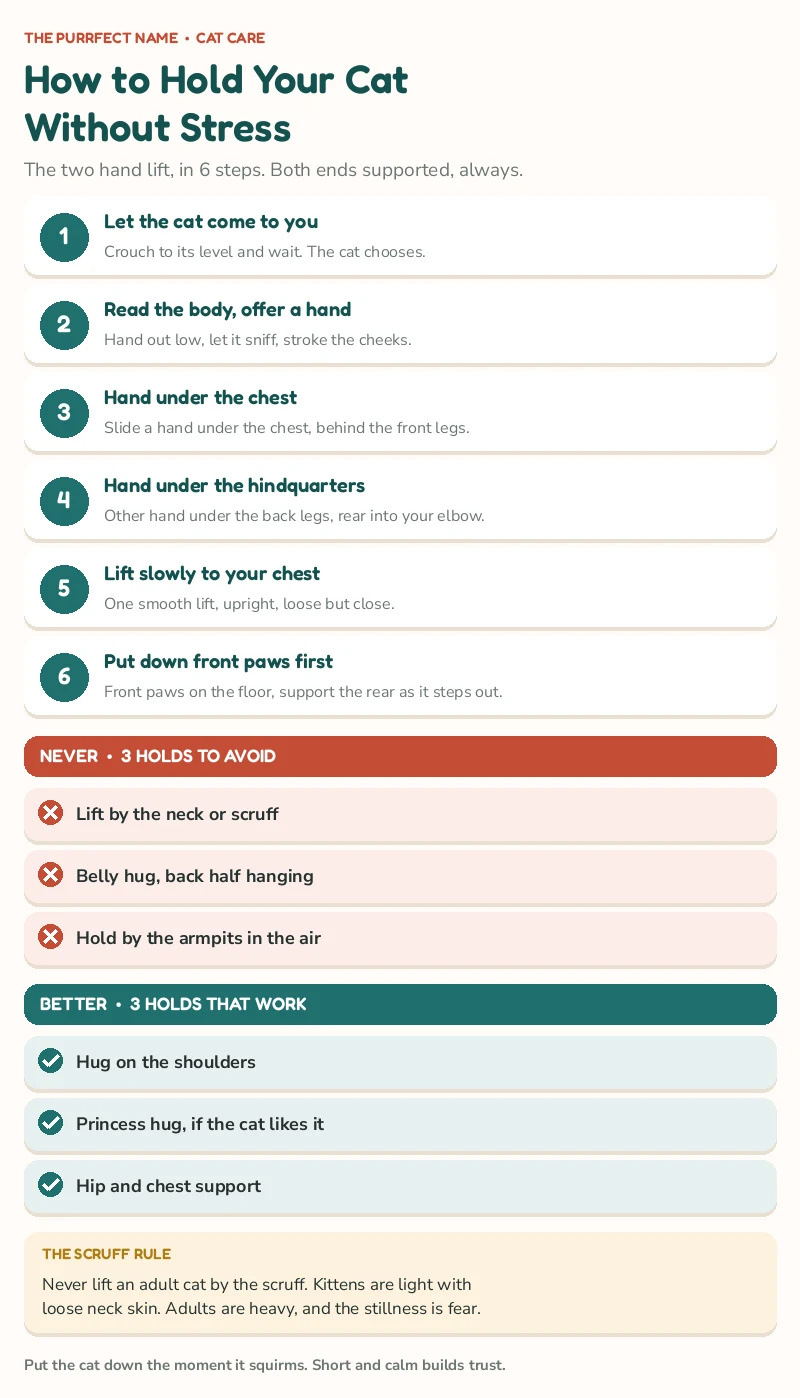
The 6 Steps
| Step | What to do | Why it matters |
|---|---|---|
| 1. Let the cat come to you | Crouch to its level, stay still, wait | The cat chooses the interaction |
| 2. Read the body, offer a hand | Hand out low, let it sniff, stroke the cheeks | Permission before touch |
| 3. Hand under the chest | Slide a hand under the chest, behind the front legs | Supports the front half |
| 4. Hand under the hindquarters | Other hand under the back legs, rear into your elbow | Supports the back half, nothing dangles |
| 5. Lift slowly to your chest | One smooth lift, hold upright against your chest | Close contact feels secure |
| 6. Put down front paws first | Front paws on the ground, support the rear as it steps out | The cat leaves on its own terms |
Step 1: Let the Cat Come to You
Do not chase a cat to pick it up. Do not corner it, do not reach for it from above, and do not grab it while it is walking past. A cat that is chased is a cat that is already stressed before the lift begins, and a stressed cat is a cat that will scratch, bite, and remember the experience. Instead, crouch down to the cat’s level, which makes you smaller and less threatening, and wait.
Let the cat approach you on its own terms. This is the advice of every behaviorist on the ranking pages, and it is the step owners skip most often, because waiting feels slow and grabbing feels fast. Grabbing is fast, and it is also the reason the cat runs from you next time.
If the cat does not come, that is an answer. Unless there is an emergency, a fire, a dog at the door, a pill that cannot wait, respect the no.
You can try again later, with a treat or a toy, and the cat may change its mind. A cat whose no is respected says yes more often. A cat whose no is ignored learns that the only way to say no is with teeth.
Step 2: Read the Body and Offer a Hand
Before you touch the cat, read it. A relaxed cat has a loose body, ears forward or to the side, a tail up or loosely curled, and slow blinks.
A cat that is not ready to be picked up has flattened ears, a tucked tail, dilated pupils, a tense crouched body, a lashing tail, or skin twitching along its back. Never attempt to hold a cat that is showing those signals. Give it space and let it approach you when it feels comfortable.
If the body is relaxed, hold out a hand low, at the cat’s head height, and let it sniff. Stroke the cheeks for a few seconds and then pause. The cheeks are the safe spot: cats rub their own scent glands there, and a cheek stroke is a greeting, not a grab.
If the cat stays put and stays loose, leans into the stroke, or head bunts your hand, you have permission to proceed. If it walks away, you do not. The pause is the test, and it takes three seconds.
Step 3: One Hand Under the Chest
Facing the same direction as the cat, which is less intimidating than facing it head on, slide one hand under the cat’s chest, just behind the front legs, with your fingertips pointing toward the cat’s face. This is the hand Walkerville Vet describes: slide a hand under the front legs from either direction, with your fingers under the arms.
The hand supports the ribcage and the front limbs. Do not lift yet. Do not pull up under the front legs alone, because that puts the cat’s whole weight on its shoulders and chest and gives it nothing to brace against.
The common mistake here is the armpit lift: grabbing under the front legs and hoisting, with the back half hanging in the air. That is one of the three holds to avoid, and it is the one owners do most often without noticing.
The cat’s back legs dangle, its spine is unsupported, and it feels like it is falling. A cat that kicks with its back legs the moment it is lifted is usually telling you the second hand is missing, not that it hates being held.
Step 4: The Other Hand Under the Hindquarters
As you lift, slide your other hand under the cat’s rear legs to support its body, so the hindquarters settle into the crook of your elbow. PetMD’s Dr. Julie Liu describes this as tucking the hind end into the crook of the elbow, like holding a football.
Walkerville Vet says the same thing in plainer words: slide your other hand under the rear legs to support the body and bring the cat up to your chest. The rear end must be supported. Cats Protection’s rule, as reported by Bonbeno, is that the cat must be fully supported at all times and the back legs must not be left dangling in the air.
If you are already holding a cat with its back legs dangling, do not put it down fast. Slide your free hand under its rear first, then carry on. The fix is one hand movement, and it changes the hold from a dangle into a carry. This is the step that separates a hold a cat tolerates from a hold a cat hates.
Step 5: Lift Slowly and Hold Against Your Chest
Lift slowly and smoothly, in one motion, and bring the cat up against your chest so most of its body is touching yours. Hold it upright, with its head above its body, and keep your grip loose but close enough that the cat feels secure. The front paws can rest on or near your shoulder.
Do not squeeze. A tight grip feels like a trap, and a trapped cat panics. A loose grip with full contact feels like a perch, and a cat on a perch can relax.
Keep it short. Most cats want down inside two minutes, and many want down inside thirty seconds. That is normal, and it is not a failure. A short calm hold that ends on the cat’s terms builds trust. A long hold that ends in a struggle destroys it.
Watch the body while you hold: ears moving back, tail lashing, skin twitching, or a sudden stiffening are the signs to put the cat down now, before the squirm becomes a scratch.
Step 6: Put the Cat Down Front Paws First
Putting a cat down matters as much as picking it up. Lower the cat toward the floor, put its front paws on the ground first, and support its rear as it steps fluidly out of your arms. That is Vetstreet’s method, and it is the reverse of the lift.
Do not drop the cat, do not toss it, and do not put it down on a high surface it has to jump from. All four paws on the floor, on a surface the cat chose or at least knows, and then let go.
If the cat panics in your arms, do not fight to hold it. Open your arms and let it go. A cat that blasts out of your arms will be frightened for a minute and fine after that.
A cat that is held while it panics will bite and scratch, and it will remember the hold as a fight. The rule is simple: the cat decides when the hold ends, and your job is to make the ending smooth.
3 Holds That Work
Once the two hand lift is natural, the hold itself has three good versions, and the right one depends on the cat. All three follow the same rule: both ends supported, back legs never dangling, cat upright against your body.
The Shoulder Hug
The cat sits upright against your chest with its front paws resting on or near your shoulder, one of your arms under its hindquarters and the other around its chest. This is the most common good hold, and it is the one most cats accept first, because the cat can see where it is going and its head is high.
Keep the cat’s body straight rather than letting it sag against your chest with its head and neck craned downward. If the cat leans its head against your chest, that is a good sign. It is settling.
The Princess Hug
The cat is cradled in your arms on its back, like a baby, with one arm supporting its whole body and the other hand steadying its chest. This is the hold from the reference image, and it comes with a warning that the image does not give: many cats hate it. Being on their back makes cats feel insecure and trapped, because the belly is exposed and escape is impossible.
Only use the princess hug with a cat that already likes it, a cat that rolls onto its back in your arms voluntarily and stays loose. If the cat stiffens, kicks, or tries to flip over, the princess hug is over. Go back to the shoulder hug and do not try again that day.
Hip and Chest Support
One hand under the chest and the other under the hips, the cat held upright against your side with its body supported along its full length. This is the most secure hold for a heavy cat, a long cat, or a cat that needs to be carried across a room, because the weight is spread across both hands and the spine stays level.
It is also the best hold for a vet visit, because the cat is contained without being squeezed, and a vet can reach the cat without you having to let go. For a very heavy cat, or a cat you need to carry for more than a few seconds, use a carrier instead. A carrier is not a defeat. It is the right tool.
3 Holds to Never Use
Never Lift by the Neck or Scruff
This is the big one, and it has its own section below, because the myth behind it is so persistent. Lifting an adult cat by the scruff, the loose skin at the back of the neck, is not safe, not kind, and not what a mother cat does to an adult.
It is the most common bad hold, and it is the one this guide is most certain about. Never lift a cat by the neck. Never lift a cat by the tail. Never lift a cat by one leg, or by the front legs alone.
Never the Belly Hug
Holding a cat vertically against your body with its belly facing out, its weight hanging on its abdomen, and its hind legs dangling, is the belly hug, and it fails every rule for a safe hold. The back legs have no support, the spine is unsupported, and the cat feels like it is falling, because it is, held up by one point.
The cat will kick, twist, and scratch to get its back feet onto something solid, and the person holding it will usually conclude the cat is aggressive. The cat is not aggressive. It is falling. Use the two hand lift instead.
Never Hold by the Armpits in the Air
Holding a cat up by its armpits, front legs in your hands, back half hanging in the air, is the hold that looks most like holding a child, and it is the worst of the three for a cat’s joints. The whole weight hangs from the shoulders and chest, the back legs dangle with nothing to brace on, and the cat has no sense of where its body is.
Some owners do this to look at the cat’s belly or to show the cat to someone. Do not. If you need to look at the belly, put the cat on a table and let it stand on all four paws while a vet examines it.
The Scruff: Why Everyone Gets It Wrong
The myth goes like this: a mother cat carries her kittens by the scruff, so it must be safe to pick up an adult cat the same way. Walkerville Vet, writing in 2020, calls this just plain wrong, and the reasoning is simple. Kittens have a very low body weight and large heads and necks with relatively loose skin designed for the purpose.
When a cat grows up, the body size increases and the scruff becomes tighter. As Walkerville puts it, there is not really a scruff any longer. Trying to hold or pick up an adult cat by it pulls on an area not designed for trauma, and it is probably going to hurt.
The stillness is the other half of the myth. A cat gripped by the scruff often goes limp and still, and people read that as calm. It is not calm. Researchers at Ohio State University gave it a name, pinch-induced behavioural inhibition, because that is what it is: a reflex freeze, not relaxation. The reflex is strongest in the first weeks of life and fades as the cat grows.
By adulthood it does not reliably produce calm at all. It produces tolerance at best, and active distress in some cats. An adult cat can weigh 4 to 6 kilograms, and lifting that much bodyweight by a fold of neck skin puts real strain on the tissue and the spine beneath it.
The veterinary position has moved with the evidence. The 2022 AAFP and ISFM Cat Friendly Veterinary Interaction Guidelines say scruffing is no longer recommended for cats at any life stage, and that it is a mistaken premise that scruffing makes patients easier to work with. Scruffing removes two things at once: the cat’s sense of control and its ability to move away.
Walkerville is honest about the exception: vets sometimes hold the scruff briefly when a cat is about to bite and they need to stop it before changing approach, and even then it is a last resort, with the body supported, never a lift. For an owner at home, there is no version of scruffing that is a good idea. Use the two hand lift, or use a towel.
The Towel Wrap
Some cats will not be picked up at all, and that is a real situation, not a failure. Walkerville’s answer for a cat that is too unhappy to be picked up with the two hand lift is to wrap it in a towel and pick up the bundle.
The method is simple: lay a large towel flat, put the cat in the middle, fold the towel over the cat so its body is wrapped and its head is free, and lift the bundle with both hands underneath. The towel gives the cat a sense of enclosure, which many cats find calming, and it protects your hands.
The towel wrap is for moving a cat, not for restraining one for a procedure. If your cat cannot be handled at all, even in a towel, talk to your vet.
A vet can advise on calming medication, a different carrier, or a home visit, and that is a better answer than a struggle. Never use the scruff because the towel did not work. The towel failing is information, not a reason to escalate.
Kittens, Seniors, and Pregnant Cats
Kittens are small enough to fit in one hand, but PetMD’s advice is to use two hands even for them. A kitten picked up with one hand and held in the air like a stuffed animal is frightened, and a frightened kitten learns that hands are scary.
Support a kitten’s whole body, one hand under the chest and the other cradling the hindquarters, and keep the hold short and close to the ground. A very young kitten can be lifted briefly by the scruff by its mother, but you are not its mother, and the kitten’s weight doubles fast.
Senior cats need the same two hand lift, done more slowly, with extra attention to sore joints. Arthritis is common in older cats, and a hold that twists the spine or lets the back legs dangle will hurt. Lift from a table or a raised surface rather than from the floor if that is easier, and keep the cat’s body level.
Pregnant cats need two hands and support under both the chest and the hindquarters, with no pressure on the belly. Never lift a pregnant cat by the belly or squeeze the abdomen. Our guide to cat tail language helps with reading the body signals of a cat that is uncomfortable being held, at any age.
Frequently Asked Questions
Is it ever OK to hold a cat by the scruff?
For an owner at home, no. The 2022 AAFP and ISFM guidelines advise against scruffing at any life stage, and Walkerville Vet calls the mother cat argument plain wrong for adults. Vets may hold the scruff briefly as a last resort during a procedure, with the body supported, but that is a clinical decision, not a way to pick up a cat.
Why does my cat go limp when I scruff it?
That is pinch-induced behavioural inhibition, a reflex freeze, not relaxation. The reflex is strongest in kittens and fades in adults. A limp cat is a frightened cat that has stopped struggling, not a calm one.
How long should I hold my cat?
As short as possible. Most cats want down inside two minutes, and many inside thirty seconds. Put the cat down the moment it squirms, stiffens, lashes its tail, or twitches its back skin. A short calm hold builds trust. A long hold that ends in a struggle does the opposite.
My cat kicks when I pick it up. Does it hate being held?
Not necessarily. A cat that kicks with its back legs the moment it is lifted is usually telling you the second hand is missing and its back legs are dangling. Slide your free hand under its hindquarters and try again. If the cat still kicks with full support, it may simply not like being held, and that is a preference to respect.
What if my cat will not let me pick it up at all?
Try the towel wrap, and try again another day. Some cats never enjoy being held, and that is normal. Use a carrier for vet visits, let the cat come to you, and build trust with play and cheek strokes instead of lifts. If the cat cannot be handled at all, talk to your vet about calming options.