
If Cats Could Use Google: 20 Searches Your Cat Would Definitely Make
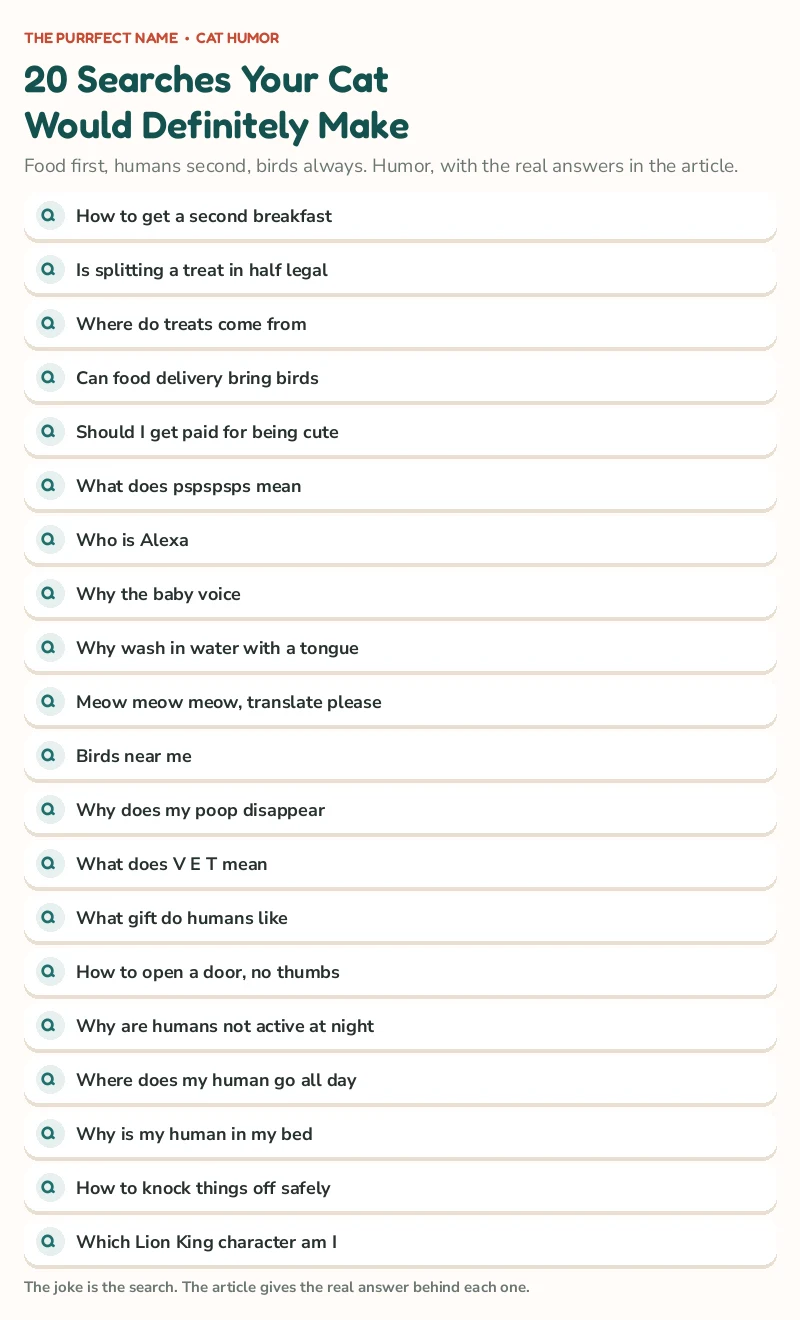
Your cat has watched you type questions into a search box for years. It has sat on the keyboard, walked across the screen, and stared at the cursor like it was a bug that needed catching. It has never once been allowed to ask its own questions. Today that changes. These are the 20 searches your cat would definitely make, if it had thumbs, a laptop, and five unsupervised minutes.
This is humor, not science. Each search is a joke first, and where a real fact sits behind the joke, it is marked as the real answer. If you have ever caught your cat staring at you like you owe it an explanation, this list is that explanation, in search form. Our cat memes collect the same feeling in pictures, if you want more after this.
Key Takeaways
- The joke searches fall into four groups: food, strange human habits, hunting, and home life.
- The viral meme exists in at least four independent versions, and the funniest lines repeat across all of them: two breakfasts, the vet spelled out, and birds near me.
- Behind most jokes sits a real behavior: crepuscular sleep, meowing only at humans, the pspspsps sound, and the hunting instinct.
- Adult cats sleep 12 to 16 hours a day and are most active at dawn and dusk, which explains half of this list.
- The dead animal on your floor is probably not a gift. The best supported explanation is that home is where your cat feels safe.
Part 1: Food Comes First
Every cat search history would start with food. Not because cats are hungry. Because in a cat’s mind, food is always the most urgent open tab.
1. How to get a second breakfast
The first breakfast was eaten at 5 a.m. It is now 5:04 a.m. The bowl is empty, the human is awake, and a second breakfast is clearly owed. Your cat will now follow you from room to room, sit by the cupboard, and meow in the exact tone of a creature that has never once been fed.
The real answer: cats evolved to eat several small meals a day rather than one big one, so the constant asking is an old hunting rhythm, not a conspiracy. A regular feeding schedule beats a second breakfast, and a vet can help set the portions.
2. Is splitting a treat in half legal
You broke one treat into two pieces and called it two treats. Your cat watched you do it. Your cat is now consulting a lawyer. The search history will show three attempts at the same question, each typed with increasing force.
The real answer: treats should stay small. Vets generally advise keeping treats to about 10 percent of daily calories or less, so a split treat is actually the correct move, even if your cat disagrees in writing.
3. Where do treats come from
Treats appear from a cupboard, a bag, or a pocket, always after a sound your cat cannot identify. Do they grow in the cupboard? Is there a treat factory inside the kitchen? Your cat has spent years on this question and is no closer to an answer than you are to explaining where socks go in the wash.
The real answer: cats learn routines fast. The rustle of a bag or the opening of a cupboard becomes a promise, and the cat arrives before the promise is even finished. That is learning, not magic, though your cat would prefer the magic version.
4. Can food delivery bring birds
The delivery rider brings food in bags and boxes. None of it has feathers. Your cat has checked every bag, twice, and is now searching for a delivery service that understands the assignment. One bird, please. Still warm. No sauce.
The real answer: no delivery service brings live birds, and that is probably for the best. The wish behind the search is the hunting instinct. Cats hunt even when they are well fed, because the drive to chase and catch is separate from hunger.
5. Should I get paid for being cute
Your cat has provided years of cute, free of charge. Sitting in sunbeams. Sleeping in impossible positions. Looking at you with slow blinks. The invoice is now due, payable in treats, chin scratches, and one (1) open window with birds behind it.
This one is a pure joke, and there is no real answer. No study has measured the market rate for cute, and your cat would reject the findings anyway.
Part 2: Humans Are Very Strange
From a cat’s point of view, humans are the weird ones. They wash in water, talk in baby voices, and make a strange hissing sound that somehow always works.
6. What does pspspsps mean
You make the sound and the cat appears. You make it again and the cat appears faster. What is it? A spell? A secret password? Your cat has decided it must mean something important, possibly “treats” or possibly “come here so I can judge you up close.”
The real answer: nobody knows for certain, because no peer reviewed study has tested the sound itself. The best expert explanation is that the s sound is high frequency, cats hear far above the human range, up to about 64 kHz and higher, and the sound resembles prey rustling in leaves.
Cats also learn the association: the sound has always meant attention, food, or affection before. It is probably a shortened form of “Here, pussy, pussy, pussy,” a call popularized by a 1938 song of the same name.
7. Who is Alexa
There is a voice in a box on the shelf. It answers questions, plays music, and never once offers a treat. Your cat has stared at the box, sniffed the box, and sat on the box, and the voice keeps coming out of it anyway. Who is she? Where are her legs? Why does she know the weather and not the location of the treats?
The real answer: cats recognize the voices of their own people, and a speaker voice is a stranger’s voice coming from an object, which is exactly as confusing as it looks. Your cat is not being rude to Alexa. It simply has no reason to trust a box.
8. Why the baby voice
You speak to your cat in a voice you use for nobody else. Higher, softer, full of words like “who is a good baby.” Your cat tolerates this. Your cat also suspects you do not talk to your boss this way, and would like to know why it gets the special voice and the vet gets the normal one.
The real answer: high pitched, gentle speech is close to the sounds cats themselves pay attention to, and owners who use it usually get a faster response. It works, which is why everyone keeps doing it, even while feeling slightly embarrassed about it.
9. Why wash in water with a tongue
Your cat has a tongue. The tongue works perfectly well. It cleans fur, paws, and, on occasion, your hand. Humans, meanwhile, stand under falling water every single day, on purpose, and then complain about being wet. Your cat has questions, and the first one is why you do not simply lick yourself clean like a normal animal.
The real answer: cats do clean themselves with their tongues, and they are good at it. Most cats never need a bath at all. A bath is only needed when a cat gets dangerously dirty, is ill, or is elderly and cannot groom properly. Your cat is not judging your shower. It is just confused by the plumbing.
10. Meow meow meow, translate please
Your cat typed this one itself, by walking across the keyboard. It would like to know what it just said, and whether you understood any of it, because you keep responding with “what” and “I know, sweetie,” which are not translations.
The real answer: adult cats meow almost exclusively at humans. Kittens meow to their mothers, but adult cats rarely meow at each other, and instead use scent, posture, and body language. The meow is a language cats kept for us, shaped by which sounds get a response.
Your cat also knows its own name, according to a 2019 study of 78 cats, which found cats could tell their name apart from similar sounding words, even when a stranger said it. It just does not always answer.
Part 3: The Hunt Never Ends
Your cat is a small predator living in a house full of prey shaped objects. The search history in this section is all hunting, all the time.
11. Birds near me
Three words. The whole search history in miniature. Not “birds near me, open now.” Not “birds near me, reviews.” Just birds, near me, now, please, immediately.
The real answer: birds are prey, windows are television, and your cat is the audience that never leaves its seat. Watching birds from a window is one of the most absorbing things a house cat can do, and it is also why the bird feeder outside your window is the most popular show in the house.
12. Why does my poop disappear
Your cat buried it carefully. It did the work, covered the evidence, and walked away with dignity. Then it came back and the evidence was gone. Somebody took it. Somebody is stealing poop, and your cat would like a full investigation, starting with the human holding the scoop.
The real answer: cats bury waste by instinct, and humans remove it for hygiene. Your cat does not understand litter cleaning, and does not need to. The arrangement works for everyone, even if your cat files a complaint about it once a day.
13. What does V E T mean
You spelled it out letter by letter, very quietly, to another human. Your cat heard you anyway. It heard the tone, the whisper, and the word “appointment,” and it is now under the bed, researching what those three letters mean and whether they can be avoided by hiding until Tuesday.
The real answer: cats are masters at hiding when something is wrong, which is why vet visits matter even when a cat looks fine. The spelling is an owner trick, not a code cats can crack. Your cat is reacting to your tone and your behavior, not to the letters, and that is usually enough warning.
14. What gift do humans like
Your cat brought you a dead mouse, placed it carefully on the floor, and waited for your reaction. You screamed. Your cat is now searching for what kind of gift humans actually want, because the mouse was clearly a thoughtful present and your response was, frankly, rude.
The real answer: the mouse was probably not a gift at all. The best supported explanation is that home is where your cat feels safe, so a cat that catches prey and is not hungry enough to eat it carries it back to the safe place.
In one study of 55 free roaming pet cats, 23 percent of caught prey was brought back to the house. There is no good evidence cats intend prey as a present or are teaching you to hunt. Our guide on why cats bring you dead animals separates the theories by strength of evidence, and the gift theory comes last.
15. How to open a door, no thumbs
The door is closed. The treats are on the other side. The handle is round, the gap is small, and your cat has no thumbs. This is a design flaw, and your cat would like to file a report, preferably with someone who can open doors.
The real answer: cats are better at doors than they look. Their forepaws are packed with nerve endings, and they use them to test, push, and pull at anything interesting. Many cats learn to open lever handles and sliding doors by watching and trying, which is why the bedroom door is never really closed, only temporarily shut.
Part 4: Home Life, According to the Cat
The last five searches are about the house, the schedule, and you. Your cat has opinions on all three.
16. Why are humans not active at night
It is 3 a.m. Your cat is ready. The hallway is empty, the energy is high, and the zoomies are calling. The human is asleep. The human has been asleep for hours. Your cat would like to know why humans waste the best part of the day by lying still with their eyes closed.
The real answer: cats are crepuscular, most active around dawn and dusk, not truly nocturnal. Adult cats sleep 12 to 16 hours a day, and the sudden burst of energy at night is a normal part of that rhythm. Our guide on what cat zoomies are explains these sudden sprints and why they so often happen when you are trying to sleep.
17. Where does my human go all day
You leave in the morning and come back hours later smelling of outside. Where do you go? Is there a second house? Is there a second cat? Your cat has searched the whole house for you, twice, and has concluded that you must be somewhere with other humans, doing something that is definitely less important than staying home.
The real answer: cats mostly sleep while you are out, then wake up for your return, which is why the greeting at the door is so enthusiastic. A cat that sleeps all day is not bored or angry. It is running its normal schedule, and your return is the most interesting event in it.
18. Why is my human in my bed
The bed is warm, soft, and exactly cat sized. Your cat claimed it weeks ago. Yet every night a large human climbs into it, takes up most of the space, and then complains that the cat is taking up most of the space. Your cat would like this contradiction explained.
The real answer: your cat sleeps on you and near you for warmth, your familiar scent, and security. The bed is the warmest spot in the house, and you are the warmest thing in the bed. The human is not an intruder. The human is the heating system.
19. How to knock things off safely
The glass is on the edge of the table. It is round, it is shiny, and it is asking to be pushed. Your cat would like instructions: which paw, how much force, and how to look innocent afterward, ideally before the glass hits the floor.
The real answer: cats knock things off because they are curious, because batting at an object tests whether it is alive or interesting, because they are bored, and because they have learned that a crash gets a reaction. It is not spite. Cats do not plot against your mug. The mug was simply there, at paw height, and the fall was interesting.
20. Which Lion King character am I
Your cat has watched the film. It has identified with the lions, the drama, and the soundtrack. It would like to know which character it is, and it already has a strong opinion: obviously the king, obviously the hero, obviously not the comic relief.
This one is a pure joke, with one real fact attached. Domestic cats share 95.6 percent of their DNA with tigers, according to the 2013 tiger genome study, and the two lineages split about 10.8 million years ago. That measures matching DNA sequences, not looks or behavior, so your cat is not actually a tiger. But it will not believe you if you tell it that.
Frequently Asked Questions
Is the “if cats could use Google” meme real?
The meme is a format, not one single post. At least four independent versions have gone viral since 2025, with overlapping lists of eight searches each, plus a National Cat Day version from a pet food brand and an official Google India carousel in 2026. No cat has ever actually used Google. The lists are written by humans, for humans, about cats.
What would cats search for most?
Based on every viral version, the top themes are food, the vet, birds, and strange human habits. Two breakfasts, treats, the vet spelled out, birds near me, and pspspsps appear again and again. The joke works because each one maps to a real behavior owners recognize at once.
Why do cats respond to pspspsps?
The best expert explanation is that the s sound is high frequency, cats hear far above the human range, and the sound resembles prey rustling in leaves. Cats also learn the association with attention and food. There is no peer reviewed study on the sound itself, so this is an expert explanation, not a proven fact.
Do cats really think we are their servants?
No, and the joke is funnier because it is not true. Cats do not have a servant concept. They have a warmth concept, a food concept, and a safety concept, and humans happen to provide all three. The servant line is a human joke about a real dependency, not a cat belief.
That is the full search history: 20 searches, four parts, one very demanding user. If your cat recognized itself in every single one, congratulations. You do not live with a pet. You live with a searcher who has strong opinions about your schedule, your food, and your poop disposal policy, and who will never, ever tell you what it actually typed.