16 Signs of Stress in Cats: Acute and Chronic, and What to Do
Stress in cats is easy to miss, and that is the problem. Dogs pant, pace, and whine. Cats go quiet. A stressed cat does not usually make a scene.
It hides a little more, sleeps a little longer, plays a little less, and grooms a little harder, and each change is small enough to explain away. By the time the change is obvious, the stress has usually been going on for weeks.
The short answer is that stress in cats comes in two forms, and you need to know both. Acute stress is sudden and obvious: a loud noise, a stranger, a trip to the vet, and the cat freezes, crouches, flattens its ears, and tries to escape.
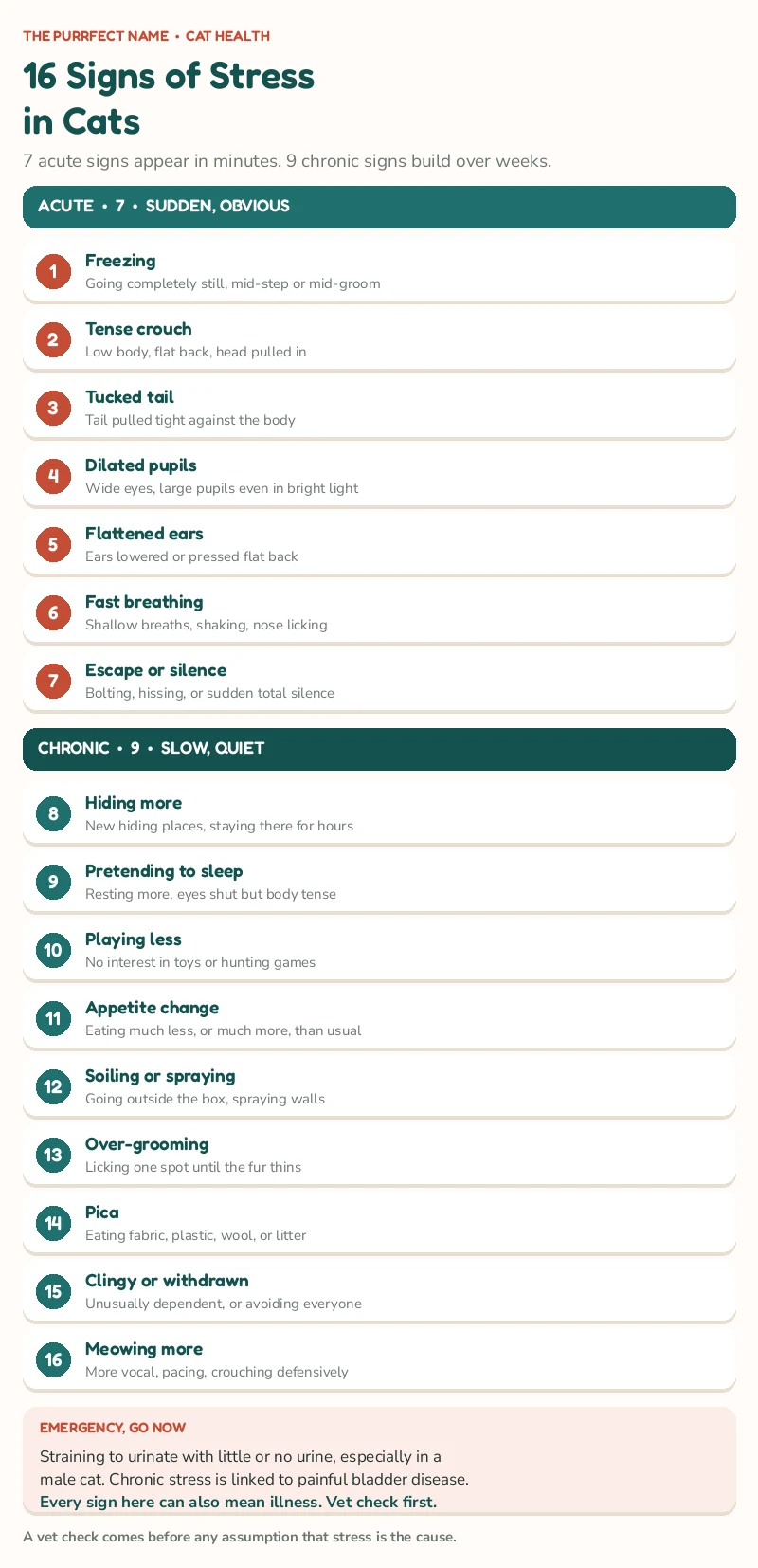
Chronic stress is slow and quiet: a new baby, a new cat, building work, a moved litter box, and the cat hides, pretends to sleep, stops playing, and starts soiling or over-grooming. The 16 signs below are split into those two groups, 7 acute and 9 chronic, using the lists published by International Cat Care.
One rule sits above all of them: stress signs overlap with illness and pain, so a vet check comes before you assume stress is the cause. Our guide on when to take your cat to the vet covers the thresholds that mean go now rather than wait.
Key Takeaways
- 16 signs make the list: 7 acute signs that appear in minutes, and 9 chronic signs that build over weeks.
- Acute stress is obvious: freezing, crouching, tucked tail, dilated pupils, flattened ears, rapid breathing, and trying to escape.
- Chronic stress is quiet: hiding, pretending to sleep, playing less, appetite changes, soiling or spraying, over-grooming, pica, clinginess or withdrawal, and meowing more.
- Chronic stress is linked to feline idiopathic cystitis, a painful bladder condition. A cat straining with little or no urine is an emergency, especially a male cat.
- Every sign on this list can also mean illness or pain. A vet check comes first, before any assumption about stress.
- Over-grooming must have skin problems, fleas, allergy, and pain ruled out before stress is blamed.
Acute Stress: 7 Signs That Appear in Minutes
Acute stress starts suddenly, because of an unexpected incident or a threat, and it is relatively easy to recognise. The cat’s body goes into survival mode: freeze, hide, or run. The signs below usually fade within minutes or hours once the threat is gone. If they do not fade, or they keep coming back, you are looking at chronic stress instead.
| Acute sign | What it looks like |
|---|---|
| 1. Freezing | Going completely still, mid-step or mid-groom |
| 2. Tense crouched posture | Low body, flat back, head and tail down |
| 3. Tucked tail | Tail pulled tight against the body or under it |
| 4. Dilated pupils | Eyes wide open, pupils large even in bright light |
| 5. Flattened ears | Ears lowered or pressed flat back on the head |
| 6. Rapid breathing or shaking | Fast shallow breaths, trembling, whiskers drawn back |
| 7. Trying to escape, hissing, or going silent | Bolting, growling, yowling, or sudden total silence |
1. Freezing
A cat that freezes has stopped moving entirely, often in the middle of what it was doing. International Cat Care lists freezing first among the acute signs, and it is the most misread one. Owners see a still cat and think it is calm. It is not calm.
It is deciding whether to run, and it is doing it as quietly as possible, because movement draws attention. A frozen cat is a cat that feels threatened and has no good escape route yet.
Do not touch a frozen cat. Do not pick it up, do not reach for it, and do not crowd it. Give it a clear path to a hiding place and step back. The freeze should break on its own within a minute or two. If the cat stays frozen for much longer, or freezes every time the same trigger appears, the trigger needs removing, not the cat needs handling.
2. Tense Crouched Posture
The classic stressed posture is low and tight: body crouched down, muscles tense, back flat, head lower than the body, pulled in toward the chest. The cat looks smaller than usual, as if it is trying to take up less space.
Hepper describes the same posture as walking with a low body, a flat back, and the head and tail down. It is the opposite of a relaxed cat, which sprawls, stretches, and takes up room.
This posture often comes with the other acute signs on this list, and that is the point. One sign on its own can be ambiguous. A crouch plus flattened ears plus a tucked tail is not ambiguous. It is a frightened cat. Leave it alone, remove the trigger if you can, and let the cat choose when to come out.
3. Tucked Tail
A relaxed cat carries its tail up, down, or loosely curled, with the tip free to move. A stressed cat tucks the tail in close to the body, sometimes right underneath, as if protecting it.
International Cat Care lists the tucked tail alongside the crouch, and the two usually arrive together. The tail is one of the fastest stress indicators you have, because it changes before the rest of the body catches up.
Compare against your own cat. Some cats naturally carry their tails low, and that is their normal. The signal is the change: a tail that is usually up and is now tucked tight is telling you something. A tail that is tucked and also puffed up is a different message again, and it means fear or extreme agitation. Give that cat space immediately.
4. Dilated Pupils
Wide, fully dilated pupils are on International Cat Care’s acute list, and they are easy to spot even from across the room. A cat’s pupils widen in dim light, so check the light first. Dilated pupils in a bright room, with the eyes fully open and staring, mean the cat is aroused, frightened, or overstimulated. The eyes may also dart, look away rapidly, or blink very fast.
Dilated pupils on their own are not a diagnosis. Excitement widens pupils too, and so does play. The stress reading comes from the company the pupils keep: dilated pupils plus flattened ears plus a crouch is stress. Dilated pupils plus a loose body and a toy is play.
Read the whole cat, and if the pupils stay wide for a long time after the trigger is gone, call the vet, because persistent dilation has medical causes too.
5. Flattened Ears
Ears lowered or fully flattened back on the head are one of the most reliable acute stress signs, and they are visible from a distance. A relaxed cat’s ears point forward or to the side, swiveling to track sounds.
A frightened cat pulls them back and down, out of the way, in the same motion as tucking its tail. Cats.com notes that stressed cats may keep their ears flattened or rotated backward much of the time, which is the chronic version of the same sign.
Ears are also a warning. A cat with flattened ears that is also growling or hissing is telling you to back off, and it means it. Do not test it. A bite from a frightened cat is fast, deep, and easily infected. Step back, give the cat an exit, and deal with whatever scared it.
6. Rapid Breathing or Shaking
Rapid breathing, shaking, swallowing, drooling, and nose licking all sit on International Cat Care’s acute list, and they are the body showing the stress rather than the behavior showing it. A cat that is breathing fast with its mouth closed, trembling, or licking its nose repeatedly after a scare is still in the acute response. The breathing should settle as the cat calms down.
Rapid breathing that does not settle is a different matter. Breathing faster than 40 breaths per minute at rest, open mouth breathing, or labored breathing is an emergency, not a stress sign, and it needs a vet now. Do not wait to see if it passes. The same applies to drooling that does not stop, which can mean nausea, mouth pain, or poisoning.
7. Trying to Escape, Hissing, or Going Silent
Some cats run. Some hiss, growl, or yowl. Some go completely silent, which owners often miss because silence looks like calm. International Cat Care lists all of these as acute signs, including the silence, and the silence is the one to remember. A cat that was vocal and is suddenly silent in a frightening situation is not relaxed. It is frozen in a different way.
Never block a cat’s escape route, and never corner a frightened cat to comfort it. A cat that cannot run will fight, and a cat that is held while frightened will bite and scratch the person holding it. Open a door, step aside, and let it go. You can comfort the cat later, when it comes back on its own terms.
Chronic Stress: 9 Signs That Build Over Weeks
Chronic stress is more difficult to recognise because it develops over a long period and the signs are more subtle. It changes patterns and routines rather than producing a dramatic moment: how much the cat eats, grooms, sleeps, plays, and uses the litter box.
International Cat Care is clear that chronic stress is the dangerous kind, because the hormonal systems that manage short term stress are not built to handle long term pressure, and that gap is where behavior problems and stress related illness develop. Each sign below is a change from the cat’s own normal, not a fixed number.
| Chronic sign | What it looks like |
|---|---|
| 8. Hiding more | New hiding places, staying there for hours |
| 9. Pretending to sleep | Resting more, eyes shut but body tense |
| 10. Playing less | No interest in toys, play, or hunting games |
| 11. Appetite change | Eating much less, or much more, than usual |
| 12. Soiling or spraying | Urinating outside the box, spraying walls and furniture |
| 13. Over-grooming | Licking one spot until the fur thins or the skin is sore |
| 14. Pica | Eating fabric, plastic, wool, or other non-food items |
| 15. Clingy or withdrawn | Unusually dependent, or avoiding people and other cats |
| 16. Meowing more, pacing | More vocal than usual, pacing, crouching defensively |
8. Hiding More Than Usual
Hiding is the most common chronic stress sign, and the most easily dismissed. A cat that used to sleep on the sofa and now sleeps under the bed, in a wardrobe, or behind the washing machine has changed its mind about what feels safe.
International Cat Care lists hiding among the chronic signs, and it is often the first behavioral clue owners notice. A cat sleeping under the bed instead of on top of it is not being quirky. It is choosing cover.
Hiding alone does not tell you the cause. It appears on the pain list as well as the stress list, so a cat that hides and also stops eating, or hides and stops grooming, needs a vet check before any stress plan. Do not drag a hiding cat out.
A hiding place is the cat’s coping strategy, and removing it makes the stress worse. Instead, make sure the hiding place is safe and warm, and work on what changed in the house.
9. Pretending to Sleep and Resting More
International Cat Care lists resting more, or pretending to sleep, as a chronic stress sign, and it is a strange one until you have seen it. The cat lies down with its eyes shut, in a loaf or curled position, and looks asleep.
But the body is tense, the ears keep moving, and the cat does not relax into deep sleep. It is resting without resting, staying still because stillness feels safer than moving around.
A cat that sleeps 16 hours a day is normal. Cats sleep a lot.
The signal is the change: a cat that used to sleep deeply and now dozes lightly in tense positions, or a cat that rests far more than it used to and has stopped doing the things it used to do between naps. Senior cats also sleep more, so age is part of the picture, and a vet check sorts out which one you are looking at.
10. Playing Less
A cat that stops playing has lost something important. Play is not a luxury for cats. It is hunting practice, exercise, and mental stimulation in one, and a healthy cat plays every day, even a senior one, even if the play is slower.
International Cat Care lists playing less as a chronic stress sign, and it is one of the most reliable, because play is one of the first things a stressed cat drops.
Try a short play session with a wand toy before you conclude the cat has stopped playing. Some cats will not play in front of people when they are stressed, but will play alone at night. Some have stopped because the toy is boring, not because they are stressed, and a new toy fixes it.
The sign is real when the cat ignores every toy, every game, and every invitation, day after day. That cat is not bored. It is stressed, ill, or in pain, and the vet sorts out which.
11. Appetite Change in Either Direction
Chronic stress changes appetite, and it can go either way depending on the cat. Some cats eat less or stop eating. Some eat more. International Cat Care lists both, and that is why the sign is a change, not a direction.
A cat that leaves food it used to finish, or a cat that suddenly begs constantly and empties the bowl twice as fast, has both changed, and both changes matter.
Not eating is the urgent one. A cat that has eaten nothing for 24 hours needs a vet call, and 48 hours without food is an emergency, because cats can develop fatty liver disease, hepatic lipidosis, very quickly. That rule applies whatever the cause, stress or illness.
Eating more also needs a vet check, because diabetes, hyperthyroidism, and other conditions cause it. Measure the food for a few days and write down what the cat actually eats. A dated note is the most useful thing you can bring to the vet.
12. Soiling or Spraying Outside the Litter Box
A cat that starts urinating or defecating outside the litter box, or spraying urine on walls and furniture, is telling you something, and it is one of the most common reasons owners seek help.
International Cat Care lists both soiling and spraying as chronic stress signs, and the Pet Professional Guild lists urination outside the box as a chronic stress outcome. Stress is a common trigger, but it is never the first assumption. Urinary tract disease, constipation, arthritis that makes the box hard to enter, and a dirty or badly placed box all cause the same behavior.
The vet check comes first, every time, and this is where the emergency rule matters most. A cat that strains to urinate with little or no urine coming out needs an emergency vet now, especially a male cat.
Cornell Feline Health Center calls urethral obstruction an absolute emergency and says death may follow complete obstruction in less than 24 to 48 hours. Do not wait overnight to see if it passes. Once the vet has ruled out a medical cause, the stress plan starts: more boxes, in quiet places, one per cat plus one spare, cleaned daily.
13. Over-Grooming and Bald Patches
Over-grooming is a cat licking itself so much that the fur thins, breaks, or disappears, leaving bald patches or sore skin, most often on the belly, the insides of the back legs, and the flanks. International Cat Care lists it as a chronic stress sign.
Cats groom to soothe themselves, and a stressed cat can push a normal soothing behavior into a compulsive pattern. The coat changes too: a cat that grooms less develops a dull, greasy, or matted coat, while a cat that over-grooms develops bald patches.
But stress is not the first explanation, and this is the sign where owners most often get it wrong. PetMed Direct puts the causes into three groups: skin problems such as fleas and allergies, underlying pain, and stress, and notes that most cases begin with a skin or pain problem, and most also have a stress element.
The vet must rule out medical causes first. Do not put a collar on the cat, do not spray it with deterrents, and do not assume boredom. Get the skin checked, then deal with the stress.
14. Pica: Eating Things That Are Not Food
Pica is eating non-food items: fabric, wool, plastic, paper, rubber bands, or litter. International Cat Care lists it as a chronic stress sign, and the WSAVA 2001 review notes that pica can start after a stressful event such as moving home or adding another cat to the household. It is also a sign of medical problems, including anemia and nutritional deficiencies, so the vet check comes first here too.
Pica is dangerous in a way the other signs are not. Fabric and plastic can block the gut, and a blockage needs surgery. If your cat is eating non-food items, remove the items from reach today, before the vet visit, and keep a note of what the cat ate and when.
Wool sucking in particular is common in some breeds and can become a lifelong habit, so early help matters. Do not punish the cat. Punishment adds stress to a stress behavior, and it does not teach the cat to stop.
15. Becoming Clingy or Withdrawn
Chronic stress changes how a cat handles people, and it goes in either direction depending on the cat. Some cats become more dependent on their owners, following them, demanding attention, and distressed when left alone. Others withdraw from social interaction, avoiding people and other cats they used to enjoy. International Cat Care lists both, and the key is the change from that cat’s normal, not the direction.
Owners often call this a mood swing, but that phrase hides more than it explains. There is no single mood swing sign in cats. What you are seeing is a changed social pattern, and the cause could be stress, pain, or illness.
A cat that was social and is now hiding from visitors, or a cat that was independent and is now Velcroed to your leg, has both changed. Note when it started and what else changed at the same time. A new baby, a new pet, building work, or a change in your working hours are all common triggers.
16. Meowing More, Pacing, or Crouching Defensively
The last chronic sign is a noisy one: a cat that meows far more than usual, paces around the house, or walks around in a low defensive crouch. International Cat Care lists increased vocalisation and reactivity among the chronic signs, and Cats.com lists pacing as a stress behavior.
A cat that paces and cries at night, or that meows at walls and doors, is often a cat that cannot settle, and not settling is a stress sign.
Night crying has other causes, especially in senior cats, where cognitive dysfunction is common, and that needs a vet check of its own. The same applies to a cat that suddenly becomes reactive, hissing or swatting at people or other cats it used to tolerate.
Reactivity is often pain. A cat that hurts will guard the sore spot, and a hand that reaches for it will get a warning. Do not punish the reaction. Find the cause.
When Stress Becomes Illness: FIC
The most important link here is between chronic stress and the bladder. Feline idiopathic cystitis, FIC, is painful bladder inflammation with no infection and no stones behind it, and it is the most common diagnosis in cats with lower urinary tract signs, according to the Cornell Feline Health Center.
Around 55 to 65 percent of feline lower urinary tract disease cases are FIC. Stress is an important factor in it, and an episode is often triggered by a stressful event: a house move, a new cat, building work, or a change in routine.
A flare looks like this: frequent trips to the litter box, small clumps, pink or bloody urine, crying while peeing, licking the genitals, and peeing outside the box. FIC is diagnosed by ruling out stones and infection, so a urine test is needed, and the vet visit is not optional.
Managing stress is a core part of treatment, and that is why this guide matters: the same changes that reduce stress reduce flares. But the emergency rule overrides everything. A cat straining with little or no urine, and any male cat peeing often in small amounts, needs an emergency vet now. Do not wait.
What to Do About It
Start with the vet. Every sign above overlaps with illness or pain, and the vet rules those out first. Bring your notes: what changed, when it started, and what else changed in the house at the same time.
If the vet clears the cat medically, the stress plan is about the cat’s core needs, as International Cat Care defines them: sufficient space, control over social interactions, multiple safe retreat points, and predictable access to food, water, and litter.
In practice that means: keep the routine steady, especially feeding times. Give each cat its own food bowl, water bowl, and litter box, plus one spare box, in quiet places where the cat will not be ambushed. Provide high resting places and hiding places the cat can choose freely.
Add play, a few minutes a day with a wand toy, because play burns off stress hormones. Use a pheromone diffuser in the room the cat uses most, and change only one thing at a time, so you can tell what helped.
Our guide on keeping your cat calm covers the same ideas for the specific stress of vet visits, travel, and guests. And if the stress does not ease in two weeks, or any sign gets worse, go back to the vet. Stress that does not lift is a medical problem until proven otherwise.
A Note on Twitching Back Skin, Head Shaking, and Nose Licking
The reference image for this guide lists shaking the head, twitching back skin, and rapidly licking the nose as stress signs. This guide does not list them as stress signs, and the reason matters.
Rippling or twitching skin along the back, especially after petting, is associated with feline hyperesthesia syndrome, a poorly understood condition involving extreme skin sensitivity along the back, and Cornell University notes that medical causes must be ruled out first, because disc problems and other disorders can cause it. Head shaking has many medical causes, from ear infections to allergies.
Rapid nose licking does appear on International Cat Care’s acute list, as part of the immediate fear response, not as a chronic stress sign. If your cat’s back skin ripples or twitches regularly, or it shakes its head often, that is a vet visit, not a stress management project.
Frequently Asked Questions
How do I know if my cat is stressed or sick?
You often cannot tell from the sign alone, because hiding, appetite change, vomiting, diarrhea, and over-grooming appear on both lists. That is why the vet check comes first. A vet rules out illness and pain, and only then is stress the working explanation. Never assume stress and wait.
What is the most common sign of stress in cats?
Hiding more than usual is usually the first sign owners notice, followed by changes in eating, grooming, and litter box use. Acute stress is more obvious: freezing, crouching, flattened ears, and dilated pupils. Chronic stress is quieter and easier to miss, which is why it causes more harm.
Can stress make my cat ill?
Yes. Chronic stress is linked to feline idiopathic cystitis, a painful bladder condition, and to behavior problems, vomiting, diarrhea, and lowered resistance to illness. The link is real but it is a link, not a guarantee: not every stressed cat develops FIC, and not every FIC case is caused by stress.
How long does cat stress last?
Acute stress usually fades within minutes or hours once the trigger is gone. Chronic stress lasts as long as the trigger lasts, which can be weeks or months. If the signs do not ease within two weeks of fixing the trigger, go back to the vet.
Should I use a calming diffuser for a stressed cat?
A pheromone diffuser can help as part of a wider plan, and it is low risk. It is not a treatment on its own. The plan that works is the boring one: steady routine, safe hiding places, enough litter boxes, daily play, and a vet check first.