
Allow Your Cat Choices: 6 Areas That Build a Calmer Cat
Your cat does not want to run the house. It wants a say in the small things: where to sleep, what to scratch, whether to be petted right now, and where to go when the house gets too loud. That is not spoiling a cat. It is how cats are built.
In 2013, the American Association of Feline Practitioners and the International Society of Feline Medicine published the Feline Environmental Needs Guidelines. At the center of them is a simple idea: cats do best when their surroundings give them familiarity, predictability, and a sense of control.
Choice is the practical version of that idea. A cat that can choose between two resting spots, two scratchers, and two ways to play can manage its own comfort. And a cat that can manage its own comfort is a calmer cat. A cat with no choices has only one way to cope when something feels wrong: hide, scratch the sofa, or lash out.
One honest limit before the list. Choice does not mean the cat decides everything. Your cat does not choose whether to go to the vet, whether to eat chocolate, or whether to run outside into traffic. The six areas below are where choice is safe, useful, and easy to offer. They are the ones that make the biggest difference to a cat’s daily life.
The information here is general information only and is not veterinary advice. If your cat hides constantly, stops eating, or becomes aggressive, contact your vet. A behavior change can be a health problem first and an environment problem second.
Key Takeaways
- Choice and control are core needs for cats, not luxuries, according to the AAFP and ISFM Environmental Needs Guidelines.
- Offer more than one resting spot, in different parts of the house, and let the cat rotate between them.
- Most cats prefer a tall vertical sisal post, but some prefer a flat cardboard scratcher, so offer both.
- Let the cat start contact, pet the face only, and use the 3-second rule: stroke for 3 seconds, pause, and let the cat ask for more.
- Offer several ways to play, and remember that cats prefer free food, so a food puzzle is an option next to a normal meal, never a replacement.
- Every cat needs a quiet place to retreat to, and nobody should ever pull a cat out of hiding.
- Let the cat take part in handling instead of forcing it through, and keep sessions short.
The 6 Choice Areas, One by One
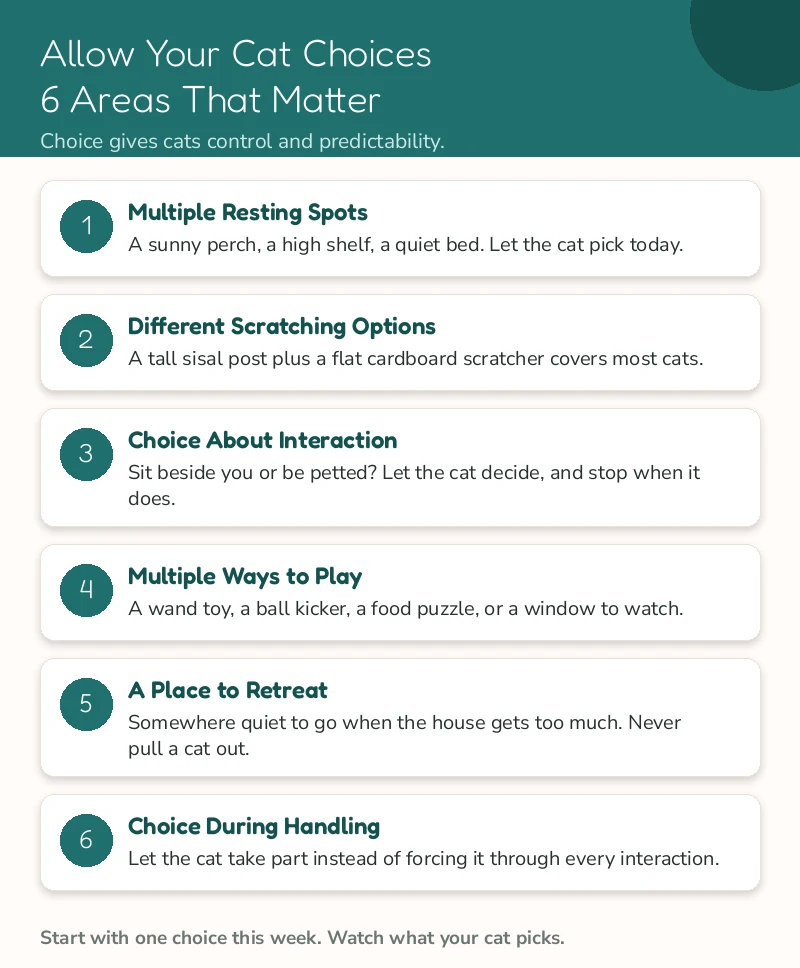
1. Multiple Resting Spots
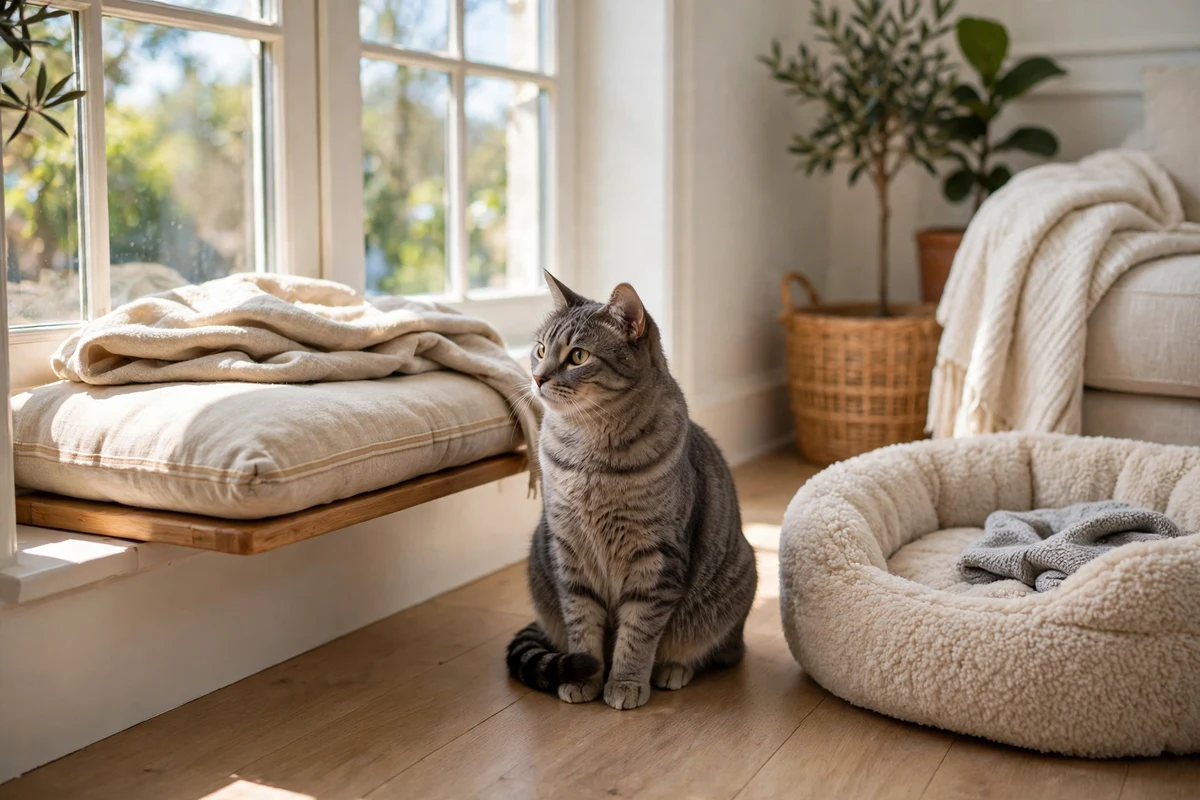
Ask a cat where it wants to sleep and the answer changes during the day. Morning sun on the windowsill, midday shade on the sofa, evening warmth on your lap, and a quiet bed in the corner for the night.
The AAFP and ISFM guidelines list resting and sleeping locations as key environmental resources, and they recommend providing several appealing spots rather than assuming one designated cat bed will do for every occasion.
Offer at least two or three, in different parts of the house, at different heights, and with different temperatures. A sunny perch by a window, a high shelf with a view of the room, and a soft bed in a quiet corner cover most cats.
Do not be surprised when the cat ignores the expensive bed and sleeps on a pile of laundry. That is the cat choosing, and the choice is the point. Our guide to cat sleeping positions explains what each pose means, so you can read how relaxed your cat is in each of its spots.
In a multi-cat home, count the spots. The guideline is one resting place per cat plus one extra, the same rule as litter boxes, so no cat has to compete for a place to sleep. A cat that has to fight for a bed is a cat that has no real choice at all.
2. Different Scratching Options
Scratching is not bad behavior. It is how a cat sheds the old outer layer of its claws, stretches its back and shoulders, relieves stress, and leaves a scent mark from the glands in its paws.
A cat that has nowhere good to scratch will scratch the sofa, and that is not spite. It is a cat using the tallest, sturdiest thing available, because that is what a scratcher is supposed to be.
A 2016 study published in the Journal of Feline Medicine and Surgery surveyed owners about their cats’ scratching, and found that most cats preferred tall, vertical posts covered in sisal or carpet, although individual cats had their own preferences.
Cats Protection gives the matching advice for the other side: if your cat scratches carpets or rugs, offer a flat horizontal scratching pad. Cardboard is cheap, cats love shredding it, and it is the best option for floor-level scratching.
Offer both. A tall, stable sisal post near the sofa, and a flat cardboard scratcher where the cat already scratches the floor, covers most cats. Put the post where the cat wants to scratch, not where it looks tidy, and make sure it does not wobble. A post that rocks when the cat leans into it will be rejected, and the sofa will win again.
3. A Choice About Interaction
This is the choice that changes a relationship. Most cats do not want to be picked up and cuddled on a human schedule. They want to decide when contact happens, and for how long. Research from Nottingham Trent University turned this into a method called the C.A.T. Protocol: Choice, Attention, Touch.
Let the cat initiate contact, pay attention to what it is telling you, and touch only in the ways it enjoys. In the study, this approach significantly reduced aggression and increased friendly behavior during human-cat interactions.
The simplest version of it is the 3-second rule, recommended by Battersea and International Cat Care. Offer your hand at the cat’s level and wait. If the cat rubs against it, stroke for 3 seconds, then stop. If the cat asks for more, give more. If it walks away, that was the whole session, and it went well. Sniffing your hand is not consent. Rubbing against it is.
The same rule answers the question in the reference image: does your cat want to be petted, or would it rather sit beside you? Offer both. Sit on the floor with your hands still, and let the cat choose. Some cats will climb onto your lap.
Some will sit a foot away and simply be near you. Both are affection, and both count. A cat that knows it can say no is a cat that says yes more often.
4. Multiple Ways to Play
Play is hunting practice, and cats need it every day. But not every cat hunts the same way, and not every cat wants the same toy. Offer several kinds and watch what your cat picks: a wand toy for chasing, a ball kicker for wrestling, a food puzzle for thinking, and a window with a view for watching.
A cat that can choose its play is a cat that plays longer and settles better afterward. Our guide to cat zoomies explains what all that energy is for, and why a tired cat is a calm cat.
One honest nuance about food puzzles. A 2021 study at the University of California, Davis gave 17 indoor cats a choice between a food puzzle and a free tray of the same food, and the cats ate more from the free tray. Eight of them never touched the puzzle at all. Cats, unlike most animals tested, do not prefer to work for their food.
That does not mean puzzles are useless: an earlier study found they can help with weight loss, anxiety, and litter box training. It means a puzzle is an option, not a replacement. Put the puzzle next to the normal meal and let the cat choose. Never make a cat work for its only food.
Rotate the toys, not the cat. A toy that has been on the floor for a month is furniture. Put half the toys away, swap them weekly, and the old ones become new again. Ten minutes of active play in the evening, followed by the largest meal of the day, is the routine that works for most cats.
5. A Place to Retreat
Every cat needs somewhere to go when the house gets too much: visitors, a loud television, a dog, a child, a vacuum cleaner.
The AAFP and ISFM guidelines call this a safe place, and they are specific about what it must be: a spot where the cat can get out of sight, is not cornered, and cannot be reached by a person, a dog, or another cat without warning. A cardboard box with a hole cut in the side, a high shelf, a room with the door ajar, or a covered bed in a quiet corner can all work. The cat decides which one is safe, not you.
The rule that matters most is the one people break most often: never pull a cat out of hiding. A cat in its retreat is not being rude. It is coping, and pulling it out takes away the one thing that was helping. Let the cat come out on its own, and it will come out sooner. The same applies to children and visitors.
Teach them that a hiding cat is a cat that is not available, and that waiting is the kindest thing they can do. Our guide to indoor versus outdoor cats covers how to build safe indoor spaces that give a cat room to choose.
A retreat needs an escape route. A hiding spot with only one way in and out is a trap, not a refuge, and a cat will not use it twice. Make sure the cat can leave without passing the thing it is hiding from, whether that is a dog, a visitor, or another cat.
6. Choice During Handling
Handling is where choice is hardest to offer, and where it matters most.
Picking a cat up, putting it in a carrier, trimming its nails, or holding it still at the vet are all moments when a cat has no control, and a cat with no control will fight, freeze, or remember the experience and refuse next time. The fix is to give the cat a part in the process, even a small one.
Start at home. Let the cat walk into the carrier on its own, with a treat inside and the door left open for a week before the trip. Pick the cat up only when you need to, support its body, keep it brief, and put it down the moment it tenses.
During grooming or nail trims, work in short sessions and stop while the cat is still calm, not after it has had enough. The C.A.T. Protocol applies here too: the cat should be the one that starts contact, and you should be the one that ends it early.
At the vet, tell the staff what works for your cat: whether it prefers to stay in the carrier with the top off, whether it calms down with a towel over its head, whether a treat keeps it still. A good vet will work with that, because a cat that feels it has some choice is a cat that can be examined without a fight.
And after any handling your cat did not enjoy, do not chase it to apologize. Let it go to its retreat, and let it come back to you when it is ready. It will, and sooner than you think.
How to Start This Week
Do not try all six at once. Change one thing at a time and judge it over two to three weeks, because stacking five changes at once makes it impossible to tell which one helped.
Start with the easiest one: put a second resting spot somewhere your cat already likes to be, or add a cardboard scratcher next to the sofa. Watch what the cat does. A cat that uses the new option has just told you what it wanted.
Then add the next one, and the next. The order does not matter much, but the sequence does: one change, watch, then the next.
Within a month, most owners see the difference in the same signs the other articles in this series describe: a tail held high, a cat that sleeps out in the open, and a cat that comes to you because it wants to, not because it has nowhere else to go.
If nothing changes after a month, or if the cat is hiding more, eating less, or toileting outside the box, stop treating it as a choice problem and call your vet. Environment helps a healthy cat a great deal. It does not fix a sick one.
Frequently Asked Questions
Will giving my cat choices make it spoiled?
No. Choice is not the same as letting a cat do whatever it wants. The six areas below are all safe and bounded: where to sleep, what to scratch, how to play, when to be petted, where to hide, and how handling happens.
The cat still eats what you provide, goes to the vet when it needs to, and stays indoors if that is your rule. A cat with choices is usually calmer and easier to live with, not harder.
My cat always picks the same spot. Is that a problem?
No. A cat that always picks the same spot has made its choice, and that is the point. The value of the other spots is that they exist when the cat wants them: on a hot day, after a scare, or when a visitor is in the usual place. Keep the options open even if the cat ignores them most of the time.
How many scratchers does one cat need?
At least two, in different places and different orientations: one tall vertical sisal post, and one flat cardboard scratcher. Most cats prefer the vertical post, but the cats that prefer the flat one really prefer it, and a single post will not cover both. In a multi-cat home, add one scratcher per cat, in different rooms.
What if my cat hides all day?
A cat that hides for a few hours after something stressful is normal. A cat that hides all day, every day, is not. It may be in pain, it may be frightened, or the house may not have a safe place it can use without being disturbed.
First check the environment: is the retreat quiet, does it have an escape route, is anyone pulling the cat out? If the hiding continues for more than a day or two, or comes with eating less, call your vet.
How long does it take for choices to make a difference?
Most owners see a change within two to three weeks of adding the first option, usually in small things: the cat sleeping in the open more, greeting you at the door, or playing harder in the evening.
Give each change at least two weeks before judging it. Anxiety settles slowly, and a cat that has had no choices for years will take time to trust that the new ones are real.
The Bottom Line
Your cat does not need a bigger house. It needs a house it can make small decisions in. A second bed, a second scratcher, a toy it can choose, a quiet corner nobody disturbs, and a person who asks before touching.
Those six choices cost almost nothing, and they are the difference between a cat that endures its home and a cat that owns it. Start with one this week, watch what your cat picks, and let the cat teach you the rest.