
5 Types of Cat Head Bumps and What They Mean
Your cat walks up, presses its forehead into your hand, and holds it there. Or it gives you one soft tap and walks on. Or it bonks you hard enough to make you laugh. These are not the same gesture. Cats have at least 5 distinct head bump styles, and each one carries a slightly different message. Learn to tell them apart and you will know when your cat is saying hello, when it wants attention, and when it is asking you to stay put and keep petting.
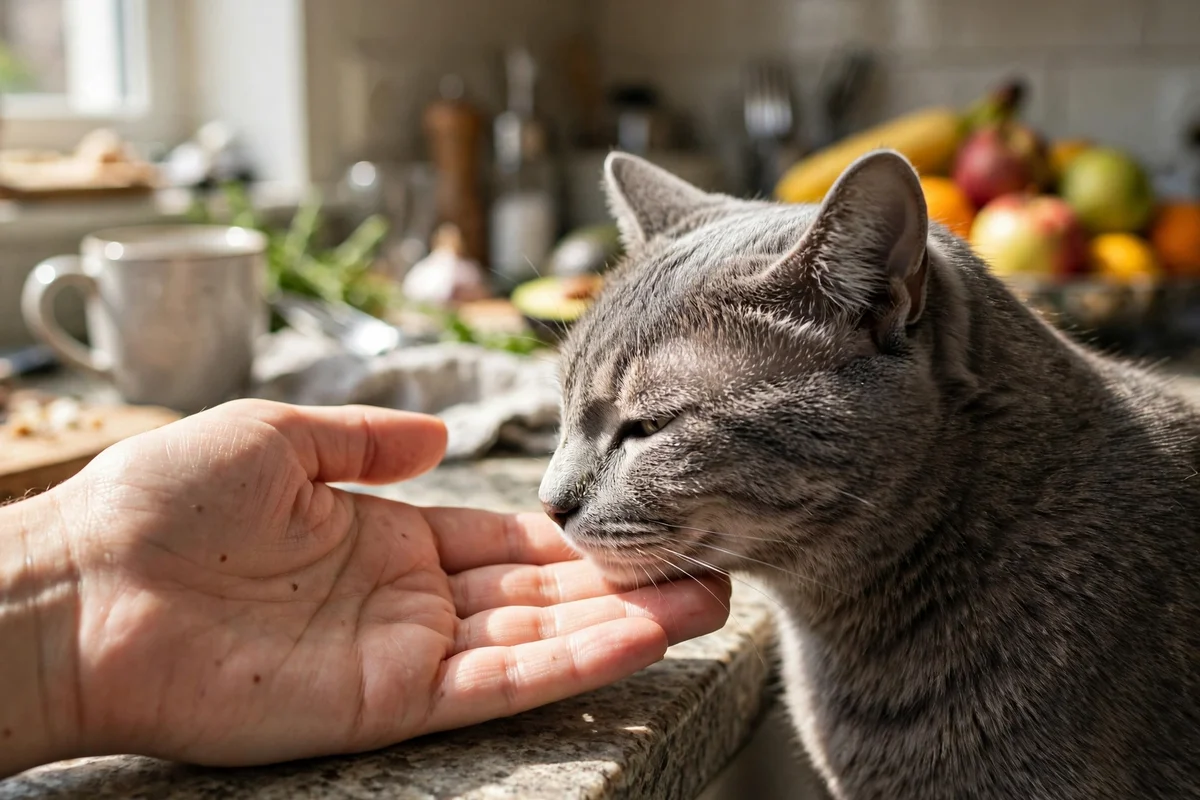
The short answer is that a head bump, also called bunting or headbutting, is a friendly social behavior. Your cat is pressing scent glands on its face against you to mark you as familiar and safe, and to mix its scent with yours. It is one of the warmest compliments a cat can pay. The details below show which bump you just got.
The information here is general information only and is not veterinary advice. If your cat’s behavior changes suddenly, or a change comes with hiding, appetite change, or signs of pain, contact your vet.
Key Takeaways
- A head bump is called bunting. It is a normal, friendly behavior, not aggression.
- Cats have scent glands on the forehead, cheeks, lips, chin, and near the ears. A bump deposits pheromones that mark you as familiar and safe.
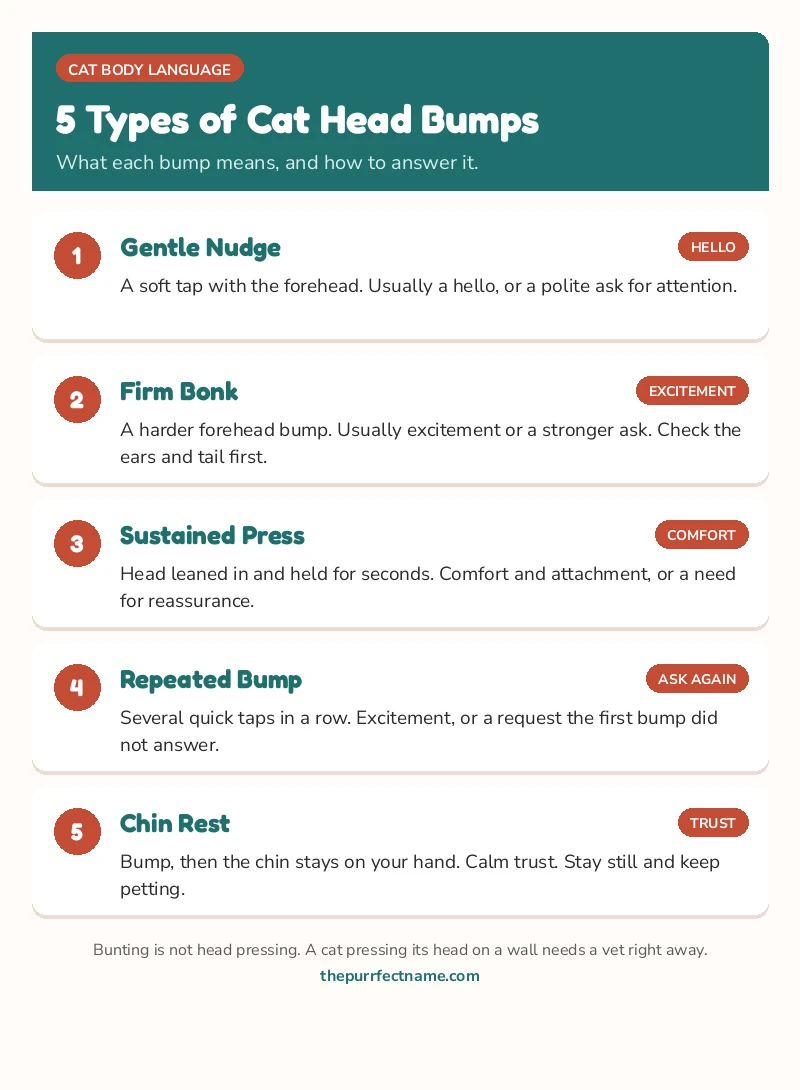
- The 5 types are the Gentle Nudge, the Firm Bonk, the Sustained Press, the Repeated Bump, and the Chin Rest.
- A firm bump does not prove stronger love. It usually means excitement or a stronger request, so read the rest of the body before you decide what it means.
- Head bumping is not head pressing. Head pressing is a cat pushing its head against a wall or floor and holding it there, and it needs an immediate vet exam.
- Answer a bump with light pets on the cheeks, chin, and base of the ears, and stop when your cat moves away.
What Is Bunting?
Bunting is the behaviorist name for a cat pressing or rubbing the top of its head, its forehead, its cheeks, or its chin against a person, another cat, or an object. It is slow, deliberate, and almost always aimed at someone the cat trusts. Cats do not bunt strangers or things that make them uneasy. Bunting is reserved for the inner circle.
When your cat bunts you, it is doing two things at once. It is saying hello in the way cats greet each other, and it is leaving its scent on you. Cats that live together do the same thing with each other, a back and forth ritual called allorubbing, which blends their individual scents into one shared group scent. When your cat bunts you, it is folding you into that group.
A bump is often joined by other friendly signals. Purring, kneading, a tail held high, and a slow blink all point the same way. Our guide on why cats purr explains that purring is not always happiness on its own, so read the whole cat, not one signal. Our guide on cat ear language shows how ear position adds to the picture, and our guide on cat tail language covers the tail half of the same conversation.
The Scent Glands Behind Every Bump
Your cat’s face is covered in scent glands. Each gland zone powers a different kind of bump, which is why the type matters.
| Gland zone | Where it sits | The bump it powers | What it usually means |
|---|---|---|---|
| Temporal glands | Between the eyes and the base of the ears | Direct forehead bump | Greeting, bonding, deep trust |
| Cheek glands | On the cheeks and along the jaw | Cheek rub and side swipe | Marking you as familiar |
| Perioral glands | Around the lips | Lip and mouth rub | Close contact marking |
| Submandibular glands | Under the lower chin | Chin hook and chin rest | Scent anchoring, calm trust |
The pheromones these glands release are undetectable to the human nose but clear to another cat. One fraction, called F3, is linked to marking familiar territory and feeling safe. Another, called F4, is linked to social rubbing between bonded cats. That is the science in one sentence: your cat is making you smell like home.
5 Types of Cat Head Bumps and What They Mean
Read the pressure, the duration, and what happens next. Those three details separate one type from another.
1. The Gentle Nudge
A soft tap with the forehead or the side of the head, then a pause. This is the most common bump and the easiest to read. It usually means hello, or a polite request for attention. Your cat may follow it with a purr, a rub, or a look up at you. If you pet it, the nudge has done its job. If you are busy, a quick stroke on the cheek is usually enough.
2. The Firm Bonk
A harder bump, forehead first, sometimes with a little thud you can feel. It is tempting to read this as extra love, but the sources do not support that. A firm bump is usually excitement, or a stronger request for something your cat wants right now, such as food, play, or a door opened.
It can also come with tension, so check the rest of the body. Relaxed ears, soft eyes, and a loose tail point to excitement. Flattened ears, a twitching tail, or a tense body point to frustration, and that is a cue to give your cat space instead of more petting.
3. The Sustained Press
Your cat leans its head into you and holds it there for several seconds, sometimes with its eyes half closed. This is a deeper version of the nudge. It usually means comfort and attachment, or a need for reassurance. A cat that sustains a press after a loud noise, a visitor, or a vet trip is often soothing itself with your scent. Stay still, keep your hand where it is, and let the cat decide when the press ends.
4. The Repeated Bump
Several taps in quick succession, often aimed at the same spot. This usually means excitement or a repeated request that the first bump did not answer. It is common around feeding time, play time, and the front door when you come home. If the taps keep coming with a tense body, loud meowing, or pacing, your cat may be anxious rather than playful. In that case, check for what changed in the house before you assume it wants a game.
5. The Chin Rest
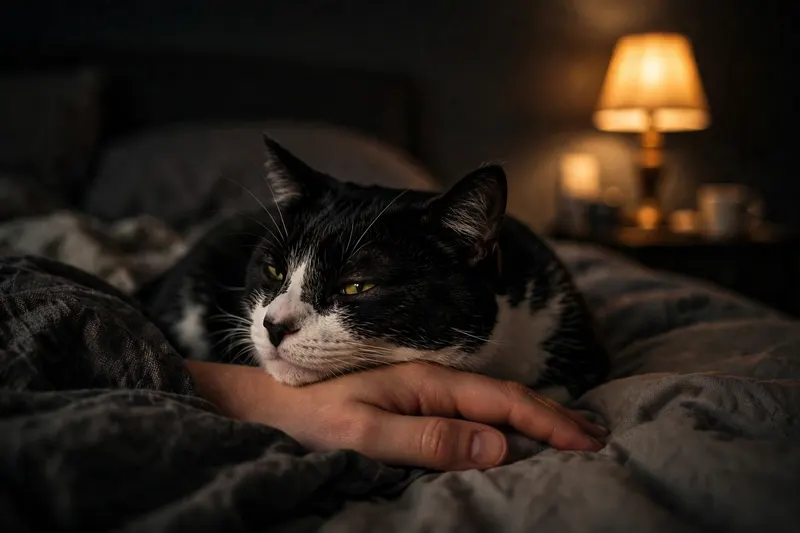
Your cat bumps you, then leaves its chin resting on your hand, your arm, or your leg, and stays there. This is the quietest type and often the most trusting. The glands under the chin are marking you while the cat rests, and the cat is choosing to stay in contact rather than move on. Do not move. A chin rest is usually a request for company, not for play, and the best answer is a slow stroke under the chin and a few minutes of stillness.
How to Respond to a Head Bump
Answer the bump where your cat offered it. Light pets on the cheeks, under the chin, and at the base of the ears feel best, because that is where the scent glands are. Keep your touch slow and short at first. If your cat leans back in, it wants more. If it turns its head, flicks its tail, or walks away, the moment is over. Do not chase it for another bump.
A lower head of your own can help. Lean down slowly and let your cat meet your forehead if it wants to. Some cats will return the gesture with a soft forehead to forehead tap. If your cat backs away, do not follow. Trust is the cat’s choice, and a bump refused is not a rejection.
Bunting Is Not Head Pressing
This is the one warning in this article, and it matters. Bunting is social, brief, and relaxed. Head pressing is different, and it is serious.
| Sign | Bunting | Head pressing |
|---|---|---|
| Target | You, another cat, or a familiar object | A wall, corner, floor, or heavy furniture |
| Movement | Active, brief, then the cat moves on | Compulsive, prolonged, the cat seems stuck |
| Body language | Relaxed, purring, soft eyes, slow blinks | Blank or distressed look, disorientation |
| Other signs | None, the cat behaves normally after | Pacing, vision changes, wobbling, strange vocalizing |
Head pressing can be a sign of a serious neurologic condition, and PetMD advises an immediate vet exam if you see it. Do not wait to see whether it resolves on its own. If your cat is pressing its head against a hard surface for no clear reason, especially with confusion or a wobbly walk, contact your vet or an emergency vet right away.
When a Bump Changes
A cat that used to bunt every evening and suddenly stops may not be feeling well, especially if the change comes with lethargy, grumpiness, hiding, or eating less. A cat that suddenly bunts far more than usual may be anxious, in pain, or asking for help in the only way it knows. Both changes are worth a vet visit if they last more than a day or come with other symptoms. A single quiet evening means nothing. A pattern means something.
Frequently Asked Questions
Why does my cat headbutt me?
Your cat is greeting you, marking you with its scent, and showing trust. The most common reasons are affection, a hello, scent marking, attention, and self soothing. Read the pressure and duration to tell which one applies.
Is headbutting a sign my cat loves me?
It is a sign your cat trusts you and counts you as part of its group. No single bump proves love on its own, but a cat that bunts you regularly has chosen you as safe and familiar.
Why does my cat headbutt me so hard?
A hard bump usually means excitement or a stronger request, not stronger love. Check the ears, tail, and body tension. If the body is relaxed, it is excitement. If the body is tense, give your cat space.
Should I headbutt my cat back?
You can lower your head slowly and let your cat come to you. Do not push your forehead into your cat. Let the cat decide the contact.
What is the difference between bunting and head pressing?
Bunting is a brief, social press against you or a familiar object, with relaxed body language. Head pressing is a prolonged, compulsive press against a wall or floor, often with disorientation, and it needs an immediate vet exam.
The Bottom Line
A head bump is your cat’s way of saying you belong to its group. The Gentle Nudge is a hello. The Firm Bonk is excitement or a stronger ask. The Sustained Press is comfort. The Repeated Bump is a request that needs an answer. The Chin Rest is trust, plain and simple. Learn the five, answer them gently, and watch for the one pattern that is not a bump at all. Head pressing is the exception, and it always deserves a vet call.