
5 Cat Personality Types: Which One Is Your Cat?
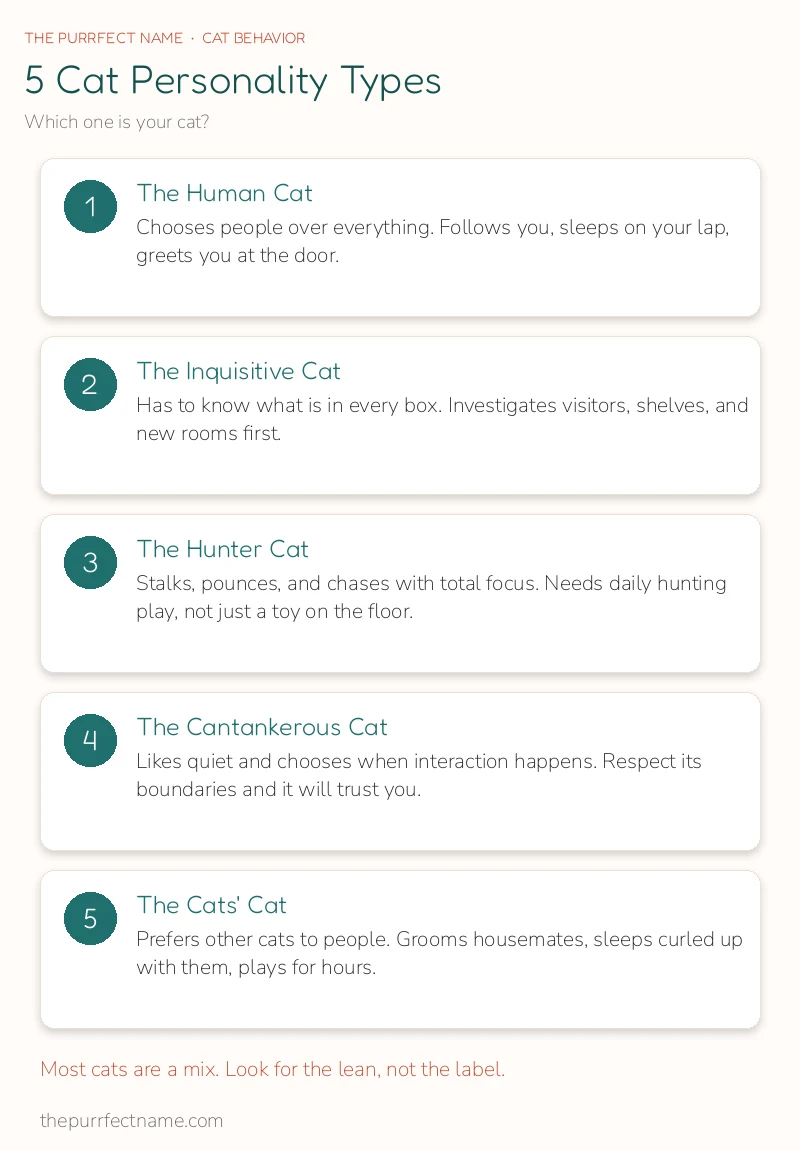
There are 5 cat personality types, identified by researcher Dr. Lauren Finka after studying about 200 cats and their owners: the Human Cat, the Inquisitive Cat, the Hunter Cat, the Cantankerous Cat, and the Cats’ Cat. Most cats lean toward one or two of these, and almost none fits a single type perfectly.
Every cat owner has met the cat that does not fit the label. The lap cat that suddenly turns into a hunter at 3 in the morning. The aloof cat that follows one person from room to room. The shy cat that turns fearless with a feather wand. Cats are not one personality, and they are not five neat boxes either. But five patterns show up again and again, and learning them makes it much easier to give your cat the life it actually wants.
A separate study, the Feline Five, measures five trait dimensions in every cat instead of sorting cats into types, and this article keeps the two frameworks apart so you do not mix them up.
The information here is general information only and is not veterinary advice. If your cat’s behavior changes suddenly, or a change comes with hiding, appetite change, or signs of pain, contact your vet.
Key Takeaways
- The 5 types are the Human Cat, the Inquisitive Cat, the Hunter Cat, the Cantankerous Cat, and the Cats’ Cat, from Dr. Lauren Finka’s research on about 200 cats and their owners.
- Most cats are a mix. Use the types as a way to observe your cat, not as a fixed label.
- Personality comes from genetics, the parents’ temperament, and experiences during development and adulthood.
- The Feline Five is a different study: 5 trait dimensions (Neuroticism, Extraversion, Dominance, Impulsiveness, Agreeableness) measured in 2,802 cats, not 5 cat types.
- Once you know your cat’s lean, you can match its play, its space, and its social life to what it actually enjoys.
Before You Sort Your Cat: Most Cats Are a Mix
Finka’s types were built to help shelters match cats to homes, not to hand out permanent labels. Her project, “The prediction of human-sociability in the domestic cat,” was supported by International Cat Care and the Centre of Applied Pet Ethology, and its goal was practical: help rehoming teams read a cat quickly and place it well. The types describe leanings, and a cat can be a Human Cat with its favorite person and a Cantankerous Cat with strangers, or a Hunter Cat at dawn and a lap cat by evening.
Personality itself comes from a mix of causes. Finka’s work points to genetics, the temperament of the cat’s parents, the cat’s own DNA, and its experiences during development and in adulthood. Early life matters most: the socialization sensitive period starts at around 2 weeks of age, and a kitten that misses positive human contact between about 2 and 7 to 8 weeks of age may grow up wary of people for life.
That is why two cats from the same litter can turn out so differently. Read the five types below with that in mind, and look for the lean, not the label.
If you already have a name in mind for the personality you see, our names by personality list groups names the same way, so you can match a name to the cat in front of you.
1. The Human Cat: Your Shadow With Whiskers
How to spot it: this cat chooses people over everything else. It follows you from room to room, sleeps on your lap or your pillow, greets you at the door, and asks for attention with head bumps, chirps, and slow blinks. It is happy to share your home, your life, and often your personal space, and it usually prefers a person to a toy.
What it needs: company and contact. Play with it daily, talk to it, and give it lap time on a predictable routine. A Human Cat left alone for long stretches may get bored or restless, so puzzle feeders, a window perch, and a second daily play session help on work days.
Common mistake: assuming it wants cuddles on demand. Even a Human Cat has moods, so let it come to you and end petting while it is still enjoying it.
2. The Inquisitive Cat: The Explorer
How to spot it: this cat has to know what is in the box, behind the door, and on top of the shelf. It investigates every new bag, greets visitors, and treats a rearranged room like a new country to map. It is playful, alert, and outgoing, and it gets bored fastest when nothing changes.
What it needs: novelty and safe exploration. Rotate toys instead of leaving the same ones out, add shelves and perches at different heights, and let it watch the world from a window. New people and new objects are enrichment for this cat, not a threat, so introduce change in small doses and let it investigate at its own pace.
Common mistake: keeping its world too small. An Inquisitive Cat in a single room with no vertical space and no new sights will invent its own entertainment, usually at 3 in the morning.
3. The Hunter Cat: The Athlete
How to spot it: this cat stalks, pounces, and chases with total focus. It watches birds from the window for an hour, brings you toy mice or, less welcome, real prey, and treats a feather wand like a serious job. All cats hunt, but the Hunter Cat lives for it, and it has the energy to match.
What it needs: daily hunting play, not just a toy left on the floor. Use wand toys that mimic prey, let the cat stalk and catch, and finish with a small meal or treat so the hunt ends the way a real hunt would. Puzzle feeders that make it work for food also help. Without an outlet, a Hunter Cat gets frustrated and may redirect that energy onto ankles, curtains, or other pets. Our guide to playing with your cat the right way shows how to run a proper hunt and play session.
Common mistake: playing with hands. Hands teach the cat that people are prey, and that lesson is hard to unteach.
4. The Cantankerous Cat: The Cat on Its Own Terms
How to spot it: this cat likes quiet spaces, chooses when interaction happens, and says no clearly. It may be easily frustrated, less tolerant of handling, and sensitive to touch and to changes in its environment. It is often on high alert, and it may swat or walk away when attention goes on too long. None of that makes it a bad cat. It makes it a cat with firm boundaries.
What it needs: respect, routine, and space. Give it high perches and hiding spots it can retreat to, keep its routine steady, and let it approach you instead of picking it up. Keep petting short and in the zones most cats prefer, the cheeks and chin, and stop before it asks you to stop.
Common mistake: pushing for affection. The fastest way to earn a Cantankerous Cat’s trust is to stop asking for it and let the cat decide. Over weeks and months, many Cantankerous Cats become deeply loyal to one person, on their own schedule.
5. The Cats’ Cat: The Social Cat, With Other Cats
How to spot it: this cat is less focused on people and far more interested in other cats. It grooms its housemates, sleeps curled up with them, plays with them for hours, and seems most relaxed in feline company. A Cats’ Cat may tolerate you politely and still choose the other cat’s bed over your lap every time.
What it needs: feline company, or at least the option of it. If you are considering a second cat, this is the type that benefits most, but introductions still need to be slow and careful, and not every cat pair will bond. Give it shared perches, multiple food and water stations, and enough litter boxes that no cat has to guard a resource.
If a second cat is not possible, extra play and a window with a view of the outside world help, but they do not fully replace another cat. Read should you get a second cat before you decide, because a second cat is a ten year commitment, not a toy for the first one.
Common mistake: assuming it does not like you. It does, in its own way. It just prefers cats, and that is fine.
Quick Check: Which Type Leans Closest to Your Cat?
Answer these five questions honestly, and the type with the most yes answers is your cat’s lean. This is a casual observation check, not a validated test, and most cats will score yes on more than one.
- Does your cat follow you from room to room and choose your lap over a toy? That leans Human Cat.
- Does your cat investigate every new box, bag, and visitor first? That leans Inquisitive Cat.
- Does your cat stalk and pounce daily, and treat wand toys like a job? That leans Hunter Cat.
- Does your cat walk away or swat when petting goes on too long, and prefer quiet corners? That leans Cantankerous Cat.
- Does your cat groom, sleep with, and play with other cats more than with people? That leans Cats’ Cat.
If you got three yes answers, congratulations: you have a normal cat. Blends are the rule, and the lean can shift with age, health, and who is in the house.
The Other Feline Five: 5 Trait Dimensions, Not 5 Types
You will also see the phrase “Feline Five” used for a different study, and the confusion is so common that it needs its own section. In 2017, Litchfield and colleagues at the University of South Australia published a study in PLOS ONE that asked owners of 2,802 pet cats in South Australia and New Zealand to rate their cats on 52 personality traits. The analysis found five reliable trait dimensions: Neuroticism, Extraversion, Dominance, Impulsiveness, and Agreeableness.
These are sliding scales, not types. Every cat scores somewhere on each one. Neuroticism covers insecure, anxious, fearful of people, suspicious, and shy. Extraversion covers curious, active, and engaged. Dominance covers bullying, dominant, and aggressive to other cats. Impulsiveness covers impulsive, erratic, and reckless. Agreeableness covers affectionate, friendly to people, and gentle.
The study’s authors noted that high Agreeableness likely marks cats that are well adjusted and happy, and that such cats can be a source of enrichment for other cats.
So the two frameworks answer different questions. Finka’s five types ask: what kind of cat is this, in plain words a shelter worker can use? Litchfield’s Feline Five asks: where does this cat sit on five measured scales? Both are useful, and neither one puts your cat in a single box.
How to Use Your Cat’s Type
Start with one change, not five. If your cat leans Hunter, add one real hunt and play session a day. If it leans Cantankerous, add one hiding spot and stop picking it up for a week. If it leans Human, add a predictable lap time each evening. Watch for a week and see what changes. The type is a guess about what your cat wants, and your cat’s response is the test of that guess.
Also remember that personality shifts. Kittens are usually more Inquisitive and more Hunter than they will be as adults. Older cats often lean more Cantankerous as their joints ache or their hearing fades, and a cat that suddenly turns grumpy or withdrawn deserves a vet check before you relabel it. Types help you understand your cat. They never replace watching the cat in front of you.
Frequently Asked Questions
Can a cat be more than one personality type?
Yes, and most cats are. Finka’s types describe leanings, not fixed boxes. A cat can be a Human Cat with its favorite person, a Hunter Cat at dawn, and a Cantankerous Cat with strangers, all in the same day.
What is the difference between Finka’s 5 types and the Feline Five?
Finka’s 5 types are five named profiles (Human, Inquisitive, Hunter, Cantankerous, Cats’ Cat) from a study of about 200 cats and owners. The Feline Five is a 2017 study of 2,802 cats that found five trait dimensions (Neuroticism, Extraversion, Dominance, Impulsiveness, Agreeableness) that every cat scores somewhere along. They are different studies with similar names.
Can a cat’s personality type change?
Its lean can shift with age, health, and environment. Kittens are usually more curious and more hunter driven. Older cats may become less tolerant of handling. A sudden change in personality is worth a vet visit, because pain and illness change behavior first.
Which personality type is best for a family with children?
There is no single best type, and the individual cat matters more than the label. As a rough guide, Human Cats and Inquisitive Cats usually enjoy busy homes, while Cantankerous Cats do better in quiet homes with older children who respect boundaries. Always meet the cat first.
Does breed decide personality type?
No. Finka’s research found personality comes from genetics, the parents’ temperament, and life experience, not from breed alone. Breed can tilt the odds, but two cats of the same breed can have very different types.