
11 Signs Your Cat Is Basically a Baby (Funny Proof)
Your cat screams at 3 a.m., naps all day, cries for attention, chews everything in reach, and knocks your glass off the table while looking you dead in the eye. Then it curls up on your chest and you forgive all of it in about four seconds. If that sounds familiar, congratulations: you are not a cat owner. You are a parent, and your baby has fur, claws, and zero respect for your sleep schedule.
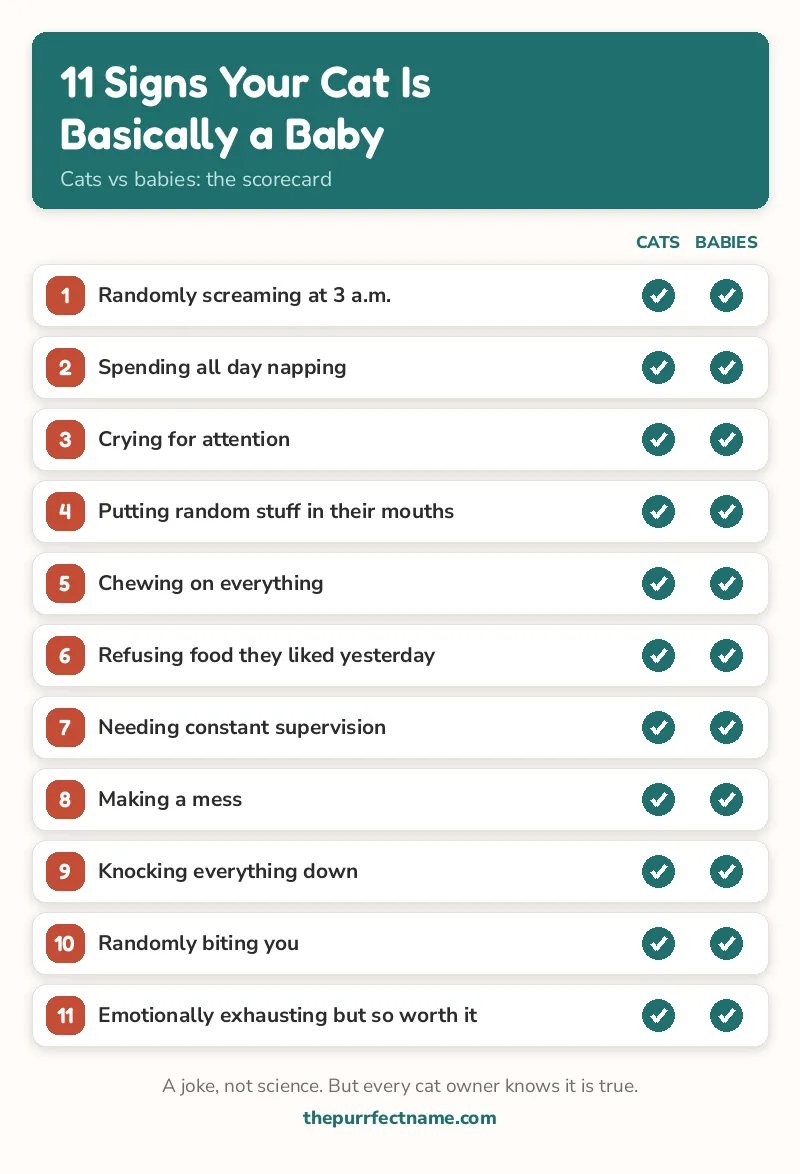
This is a joke, not science. Nobody is claiming cats are literally human babies. But the viral table that started this whole argument lists 11 traits that cats and babies share, and every single one of them is true. Here are the 11 signs, one by one, with the evidence.
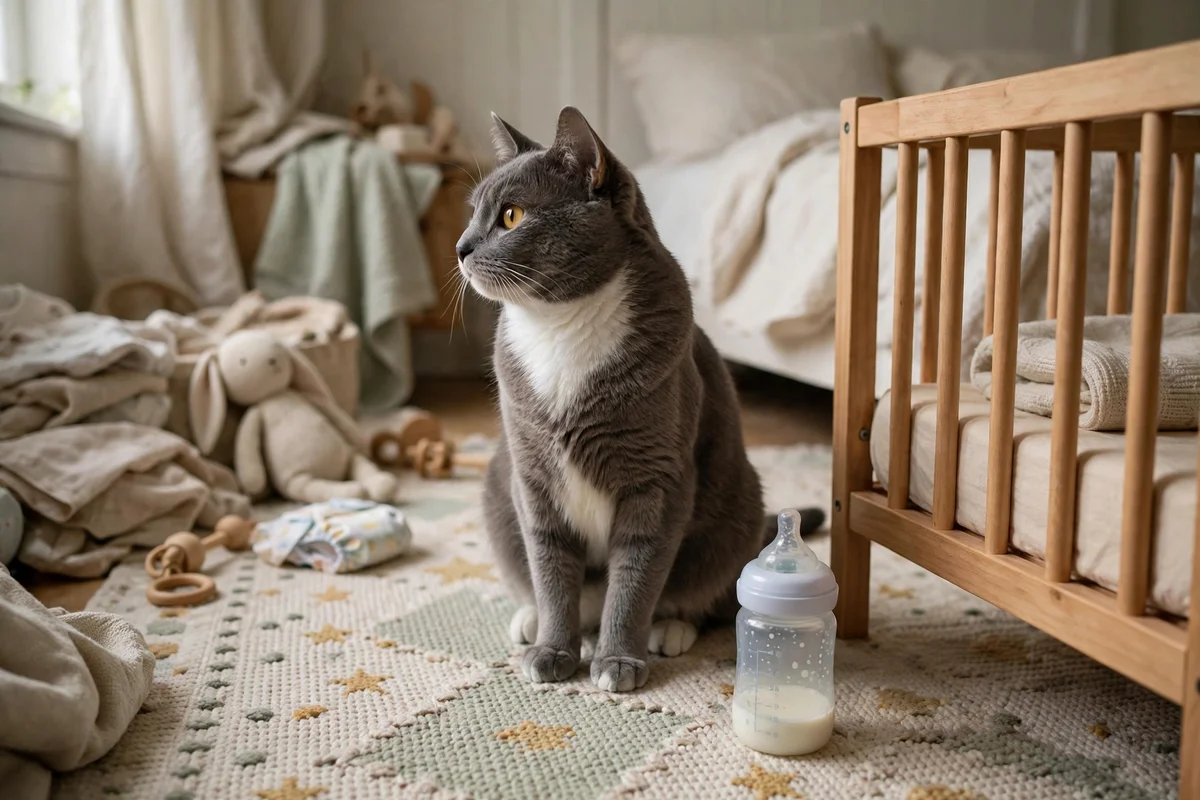
Key Takeaways
- 11 traits appear in the viral cats versus babies table, and all 11 match real cat behavior.
- Cats sleep 12 to 16 hours a day, which is why the napping never stops.
- Cats are crepuscular, most active at dawn and dusk, which is why 3 a.m. feels like their favorite hour.
- There is real science behind why cats look and sound baby-like, but the table itself is a joke.
- The verdict is unanimous: emotionally exhausting but so worth it.
11 Signs Your Cat Is Basically a Baby
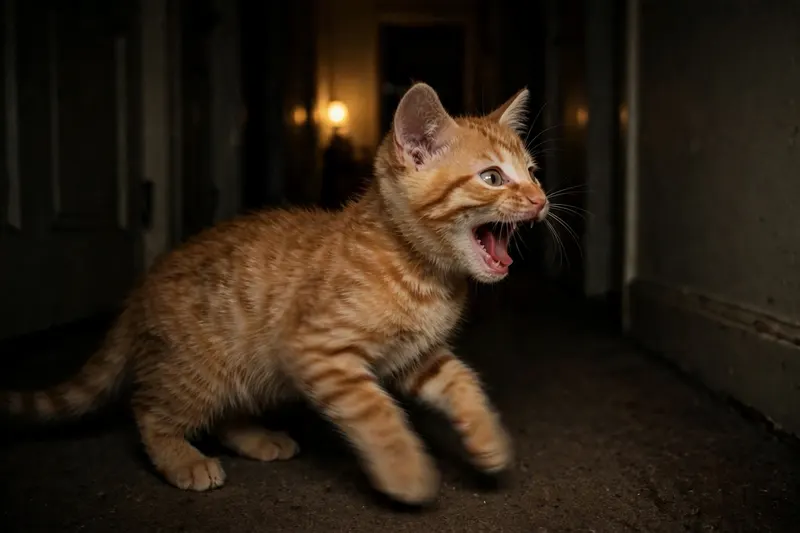
1. Randomly screaming at 3 a.m.
There is no warning. The house is silent, you are deep asleep, and then a yowl rips through the dark like a fire alarm with feelings. A baby cries at 3 a.m. because it is hungry or wet or lonely. A cat yowls at 3 a.m. because it is a crepuscular hunter whose body clock peaks before dawn, and because it slept 12 to 16 hours during the day and is now fully charged.
Our guide to why cats get the zoomies at night explains the same pattern: a rested hunter, a quiet house, and a body full of stored energy. The sound is different, the hour is the same, and the effect on your sleep is identical.
2. Spending all day napping
A baby sleeps most of the day because it is growing. A cat sleeps most of the day because it is a cat. Healthy adult cats typically sleep 12 to 16 hours a day, according to the Cornell Feline Health Center, broken into many short naps. Your cat is not lazy. It is running a highly efficient energy budget: sleep hard, sprint hard, sleep again.
The only difference from a baby is that the baby eventually grows out of it. The cat does not. A 12 year old cat still naps like it has a big day of nothing planned, because it does.
3. Crying for attention
A baby cries and a parent comes running. A cat meows and a human comes running. That is not a coincidence.
Adult cats rarely meow at each other; the meow is mostly a sound they aim at humans. Researchers have found that domestic cat meows are shorter and higher pitched than wild cat calls, and that they can resemble the cry of a human baby.
Your cat has, over thousands of years of living with people, developed a sound that is very hard for a human brain to ignore. It works on you the same way a baby’s cry works on you, which is the whole point.
4. Putting random stuff in their mouths
Babies explore the world by putting it in their mouths. Cats explore the world the same way, except the world includes your charging cable, a hair tie, a rubber band, and that one sock you thought was safely in the drawer.
Kittens do it while learning. Adults do it because the mouth is how a cat tests whether something is food, a toy, or a toy that might be food. The supervision rule is the same for both: if it is small enough to swallow, it needs to be out of reach.
5. Chewing on everything
A baby chews because it is teething. A cat chews because the texture is interesting, the thing moves, or the thing is yours and therefore better than its own toys. Cables, cardboard corners, plant leaves, the edge of your book: all fair game. Kittens chew most while their adult teeth come in, but plenty of adults never stop. The difference is that a baby gets a teething ring. A cat gets your laptop charger, and you get to buy a new one.
6. Refusing food they liked yesterday
Yesterday your cat loved the salmon pate. Today your cat sniffs it, looks at you like you have insulted its ancestors, and walks away. A baby does the same thing with peas. The food did not change. The mood changed. Cats are famously fussy about temperature, texture, freshness, and whether the bowl was washed to their satisfaction. The only reliable rule is that the food they refuse today is the food they will demand tomorrow, and the food they demand tomorrow is the food they will refuse the day after.
7. Needing constant supervision
You cannot leave a baby alone in a room. You cannot leave a cat alone in a room either, not if the room contains anything breakable, chewable, climbable, or openable. A baby needs supervision because it is helpless. A cat needs supervision because it is the opposite of helpless: it can open doors, climb shelves, knock over lamps, and get itself stuck in places you did not know existed. Both of them will find the one dangerous thing in a childproofed room within minutes.
8. Making a mess
A baby makes a mess with food, toys, and everything it touches. A cat makes a mess with litter tracked across the floor, fur on every surface, a water bowl tipped over for reasons nobody understands, and a toy mouse under the sofa that will stay there until you move house. The mess is different in detail and identical in spirit: you clean it up, you turn around, and it is back. Cat owners who also have babies report the same feeling twice a day, once per species.
9. Knocking everything down
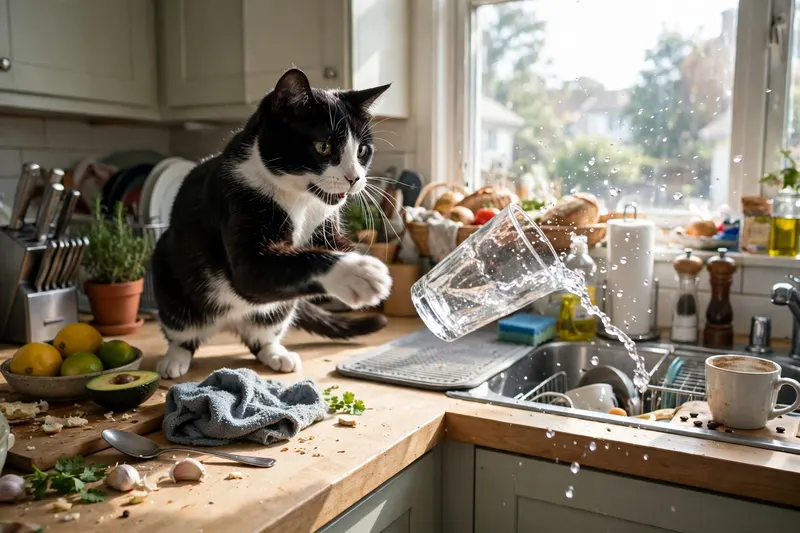
This is the trait that sells the whole comparison. A baby knocks things down by accident. A cat knocks things down on purpose, slowly, while maintaining eye contact, as if conducting a physics experiment with your favorite mug as the test subject. It is not clumsiness. It is curiosity plus paws plus gravity, and the cat is genuinely interested in what happens when the glass meets the floor. The answer is always the same: it breaks, you sigh, and the cat looks pleased with the result.
10. Randomly biting you
A baby bites while teething or playing. A cat bites while playing, while being petted, while being loved too much, or for absolutely no reason at all at 2 p.m. on a Tuesday.
Most of the time it is not aggression. It is overstimulation, or play that went one step too far, or a love bite that was slightly more bite than love. The rule for both is the same: stay calm, stop the game, and do not reward the bite with a big reaction.
The cat will forget about it in a minute. You will remember it every time you see the tiny mark on your hand.
11. Emotionally exhausting but so worth it
This is the trait that turns the joke into something true. A baby exhausts you and you would not trade it for anything. A cat exhausts you and you would not trade it for anything.
The 3 a.m. screaming, the mess, the knocked over glasses, the refused food, the random bites: all of it is real, and all of it is forgiven the moment the cat falls asleep on your lap and starts purring.
That is the whole argument in one line. It is not proof that cats are babies. It is proof that loving something small and chaotic feels the same no matter how many legs it has.
The Science Bit, Honestly
The table is a joke, but the reason the joke lands has real science behind it. Cats look baby-like because of something researchers call the baby schema: a large head and round face, large eyes, a small nose and a small mouth. People rate kittens as equally cute as human infants, and cute features trigger a strong urge to care for and protect the creature that has them.
Cats also knead, a behavior that starts with kittens pressing their mother’s belly while nursing, and many adults keep doing it as a comfort behavior. And adult cats meow mainly at humans, in a pitch that researchers say can resemble a baby’s cry.
There is even a 2026 study behind the comparison. Researchers at Kyoto University surveyed about 310 cat owners and found a group of cats that are fearful yet curious about strangers, a mix that resembles shyness in human infants from about 9 months old. The study was published in the journal PLOS One on 2026-11-04, and the researchers were careful: only a subset of cats showed the mix, the findings came from owner surveys rather than direct observation, and further study is needed.
It does not prove cats are babies. It does prove that the comparison is not entirely made up, which is more than the joke needs.
The Verdict: 11 Out of 11
Every trait in the table checks out. Cats scream at night, nap all day, cry for attention, mouth random objects, chew everything, refuse yesterday’s favorite food, need supervision, make messes, knock things down, bite without warning, and exhaust you completely while being entirely worth it. The score is 11 out of 11, and the case is closed, at least as far as jokes go.
If the table made you laugh, our 25 cat name memes will feel familiar too, because every one of them is built on the same truth: living with a cat is funny, chaotic, and a little bit like raising a tiny furry person who never grows up. And if your baby-like cat still needs a name, our funny cat names list has 284 picks, each with its meaning and the joke behind it.
FAQ
Are cats really like babies?
Not literally. Cats are adult animals with their own behavior and needs. But they share a lot of surface traits with babies: they sleep most of the day, they cry for attention, they need supervision, and they make messes. The comparison is a joke that works because the overlap is real.
Why do cats scream at 3 a.m.?
Cats are crepuscular, most active at dawn and dusk, and they sleep 12 to 16 hours a day, so they often wake up full of energy while the house is quiet. Hunger, boredom, and learned behavior can add to it. Our zoomies guide covers the full list of causes and what helps.
Why does my cat knock things off tables?
Curiosity and hunting instinct. A cat tests objects with its paws, and moving objects are interesting. It is normal behavior, not spite, though it certainly feels personal when the object is your favorite mug.
Is it normal for a cat to bite during play?
Play biting and love bites are common, especially in kittens and young cats. It is usually overstimulation or play that went too far, not aggression. If biting is sudden, hard, or comes with other changes in behavior, talk to a vet, because pain or stress can also be behind it.
Do cats ever grow out of acting like babies?
Not really. Kittens are the most chaotic, adults settle into a steadier pattern, and seniors slow down, but the baby-like traits never fully leave. A 12 year old cat will still nap all day, demand attention, and knock a glass off the table if it feels like it. That is part of the deal.