
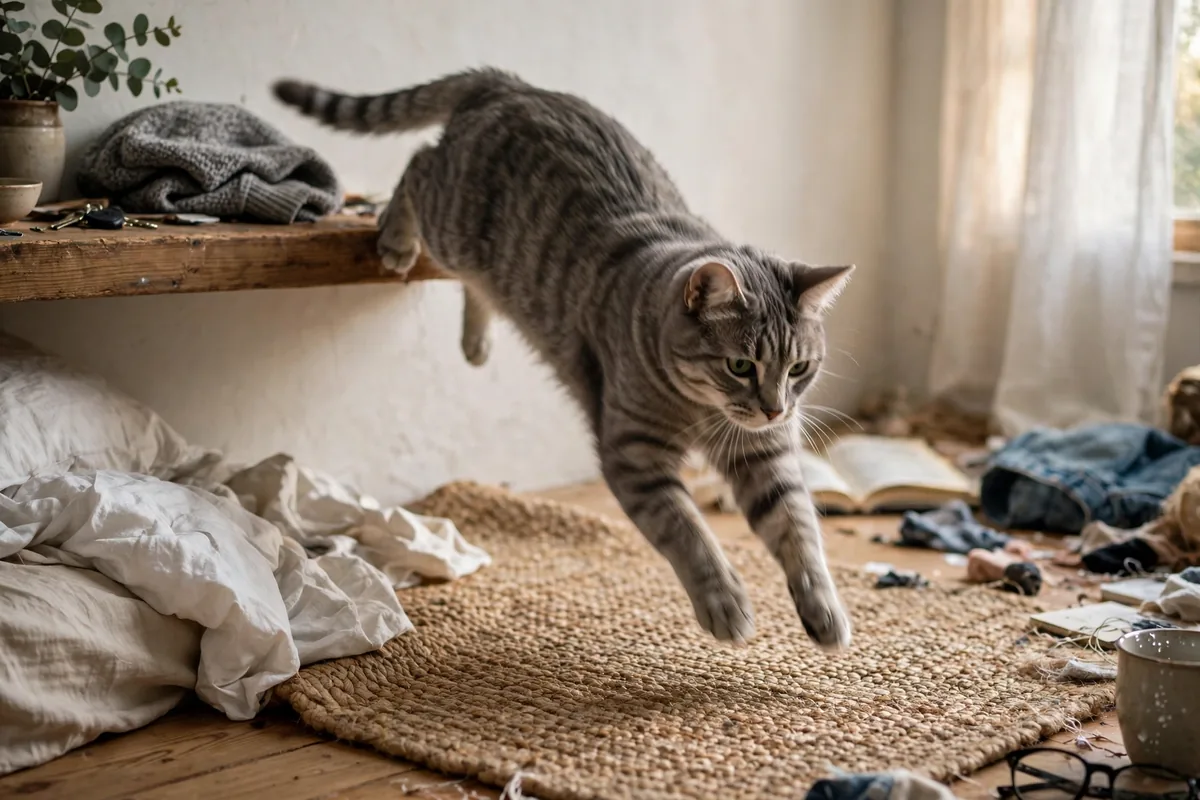
Do Cats Always Land on Their Feet? Explained
No, cats do not always land on their feet. They usually do, and the way they do it is one of the most remarkable pieces of animal engineering you will ever see, but usually is not always. A cat that falls from a bookshelf, a balcony or a window can twist in midair, get its feet underneath it, and still land badly hurt. Short falls give it no time to turn. Very high falls give it time to turn and still hit the ground hard enough to break bones and bruise lungs. The righting reflex is real, but it is not a safety net.
The information here is general information only and is not veterinary advice. If your cat falls from any height, contact your vet, even if your cat looks fine.
Key Takeaways
- No, cats do not always land on their feet, though healthy adult cats usually manage it when they have enough height and time.
- The righting reflex is an automatic response driven by the balance system in the inner ear, a very flexible spine, and no fixed collarbone.
- A cat needs roughly 12 inches of fall to complete the turn. Below that, there is often not enough time.
- Landing feet first does not mean landing safely. Legs, jaws, teeth, chests and lungs are often injured anyway.
- The famous claim that higher falls are safer is wrong. Newer and larger studies show injury gets worse as height rises.
- High rise syndrome is the veterinary name for the pattern of injuries from falls from the second story or higher.
- Any fall from a height deserves a vet check, even if the cat walks away, because some injuries appear hours or days later.
- Prevention works: fitted cat proof screens, secured balconies, and safe indoor climbing spots.
The Short Answer: No, Not Always
Watch a cat slip from a shelf and you will see the trick happen in less than a second. The head turns, the body twists, the legs come underneath, and the cat lands on all four paws as if it had planned the whole thing. Chewy quotes licensed veterinary technician Ellen Carozza putting the odds at about 50/50 for cats landing on their feet, which surprises most owners. Most healthy cats, given enough height, will get feet down. But enough height, enough time, a healthy body and a clear landing are all conditions, and any one of them can fail.
A cat that is caught by surprise, asleep, overweight, old, stiff, ill, or tangled in something may not turn in time. A cat that falls only a short distance may hit the ground before the turn is finished. A cat that falls from a great height may turn perfectly and still be hurt by the force of the landing. VCA Animal Hospitals puts it plainly: cats land on their feet during most falls, but it does not happen every time. That gap between most and always is where cats get hurt.
What Is the Righting Reflex?
The righting reflex is the automatic sequence a cat uses to turn itself feet down while it falls. It is not a decision the cat makes, and it is not a trick the cat learns by practice. It is built into the nervous system, and it starts working while the cat is still a kitten. It begins to appear at 3 to 4 weeks of age, and it is perfected at 6 to 9 weeks. VCA says most kittens develop it by seven weeks old, and Chewy says kittens tend to be completely able to right themselves by 9 weeks. Either way, a kitten only a couple of months old can already do something most adult animals cannot do at all.
Three pieces of cat anatomy make the turn possible. The first is the vestibular apparatus in the inner ear, the balance system that tells the brain which way is up. The second is a spine with about 30 vertebrae, far more flexible than a dog spine or a human spine. The third is the absence of a working collarbone. A cat collarbone floats free in muscle instead of locking the shoulders to the skeleton, so the front half can twist independently of the back half.
Step 1: The Inner Ear Spots the Problem
The fall starts with a signal, not a thought. Fluid filled canals in the inner ear sense the change in orientation within milliseconds of the cat leaving its perch. The vestibular system tells the brain which way down is. Cats can also use their eyes, but the inner ear is the main driver, and it works even in the dark and even in cats born blind. A cat that is asleep or dazed may start a fraction of a second late, and in a short fall that fraction is the whole difference.
Step 2: The Head Turns First
The head moves first, and that is not an accident. The brain uses head position as its reference point for reorganising the rest of the body. Once the head is rotated toward upright, the neck and shoulder muscles can start bringing the chest into line, and then the pelvis follows. If you watch slow motion footage of a falling cat, you will see the head snap level first, almost before the body seems to move at all. Anything that affects the inner ear or the neck, such as a vestibular problem or a head injury, can weaken the whole reflex.
Step 3: The Front Half Twists, Then the Back Follows
Here is where the cat does something no rigid animal can copy. It bends in the middle so the front half rotates about a different axis from the rear half. It tucks its front legs in close, which lets the front half spin faster, and extends its rear legs, which slows the rear half down. The front half can rotate by as much as 90 degrees while the rear half rotates in the opposite direction by as little as 10 degrees. Then the cat reverses the leg positions so the rear half can catch up, repeating the exchange to complete a full 180 degree turn.
New research has sharpened this picture. A team at Yamaguchi University, reporting in March 2026, found the rotational engine is the thoracic spine, the upper chest section, not the middle of the back. That section has a neutral zone where it twists almost freely, up to about 50 degrees, with very little effort. The lower spine stays stiff as a stabiliser. The tail can help fine tune the spin, but tailless cats still right themselves, so the tail is a helper, not the engine.
Step 4: Legs Out, Back Arched, Ready to Land
Once the body is mostly upright, the cat prepares for impact. It extends all four legs downward, arches its back slightly, and gets its muscles ready to absorb the landing. The front legs usually touch down first, and the joints and muscles in the legs act as shock absorbers, folding to take the force. On a longer fall the cat may also spread its legs and flatten its body a little, which increases air resistance and slows the fall, a little like a flying squirrel. The whole sequence, from first signal to feet down, can take under one second.
The Physics in Plain Words
People often ask how a cat can start a turn in midair without pushing off anything, and whether that breaks the laws of physics. It does not. A body in free fall cannot create rotation out of nothing, because the total rotation of the system has to stay constant unless an outside force acts on it. That rule is called conservation of angular momentum, and cats obey it. What they do is redistribute rotation inside their own body. By bending in the middle and counter rotating the front and back halves against each other, tucking one set of legs to spin faster and extending the other to spin slower, the cat ends up feet down while the total rotation still adds up to zero.
Think of a figure skater pulling in her arms to spin faster, then extending them to slow down. A cat does the same with its legs, front half and back half in turn. Dogs cannot do it: they lack the flexible spine, the free collarbone, and the fast air righting reflex. The reflex can change orientation, but it cannot cancel speed or soften the ground. A perfect turn still ends in an impact, and the impact is what hurts cats.
Why Short Falls Are the Dangerous Ones Owners Miss
A cat needs roughly 12 inches, about 30 cm, of fall to complete its righting turn. Below that, there is simply not time to rotate, which is why a cat sliding off a low coffee table can land in a heap while the same cat drops cleanly from the top of a wardrobe. Short falls are also the falls owners actually see: a cat misjudges a jump from a counter, slips from a chair, or is knocked off a shelf during a burst of energy. Our page on what cat zoomies are describes those sudden sprints, and a cat in full zoomie mode is the cat most likely to take a corner too fast and come off a surface badly. There is no safe height, and even a jump from a countertop can lead to injury.
How High Is Too High? A Height by Height Guide
There is no height from which a fall is guaranteed safe. The table below shows what changes as height rises. Chewy notes healthy cats are usually fine leaping from 5 or 6 feet indoors, like a counter or a cat tree, and anything higher warrants caution and a soft landing area.
| Fall height | What usually happens | Main risk |
|---|---|---|
| Under 12 inches | Often not enough time to turn | Awkward landing, leg or chin injury |
| 12 inches to about 6 feet | Usually turns feet down | Broken leg, broken tooth, jaw injury |
| 2 to 6 stories | High rise syndrome range | Chest, lung, face and leg injuries |
| 7 stories and above | Reaches terminal velocity near 60 mph | Severe chest and internal injuries |
High Rise Syndrome and the 1987 New York Study
High rise syndrome is the veterinary name for the pattern of injuries cats get when they fall from a building, typically from the second story or higher. The term was coined by veterinarians in New York City in the 1980s, after an animal medical center treated more than 100 cats over a 5 month period that had fallen from high rises. The study that defined it, by Whitney and Mehlhaff in 1987, looked at 132 cats with a mean age of 2.7 years and an average fall of 5.5 stories.
| Injury in the 1987 study | Cats affected |
|---|---|
| Chest trauma | 90 percent |
| Lung bruising | 68 percent |
| Collapsed lung | 63 percent |
| Facial trauma | 57 percent |
| Limb fractures | 39 percent |
| Needed life saving treatment | 37 percent |
| Survived with treatment | 90 percent |
Ninety percent survived with treatment, but 37 percent needed life saving treatment, mainly for chest trauma and shock, and about a third would have died without emergency care. One cat fell 32 stories and was returned to its owner only two days later with only a chipped tooth and a punctured lung. Those stories are real, and they are also the exception. Most cats in the study were badly hurt, and most needed a vet to survive.
The Higher Is Safer Myth, and Why It Is Wrong
The 1987 study also produced the most misleading claim in this subject. Injuries per cat rose with height up to about seven stories, then appeared to fall, so cats falling from seven stories or more seemed to do better. The proposed reason was that after about five stories a cat reaches terminal velocity, about 60 mph, stops accelerating, relaxes, and spreads out flat. The flaw is survivorship bias: the study only counted cats brought to a vet alive. A cat that died on impact never entered the numbers, so high falls looked safer than they are.
What the Newer Studies Found
A 2004 study of 119 cats found 96.5 percent survived, but cats falling from higher places suffered more severe injuries, with more chest trauma at seven stories and above. A 2025 Berlin study of 1,125 falls found injury severity rose more or less linearly with height: about 87 percent survived, but survival stayed above 80 percent only up to around 21 metres. Musculoskeletal damage affected 92.4 percent, chest trauma 58.3 percent, and facial injuries 51.1 percent. Seventy seven percent of falls occurred in warmer months and 62 percent at night.
What Injuries Do Falls Cause?
The legs take the force first, the chin and jaw often hit next, and the chest and lungs take the shock of the sudden stop. Some of the worst damage, internal bleeding and lung bruising, shows no sign at all from the outside.
Legs and Pelvis
Broken limbs are common, because cats land on their feet. PetMD notes the back legs are broken most often, with the shin bone broken most and the thigh bone second most often. A fractured pelvis is less common, but many cats will still walk with one, which can fool an owner into thinking the cat is fine. Most pelvic fractures heal with strict cage rest for 4 to 6 weeks.
Jaw, Teeth and Face
Facial trauma affected 57 percent of cats in the 1987 study. Blood around the nose, mouth or chin, a swollen face, or a cat that will not eat are common signs. The lower jaw can fracture at a weak cartilage point below the lower incisors, and a vet may need wire to stabilise it. Broken teeth are common too, most often a canine tooth.
Chest and Lungs
Chest trauma is the most dangerous part of high rise syndrome. Lung bruising affected 68 percent of cats in the 1987 study, and a collapsed lung affected 63 percent. A broken rib can puncture a lung. PetMD warns lung bruising can worsen over 48 hours, so a cat that seems to be breathing well at first can get worse later.
Shock and Hidden Injuries
Shock affected 24 percent of cats in the 1987 study. A cat in shock may be quiet, cold, pale, weak, or unwilling to move. VCA warns some injuries are not apparent until hours or days after a fall. A cat that runs away and hides after a fall has not proved it is unhurt. Our page on why cats hide explains what hiding usually means and when it needs a vet visit.
Who Is Most at Risk?
- Kittens. They have the curiosity and climbing drive before the reflex is fully polished. More than a quarter of cats in the 2025 study were under a year old.
- Senior cats. Joint stiffness or arthritis can make midair twists harder, and older cats lose muscle mass and balance. Our cat age calculator can help you work out your cat’s life stage.
- Overweight cats. VCA notes they are much less likely to right themselves, and a heavier body hits the ground harder.
- Cats with health problems. A missing limb, hip dysplasia, cerebellar hypoplasia, or a vestibular problem can all weaken the reflex. Deaf cats are not at extra risk, because genetic deafness usually affects hearing, not balance.
Balcony and Window Safety
- Windows. Fit secure, cat proof screens on any window you open. Ordinary fly screens are not enough: cats can tear through them or push them out. If you have no screens, keep windows shut.
- Tilt windows. A tilted window can trap a cat in the narrow gap, which can cause nerve damage and circulation problems. Fit a safety grill or window stopper.
- Balconies. No unsupervised access unless cat safe: no gaps between bars, no railing access, and sturdy netting fitted floor to ceiling with no gaps larger than 2 inches. Give the cat safe indoor climbing instead. Our new cat owner starter kit covers the basics for a new home.
What to Do If Your Cat Falls
Stay calm and move slowly. A hurt cat may bite or scratch. Do not assume the cat is fine because it runs off.
- Call a vet at once. Describe the height and what you can see. Our page on when to take a cat to the vet explains how to judge urgency.
- Keep the cat still. Support it behind the front legs and in front of the back legs, and place it gently in a carrier with the top off, or on a rigid surface like a baking sheet.
- Watch breathing. Panting or open mouth breathing is an emergency. Go to an emergency vet now for breathing difficulty, pale gums, inability to stand, heavy bleeding, or disorientation.
- Do not give food, water or medicine. Keep the cat warm and quiet. Watch it closely for at least 48 hours, because lung bruising can worsen over that time.
Frequently Asked Questions
Do cats always land on their feet?
No. Healthy adult cats usually land feet first with enough height, but not always, and landing feet first does not mean landing unhurt.
How far can a cat fall without getting hurt?
There is no safe height. Cats have survived falls from over thirty stories, and cats have been hurt by falls from a countertop. Any fall deserves a vet check.
At what age do kittens learn to land on their feet?
The reflex begins at 3 to 4 weeks and is perfected at 6 to 9 weeks. VCA says most kittens develop it by seven weeks, and Chewy says by 9 weeks.
What should I do first if my cat falls from a balcony?
Stay calm, approach slowly, call a vet at once, keep the cat still, and transport it in a carrier. Do not give food, water or medicine.