
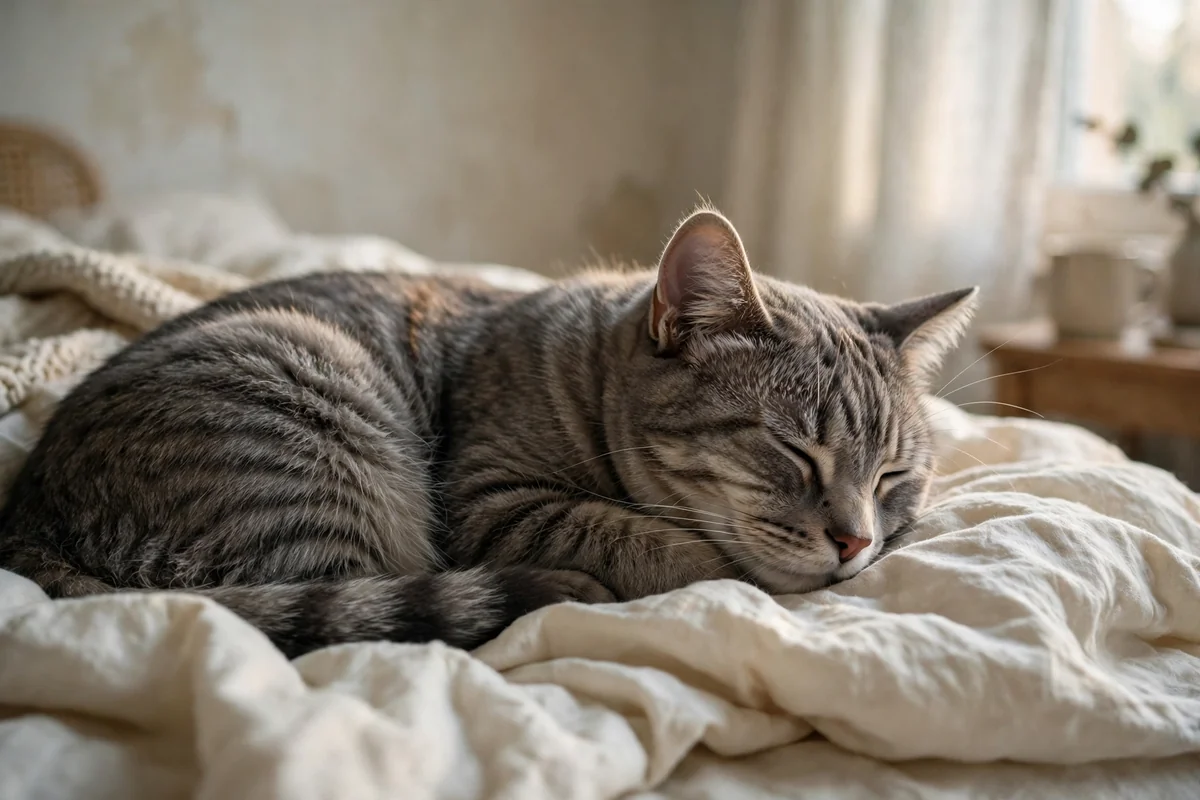
Do Cats Dream?
Your cat is curled up on the bed, fast asleep, and then a paw starts to paddle in the air. The whiskers flick, the ears turn, and the eyes move under closed lids. It looks so much like dreaming that most owners ask the same question: do cats dream? The short answer is yes, almost certainly. Cats go through the same sleep stage that brings dreams in people, and their brains behave in that stage like a dreaming human brain.
What follows is the plain version of that science, what your cat is probably dreaming about, how dreaming changes with age, whether nightmares are real, and how to tell a dream twitch from a seizure.
The information here is general information only and is not veterinary advice. If your cat has repeated shaking, stiff episodes, or a sudden change in sleep, contact your vet.
Key Takeaways
- Yes, cats almost certainly dream. They enter REM sleep, the stage linked to dreaming in people, and their brainwaves there look like a dreaming person.
- Adult cats sleep about 12 to 16 hours a day, in many short naps, and enter REM sleep about every 25 minutes.
- Michel Jouvet showed in the late 1950s and 1960s that the pons switches the body off during REM sleep, and cats without that switch acted out hunting dreams while asleep.
- Cats probably dream about the day they just lived: hunting, playing, eating, grooming, and the people and pets around them.
- Kittens likely dream more than adults, because they spend a larger share of sleep in REM sleep while still learning.
- Nightmares are possible but not proven in cats. A frightening experience may replay in sleep, but no study proves cats have nightmares as people do.
- Small, brief twitches of a paw, ear, whisker or tail are normal dreaming. A stiff body, shaking longer than a minute or two, drooling, or loss of bladder control are vet prompts.
- Do not wake a sleeping cat if you can avoid it. If you must, use a soft voice from a distance first, not a touch.
The Short Answer: Do Cats Dream?
Yes, almost certainly. The word almost matters, because no one can ask a cat to describe a dream. Cats sleep in stages, just as people do. One stage is REM sleep, short for rapid eye movement sleep, and in people it is the stage where most vivid dreaming happens. A cat in REM sleep shows the same signs: fast brainwaves that look like waking, eyes flicking under closed lids, and a body gone limp.
During REM sleep the memory part of the brain, the hippocampus, is active in cats, just as it is in people. In a rat study from MIT in 2001, rats showed similar brain activity while running a maze awake and while asleep in REM sleep, which suggests the sleeping brain was replaying the maze. Harvard researcher Deirdre Barrett has said cats likely dream about stalking and pouncing prey. Elizabeth Stelow of UC Davis has said animals probably relive natural behaviours such as hunting, playing, eating, fighting and grooming.
How Cat Sleep Works: The Stages in Plain Words
Cats do not sleep in one long stretch. They sleep in many sessions through the day and night, a pattern called polyphasic sleep. A single nap may last 15 to 30 minutes. One full cycle takes about 25 to 30 minutes in a cat, against about 90 minutes in a person. That short cycle is why a cat can dream for a few minutes, wake, stretch, and doze off again, all inside an hour.
Each cycle moves through stages. Light sleep comes first. The cat is relaxed but ready, and a small noise can wake it at once. Then comes slow wave sleep, the deep, quiet stage. Breathing slows, the heart rate drops, and the body repairs muscle and bone. After that comes REM sleep, the dreaming stage, when the brain wakes up while the body stays asleep.
| Stage | What the cat looks like | What the brain and body are doing |
|---|---|---|
| Light sleep | Curled, ears still turning | Relaxed but alert, easy to wake |
| Slow wave sleep | Stretched out, still, breathing slow | Deep rest, body repair |
| REM sleep | Eyes flicking, paws paddling | Brain active, body limp, dreams likely |
In REM sleep the brain is busy and the body is still, and that stillness is switched on by the brain itself. When researchers switched it off, cats started acting out their dreams.
The Cat Study That Proved Cats Dream: Michel Jouvet and REM Sleep
Michel Jouvet was a French researcher at the University of Lyon. In the late 1950s he studied sleeping cats with wires that recorded brainwaves and muscle activity. In 1959 he described a state of sleep that did not fit waking or slow wave sleep. The cats were clearly asleep, lying still with eyes closed, yet their brainwaves looked like the brainwaves of an awake, alert animal. Their muscles had gone completely slack. He called it paradoxical sleep, now known as REM sleep.
The slack muscles were the clue that mattered most. Jouvet traced the switch to a part of the brainstem called the pons. Signals from the pons shut down the motor centres in the lower brain, so the body cannot move even while the brain is active. That shutdown is called atonia, and it is a safety feature. Without it, a dreaming animal would act out its dreams and could hurt itself.
Then came the experiment that turned a theory into something you could watch. Jouvet made small lesions in the pons area of cats, so the atonia switch no longer worked. The cats still entered REM sleep, but their bodies were no longer still. While fast asleep, they stood up, stalked, pounced, swatted, searched and explored, as if hunting prey that was not there. Some groomed, some chased, some showed attack and defence movements.
Two cautions belong here. This was laboratory work in the 1950s and 1960s, not a test on a pet cat at home. And it proves that cats dream in the sense that their brains run dream like activity, not that we know the pictures. The hunting movements tell us the dreams are probably about hunting. They do not tell us whether the cat dreamed of a mouse, a toy, or a bird at the window.
What Do Cats Dream About?
No one can know for sure. What we have is a strong theory, backed by brain studies and by behaviour: dreams are built from waking life. People dream about the day they lived. Barrett has said there is no reason to think animals are any different. So the best way to guess what your cat dreams about is to look at what filled its day.
The day replayed
The memory replay theory says sleep sorts the day. During slow wave sleep the brain files images and events away, and during REM sleep it replays them. The MIT rat study is the clearest version: rats that had run a maze showed the same brain patterns in sleep as they had while running it awake. For a cat, the day might include a sunny spot, a window full of birds, or a loud noise.
Hunting and play
This is the most likely dream theme, because it is what Jouvet cats acted out, and what pet cats act out in small ways every night. A paw paddles as if running. A tail flicks as if stalking. Your cat may be dreaming of the toy mouse it chased, the red dot it could never catch, or the bird it watched from the window. Even a cat that has never caught live prey can dream of hunting, because the sequence of stalk, crouch, pounce and grab is built into the cat brain. Our guide on why cats get the zoomies explains the dawn and dusk energy burst behind it.
Food and the food bowl
Food is a large part of a cat day, so it is a likely part of a cat dream too. A cat that has just eaten may dream of eating again, or of the sound of the tin opening. None of this can be proven from outside, but dreams replay what matters to the dreamer, and food matters to every cat. Our guide on the best cat food explains what a good diet looks like.
You, and the other pets in the house
People dream about the people they care about, and cats likely do the same. Your face, your voice, your lap and your routine may all appear in your cat dreams, because you are the largest part of its social world. A cat that lives with another cat or a dog may dream about that animal too. You will never know which face your cat saw.
Do Kittens Dream More Than Adult Cats?
Yes, almost certainly. Kittens spend a much larger share of their sleep in REM sleep than adult cats do, and their brains are learning at a speed no adult brain has to match. Every day brings new rooms, new sounds, new people, and new textures under the paws. REM sleep is when the brain files that learning away, so a kitten brain needs more of it. You can see it in the twitching: a kitten asleep with its littermates may paddle its paws and chirp far more often than a calm adult cat. Newborn kittens sleep almost all day, waking only to feed. That extra movement is normal. Let kittens sleep, and let the twitching run its course.
Do Senior Cats Dream Differently?
Senior cats still dream, but their sleep changes with age. An older cat may sleep more hours in total, sometimes 18 to 20 hours a day, yet sleep less deeply. The sleep may be lighter, broken into more pieces, and the cat may wake more often in the night. The share of REM sleep tends to fall with age, so an older cat may dream less intensely than a kitten, though it still dreams. What matters more is a change in the pattern. A senior cat that suddenly sleeps far more or far less, or starts twitching in a new and violent way, is telling you something has changed. A vet check is the right next step when a senior cat sleep pattern shifts and stays shifted.
Do Cats Have Nightmares?
Probably, but it is not proven. If dreams replay the day, a frightening day could replay as a frightening dream. A cat chased by a dog, scared by fireworks, or hurt in a fall has a bad memory to file. Owners report jerky movements, growling, hissing, and waking up startled. That is still not proof, and a single restless night is not a diagnosis. If restless sleep keeps happening night after night, ask your vet to rule out pain or illness.
Twitching in Sleep or a Seizure? How to Tell the Difference
Most sleep twitching is normal dreaming. A seizure is rare, and it looks different in ways you can learn to spot.
| Sign | Normal dreaming | Possible seizure |
|---|---|---|
| Movement | Small twitches of one paw, ear or tail | Violent full body jerking, stiff limbs |
| Body tone | Relaxed and limp | Stiff and rigid |
| Length | Seconds at a time | Longer than a minute or two |
| Eyes | Closed, flicking under lids | Open, fixed, or rolled back |
| After waking | Wakes normally, acts like itself | Confused, wobbly, or unresponsive |
| Other signs | No drooling, no accidents | Drooling, loss of bladder control |
| When it happens | Only in sleep | Can happen while awake too |
Call your vet urgently if you see a stiff body through the episode, shaking that lasts longer than a minute or two, drooling, loss of bladder control, twitching that also happens while the cat is awake, a cat that cannot be woken, or a cat that seems confused or unresponsive after. Call too if episodes are getting more frequent, or if twitching starts suddenly in a senior cat that never used to twitch. Film the episode if you can do so safely. A short video helps a vet far more than a description. Do not restrain a cat you think may be having a seizure.
Should You Wake a Sleeping Cat?
No, if you can avoid it. Sleep is when a cat body repairs itself and a cat brain files the day. A cat woken suddenly from deep sleep, and especially from a bad dream, may not know where it is for a few moments. It may react before it thinks, with claws or teeth, even if it is normally gentle. That is not aggression. It is a startled animal defending itself. When waking cannot be avoided, start with your voice, not your hands. Say the cat name softly from a short distance away, and give it time to open its eyes. Do not pick it up or shake it while it is still half asleep.
How to Help Your Cat Sleep Well
Good sleep comes from a day that ends well, a bed that feels safe, and a routine the cat can trust. A cat that has played, eaten, and settled in a warm, quiet spot will sleep deeper than a cat that has spent the day bored and restless.
- Play before bed. A short evening play session burns off the energy that would otherwise arrive at 3am. End the game with a small meal, so the cat can eat, groom, and settle.
- Keep a fixed routine. Feed and play at the same times each day, and keep bedtime quiet. Cats trust routine.
- Give the cat a warm, quiet bed. A bed in a corner away from doors and busy hallways, with a blanket that smells of home, beats a costly bed in a noisy room.
- Keep nights dark and calm. If your cat wakes you at 3am, do not feed it or play with it at once, or the waking becomes a habit.
- Feed a last meal in the evening. A cat that goes to bed with a full stomach settles faster.
- Give the cat a safe high spot. Many cats sleep best where they can see the room, on a shelf or a cat tree.
- Watch for changes. A cat that suddenly sleeps far more or far less, or cries at night, is worth a vet visit.
Frequently Asked Questions
Do cats dream in colour?
We do not know. Cats see a limited range of colours, mainly blues and greens and yellows, and they cannot tell reds, oranges and pinks apart well. If dreams use the same visual system as waking sight, a cat dream would probably be in those muted colours. But no study has measured the colours of a cat dream, so the honest answer is unknown.
How often do cats dream?
There is no counted answer, and no study counts dreams per day in cats. Cats enter REM sleep about every 25 minutes, and each REM episode lasts only a few minutes, so a cat that sleeps 12 to 16 hours a day will pass through REM sleep many times in a day. That means many short dreams, not one long dream.
Why does my cat twitch in his sleep?
Most often, because he is dreaming. In REM sleep the brain is active and the body is still, and small signals leak through as twitches in the paws, whiskers, ears and tail. It is normal and healthy. Worry only if the twitching is violent, full body, or stiff, if it lasts longer than a minute or two, or if it happens while the cat is awake.
Why does my cat run in his sleep?
The paddling paws that look like running are the same dream twitch, only larger. The cat is probably dreaming of chasing or fleeing, and the legs move as if running while the body stays on the bed. It is normal in a relaxed cat, and it usually stops on its own in seconds. If the running is violent, with a stiff body and no break, use the seizure checks above and call your vet.
Do cats dream about their owners?
Probably, yes. People dream about the people they care about, and Barrett has said animals likely dream about what interests them by day. You are the largest part of your cat social world, so your face, voice and lap are likely to appear in its dreams. It cannot be proven, but it fits how dreams are built from the day.
Why does my cat wake me up at 3am?
Cats are most active at dawn and dusk, and their clock does not match ours. A cat that wakes you at 3am is often hungry, bored, or ready to play, and if you feed it or play with it, you teach it that waking you works. Play in the evening, feed last thing at night, and feed at the normal morning time. If the waking is new, or comes with crying or a change in appetite, ask your vet.
The Bottom Line
Your cat almost certainly dreams, and the dreams are probably built from the day it just lived: the chase, the toy, the food bowl, the sunny spot, and you. Cats have REM sleep, their brains act like dreaming brains in that sleep, and when the body switch was removed in Jouvet cats, they acted out hunting dreams in front of researchers. What the dreams look like from inside stays unknown. Watch the twitching paws, let the cat sleep, learn the seizure signs, and give the cat a warm bed and a calm evening to dream about.