
How Many Cats Should You Have by Age? 9 Funny Answers From the Viral Formula
Here is a formula for deciding how many cats you should have. Take your age, drop the last digit, and that is your ideal number of cats. In your teens, one cat. In your 20s, two cats. In your 90s, nine cats. Simple, scientific, and completely made up.
This is a joke, not advice. The formula comes from a viral meme, and it is funny precisely because it treats a real decision like a maths problem with one step. Nobody should pick a pet based on their birth year. But before we get to the serious part, let us enjoy the joke properly, because the table is wonderful and every cat owner will immediately check where they land.
Key Takeaways
- The viral formula is simple: drop the last digit of your age, and that is your cat count.
- The table has 9 age rows, from teens with 1 cat to 90s with 9 cats.
- The formula is a joke, not advice. Never pick a pet based on your birth year.
- What really decides the number is space, time, budget, and local rules, not your age.
- Most vets recommend no more than 4 to 5 cats in a household, with a hard cutoff of 6.
- The litter box rule is one box per cat plus one extra.
How Many Cats Should You Have by Age? The 9 Funny Answers
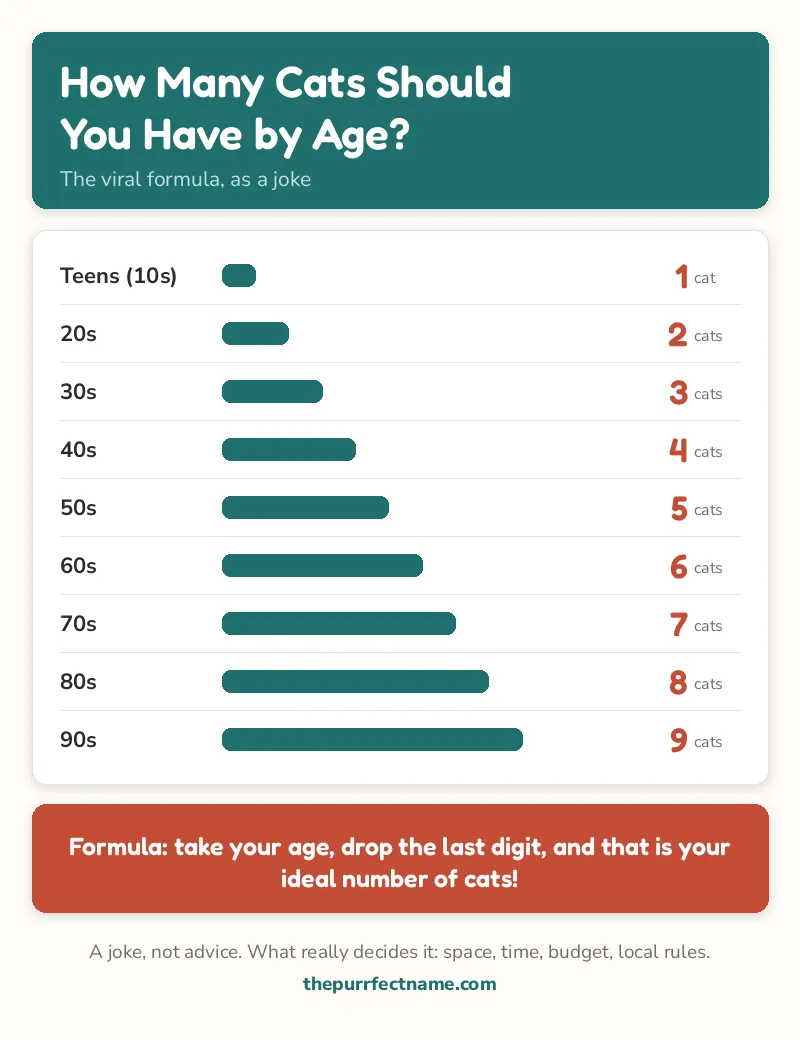
Here is the full table, exactly as the meme lays it out. Find your decade, read your number, and decide whether you are ahead of schedule, behind schedule, or exactly where the formula says you should be.
| Your age | Cats the formula says you should have |
|---|---|
| Teens (10s) | 1 cat |
| 20s | 2 cats |
| 30s | 3 cats |
| 40s | 4 cats |
| 50s | 5 cats |
| 60s | 6 cats |
| 70s | 7 cats |
| 80s | 8 cats |
| 90s | 9 cats |
Formula: take your age, drop the last digit, and that is your ideal number of cats. This is a joke, not advice.
Are You Ahead or Behind Schedule?
The best part of the meme is not the table. It is what happens when people apply it to themselves. The comments on the original post are full of cat owners doing the maths and reporting back, and they fall into three groups.
Ahead of schedule
You are 25 and you already have 4 cats. The formula says 2. You are not behind, you are an overachiever, and the formula is clearly too slow for you. Ahead of schedule is the most common result, because cat people rarely stop at the number the maths suggests. One cat becomes two cats because the first one looked lonely, two become three because a rescue needed a home, and suddenly the formula is a distant memory.
Behind schedule
You are 45 and you have 1 cat. The formula says 4. You are behind, but only according to a joke on the internet, which is not a real problem. Behind schedule usually means you have a small home, a busy life, or a cat that has made it very clear that it is an only cat. All three are good reasons. The formula does not know about your flat, your job, or your cat’s opinions, which is why it is a joke and not a plan.
Exactly on schedule
You are 32 and you have 3 cats. The formula says 3. This is the rarest result, and if it is you, enjoy the moment, because the formula will be wrong again within a year, either because your age changes or because your cat count does. On schedule is a snapshot, not a lifestyle.
If this kind of joke is your sense of humor, our 25 cat name memes run on the same fuel: everyday cat chaos, presented with a straight face. The two cats called Max and Milo in meme 8 are a perfect example of the ahead of schedule problem, because their owner calls the wrong name every time and both cats ignore it equally.
Why the Formula Is So Funny
The joke works because it looks like real advice. It has a bold title, a neat table, column headers, and a formula at the bottom, all the furniture of a serious guide. Then you read the formula and realise the whole thing is one arithmetic trick: your age, minus its last digit.
It is the same trick as the birth month version of the meme, where January gets 1 cat, February gets 15 or 28 cats depending on the version, May gets none, and December gets all the cats. Both versions treat a personal, emotional decision like a tax calculation, and that mismatch is the entire joke.
It also works because it flatters the reader. Whatever your age, the formula gives you permission to have more cats. In your 20s you get 2, in your 40s you get 4, and by your 90s you get 9, which is a retirement plan most cat lovers would sign up for on the spot. The formula never says fewer cats. It only ever says more, and more is exactly what cat people want to hear.
The Serious Part: What Really Decides How Many Cats You Should Have
Now the joke ends and the honest part begins. There is no magic number of cats, and age has nothing to do with it. Every serious source that ranks for this question says the same thing: the right number depends on your space, your time, your budget, and your local rules. Here are the 4 factors that actually decide it.
1. Space
Cats need room to move, climb, hide, and get away from each other. A small studio flat can keep 1 cat happy, but 4 cats in the same space will struggle, because cats are territorial and they need enough resources to go around. A bigger home with more rooms can support more cats.
One common rule of thumb is one cat per bedroom plus one, so a two bedroom home can comfortably keep 3 cats. The space question is not about square footage alone. It is about whether every cat has its own places to eat, sleep, hide, and use the litter box without queuing.
2. Time
Every cat needs daily play, attention, and care, and the time adds up fast. Two cats who get along can keep each other company while you are out, which is one reason a pair often works better than a single cat for a busy owner.
But 6 cats need far more of your time than 2, and if you work long hours, the cats will be the ones who notice. Multi-cat tension is real too: our guide to why cats get the zoomies at night notes that stress and tension with another cat can leave a cat wound up and restless, which is a sign the household has more cats than it can comfortably hold.
3. Budget
Each extra cat is a real cost, every year, for food, litter, routine vet care, and the unexpected bill. Adopt-a-Pet puts the average annual cost of caring for one cat at $1,149, and adding a second cat roughly doubles it. A vet bill for one cat is manageable. The same bill times 5 cats is a different conversation. Before adding a cat, the honest question is whether you can afford the same standard of care for every cat you already have, plus one more, including an emergency.
4. Local rules
Some places limit how many pets a household can keep. In the United States the rules vary by state and city, and some areas limit households to 2 pets without a kennel permit, while other places allow up to 10. Check your local rules before you adopt, because a limit you did not know about can turn into a real problem. The same applies to rental agreements: many landlords cap the number of pets, and a landlord’s limit is not negotiable with a formula from the internet.
The Reality Check in Numbers
Here is what the serious sources actually say, in one place, so the joke and the truth sit side by side.
| Question | What the sources say |
|---|---|
| Is there a magic number? | No. It depends on space, time, budget, and local rules. |
| What do vets recommend? | Most vets recommend no more than 4 to 5 cats, with a hard cutoff of 6. |
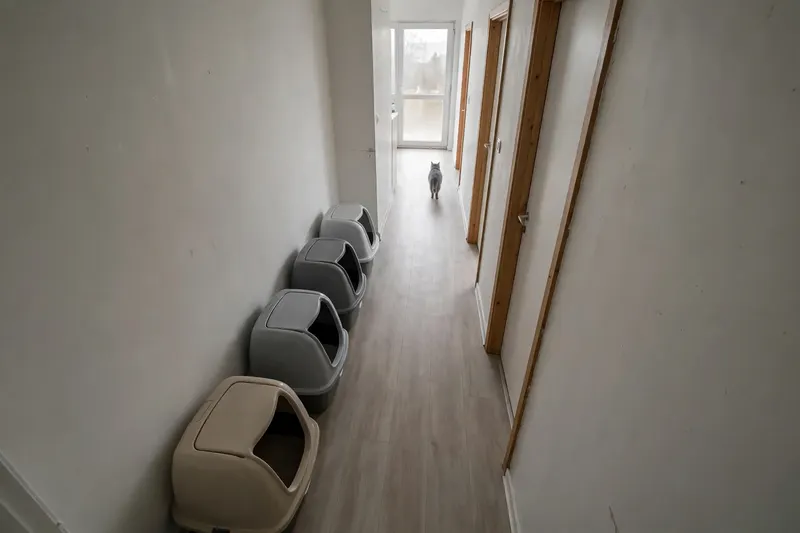
| How many litter boxes? | One per cat plus one extra. 3 cats need 4 boxes. |
| What is the space rule of thumb? | One cat per bedroom plus one. |
| What does one cat cost per year? | About $1,149 on average, according to Adopt-a-Pet. |
| What happens when there are too many? | Fighting, spraying, stress, and behavior problems rise, and too many animals is the top cited reason people give for rehoming pets. |
The information in this section is general information, not veterinary advice. If you are thinking about adding a cat, talk to your vet about your household, your cats, and whether another one is a good fit.
The Verdict: 9 Funny Answers, 1 Real Answer
The formula gives you 9 funny answers, one per decade, and every one of them is a joke. The real answer is shorter: as many cats as you can care for properly, in the space you have, with the time and money you have, inside the rules where you live. For most people that is 2 to 3 cats. For some it is 1, and for a few it is 5. Age never enters into it, no matter what the table says.

So enjoy the table, check your schedule, and laugh at the result. Then, when you do decide to add a cat, pick the name properly. Our funny cat names list has 284 picks, each with its meaning and the joke behind it, which is a much better use of your time than doing the maths on your birth year.
FAQ
How many cats should I have?
There is no single right number. It depends on your space, your time, your budget, and your local rules. Most vets recommend no more than 4 to 5 cats in a household, with a hard cutoff of 6. For most people, 2 to 3 cats is the comfortable range.
Is the age formula real?
No. It is a joke from a viral meme. Take your age, drop the last digit, and that is your cat count. It is funny because it looks like a serious guide, but no vet, behaviorist, or rescue organisation recommends choosing a pet based on your age.
How many litter boxes do I need for 3 cats?
Four. The rule is one box per cat plus one extra, so 3 cats need 4 boxes, placed in different areas of the home and away from the food area.
Is 6 cats too many?
It can be. Most vets put the hard cutoff at 6, and medical and behavioral problems rise above 5 cats. Whether 6 works depends on your home size, your time, your budget, and whether the cats get along. If there is fighting, spraying, or stress, the household has too many cats for the space.
Can I legally own 9 cats?
It depends on where you live. Some places limit households to 2 pets without a kennel permit, while others allow up to 10. Check your local rules and your rental agreement before adopting.