
How Old Is My Cat in Human Years? 6 Life Stages and a Full Age Chart
A one year old cat is not a seven year old child. It is closer to a fifteen year old teenager, and by its second birthday it has already reached the human equivalent of twenty four. After that fast start, ageing slows down to about four human years for each cat year. That curve is the whole answer in one paragraph, and the rest of this guide turns it into a chart you can use, stage by stage, from a new kitten to a cat of fifteen years and older.
If you want a number for one cat right now, use our cat age calculator. It runs the same curve and gives you the life stage as well. This article is the longer version: the chart, the year by year table, what each stage usually brings, and where the numbers are rough around the edges.
Key Takeaways
- A cat’s first year counts as about 15 human years, and the second year adds about 9 more, reaching about 24.
- Each year after that adds about 4 human years, so a 5 year old cat is about 36, a 10 year old cat is about 56, and a 15 year old cat is about 76.
- The old multiply by 7 rule fails twice: it makes a 1 year old cat look like a small child, and it makes a 15 year old cat look far older than 76.
- Human age equivalents are comparisons for understanding development, not measurements of health, fitness, or remaining lifespan.
- The kitten range is the roughest part of the whole chart. Treat the months under one year as a guide, not a precise figure.
The 6 Life Stages at a Glance
Cats pass through six life stages in the chart most vets and cat care guides use. The stage names come from the feline life stage framework published by the American Animal Hospital Association and the American Association of Feline Practitioners, with the six stage split used by International Cat Care.
The 2021 AAHA/AAFP guidelines use five clinical stages for day to day vet work, but the same 2021 document says the physiological basis for six feline life stages remains valid, so the six stage chart below is still the one most owners meet.
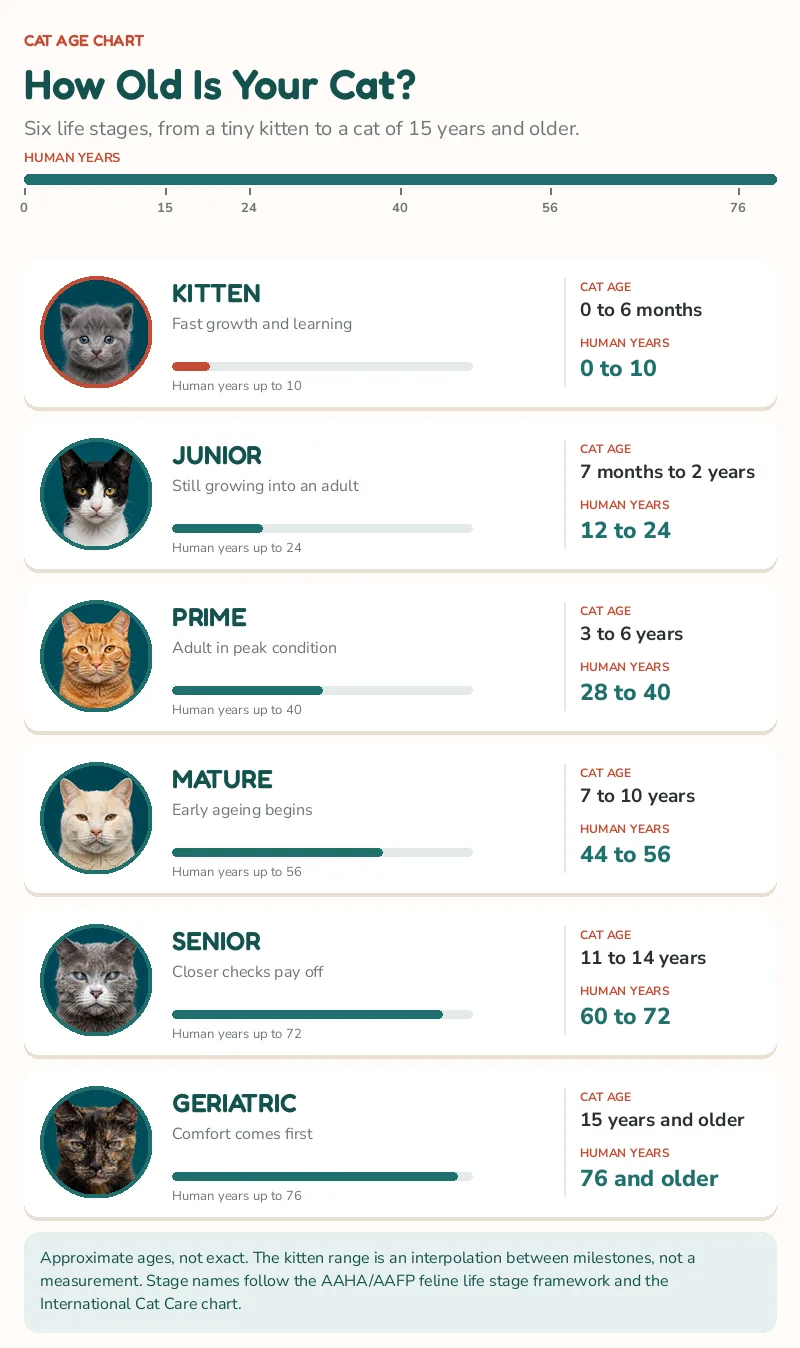
| Life stage | Cat age | Human years, about |
|---|---|---|
| Kitten | 0 to 6 months | 0 to 10 |
| Junior | 7 months to 2 years | 12 to 24 |
| Prime | 3 to 6 years | 28 to 40 |
| Mature | 7 to 10 years | 44 to 56 |
| Senior | 11 to 14 years | 60 to 72 |
| Geriatric | 15 years and older | 76 and older |
One honest note before the detail: not every source draws the first boundary in the same place. This chart starts the Junior stage at 7 months. Some tables keep a cat labelled Kitten until its first birthday and start Junior at 1 year, which is also how our own calculator labels the stages. The ages and the human equivalents are the same either way; only the label for the 7 to 12 month stretch differs.
How the 15, 24, Plus 4 Rule Works
The conversion is three steps, and it is the same on every reputable chart:
- Year 1 counts as about 15 human years. A kitten becomes a young adult within this year.
- Year 2 adds about 9 more human years, reaching about 24 in total.
- Year 3 onwards adds about 4 human years for each additional cat year.
So a 3 year old cat is about 28, a 4 year old cat is about 32, a 7 year old cat is about 44, a 20 year old cat is about 96, and a 25 year old cat is about 116. The formula for a cat over 2 years old is 24 plus 4 for each year past 2.
There is no reliable scientific way to turn a cat’s age into a human age exactly, and the numbers below are the standard approximation, not a measurement of any individual cat.
Cat Age to Human Age, Year by Year
Use this table when the stage chart is not precise enough. It runs from 6 months to 25 years on the same 15, 24, plus 4 curve. Some charts call the 15 years and older stage Super Senior instead of Geriatric; the ages are the same either way.
| Cat age | Human years, about | Life stage |
|---|---|---|
| 6 months | 10 | Kitten |
| 1 year | 15 | Junior |
| 2 years | 24 | Junior |
| 3 years | 28 | Prime |
| 4 years | 32 | Prime |
| 5 years | 36 | Prime |
| 6 years | 40 | Prime |
| 7 years | 44 | Mature |
| 8 years | 48 | Mature |
| 9 years | 52 | Mature |
| 10 years | 56 | Mature |
| 11 years | 60 | Senior |
| 12 years | 64 | Senior |
| 13 years | 68 | Senior |
| 14 years | 72 | Senior |
| 15 years | 76 | Geriatric |
| 16 years | 80 | Geriatric |
| 17 years | 84 | Geriatric |
| 18 years | 88 | Geriatric |
| 19 years | 92 | Geriatric |
| 20 years | 96 | Geriatric |
| 21 years | 100 | Geriatric |
| 22 years | 104 | Geriatric |
| 23 years | 108 | Geriatric |
| 24 years | 112 | Geriatric |
| 25 years | 116 | Geriatric |
What Each Life Stage Usually Brings
Kitten, 0 to 6 months, 0 to 10 human years
This is the fastest change a cat ever goes through: eyes opening, first steps, weaning, and a full set of adult teeth by about 6 months, all inside half a year. That is why the human comparison jumps so fast, and also why it is the least exact part of the chart. The 0 to 10 range is an interpolation between milestones, not a measurement, and other reputable charts put 6 months at 9 human years instead of 10.
Our kitten development week by week guide follows the same first months in detail. For feeding, vaccines, and care in these first months, your vet’s guidance matters far more than any age conversion.
Junior, 7 months to 2 years, 12 to 24 human years
A junior cat is a teenager becoming a young adult. It reaches full size and sexual maturity, tests limits, and settles into its adult personality. Energy is usually at its highest, and so is curiosity about doors, shelves, and anything left on a table. This is the stage where steady routines and play pay off most, because the habits a cat learns now tend to stick.
Prime, 3 to 6 years, 28 to 40 human years
Prime is the long, stable middle of a cat’s life. Most cats are at peak condition here, assuming good weight and health, and need little more than a yearly checkup, steady food, and regular play. It is also the stage where weight creep starts quietly, so a yearly weigh in at the vet is worth more than it looks.
Mature, 7 to 10 years, 44 to 56 human years
Mature is early middle age. Weight, mobility, and dental changes become more likely, and a vet may start suggesting bloodwork or dental checks that were not needed before. A cat that still looks young on the outside can be changing on the inside, which is why this is the stage where skipping a yearly visit starts to cost more.
Senior, 11 to 14 years, 60 to 72 human years
Senior cats usually benefit from a vet visit every six months rather than once a year, because age related conditions become more common and catching them early matters. Sleeping more, moving more slowly, and eating a little less can all be normal ageing, but a sudden change in any of them deserves a vet visit rather than a wait. Our senior cat care guide covers what changes in these years in full.
Geriatric, 15 years and older, 76 human years and older
A cat of fifteen years and older has done well. Comfort comes first now: warm resting spots, easy access to food, water, and the litter box, and help with grooming if stiff joints make it hard. Appetite, thirst, toileting, and mobility changes deserve prompt vet attention at this age, because a small problem can become a big one quickly in an old cat.
Why Multiply by 7 Never Worked
The old rule says one cat year equals seven human years. It fails in both directions. A 1 year old cat is not a 7 year old child: it is a young adult that can reproduce, which no 7 year old human can do.
And a 15 year old cat is not 105 in human terms on the standard curve: it is about 76. The multiply by 7 rule understates how fast kittens mature and overstates how old an old cat is, so it is wrong exactly where it matters most.
Why Different Charts Disagree
If you compare three cat age charts, you will find three slightly different answers, and that is normal. The comparison is built from developmental milestones such as sexual maturity, skeletal growth, and the onset of age related conditions, and different authorities draw the lines in slightly different places.
Cornell University’s Feline Health Center, for example, uses a different model again, with a 1 year old cat comparing to a 16 year old person and a 2 year old cat to a 21 year old. Breed and size shift individual ageing too, with some large breeds maturing more slowly. Use the result as a way to understand your cat’s stage of life, not as a verdict on its health.
Frequently Asked Questions
How old is a 1 year old cat in human years?
About 15 human years. A one year old cat is a young adult, not a human toddler, which is why the old multiply by 7 rule fails so badly for kittens.
How old is a 10 year old cat in human years?
About 56 human years on the standard curve (24 at age two, plus 4 for each of the next eight years). That puts a 10 year old cat in the mature stage, where weight, dental, and mobility checks matter more.
Can I use this chart for a kitten under 6 months?
Only as a very rough guide. Kitten development in the first months is extremely fast and uneven, and the chart interpolates between milestones rather than measuring anything directly. For feeding, vaccines, and care in the first months, your vet’s guidance matters far more than any age conversion.
Does breed change the calculation?
Not in the standard formula, which is a general approximation for all cats. Breed and size do affect individual ageing in practice, with some large breeds maturing more slowly and some conditions arriving earlier in particular breeds, so treat the result as a guide rather than a precise figure for your cat.
Please note: this article is general information only and is not veterinary advice. The age comparison is approximate and must not be used to judge health, predict lifespan, or decide treatment. Any worry about weight, mobility, appetite, thirst, or toileting is a matter for your vet, whatever the chart says.