
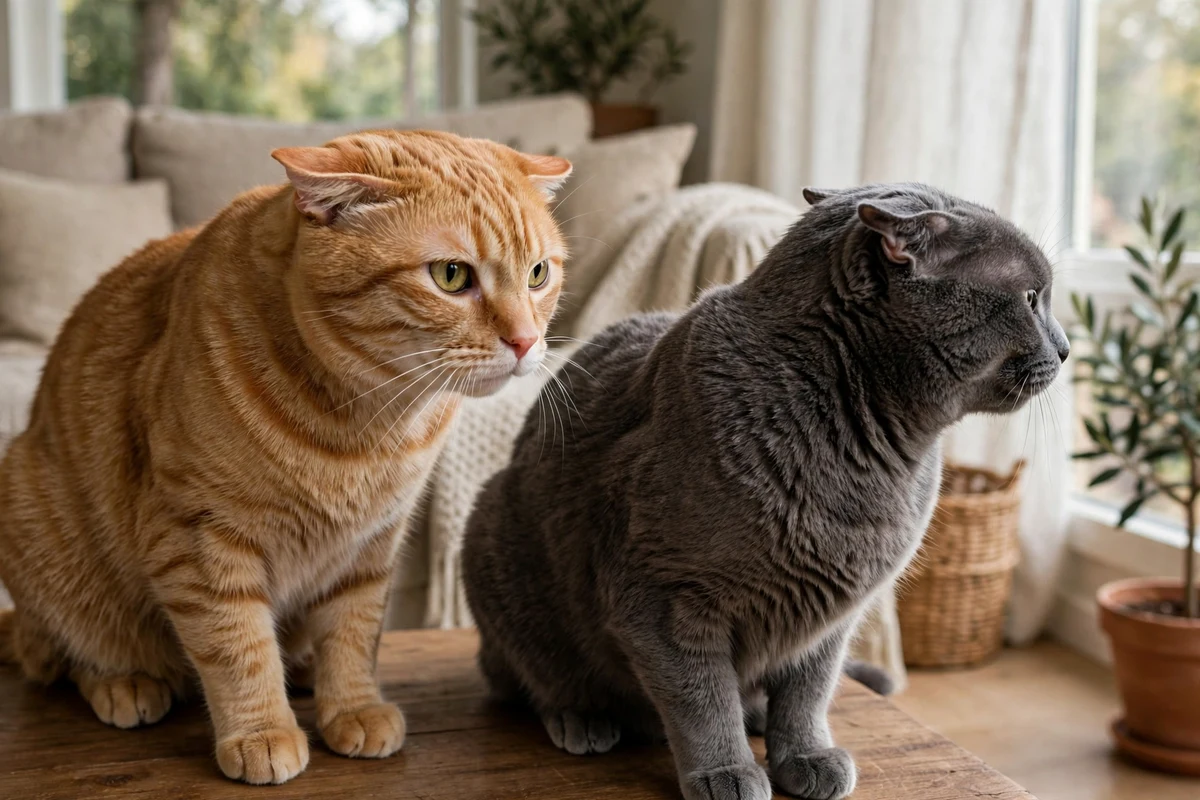
How to Recognize Tension Between Your Cats
Two cats can live in the same house for years without ever having a fight, and still be miserable. The tension between cats is often quiet: a long stare across the room, a cat that sits in the doorway of the room where the litter box is, a cat that waits until the other one leaves before it dares to eat. Owners miss it because there is no noise, no fur flying, and no blood. But the cat that is being stared down knows exactly what is happening, and it lives with that stress every day.
Learning to recognise tension is the most useful skill a multi cat owner can build. It lets you fix a problem while it is still small, before it becomes house soiling, overgrooming, weight loss, or a fight that sends a cat to the vet. It also lets you tell the difference between play and a real fight, between a normal hiss and a warning that should make you step in, and between two cats that are bonded and two cats that are merely enduring each other. The sections below teach you to read the signs, to watch one full day with a notebook, to audit the resources in your home, and to act calmly when tension turns into conflict.
This is general information only and is not veterinary advice. If a cat stops eating, hides for more than a day, soils outside the litter box, overgrooms to the point of bald patches, or is injured in a fight, contact your vet promptly.
Key Takeaways
- Most tension between cats is silent. Staring, blocking, avoidance and hiding are the common signs, and they are easy to miss.
- Learn what relaxed cats look like first. Friendly cats approach with tails up, touch noses, rub heads, sleep near each other and groom each other.
- Play is quiet, gentle, with claws retracted and roles swapping. Fighting is loud, stiff, with claws out, flattened ears and no role changes.
- The quiet bully is the most commonly missed pattern: a cat that never fights but controls the house by staring and sitting in doorways.
- Most tension comes from scarce or badly placed resources, not from bad personalities. One litter box per cat plus one extra, in separate places, fixes more than any product.
- Watch one full day and write down what you see. A tension diary turns vague worry into a pattern you can act on.
- Interrupt a fight safely, without hands. A loud noise, a cushion between the cats, or a blanket tossed over them works. Never reach in with bare hands.
- Persistent tension deserves a vet check first. Pain, illness and stress related disease can all sit behind behaviour that looks like spite.
First, Learn What Relaxed Looks Like
You cannot spot tension until you know what relaxed looks like, so start there. Cats that like each other show it plainly. They approach each other with tails up, often with the tail tip curved like a question mark. They touch noses, rub heads and sides against each other, and groom each other’s head and ears. They sleep touching or near each other, sometimes piled together in one bed. They eat in the same room without rushing. They play together, taking turns chasing and being chased, with pauses between bursts.
The Subtle Signs: What Tension Looks Like Before a Fight
Subtle tension is the pattern most owners miss, because nothing dramatic happens. The signs below are the ones that feline behaviourists and the American Association of Feline Practitioners list most often. One sign on its own may mean little. Several together, repeated over days, mean the cats are not at ease.
Prolonged staring is the most common subtle sign. One cat fixes its eyes on the other, often while the other cat is moving, and holds the stare without blinking. The stared at cat usually freezes, looks away, or leaves the room. A stare is a threat in cat language, and it costs the staring cat nothing while costing the other cat its comfort. If you see one cat staring at the other from across the room, that is tension, even if no sound is made.
Blocking and guarding is the next sign. A cat sits in a doorway, at the top of the stairs, or beside the litter box, the food bowl or the water bowl, and the other cat will not pass. The blocking cat may look relaxed, even asleep, but the effect is the same: the other cat cannot reach what it needs without walking past a rival. Watch for a cat that waits at a distance until the other cat leaves, or that takes a long detour to reach a room it could reach directly.
Avoidance is the sign the victim shows. The cats stay far apart, use different rooms, and never share a resting spot. One cat may hide under beds or in cupboards for much of the day. One cat may refuse to enter a room if the other cat is in it, especially if that room holds food, water, a litter box or a bed. One cat may eat, drink or use the litter box only when the other cat is asleep or outside. These are all signs that a cat feels unsafe in its own home.
Other quiet signs include tail twitching while the cats are near each other, walking away when the other cat approaches, sudden short grooming sessions that start and stop abruptly, lip licking, rapid blinking, and tufts of hair found in odd places. A cat that overgrooms its belly or legs, leaving thin or bald patches, may be stressed by tension with a housemate. A cat that starts soiling outside the litter box, especially on soft surfaces or near doorways, may be avoiding a guarded box rather than making a protest.
The Obvious Signs: When Tension Turns Loud
Obvious tension is easier to spot and harder to ignore. Chasing, fleeing, hissing, growling, swatting, screaming, and physical fighting are all active signs. So is jumping onto another cat from above, cornering a cat that cannot escape, and pinning a cat down. The body language is unmistakable: arched back, raised hair along the spine and tail, puffed tail, flattened ears, dilated pupils, crouched body, and a fixed stare. A cat that stands on its hind legs and swipes rapidly with its front paws is fighting, not playing.
Vocalisations tell you a lot. A low growl or a hiss is a warning: back off. Loud growls, yowls, howls or screams mean the warning has failed and the cats are in conflict. A cat that screams during a fight is frightened, not just angry, and the fight should be stopped at once if it can be done safely.
House soiling belongs on this list too. A cat that urinates or defecates outside the litter box, sprays vertical surfaces, or soils the bed or the sofa may be marking territory, or may be too afraid to reach the box. Either way, it is a sign that the household is not working for that cat. Never punish a cat for soiling. Punishment adds fear to a cat that is already frightened, and it never fixes the cause. See how to stop unwanted cat behaviors for the reward based approach.
The Quiet Bully: The Pattern Most Owners Miss
The hardest tension to spot is the quiet bully. This is a cat that never fights, never hisses loudly, and never chases. It simply controls the house. It sits in the hallway where the other cat must pass. It sleeps on the only sunny windowsill. It rests beside the food bowls. It stares. The other cat learns the rules without a single fight: do not pass, do not eat until the bully leaves, do not use that litter box, do not sleep there.
Owners often miss it because the bully looks calm and the victim looks shy, and it is easy to call the victim the problem cat. The victim may be described as nervous, unfriendly or aloof, when in fact it is living with a housemate that controls its access to food, water, rest and the toilet. The fix is not to scold the bully, which would only add stress, but to change the house so control becomes impossible: more resources, more routes, more exits, and more places to rest.
Play or Fight? How to Tell the Difference
Play fighting and real fighting can look similar at a glance, and confusing them is common. The table below gives the differences that behaviourists use. Watch a whole interaction, not a single second, because play and fighting can start the same way and diverge quickly.
| What you see | Play | Real fight |
|---|---|---|
| Sound | Mostly silent, maybe a soft chirp | Hissing, growling, yowling, screaming |
| Claws | Retracted, paws soft | Out, swiping hard |
| Biting | Gentle, inhibited, no injury | Hard bites that break skin or pull fur |
| Roles | Cats swap who chases and who is chased | One cat always chases, the other always flees |
| Pauses | Frequent little breaks to reposition | No breaks, the chase does not stop |
| Body | Loose, ears forward, tail relaxed | Stiff, ears flat, tail swishing or puffed |
| Afterwards | Both cats calm, may groom or sleep near each other | One cat hides, the other patrols, tension stays high |
When Tension Appears: Times and Triggers
Tension often follows a pattern in time. Some households are calm all day and tense at feeding time, when both cats want the same bowl. Some are calm until night, when one cat wants to play and the other wants to sleep. Some flare up when an outdoor cat walks past the window, and the indoor cat, unable to reach the stranger, turns on its housemate. That last pattern is called redirected aggression, and it is one of the most confusing causes of household tension, because the fight seems to come from nowhere.
Changes in the cats themselves matter too. Cats reach social maturity between 2 and 4 years of age, and a cat that was friendly as a kitten can become less tolerant as an adult. Pain can also change behaviour: a cat with a sore tooth, an arthritic joint, or a urinary problem may become irritable and lash out at a housemate. If tension starts suddenly in cats that previously got along, a vet check should come before any behaviour plan.
The One Day Tension Diary
The most useful thing you can do this week is to watch one full day and write down what you see. A diary turns a vague feeling that the cats do not get along into a pattern you can act on, and it gives a vet or behaviourist something concrete to work with. Use a notebook or a phone, and record the time, the place, what each cat was doing, and what happened next.
Note each meal: who ate, who waited, who left food, and whether anyone guarded a bowl. Note each litter box visit: who used which box, and whether anyone waited or avoided a box. Note each resting period: where each cat slept, how far apart they were, and whether anyone moved when the other approached. Note every stare, hiss, chase or swat, with the time and the place. Note every friendly moment too: noses touched, heads rubbed, sleeping near each other, playing together. Friendly moments matter, because they show you what the relationship can be.
The Room by Room Resource Audit
Most tension between cats comes from resources, not from personality. Cats are territorial, and they feel safe when they can reach food, water, rest and a toilet without passing a rival. The standard rule is one resource per cat plus one extra, in separate places. For two cats that means three litter boxes, three water stations, two or three food stations, more beds than cats, and more high perches than cats. For three cats, four of each. The numbers matter less than the placement: resources grouped together in one corner count as a single resource, because one cat can guard the whole group.
Walk through your home with a piece of paper and map each resource. Draw a rough floor plan and mark every litter box, food bowl, water bowl, bed, perch and hiding place. Then ask three questions about each one. Can a cat reach it without passing another cat’s favourite spot? Can a cat leave it by more than one route, or is there only one way in and out? Is it in a quiet spot where the cat can eat, drink or rest without being watched?
Common mistakes show up fast. All the litter boxes in one room, or worse, in one corner. Food and water bowls side by side in the kitchen, so one cat guards both. A single bed in the sunny spot that one cat always claims. A litter box with only one exit, in a dead end, where a nervous cat can be cornered. A covered litter box that lets an aggressive cat ambush a timid one on the way out. Fix these one at a time: move a box to a second room, split the food stations across two rooms, add a water bowl in the hallway, put a second bed in the sunny room, and swap a covered box for an open one with two exits.
Add vertical space while you are at it. A tall cat tree, a shelf, or the top of a wardrobe gives a cat a safe place to watch from above and a way to move through a room without crossing the floor. Vertical space is territory that costs no floor space, and it is often the cheapest fix in a tense house. A hiding place matters too: an open box, a covered bed, or a room with a door the cat can slip behind gives a frightened cat somewhere to go, and a cat with an escape route is a calmer cat.
What to Do in the Moment
When a fight starts, your first job is to stay safe. Never reach in with bare hands to separate fighting cats. A frightened cat will bite and scratch the hand that grabs it, and cat bites can become infected quickly. Instead, interrupt from a distance. Clap loudly, drop a cushion between the cats, toss a blanket over one of them, or shake a jar of coins. A sudden noise or a visual barrier usually breaks the stare and gives both cats a reason to move apart.
Once the cats are apart, separate them calmly into different rooms and leave them alone for at least 30 minutes. Do not scold either cat. Do not pick up the frightened cat at once, because it may still be aroused and may scratch. Let both cats calm down fully before you let them see each other again. If fights happen often, separate the cats for 24 to 48 hours and then reintroduce them slowly, as if the second cat were new to the house, following our guide to introducing a new cat to your home step by step: scent first, sight second, meeting last.
Calming Aids and What They Can and Cannot Do
Synthetic pheromone diffusers are the most commonly used calming aid in multi cat homes. They release a copy of the feline facial pheromone, which cats associate with safety, or a copy of the appeasing pheromone that mother cats produce while nursing.
Other aids include calming music, regular play sessions, puzzle feeders, and extra enrichment such as window perches and scratching posts. If scratching is part of the tension, read why cats scratch the furniture for post placement that works. Play each cat separately for 10 minutes twice a day if you can. Our guide to playing with your cat the right way has session ideas that suit tense households. Play burns off energy, lowers stress, and gives each cat attention that does not have to be shared. Keep routines steady: same feeding times, same litter, same furniture layout. Cats find change stressful, and a tense house gets worse when the routine keeps shifting.
When to Call the Vet or a Behaviourist
Call your vet promptly if tension is paired with house soiling, overgrooming, weight loss, loss of appetite, hiding for more than a day, or any injury. These can be signs of illness, and behaviour work will not help until the medical cause is treated. Stress related disease, including feline idiopathic cystitis, is a recognised problem in tense multi cat homes, and it needs veterinary care. A vet check is also the right step when tension starts suddenly in cats that previously got along, because pain or illness is a common hidden cause.
If the vet finds no medical cause and the tension continues, ask for a referral to a feline behaviourist. A behaviourist will visit the home, watch the cats, read your tension diary, and build a plan for your specific house. That plan may include moving resources, a structured reintroduction, or a change in routine. A single consultation often spots a cause that is invisible from inside the home, such as a stray cat that walks past the window every evening and sets off the whole household.
Living With the Cats You Have
Not every pair of cats becomes friends, and that is fine. The goal is not cuddling on the same sofa, though that is a lovely sight when it happens. The goal is two cats that can eat, sleep, drink and use the litter box without fear, in a house where each one has space, resources and a way out. Many households reach that goal with a few moved bowls, an extra litter box, a tall perch and a slower routine.