
Male vs Female Cats: 7 Differences That Actually Matter
Walk into a shelter and you will hear two opposite claims in the same minute. One volunteer will tell you male cats are the cuddly ones. Another will tell you females are calmer and easier. Both sound sure. Both are mostly wrong, because sex is one of the weakest predictors of what a cat will actually be like to live with.
The short answer is that male and female cats differ in real but narrow ways, and most of those differences shrink or vanish once a cat is spayed or neutered. Intact males tend to be bigger, roam further, spray more, and fight other males. Unspayed females go through heat cycles that change their behavior for days at a time. Once fixed, the two sexes overlap so much that personality, early socialization, age, and breed tell you far more about an individual cat than its sex does.
The information here is general information only and is not veterinary advice. If you are choosing a cat or deciding about spaying or neutering, talk to your vet about your individual cat.
Key Takeaways
- Sex differences in cats are tendencies, not rules. Every cat is an individual, and exceptions are common.
- Neuter status matters more than sex for most behavior differences. Spaying or neutering shrinks the gap between males and females.
- The clearest real differences are size, coat color genetics, hormone driven behavior in intact cats, and sex linked health risks.
- There is no reliable rule that males are more affectionate or that females are calmer. No good evidence supports either claim as a rule.
- Meet the individual cat before you decide. A shy male and a bold female will both break the stereotype.
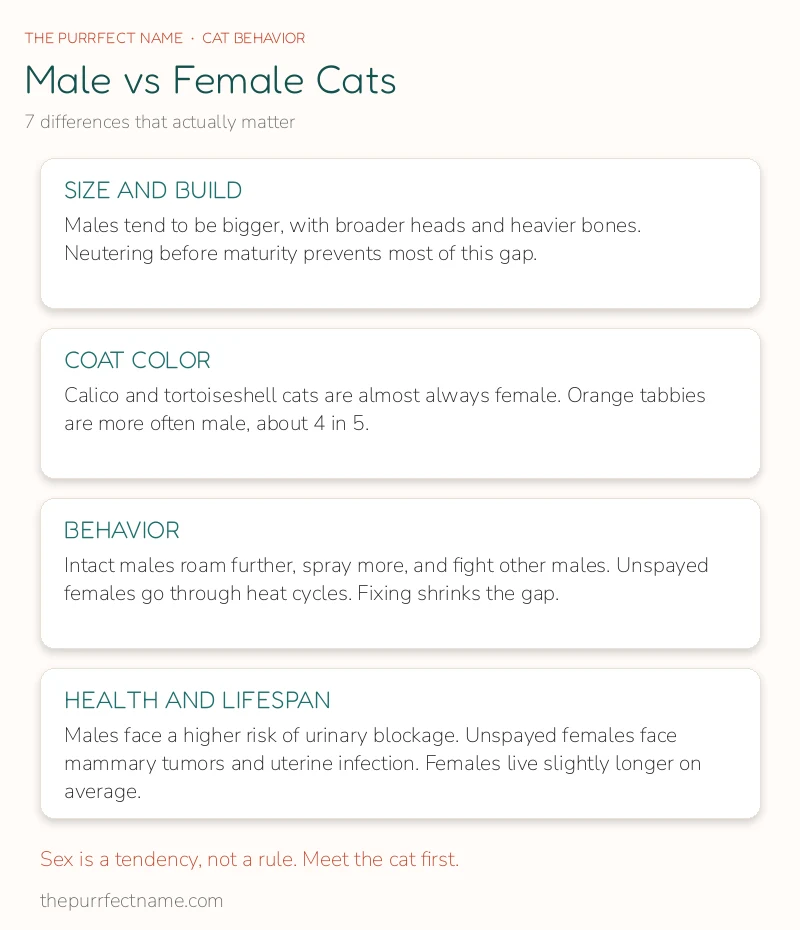
1. Size and Build: Males Tend to Be Bigger
On average, male cats are larger than females of the same breed, with heavier bones, broader heads, and more muscular necks and shoulders. The difference is most obvious in intact males, because testosterone drives much of that bulk.
A vet with the San Francisco SPCA Behavior Service, Alison Gerken, DVM, notes that male cats neutered before sexual maturity, around 5 to 7 months of age, do not develop those hormone related changes. They keep smaller heads and less muscular bodies, and their tail scent glands stay less active, which also means they smell less strong.
Breed swamps this difference easily. A female Maine Coon will outweigh a male Singapura by several kilograms. Size is a tendency you can see across a large group of cats, not a way to sex any one cat. If you need a cat of a certain size, look at the breed and the parents, not the sex.
2. Coat Color Can Hint at Sex, But It Cannot Prove It
Coat color is the one place where sex is written into the genetics, and it is genuinely useful as a clue. The genes for orange and black fur sit on the X chromosome. Females have two X chromosomes, so a female can carry one orange gene and one black gene, and the random switching off of one X in each cell paints a mosaic of orange and black. That is why calico and tortoiseshell cats are almost always female.
Males have one X and one Y chromosome, so a male can only show orange or black, not both. A male calico needs an extra X chromosome, a condition called Klinefelter syndrome, and that happens in only about 1 in 3,000 calico cats. Male calicos are usually sterile. Flip the pattern around and orange tabby cats are more often male, because a male needs only one copy of the orange gene to show it, while a female needs two. About 4 in 5 orange tabbies are male, but that still leaves plenty of orange females.
Coat color is a clue, never a diagnosis. If you want to know a kitten’s sex for certain, a vet can tell you in seconds.
If the calico pattern caught your eye, the calico cat names list is a good place to start once you have met your cat.
3. Roaming and Territory: Intact Males Roam Furthest
An intact male cat’s world is bigger than a female’s, because his hormones push him to find mates. Intact males roam further outdoors, disappear for days, and defend territory against other males. That roaming is also what gets them into fights, traffic, and infections passed on through mating and fighting, including FIV. Females roam less, though an unspayed female in heat will try hard to get out and find a mate.
Neutering changes this more than any other single step. Neutered males roam far less, fight less, and stay closer to home. Spayed females stop trying to escape for mating altogether. For an indoor cat that is already fixed, the roaming difference is mostly gone, and what is left is personality. A bold female will patrol the whole house. A lazy neutered male will sleep on the same cushion all day.
4. Spraying: Males Do It More, But Both Sexes Can
Spraying is urine marking, and it is one of the behaviors people ask about most when choosing between a male and a female. Intact males spray the most, using strong smelling urine to mark territory and advertise themselves to females. Females spray too, especially when in heat or stressed, and spayed females can spray as well.
Neutering greatly reduces spraying in many cats, though some neutered cats keep the habit, especially if they started before surgery or live with other cats they feel tense around. If spraying is your main worry, the practical answer is to neuter early, keep the litter box clean and easy to reach, and reduce tension between cats in the home. Choosing a female does not guarantee a spray free home. Read our guide to why cats spray if marking has already started, because the fix depends on the cause.
5. Heat Cycles: A Female Only Behavior That Spaying Removes Entirely
Unspayed females go into heat, usually every 2 to 3 weeks during the breeding season, and the behavior is hard to miss. Expect loud calling and yowling, restlessness, rubbing against people and furniture, rolling on the floor, raising the hindquarters when touched along the back, and sometimes extra urination or spraying. Some females also try hard to escape the house.
Spaying removes heat cycles completely, along with the calling, the restlessness, and the escape attempts. It also lowers the risk of mammary tumors and uterine infections, which are the main female specific health risks. This is the one difference in this article that is truly sex specific rather than a tendency, and it is also the one with the simplest fix. If you adopt a female, assume she needs spaying unless your vet tells you otherwise.
6. Affection and Play: Tendencies People Swear By, Evidence Does Not Back
This is where the stereotypes are loudest and the evidence is weakest. The common story is that males are clingy lap cats and females are independent queens who love you on their own terms. Ask the people who study cats and the story falls apart. There is no reliable rule that male cats are more affectionate, and there is no real evidence that females are calmer or more independent as a rule.
What decides affection is the individual cat, how it was socialized as a kitten, and the bond it builds with its people.
Play follows the same pattern. Young cats of both sexes are the most playful, and play drive fades with age in both sexes. A young male may be a whirlwind and a young female may be just as wild, or the reverse.
Energy, curiosity, and talkativeness vary far more between two males, or between two females, than they do between the average male and the average female. If you want a cuddly cat, meet several cats, sit with them, and pick the one that climbs into your lap. The sex on the paperwork will not tell you which one that is.
7. Health Risks and Lifespan: Real Differences Worth Knowing
Health is where sex genuinely matters, and the differences are worth knowing before you choose. Male cats carry a higher risk of urinary blockage, because their urethra is longer and narrower than a female’s. A blockage can close off urine flow completely, and that is a medical emergency: a cat that strains to urinate and produces nothing needs a vet at once. Unspayed females carry the matching risk on their side, with higher rates of mammary tumors and uterine infections, and spaying substantially reduces both.
Lifespan leans female, but only slightly and only on average. One large UK study of 7,936 cats in veterinary practices found a life expectancy of 12.51 years for females compared with 11.18 years for males, and the authors noted that those figures come from one UK population and say nothing about any individual cat.
An older vet reviewed source puts it differently: females average about 15 years against about 13 years for unneutered males, while neutered males live about 62 percent longer than intact males. The lesson is consistent across sources. Neutering adds years to a male cat’s life, mostly by cutting the roaming, fighting, and infection risks that kill intact males young.
How Spaying and Neutering Changes the Picture
Almost every difference in this article has the same footnote: it is biggest in intact cats and smallest in fixed cats. Neutering a male before maturity prevents the big head, the heavy muscle, the strong smell, and most of the roaming, spraying, and fighting. Spaying a female ends heat cycles and cuts the main female health risks.
What neutering does not do is rewrite personality. A playful, cautious, social, or independent temperament stays much the same after surgery, and that is why two fixed cats of opposite sexes can feel more alike than two intact cats of the same sex.
Our guide to cat spaying and neutering covers timing, costs, and recovery, and it is worth reading before you book the appointment.
Which Is Right for You?
For most homes, the honest answer is that either sex can be right, and the individual cat matters more. Choose a male if you like the odds: a slightly better chance of a big, goofy lap cat, with a slightly higher risk of urinary trouble to watch for. Choose a female if you like the odds the other way: a slightly better chance of a longer life and a cat that stays closer to home, with heat cycles to prevent by spaying. Then ignore the odds and meet the cat.
Spend time with the cat before you decide. Watch whether it approaches you, whether it tolerates handling, whether it plays, and whether it relaxes in your lap. Ask the shelter about its history, its age, and whether it is already spayed or neutered. Those answers will tell you more about your next ten years together than the sex on the card ever will.
Frequently Asked Questions
Are male cats more affectionate than female cats?
Not as a rule. Many owners say their males are clingier, but studies and vet reviewed sources find no reliable rule that males are more affectionate. Individual personality, early socialization, and the bond with the owner matter far more than sex.
Are female cats calmer than male cats?
There is no real evidence for that claim as a rule. Unspayed females can be restless and vocal in heat, and spayed females can be just as playful or just as aloof as any male. Calmness varies by individual, age, and breed.
Do male cats spray more than female cats?
Yes, especially when intact. Intact males spray the most, but females spray too, and some neutered cats of either sex keep spraying. Neutering greatly reduces spraying in many cats but does not guarantee it stops.
Which sex of cat lives longer?
On average, females live slightly longer. A 2024 UK study of 7,936 cats found 12.51 years for females against 11.18 years for males. Neutered males live much longer than intact males, so neuter status matters more than sex for lifespan.
Are calico cats always female?
Almost always. Calico and tortoiseshell patterns need two X chromosomes, so about 1 in 3,000 calico cats is male, and male calicos are usually sterile.
Should I choose a cat based on sex?
No. Meet the individual cat, check its age, history, and neuter status, and pick the cat whose temperament fits your home. Sex is a weak predictor of the cat you will actually live with.