
5 Signs Your Cat Is Well Cared For
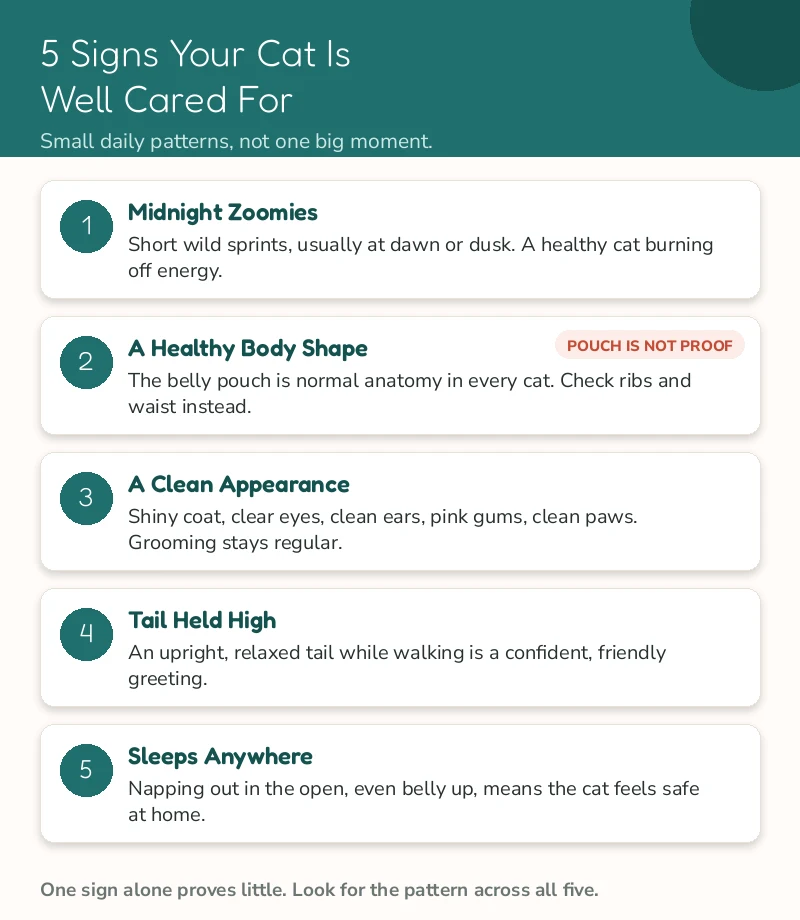
You cannot ask your cat how it feels about its life. But you can watch it. A well cared for cat shows it in small daily patterns: how it moves through the house, how it looks, how it sleeps, and how it greets you. None of these signs proves anything on its own. Together, they paint a clear picture.
This article covers five signs, and it starts with a correction. One popular image online claims that a small belly pouch means a cat is well nourished and cared for.
That is not true, and this article says so in the open, because the honest version is more useful than the flattering one. The pouch is normal anatomy in every cat. The real sign is the shape of the whole cat, and sign 2 explains how to check it.
The information here is general information only and is not veterinary advice. If your cat changes suddenly, hides constantly, stops eating, or stops grooming, contact your vet. A behavior change can be a health problem first and a happiness problem second.
Key Takeaways
- Midnight zoomies, those short wild sprints at dawn or dusk, are usually a healthy cat burning off energy.
- A belly pouch is normal anatomy in every cat. It is not proof of good nutrition, and it is not proof of weight gain either.
- The honest weight check is the whole body: ribs felt with gentle pressure, a waist visible from above, and a vet Body Condition Score.
- A clean, shiny coat, clear eyes, clean ears, pink gums, and clean paws are the visible result of regular grooming and good health.
- An upright, relaxed tail while walking is a confident, friendly greeting. A puffed tail means the opposite.
- A cat that naps out in the open, even belly up, feels safe at home. A cat that suddenly hides to sleep may be unwell.
The 5 Signs, One by One
1. Midnight Zoomies
Every cat owner knows the sound: a sudden thunder of paws down the hallway at midnight, a leap onto the bed, a skid around a corner, and then silence. These bursts are called Frenetic Random Activity Periods, or FRAPs, and they are a normal part of being a cat.
Cats are crepuscular animals, most active at dawn and dusk, which is why the sprints so often land right at bedtime. A zoomie is a cat burning off stored energy and practicing the hunting moves it was built for, in a safe house where it has nothing to fear.
A cat that still gets the zoomies is a cat with energy to spend and a body that works well. That is why the bursts are a good sign, not a problem to fix.
Play with your cat in the evening and the midnight run often moves earlier, but do not expect it to vanish. Our guide to what cat zoomies are explains the triggers, the timing, and how to manage the 3 a.m. session without punishing a healthy behavior.
One honest caveat. The sign is the usual pattern, not any single sprint. If a calm older cat suddenly starts sprinting at all hours, or the zoomies come with weight loss, loud restlessness, or a big appetite change, that is a different story.
A sudden change in activity in a senior cat can point to an overactive thyroid or another medical problem, and that deserves a vet visit, not a laugh.
2. A Healthy Body Shape, Not a Belly Pouch
This is the sign the internet gets wrong. A small flap of loose skin hangs under the belly of almost every cat. It is called the primordial pouch, and it is a normal part of feline anatomy. All cats have one, male and female, and even lions and tigers have it.
It starts to show when a cat is around six months old and it never goes away. Experts think it may protect the belly organs in a fight, or give the body extra stretch when a cat runs and jumps, but its exact purpose is still uncertain.
What is certain is what the pouch does not mean. A pouch does not mean a cat is well nourished. A lean, athletic cat can have a very obvious pouch, and a cat that is fed too much can have one too.
A pouch also does not mean a cat is overweight. Judging a cat by the pouch alone leads owners in both directions: worrying about a healthy cat, or missing real weight gain because the pouch was always there.
Check the whole cat instead. Run your hands along its sides: you should feel the ribs with gentle pressure, but the ribs should not be clearly visible. Look down from above: there should be a waist behind the ribs, not a straight or bulging line.
If you are not sure, ask your vet to assess your cat’s Body Condition Score at the next visit. That score, not the pouch, is the real measure of whether your cat’s weight is right.
3. A Clean Appearance
A well cared for cat looks cared for. The coat is the easiest place to see it: clean, smooth, and shiny across the whole body, without dry flakes, grease, or mats.
Cats are fastidious groomers by nature, and Cornell notes that cats typically spend about 30% to 50% of their day grooming. That daily work is what keeps the coat in good shape, and it only happens when a cat feels well enough to do it.
Look a little further and the rest of the picture fills in. The eyes should be bright and clear, free of discharge or irritation. The ears should be clean and pink inside, not red or smelly. The gums should be pink, and the teeth should be reasonably clean rather than coated in heavy tartar.
The paws should be clean, with no swelling or sore pads. None of these needs a vet visit to check. They are a thirty second look you can do at home, once a week.
Watch for the change, not the single bad day. A cat that stops grooming, or whose coat turns greasy or matted over a few days, is telling you something. Pain, stress, skin disease, or another medical problem can all show up first as a coat that is no longer being looked after. That is a vet conversation, not a bath.
4. A Tail Held High While Walking
Watch your cat walk across the room toward you. If the tail goes up, relaxed and upright, that is one of the clearest friendly signals a cat has. An upright tail is a confident greeting, the feline equivalent of a smile and a wave, and it is a behavior cats developed through living with people.
A slight curl at the tip, like a question mark, adds affection or playfulness to the greeting, and a quivering tip means the cat is genuinely happy to see you. Our guide to cat tail language covers the rest of the positions, so you can read the whole cat instead of guessing from one signal.
The key word is relaxed. The tail should be up and loose, with a soft body and forward ears behind it. A tail held high with the fur puffed out is a different message: the cat is trying to look bigger because it feels threatened.
A tail held low or tucked tight means the cat is unsure or afraid. Context decides the meaning, and a confident cat shows it in the whole body, not just the tail.
If your cat walks around the house with its tail up, greeting you at the door and trotting over when you come home, that is a cat that trusts its environment and the people in it. It is also a cat that was given a reason to trust them, which is what good care looks like from the cat’s side.
5. Can Sleep Anywhere
Adult cats sleep 12 to 16 hours a day, and where they choose to sleep says a lot about how safe they feel. A cat that naps out in the open, on the sofa, on the rug in the middle of the room, or on your lap, is a cat that has let its guard down.
The strongest version of this sign is the belly-up sleep: a cat lying on its back with its paws in the air is showing you its most vulnerable side, and it only does that where it feels completely safe. Our guide to cat sleeping positions explains which poses are light rest and which are deep, trusting sleep.
Do not read this sign backwards. A cat that sleeps in a different spot every day is not a worried cat. Cats rotate resting spots by time of day, temperature, and mood, and a cat with several good spots will use them all.
The warning sign is a change: a cat that used to sleep on the sofa and now hides under the bed all day, or starts sleeping in odd places it never used before, may be in pain or unwell. That is a vet conversation, and the sooner the better.
What to Do if the Signs Are Missing
First, do not panic over one missing sign. Cats are individuals, and a shy cat may never greet you with a tail held high, while an older cat may have fewer zoomies than a kitten. What matters is the pattern across all five, and whether that pattern has changed.
A cat that was playful and glossy coated six months ago and is now dull coated and hiding is a different case from a cat that has always been quiet.
Start with the basics, in this order. Make sure the food is right for the cat’s age and weight, and that fresh water is always available in more than one spot. Scoop the litter box daily and keep one box per cat plus one extra.
Give the cat places to rest, climb, and hide, and play with it for a few minutes every day. Then give the changes two or three weeks. A cat that feels better will show it in the same five signs, usually starting with the coat and the tail.
If the signs do not come back, or if the change came with eating less, drinking more, toileting outside the box, or weight loss, stop treating it as a care problem and call your vet. Good care and good health are linked, but they are not the same thing, and a sick cat needs medicine, not a nicer bed.
Frequently Asked Questions
Does a belly pouch mean my cat is overweight?
No, not on its own. Every cat has a primordial pouch, including lean and athletic cats, and its size varies with genetics, age, and breed. A pouch that sways when the cat walks is usually just the pouch. Check the ribs and the waist from above, and ask your vet for a Body Condition Score, before deciding your cat needs to lose weight.
Does a belly pouch mean my cat is well fed?
No. The pouch is normal anatomy, not a sign of good nutrition. A cat can have a prominent pouch and still be underfed, and a cat can have almost no visible pouch and be perfectly nourished. Food quality and body condition are what matter, and neither one shows up in the pouch.
My cat never gets the zoomies. Is something wrong?
Not necessarily. Older cats, overweight cats, and naturally calm cats zoom less, and a cat that plays hard during the day may have no energy left to burn at night. What matters is the change: if a cat that used to sprint every evening suddenly stops, and the change comes with eating less or hiding more, that is worth a vet visit.
How do I know if my cat is overweight?
Feel the ribs with gentle pressure: you should feel them without pressing hard, but they should not stick out. Look down from above for a waist behind the ribs. Look from the side for a belly that tucks up rather than hanging straight.
If you are unsure, ask your vet to score your cat’s body condition at the next visit. Never put a cat on a diet without a vet’s guidance.
My cat sleeps under the bed all day. Is that bad?
It depends on whether it is new. Some cats always prefer a hidden spot, and that is normal. A cat that used to sleep in the open and now hides all day is a different case, and it can be a sign of pain, stress, or illness. If the hiding comes with eating less or toileting changes, call your vet.
The Bottom Line
A well cared for cat does not send you a report card. It shows you, in small ways, every day: a midnight sprint, a glossy coat, a tail held high on the way to greet you, and a nap taken out in the open because the house feels safe.
Check those five signs together, and check them honestly. And if you have been judging your cat by its belly pouch, stop. The pouch was never the test. The whole cat is.