
9 Smells Cats Hate (And Which Ones Are Actually Dangerous)
Your cat walks into the kitchen, catches a whiff of the lemon you just cut, and backs away like you opened something rotten. It is not being dramatic. A cat’s sense of smell is about 14 to 40 times stronger than a human’s, and cats have about 200 million olfactory cells packed into a very small nose. What smells fresh to you can smell like an assault to them.
This guide covers 9 smells cats hate, and more importantly, which ones are safe to use as deterrents and which ones are actually dangerous.
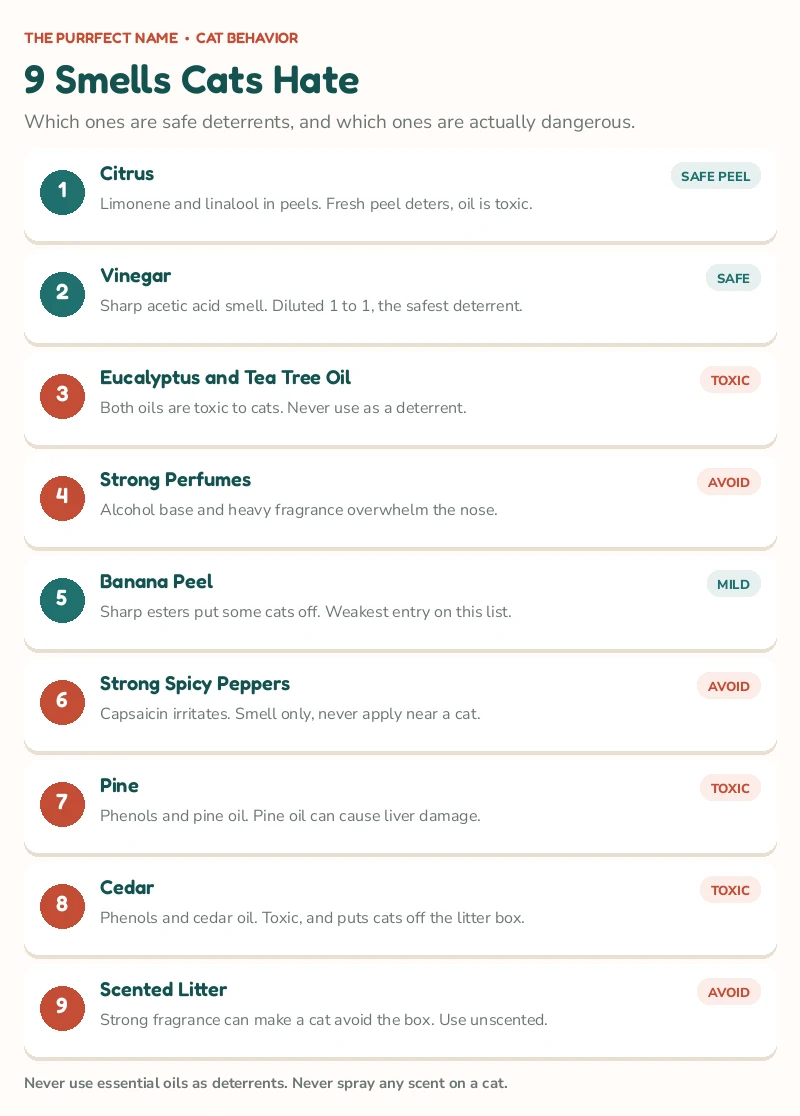
The short answer is that citrus, vinegar, eucalyptus and tea tree oil, strong perfumes, banana peel, spicy peppers, pine, cedar, and scented litter all sit on the hate list, but they are not equal. Vinegar is the safest deterrent on the list. Eucalyptus and tea tree oil are toxic and must never be used as deterrents.
Everything in between needs a closer look, and that is what the entries below give you.
Key Takeaways
- 9 smells make the list: citrus, vinegar, eucalyptus and tea tree oil, strong perfumes, banana peel, strong spicy peppers, pine, cedar, and scented litter.
- Only 2 are safe deterrents: fresh citrus peel and diluted white vinegar. Never use essential oils as deterrents.
- Eucalyptus, tea tree, pine, and cedar oils are toxic to cats. The smell is the warning, not the tool.
- Banana peel is the weakest entry on this list. It works for some cats and does nothing for others.
- Never spray any scent directly on a cat, and never use a diffuser with toxic oils in a room your cat cannot leave.
- If your cat is exposed to an essential oil and starts drooling, trembling, or struggling to breathe, call your vet right away.
Why Cats React So Strongly
Cats live by smell in a way humans do not. Scent tells a cat who has been in a room, whether food is safe, whether another cat has marked a spot, and whether something in the air is dangerous. That is why a smell a cat dislikes is not a mild annoyance. It is information the cat cannot ignore, and the usual response is to leave the area, sneeze, rub its face, or avoid the spot entirely.
There is also a survival reason behind the hate. Many of the smells cats dislike come from plants that are genuinely toxic to them. Citrus peels, eucalyptus, pine, and cedar all carry compounds that a cat’s liver clears poorly. Over thousands of years, cats that avoided those smells were the ones that stayed healthy. The dislike is the defense.
The 9 Smells Cats Hate
| Smell | How much cats hate it | Is it dangerous | Safe to use as a deterrent |
|---|---|---|---|
| Citrus | Very strong, top of the list | Peel is mild, concentrated oil is toxic | Yes, fresh peel only |
| Vinegar | Very strong | No, diluted white vinegar is nontoxic | Yes, diluted 1 to 1 with water |
| Eucalyptus and tea tree oil | Very strong | Yes, both oils are toxic | No, never |
| Strong perfumes | Strong | Irritating, not poisonous | No, avoid heavy fragrance near cats |
| Banana peel | Weak to moderate, varies by cat | No, not toxic | Yes, short term only |
| Strong spicy peppers | Strong | Capsaicin can harm cats | No, smell only, never apply |
| Pine | Strong | Yes, pine oil is toxic | No, never use pine oil |
| Cedar | Strong | Yes, cedar oil is toxic | No, never use cedar oil |
| Scented litter | Moderate to strong | Not poisonous, but causes box avoidance | No, switch to unscented |
1. Citrus
Lemons, limes, oranges, and grapefruit sit at the top of nearly every cat’s hate list. Citrus peels contain limonene and linalool, compounds that cats process poorly compared to humans. The casual smell of a lemon is usually just unpleasant to a cat, but concentrated citrus essential oil is a different matter and can cause real liver toxicity.
Safe way to use it: scatter fresh citrus peel near a plant or on a counter you want your cat to avoid. Do not use citrus essential oil, citrus spray, or a citrus diffuser. The peel is the deterrent. The oil is the danger.
2. Vinegar
Vinegar has a sharp acidic smell that cats find strongly unpleasant. Its acetic acid makes it a mucosal irritant for a nose as sensitive as a cat’s, which is why a cat will squint or back away when you clean windows with it. The good news is that vinegar is also the safest deterrent on this list.
Safe way to use it: mix white distilled vinegar one to one with water in a spray bottle and spray it lightly on furniture or surfaces you want to protect. It is nontoxic and the smell fades quickly, though most cats will avoid treated surfaces for 24 to 48 hours. Never spray it directly on or near your cat. Our guide on how to get rid of cat pee smell uses the same diluted vinegar approach for cleaning.
3. Eucalyptus and Tea Tree Oil
Eucalyptus and tea tree oil are the two scents on this list that must never be used as deterrents, because both are toxic to cats. Eucalyptus contains terpenes and cineole, which the feline metabolism cannot process efficiently. Tea tree oil, also called melaleuca, is listed by VCA Animal Hospitals and the Pet Poison Helpline among the oils known to poison cats. Ingestion, skin contact, or breathing in diffuser vapor can all be toxic.
What to do instead: if you like the smell of eucalyptus, keep it in a room your cat does not use, and never diffuse it in a closed room with a cat inside. Never apply tea tree oil or eucalyptus oil to a cat, its bedding, or its scratching post.
If your cat is exposed and starts drooling, trembling, or struggling to breathe, contact your vet or a poison helpline right away. Our guide on when to take your cat to the vet covers the signs that mean a same day visit.
4. Strong Perfumes and Colognes
Heavy perfume and cologne combine concentrated synthetic fragrances with an alcohol base, and both overwhelm a cat’s nose. Many cats will leave a room after someone applies perfume, or avoid sitting on clothing that has been heavily sprayed. Some cats sneeze or rub their faces, and strong fragrance can cause stress and avoidance that lasts for hours.
Safe way to live with it: choose unscented or lightly scented personal products, apply perfume in a room the cat can leave, and let it dry before you pick your cat up. Never spray perfume directly onto a cat. Cats also rely on scent to recognize their humans, and heavy perfume can mask your natural smell, which is one more reason a cat may keep its distance after you spray.
5. Banana Peel
Banana peel is the weakest entry on this list, and it is kept here with that caveat in plain sight. Banana peels release isoamyl acetate and ethyl acetate, sharp smelling esters that some cats find deeply unpleasant. A significant number of cats will avoid an area where banana peels are present, but plenty of cats ignore them entirely, and the results are inconsistent from cat to cat.
Safe way to use it: a fresh banana peel placed near a plant can work as a short-term deterrent. It is completely nontoxic. Remove it promptly, because peels rot quickly and attract insects, which makes them a poor long-term choice. Do not expect it to work the way citrus peel does. If your cat ignores the banana, that is normal, not a sign that something is wrong with your cat.
6. Strong Spicy Peppers
Strong spicy peppers, chili powder, and pepper flakes carry capsaicin, the compound that makes peppers hot. Cats dislike the sharp smell, and the smell alone is enough to keep most cats away from a treated spot. But capsaicin is also an irritant that can harm a cat that licks it, breathes it in, or gets it on its paws and then grooms it off.
The rule here is smell only, never apply. Do not sprinkle chili powder, pepper flakes, or pepper spray on surfaces, plants, or furniture your cat can reach, and never use them on or near your cat. The deterrent value is not worth the irritation risk, and vinegar or citrus peel does the same job safely.
7. Pine
Pine has a strong terpene scent that most cats dislike, which is why some litters and cleaners use it as a base. The problem is that pine oil is toxic to cats and can cause liver damage, and the smell of pine scented floor cleaners irritates cats even at low concentrations. VCA lists pine oil among the oils poisonous to cats, and the Pet Poison Helpline lists it among the oils known to poison cats.
Safe way to live with it: use pine scented cleaners only in ventilated areas and keep your cat off treated floors until they are fully dry. Do not use pine oil, pine scented litter, or pine diffusers as a cat deterrent. If your cat avoids a room after you clean it with a pine product, the smell is the reason, and switching to an unscented cleaner is the fix.
8. Cedar
Cedar carries the same warning as pine. Its woody scent comes from phenols and resinous compounds that overwhelm a cat’s sensitive nose, and cedar oil is toxic to cats. The ASPCA has listed cedar as toxic to cats, and concentrated cedar oil can irritate the airways. Cedar scented litter, bedding, and closet blocks are the usual ways a cat meets this smell indoors.
Safe way to live with it: skip cedar scented litter and bedding, and use unscented litter instead. If your cat has started avoiding the litter box after a switch to a cedar scented product, the scent is the first thing to change back. Never use cedar oil as a deterrent.
9. Scented Litter
Scented litter is the one entry on this list that owners buy on purpose and cats often hate. Strong synthetic fragrance, pine scent, cedar scent, and lavender scent in litter can all put a cat off the box, and a cat that dislikes its litter will often go elsewhere in the house instead. Scented litter can also trap and amplify odors rather than masking them, which makes the box doubly unpleasant.
Safe way to fix it: switch to an unscented litter, keep the box scooped daily, and clean the box itself regularly. A cat that avoids a clean unscented box is telling you something else, and that is worth a vet visit, but a cat that avoids a strongly scented box is usually just telling you the scent is too much.
Scents You Should Never Use as Deterrents
Several smells that cats hate are also toxic, and they should never be used to keep a cat away from anything. The list is: eucalyptus oil, tea tree oil, pine oil, cedar oil, citrus essential oil, peppermint oil, cinnamon oil, clove oil, lavender oil, wintergreen oil, and ylang ylang oil. VCA lists all of these as poisonous to cats, and the Pet Poison Helpline lists most of them among the oils known to poison cats.
The concentration needed to repel a cat is close to the concentration that can harm one, which is why the answer is never to use them.
The same rule covers diffusers. Active diffusers that put oil droplets into the air are the larger risk, because oils settle on a cat’s fur and are swallowed during grooming. Never run a diffuser with a toxic oil in a room your cat uses, and never apply any essential oil to a cat’s skin or fur. If an exposure happens, call your vet or ASPCA Animal Poison Control at 888-426-4435.
How to Use Scents Safely Around Cats
Only two deterrents from this list are safe to use: fresh citrus peel and diluted white vinegar. Both work because the smell is strong and the substance is not toxic at the amount used. Place peel near plants or on counters, and spray diluted vinegar lightly on furniture, never on the cat.
For everything else on the list, the safe move is removal, not use. Switch to unscented litter, unscented cleaners, and lightly scented personal products. Give your cat an escape route from any strong smell, and never trap a cat in a room with a scent it is trying to leave. If a cat is sneezing, rubbing its face, drooling, or hiding after a new scent appears in the house, remove the scent first and watch whether the cat recovers. If the signs continue, call your vet.
Frequently Asked Questions
What smell do cats hate the most?
Citrus is the most widely reported, with lemon, lime, orange, and grapefruit all at the top of the list. The compounds limonene and linalool in citrus peels are the reason, and concentrated citrus oil is toxic, so fresh peel is the only safe way to use it as a deterrent.
Is vinegar safe to use around cats?
Diluted white vinegar is one of the safest scent deterrents available. Mix it one to one with water, spray it lightly on surfaces, and never spray it directly on or near your cat. It is nontoxic and the smell fades within a day or two.
Can I use essential oils to keep my cat off the furniture?
No. Eucalyptus, tea tree, pine, cedar, citrus, peppermint, cinnamon, clove, lavender, and wintergreen oils are all toxic to cats in concentrated form. Use fresh citrus peel or diluted white vinegar instead.
Do cats really hate banana peels?
Some do, and some do not. Banana peels release sharp smelling esters that a significant number of cats avoid, but the results are inconsistent, and it is the weakest deterrent on this list. It is nontoxic and worth trying for a day, but do not rely on it.
Why does my cat avoid its litter box after I change the litter?
The scent is the most likely reason. Strongly scented litter, including pine, cedar, and lavender scented products, can put a cat off the box even when the box is clean. Switch back to an unscented litter and see if the habit returns.
The Bottom Line
Nine smells make this list, but only two are safe tools: fresh citrus peel and diluted white vinegar. Eucalyptus, tea tree, pine, and cedar oils are toxic and must never be used as deterrents, no matter how much a cat dislikes them. Strong perfumes and scented litter are unpleasant rather than poisonous, but they still cause stress and litter box avoidance, so unscented is the kinder choice.
Banana peel is the weakest entry and works for some cats only, and spicy peppers should never be applied anywhere a cat can reach. Hate is not the same as danger, and the safest way to keep a cat away from something is the scent that is strong to the cat and harmless to the cat at the same time.