

That Neck Bite Looks Like a Fight. Most of the Time, It Is Play
It looks like an attack. One cat grabs the other by the neck, pins her down, and the other cat squeals. You run across the room, and by the time you get there they are grooming each other like nothing happened. Most of the time, cats biting each others necks is not a fight at all. It is play, or mating, or a social reminder, and the cats sort it out themselves. The skill is telling the harmless version from the real fight, and that skill is not about the bite. It is about the whole body: the ears, the fur, the tail, and whether the cats take turns.
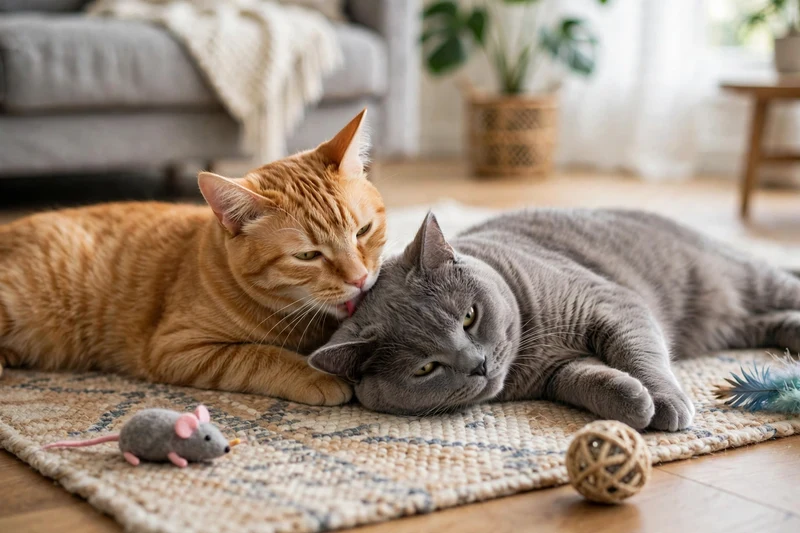
Play or a real fight: the turn taking rule
If you remember one rule from this guide, make it this one: in play, cats take turns. One cat pins the other, then they swap, and the cat that was underneath becomes the one on top. Play is quiet, with ears forward, claws mostly in, and pauses where both cats stop and start again. A real fight is loud and one sided: ears flat, fur puffed, tail lashing, no pauses, and one cat always on top. Kittens practise on necks because the neck is the centre of hunting and social skills: they stalk, pounce, bite, and wrestle, and in doing so they practise the grip they would use on prey. The neck is one of the most vulnerable areas for prey, and all predators go for the neck, which is why the grip looks so serious even when the intent is play. Mothers use the same place gently: a mother cat grasps a kitten by the scruff to move it safely, and the kitten goes limp in a natural freeze response.
Why cats bite necks when mating, and when rank is the reason
Why do cats bite necks when mating? When cats mate, the male mounts the female and bites her neck to hold her still. Cats.com says this generally will not harm the female, and that it protects the male from a swipe. In multi cat households, neck biting can also be a way to maintain hierarchy: when male cats bite each others necks, it is an expression of dominance, and the cat on top is usually the one making the point. Cats fighting over food, beds, and litter trays are not fighting about the neck. They are fighting about resources, and the neck is just where the fight lands. Give each cat her own bowl, bed, and litter tray, in different rooms where you can, and much of the neck biting fades on its own. The cat to worry about is not the one doing the biting. It is the one always on the receiving end. A cat that always loses stops playing, stops exploring, and starts hiding, and that is the cat this guide is for.
Breaking up a fight, and when to get help
Never use your hands to separate fighting cats. A cat in a fight will bite anything that touches her, including you, and a cat bite can be deep and can become infected. Throw a cushion between them, or make a loud noise, or slide a board between them, then let them cool down in separate rooms. Call the vet when the pattern changes suddenly. A cat that was playful and is suddenly aggressive may be in pain, and a cat in pain can direct that pain towards another cat through redirected aggression. The Cornell Feline Health Center guide to feline aggression explains the main causes and the first steps, and the ASPCA guide to aggression in cats covers how to keep everyone safe while you work out the cause. The International Cat Care guide to aggression between cats explains how to reintroduce cats slowly after a bad fight. Bringing a new cat home is where most dominance biting starts, and most of it is preventable: keep the new cat in a separate room for the first days, swap scents on a cloth, and let them meet through a closed door before they ever share a room. This is general information only, not veterinary advice.
If your cats take turns, make no injuries, and go back to sleeping together afterwards, you can probably stop worrying. If one cat always loses, hides, or comes away with wounds, that is the moment to step in.