
Why Do Cats Meow? What Your Cat Is Trying to Tell You
Most cats meow mainly at people, not at other cats. Kittens meow to their mothers, but adult cats usually switch to body language, scent, and quieter sounds with each other, and keep meowing as a way to talk to the humans in the house. That is the short answer to why your cat meows at you: your cat has learned that a meow gets your attention, and that attention often brings food, a door opened, play, or company. The rest of this guide helps you tell those messages apart, because a short greeting meow, a hungry meow at the kitchen door, and a sudden change in a quiet cat do not mean the same thing, and the right response depends on the context around the sound.
This article is general information only and is not veterinary advice. Meow types describe behaviour, not a diagnosis. If your cat suddenly meows much more or much less than usual, cries out in pain, hides, stops eating, or shows a sudden change in behaviour, contact your vet rather than guessing from a chart.
Key Takeaways
- Adult cats meow mainly at humans. Kittens meow to their mothers, then mostly outgrow cat to cat meowing.
- Context matters more than the sound alone. The same meow can mean hunger at the kitchen door and a greeting at the front door.
- Short meows often mean greeting or attention. Longer, repeated, or urgent meows often mean a stronger request.
- Body language completes the message. Check ears, eyes, tail, and posture together with the meow.
- A sudden change in meowing deserves attention. New loud crying, new silence, or meowing with other changes is a reason to contact your vet.
- Responding to every meow with food can teach a cat that meowing always works. Keep feeding times steady and reward quieter moments too.
- Older cats and unspayed or unneutered cats may vocalise more for reasons linked to age or mating, and those cases deserve a vet conversation, not punishment.
Why Adult Cats Meow at People
Domestic cats live in a human world, and humans are poor at reading scent marks and subtle cat body language. Meowing fills that gap. A cat that wants a door opened cannot open it, and a cat that wants dinner cannot fill its own bowl, so a sound that makes a human look up is a practical tool. Over time, cats also shape their meows to the household. If a soft chirp gets a greeting and a loud yowl gets dinner served early, the cat learns which sound works for which result, even if the owner never meant to teach it. That is simply a cat repeating what has worked before.
Breed and personality also play a part, in a general way. Some breeds and some individual cats are naturally more talkative, while others say very little day to day. A talkative cat is not necessarily unhappy, and a quiet cat is not necessarily content. What matters most is your own cat’s normal pattern. Learn that baseline first, and you will notice a real change much faster than if you compare your cat to a stranger’s cat online. Our guide to cat ear positions and our guide to cat tail language pair with this guide, because ears and tail often confirm what a meow only hints at.
What Different Meows Often Mean
No meow type has a fixed dictionary meaning, but patterns repeat often enough to be useful, provided you also watch the situation. A single short meow on meeting you is commonly a greeting. A series of short meows can mean excitement or a stronger bid for attention. A long, drawn out meow often means a demand or a complaint, such as a closed door or a late meal. A low pitched meow often goes with unhappiness or discomfort, while a high pitched, almost chirping sound often goes with greeting or excitement. Yowling, which is louder and longer than an ordinary meow, is a different category, and it is more often linked to distress, mating behaviour, disorientation in an older cat, or pain, so it deserves closer attention than a chatty meow.
| Sound | Common context | Likely meaning |
|---|---|---|
| Single short meow | Meeting you, entering a room | Greeting or simple attention |
| Several short meows | Excitement, play, or reunion | Stronger greeting or bid for interaction |
| Long, drawn out meow | Closed door, late meal, wanted object | Demand or complaint |
| Low pitched meow | Unhappiness, discomfort, or protest | Cat is not pleased or not comfortable |
| Chirp or trill | Seeing you, a toy, or a bird | Friendly excitement or invitation to follow |
| Yowl | Night, mating season, confusion, or pain | Strong distress or mating signal, check carefully |
| Sudden silence in a talkative cat | Illness, stress, or a big change at home | Possible problem, watch other behaviour closely |
Six Meow Sounds at a Glance
Pitch, length, and repetition carry most of the meaning in a meow. A short mew as you walk in is usually a hello. A longer meow by the fridge is usually a request. The table below puts the six most common patterns side by side, with the situation you usually hear each one in. If your cat meows a lot for no clear reason, our guide to why cats meow so much takes the same patterns further, into the common causes.
| How it sounds | What it often means | Where you usually hear it |
|---|---|---|
| Short mew | Hello, a greeting | When you walk in, or make eye contact |
| Multiple meows | Excited greeting | When you come home, often in a quick run |
| Mid pitch meow | A plea for something | Near a bowl, a door, or a toy |
| Drawn out meow | A demand for something | When a request has waited too long |
| Low pitch meow | A complaint | When something is wrong in your cat’s view |
| High pitch cry | Anger or pain | Sudden and sharp, check your cat and call your vet if it keeps happening |
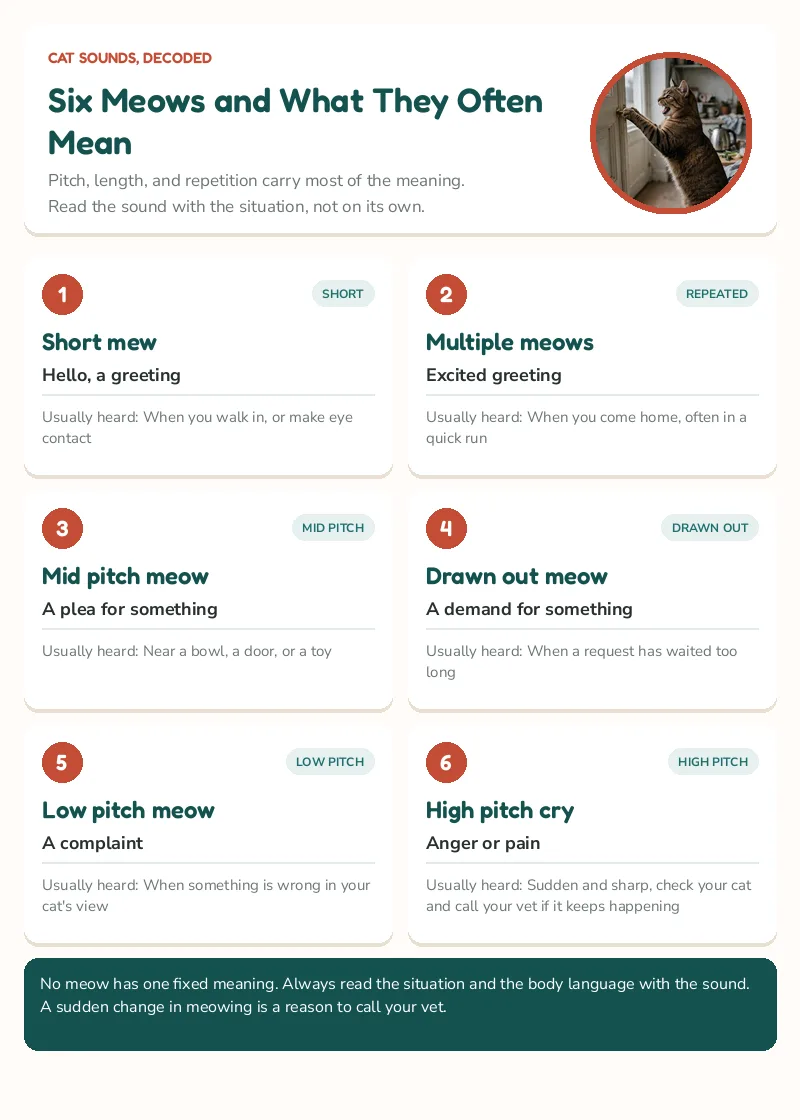
Two things to keep in mind with this table. First, the same sound can mean different things in different rooms: a short mew at the front door is a greeting, while a short mew at the kitchen door may be the start of a food request.
Second, a high pitched cry is the one row where sources disagree. A short bright high mew on greeting can be friendly, while a sudden sharp high cry is more often distress, so the shape of the sound and what happened just before it matter more than the pitch alone.
Greeting and Attention Meows
Many cats meow when a favourite person comes home, walks into a room, or wakes up in the morning. That greeting meow is usually short, bright, and paired with a tail held up, ears forward, and a body moving toward you. It is one of the friendliest sounds a cat makes, and it often stops on its own once you answer with a word, a slow blink, or a brief greeting. Some cats keep talking after the greeting because they enjoy the exchange itself. Talking back in a calm voice, without immediately offering food, helps keep a greeting as a greeting rather than turning it into a food request.
Attention meows look similar but last longer. A cat that meows while you work, read, or watch television, and that settles when you play or pet it for a while, is often asking for company. Cats that spend long hours alone, or that have little play during the day, are more likely to ask loudly in the evening, when the house finally fills with people. That pattern is worth noticing, because the fix is often more daytime play and company, not a louder response at night. If attention meows always earn an immediate reward, such as food or a lap on demand, the cat will reasonably keep using them, so it helps to offer play and affection at planned times as well as when your cat asks.
Hunger and Asking for Something
Hunger is one of the most common reasons for meowing, and it is usually easy to spot. The meowing clusters around meal times, near the kitchen, or beside an empty bowl, and it often grows more insistent as the usual feeding time approaches. Cats are quick to learn a routine, so a cat fed at slightly different times each day may start asking earlier and earlier, just in case today is an early day. Keeping feeding times steady, and measuring food rather than topping up the bowl after every meow, usually calms that pattern over time. If your cat meows for food between meals and also seems constantly hungry, or if weight, thirst, or litter box habits have changed, that combination deserves a vet conversation, since hunger alone does not explain every change.
Meowing can also mean a practical request that has nothing to do with food. A cat may meow at a closed door, at a tap, at a toy stuck under furniture, or at a litter box that needs cleaning. The clue is what the cat does next: a cat that leads you to a door, a bowl, or a toy is showing you the request, not just making noise. Follow the lead once, fix the simple problem, and the meowing usually stops. If the same request repeats every day, such as a door that is always closed at the same hour, a small routine change, like a regular play session before that hour or access to a comfortable resting spot nearby, often works better than answering the same meow again and again.
Stress, Boredom, and Anxiety
Stress can raise meowing in cats that are usually quiet. A move, a new baby, a new pet, building work, a change in routine, or a strange cat outside the window can all leave a cat unsettled, and meowing may be part of asking for reassurance or for a safe place. Stressed meowing often comes with other signs, such as hiding, flattened ears, a low crouch, less appetite, or avoiding the litter box, and it often follows the stressful event rather than meal times. The helpful response is calm and steady: keep routines as normal as possible, offer hiding places and high resting spots, and avoid forcing contact on a cat that is asking for space. If stress meowing lasts for weeks, or arrives with appetite loss or litter box problems, contact your vet.
Boredom is a related but different cause. A cat with little to chase, climb, or explore during the day may save its energy for the evening and then meow, race around, or demand play when people are trying to rest. Short, regular play sessions with toys that move like prey, plus scratching posts, window perches, and puzzle feeders used in moderation, give that energy a daytime outlet. Spread play through the day, so the evening feels like a natural wind down rather than the first exciting event of the day.
When Meowing May Mean Pain or Illness
Meowing alone does not prove illness, but a change in meowing can be an early clue, especially when it comes with other changes. Watch for a cat that suddenly cries out, yowls at night when it used to sleep, meows while using the litter box, or becomes unusually quiet after being talkative. Those patterns, on their own, do not identify a cause, and they should not be used to guess a diagnosis at home. They are reasons to contact your vet and describe what changed, when it started, and what else changed in eating, drinking, litter box habits, movement, or sleep. A vet can examine the cat and rule out causes that an owner cannot see, such as mouth pain, urinary discomfort, or age related confusion.
Older cats deserve special attention here. As cats age, some become more vocal at night, appear confused or disoriented, stare at walls, or get lost in familiar rooms. Those signs can have several causes, and only a vet examination can narrow them down, so an older cat with new nighttime crying should be checked before any behaviour plan is tried. An unspayed female cat in heat, or an unneutered male cat nearby, may also yowl loudly for days. That is a mating signal, and the long term answer is a vet conversation about neutering, not punishment. Never punish a cat for meowing, since punishment usually raises stress and can damage trust without fixing the underlying need.
How to Respond Without Making It Worse
The most useful habit is to check the simple needs first, then respond to the message rather than only to the noise. Is the water bowl full and fresh? Is the litter box clean? Has the cat had play today? Is a door blocking access to a favourite resting spot? Fixing a real need usually ends the meowing quickly. If no simple need explains it, a brief calm response, such as speaking softly, offering a short play session, or sitting nearby for a few minutes, is often enough for a greeting or attention meow. For a demand meow, it helps to wait for a short pause before giving what was asked for, so the cat learns that calm behaviour, not louder behaviour, moves things along.
Consistency matters more than any single trick. If meowing sometimes earns food at 4 in the morning and sometimes does not, the cat will reasonably keep trying, because the reward still arrives often enough to be worth the effort. A steady routine, with meals at set times, play before bedtime, and attention offered at planned moments as well as on request, gives the cat fewer reasons to escalate. Keep a short note for a week if the pattern is unclear: the time, what happened just before it, and what stopped it.
Frequently Asked Questions
Why does my cat meow at me but not at other cats?
Adult cats usually reserve meowing for humans. With other cats they rely more on body language, scent, and quieter sounds, while meowing is a tool they developed for getting a human’s attention and help.
Why does my cat meow so much at night?
Cats are most active around dawn and dusk, and a cat that slept all day may be ready to play and eat when you want to sleep. More daytime play, a play session before bedtime, and a steady feeding routine often reduce nighttime meowing, but a sudden change in a previously quiet cat deserves a vet check.
Should I ignore my cat when it meows?
Do not ignore a sudden change, crying out, or meowing that comes with other signs such as appetite loss or hiding. For ordinary attention or food meows, a calm, steady routine works better than always rewarding the loudest sound, and waiting for a brief pause before responding helps the cat learn that calm behaviour works too.
Why is my usually quiet cat suddenly meowing a lot?
A sudden increase can follow stress, a change at home, pain, or age related confusion, and it can also follow a new reward, such as food given after early morning meowing. Note when it started and what else changed, and contact your vet if it is new, loud, or paired with other changes.
Please note: this article is general information only and is not veterinary advice. Meowing is a behaviour clue, not a diagnosis, and it does not replace advice from your vet. If your cat shows a lasting change in meowing, pain, appetite loss, or a sudden behaviour change, contact your vet promptly.