
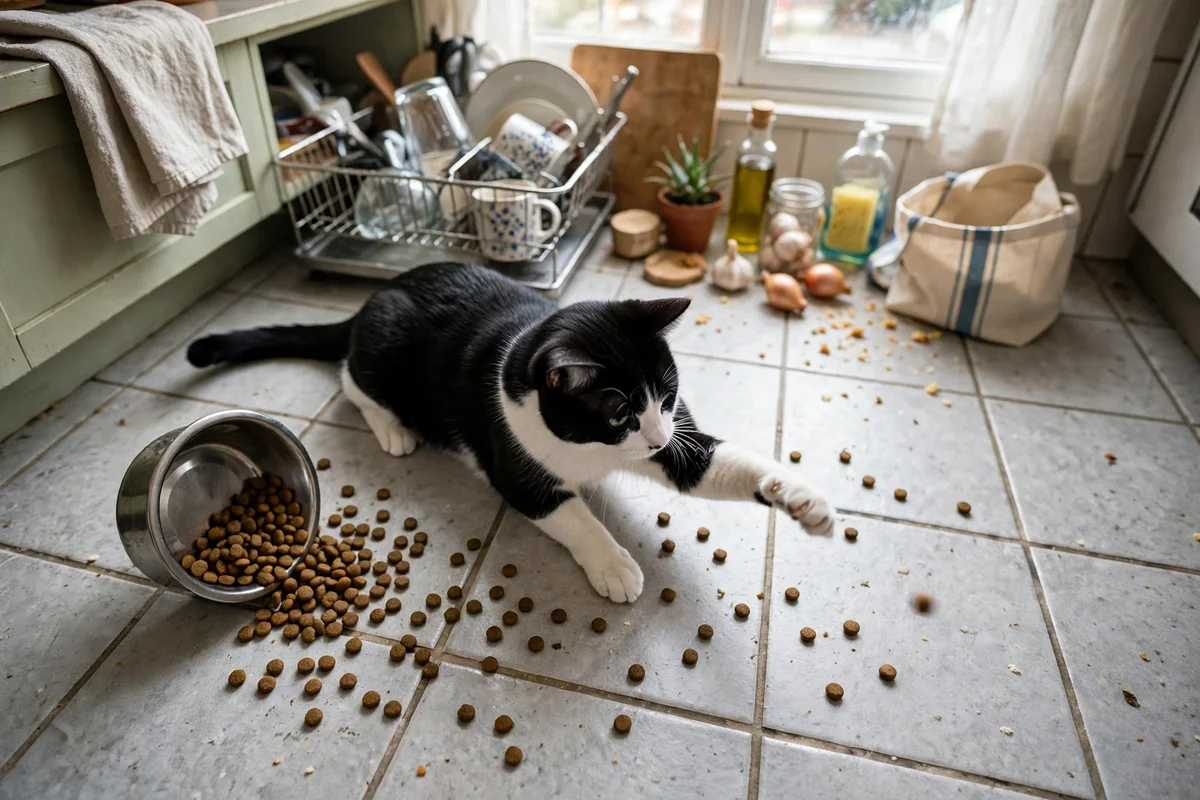
Why Do Cats Play With Their Food?
Your cat bats a piece of kibble across the kitchen floor, chases it, pounces on it, and then, maybe, eats it. It looks silly, and it makes a mess. The short answer is that food play is normal hunting play. Your cat is running the hunt sequence on a piece of food because there is no live prey to run it on. It is usually not hunger, and it is often stronger when the cat is well fed. Worry when eating drops, not when the food moves.
Food play is one of the most common cat behaviours, and the ranking pages agree on the core answer while disagreeing on the details. Hunting play, boredom, texture, bowl shape, and cold food can all turn a meal into a game. Whisker fatigue is the most argued topic in the set, and puzzle feeders are the most overclaimed fix. This guide separates what is proven from what is not, and gives you a test for each cause.
This guide covers the hunt in a bowl, the seven reasons with a test for each, wet versus dry food, temperature and smell, the whisker fatigue study, bowls and location, puzzle feeders, and a three pattern table for when to see a vet.
The information here is general information only and is not veterinary advice. If your cat plays with food but does not eat, loses weight, drops food from its mouth, drools, or has vomiting, diarrhoea, or lethargy, contact your vet. An adult cat that has eaten nothing for 24 hours needs prompt vet advice.
Key Takeaways
- Food play is normal hunting play. The cat is running the hunt sequence on food because there is no live prey.
- Hunting and hunger are partly separate systems. A well fed cat can still abandon food to chase prey, and feeding more does not stop food play.
- Dry kibble is the most playable food because it rolls, bounces, and can be chased. Wet food is played with less often, and for different reasons.
- Warm food smells stronger and is usually more attractive. Fridge cold food is least attractive. Never serve hot food.
- Whisker fatigue is unproven as a diagnosis. The only controlled study, from 2020, found no difference in eating time, amount eaten, or food dropped, but most cats preferred the wide dish when given a choice.
- Puzzle feeders help many cats, but they are not proven to be better than ordinary play.
- Play then eat is normal. Play then leave needs a food, bowl, and location test. Try to eat then drop, or paw at the mouth, is more likely pain, and needs a vet oral exam.
- An adult cat that has eaten nothing for 24 hours needs prompt vet advice. For kittens under six weeks old, just 12 hours without food can be life threatening.
The Hunt in a Bowl: Seven Steps, One Missing Kill
Every direct answer page agrees on the core point. Cats play with food because the behaviour reuses the hunting sequence: search, locate, approach or stalk, capture or pounce, manipulate or play, kill, consume. In a bowl, the kill step is missing, so batting, tossing, chasing, and releasing kibble becomes the visible part.
International Cat Care states the mechanism clearly: toying with prey comes from a conflict between the need to kill and the fear of injury from prey. Purina and Little Miss Cat give the same safety logic: a neck bite requires close contact, so tiring prey first lowers the risk of a bite or scratch. Catster is the only page that openly calls the stamina theory flawed, because wild cats rarely play with prey to exhaustion, and play itself costs energy. Present all three explanations, and avoid presenting tiring prey as settled fact.
Three pages stress that hunting is not the same as hunger. International Cat Care says the motivation to hunt is only partly related to hunger, and cats hunt opportunistically because waiting until hungry could mean starvation. Purina says domestic cats eat only 30 percent of prey killed. iHeartCats, citing Adamec from 1976, says well fed laboratory cats stopped eating to chase and kill prey, which points to separate hunger and hunting systems.
The numbers behind the hunt are worth knowing. International Cat Care says a hunting attempt succeeds less than 50 percent of the time, and with no supplementary food, a cat can make as many as 10 to 20 kills every day to meet energy needs. A well fed pet cat hunts for around 3 hours each day, compared with around 12 hours each day for an unowned feral cat. Live Science, citing a 2013 study in Nature Communications, says cats kill upward of 1.3 billion birds and 6.3 billion small mammals each year in the United States alone, mostly unowned cats. Do not mix those figures with the 2.4 billion birds and 12.3 billion mammals figure from CatWiki, which likely refers to a different scope.
The Seven Reasons, Each With a Test
1. Hunting instinct
The most common reason, and the one every page agrees on. Tell: the play is focused and stalk like, with a crouch, a pause, and a pounce, and it ends in eating or carrying the piece away. Test: give the cat a short play session before the meal, and see if the food play drops. If it does, the cat needed a hunt, not a new food.
2. Fun and stimulation
Cats play because play is rewarding in itself. Tell: the cat bats food, toys, and other objects with the same enthusiasm, at any time of day. Test: add a new toy or a short play session and see if the food play falls. If the cat plays with everything, it is not a food problem.
3. Boredom and under stimulation
Cats.com, CatWiki, ChefsResource, Little Miss Cat, JustCatCafe, and International Cat Care all link food play to boredom, especially in indoor cats left alone for long periods with few toys or activities. Tell: the play happens at any time, with toys and objects as well. Test: add daytime enrichment, a puzzle feeder, and a play session before meals, and watch whether the food play drops over a week. Our guide on why cats get the zoomies covers the same unspent energy from another angle.
4. Competition and guarding
Cats.com is the only direct food play page that treats competition as a main reason. It says a multi cat home, a toddler, or a dog can create competition, and a confident cat may play with food to show competitors that it has won, while a less confident cat may bolt food. JustCatCafe calls resource guarding less common. Tell: staring, blocking, growling, or rushing the bowl. Test: separate the cats, feed in different rooms for seven days, and watch whether the play stops.
5. Dislike, stale food, or a changed recipe
Cats may swat food to test texture and temperature and to taste a little from the paw before committing to the portion, according to Cats.com. A change in brand or formula can trigger play or rejection. Tell: the cat plays, sniffs, and leaves the food, or eats one flavour and not another. Test: offer a small amount of fresh food from a new bag or tin, at room temperature. If the cat eats it at once, the old food was stale, or the recipe changed.
6. Bowl shape and whiskers
Covered in full below. The short version is that a deep narrow bowl can make a cat scoop food out onto the floor, and a wide shallow dish is a cheap, reversible test.
7. Cold food and weak smell
Covered in full below. The short version is that fridge cold food smells weak, and a cat that bats cold wet food and then eats the same food warmed is not necessarily picky or playful. It may be responding to smell.
Wet Versus Dry: Why Kibble Rolls and Pate Smears
ChefsResource, Cats.com, CatWiki, JustCatCafe, and NutritionHealthInfo agree that dry kibble is the most playable food because it rolls, bounces, and can be chased. Wet food is played with less often, but for different reasons: pate can be smeared and pawed for tactile and smell exploration, and gravy or chunks can be fished out and moved.
| Food type | How cats play with it | What it usually means |
|---|---|---|
| Dry kibble | Batted, chased, tossed, carried away, dropped on the floor | Hunting play, boredom, or fun; kibble rolls like prey |
| Pate | Smeared, pawed, licked in lines, pushed around the bowl | Tactile and smell exploration, or dislike of the texture |
| Chunks in gravy | Fished out, moved to the floor, gravy licked and chunks left | Preference for gravy, or dislike of the chunks |
| Shreds | Pulled apart, dragged out of the bowl, scattered | Texture play, or difficulty eating the pieces |
Temperature and Smell: The 2022 Study in Plain Language
No direct food play page mentions temperature at all, except Cats.com in passing and CatWiki with warm water in kibble. That is a clear gap, because the study behind it is strong. Eyre and McGrane and colleagues, 2022, published in the Journal of Veterinary Behavior, offered 32 senior house cats, over 7 years old and averaging more than 11 years, the same wet food at 6C, 21C, and 37C. The preference order was 37C first, then 21C, then 6C, in all three comparisons. Gravy viscosity was almost identical at all temperatures, so texture did not explain the result. Warming to 37C increased meat related compounds and decreased spoilage markers. Cats made the decision before tasting, based on smell.
All temperature pages agree that warm food smells stronger and is usually more attractive, that fridge cold food is least attractive, and that hot food must never be served. The safe warming method is: warm only the portion to be served, stir thoroughly, test on the wrist, never serve hot, never repeatedly warm and refrigerate the same portion, and do not leave wet food out for more than four hours at room temperature. Do not use a single olfactory receptor number without a primary source: MrUmi reports 200 million receptors in cats, while JustCatCafe reports 45 to 80 million, compared with 5 to 20 million in humans.
Whisker Fatigue: What the 2020 Study Actually Found
This is the most contested topic in the set. All bowl pages agree on the low risk fix: try a wide shallow dish or flat plate, keep it clean, use ceramic or stainless steel rather than plastic, and watch the cat. They disagree sharply on whether whisker fatigue is real.
PetMD states it plainly: whisker fatigue is not a disease, its existence is still debated in the veterinary community, and medical issues such as dental disease, kidney disease, or gut illness must be ruled out first. Feliway agrees that scientific evidence is still developing, but argues that some cats are more susceptible than others. Centre of Excellence and Old Towne Animal Hospital, in search results, present it as a real sensory issue. Forum comments in search results call it mostly marketing.
The only controlled study cited by every serious page is from 2020, published in the Journal of Feline Medicine and Surgery, on whisker stress in cats. Forty indoor cats were filmed eating from their usual dish and then, after a 7 day transition, from a commercial whisker friendly dish. The result was no difference in eating time, amount eaten, or food dropped. Most cats preferred the whisker friendly dish when given a choice. This is the only controlled study in the set. The honest guide position is: unproven as a diagnosis, plausible as a preference, cheap to test, never a substitute for a medical check.
Cats are far sighted and use whiskers for close up sensing, according to Oklahoma State University in search results. A cat that paws food out of a deep bowl may be trying to see it better, not suffering from whisker fatigue. CatWiki adds a distinct vigilance idea: a deep bowl can shield a cat eyes while it eats, so the cat may dump food onto the floor to keep a view of the room. That is plausible, but unsourced in CatWiki, so present it as a hypothesis to test by moving the bowl to a spot with a clear view, not as fact.
Bowl, Location, and Routine
Feliway, JustCatCafe, PetMD, NextGen PetCare, and the Medium bowl guide in search results agree on the practical list. Wide and shallow is better than deep and narrow. NextGen gives about 15 cm or 6 in or more as a width guide. Low sides or a flat plate help cats that scoop food out. Ceramic or stainless steel is preferred over plastic, which can retain odours and harbour bacteria in scratches. Wash bowls daily in hot soapy water. Feed in a quiet low traffic place, away from the litter box, cat flaps, and noisy appliances. Separate food and water, as cats do not naturally eat and drink in the same place. In multi cat homes, give each cat its own station, with the Feliway rule of one resource per cat plus one extra. Consider a raised bowl for older, stiff, or flat faced cats, but do not present raised bowls as a proven digestion fix.
The location test is simple, and no direct food play page gives it. Move the bowl to a quiet spot with a clear view, away from litter and traffic, keep food and water separate, and compare for a week. If the play drops, the location was the problem. If it does not, try the bowl change, then the temperature change, one at a time. Our guide on the best cat food explains what a balanced daily ration looks like, and puzzle food must come from that ration, not on top of it. Treats should be a small share of daily intake, most vets put the limit at around 10 percent or less.
Puzzle Feeders and Play Before Meals: A Ladder, With Limits
International Cat Care, Purina, Cats.com, ChefsResource, Little Miss Cat, JustCatCafe, SnuggleSouls, and the AAFP and ISFM guidelines all recommend puzzle feeders as a way to turn a static bowl meal into a hunt. The agreed benefits are slower eating, mental stimulation, physical activity, reduced boredom, and a more natural search and capture pattern. The agreed rules are: start easy, so the cat wins at once; use part of the measured daily ration, not extra food on top; increase difficulty only after the cat returns willingly; use separate feeders in multi cat homes; clean wet food feeders thoroughly after each use; stop or simplify if the cat freezes, flattens ears, guards, or walks away without eating.
The limits are underplayed in most ranking pages, and this guide reports them honestly. Delgado and colleagues, 2016, published in the Journal of Feline Medicine and Surgery, found that many cats will eat freely available food before working for it. Hoff and colleagues, 2026, summarised by Faunalytics, studied 102 cats over four weeks and found that food puzzles and ordinary toys both reduced attention seeking behaviour, that puzzles were not significantly better than toys, and that there was no group with no enrichment, so cause cannot be proved. SnuggleSouls adds the most complete safety list, including diabetes, kidney disease, urinary disease, pregnancy, nursing, prescribed diets, and a history of guarding. Ask your vet first if any of those apply.
The ladder is: scatter feeding on a tray, then a rolling feeder, then a sliding board, with a rule to step back if the cat freezes or leaves. Play time recommendations vary, and no page reconciles them: VCA via Tail and Tonic says at least three short play sessions a day; Little Miss Cat says twice a day for 10 to 15 minutes; CatWiki says about 30 minutes a day. Present the range, and tie play to a pre meal hunt routine.
Play Then Eat, Play Then Leave, or Try Then Drop
The ranking pages do not separate three different patterns that owners confuse. This three pattern table is more useful than the usual list of six vague signs.
| Pattern | What it looks like | What it means | Next step |
|---|---|---|---|
| Play then eat | The cat bats, chases, then eats the piece or the meal | Normal hunting play | Nothing, or a puzzle feeder for fun |
| Play then leave | The cat plays and leaves the food repeatedly, or eats less | Possible dislike, stale food, cold food, stress, or early illness | Food, bowl, and location test over a week |
| Try then drop | The cat tries to eat, drops food, paws at the mouth, or walks away hungry | More likely pain, often dental | Vet oral exam, not a new bowl or flavour |
The agreed warning signs, from Cats.com, ChefsResource, CatWiki, JustCatCafe, and Feliway, are: playing with food but not eating, or eating less; weight loss; dropping food from the mouth, chewing on one side, crying out while eating; drooling; bad breath; vomiting, diarrhoea, lethargy, increased thirst, hiding, or a sudden change in behaviour. The medical causes named across the set are: dental disease, tooth resorption, stomatitis and gingivitis, mouth ulcers and tumours, nausea and gut problems, kidney disease, hyperthyroidism, respiratory infection that blocks smell, and pain elsewhere in the body.
Dental numbers from search results only: periodontal disease affected about 15.2 percent of UK cats in a year in a VetCompass analysis of 18,249 cats in 2019; tooth resorption affects 30 to 70 percent of cats according to Lake Conroe Vet and MedicAnimal; over 70 percent show signs of dental disease by age 3 according to MedicAnimal. Those numbers come from secondary pages, not from the primary VetCompass paper, so check the primary source before citing them. Cornell guidance via Fammo, snippet only, adds urgency: an adult cat that has eaten nothing for 24 hours needs prompt vet advice, and for kittens under six weeks old just 12 hours without food can be life threatening because of hepatic lipidosis, or fatty liver disease.
When to See a Vet: Red Flag Clusters
Dental pain, nausea, kidney disease, and respiratory infection are listed as separate items in the ranking pages, but no page groups them into clusters. Here they are, with the next step for each.
| Cluster | Signs | Next step |
|---|---|---|
| Mouth cluster | Dropping food, chewing on one side, crying out while eating, drooling, bad breath, pawing at the mouth | Vet oral exam within days |
| Gut cluster | Vomiting, diarrhoea, weight loss, reduced appetite, lethargy | Vet visit within days, sooner if vomiting repeats |
| Smell cluster | Blocked nose, sneezing, discharge, sudden loss of interest in food that smells weak | Vet visit within days |
| Systemic cluster | Increased thirst, weight loss, big appetite, hiding, sudden behaviour change | Vet visit within days, with blood work |
Use this two week test. Days 1 to 3: check the mouth, weight, and intake. Days 4 to 7: try a wide shallow bowl, a quiet location, and room temperature or gently warmed food. If intake is still down, weight is falling, or dropping and drooling continue, book a vet exam and do not wait for the experiment to finish.
How to Reduce the Mess Without Punishing the Cat
- Put a washable mat under the bowl, and a washable floor zone around it, so scattered kibble is easy to clean.
- Use scheduled meals, and pick up uneaten wet food after 20 to 30 minutes, so it does not spoil or attract insects.
- Do not leave wet food out for more than four hours at room temperature.
- Do not scold the cat for batting food. Even scolding can reinforce the behaviour, because it brings the owner over, and it adds stress.
Frequently Asked Questions
Why does my cat take food out of the bowl to eat on the floor?
Usually because the cat wants a clear view of the room, or the bowl is too deep or narrow, or the cat is playing a hunting game with the piece. Try a wide shallow dish in a quiet spot with a clear view.
Why does my cat play with food but not eat?
That is the play then leave pattern. It can mean dislike, stale food, cold food, stress, or early illness. Run the food, bowl, and location test for a week, and book a vet exam if intake is still down.
Is it whisker fatigue or dental pain?
Whisker fatigue is unproven as a diagnosis, and the 2020 study found no difference in eating with a whisker friendly dish. Dental pain is common and testable. Try the wide shallow bowl first, and book a vet oral exam if dropping, drooling, or crying out while eating continues.
Should I warm the food?
Usually yes, gently. The 2022 study found cats preferred the same wet food at 37C over 21C and 6C, based on smell. Warm only the portion to be served, stir thoroughly, test on the wrist, and never serve hot.
The Bottom Line
Food play is usually a hunt in a bowl, not a problem with the food. The cat is running a sequence that has no live prey to finish it on, and the kibble is the closest thing to prey in the house. Give the cat a real hunt before meals, a wide shallow dish in a quiet spot, food at room temperature or gently warmed, and a puzzle feeder to work through. Watch the pattern, not just the mess: play then eat is normal, play then leave needs a week of tests, and try then drop needs a vet.