
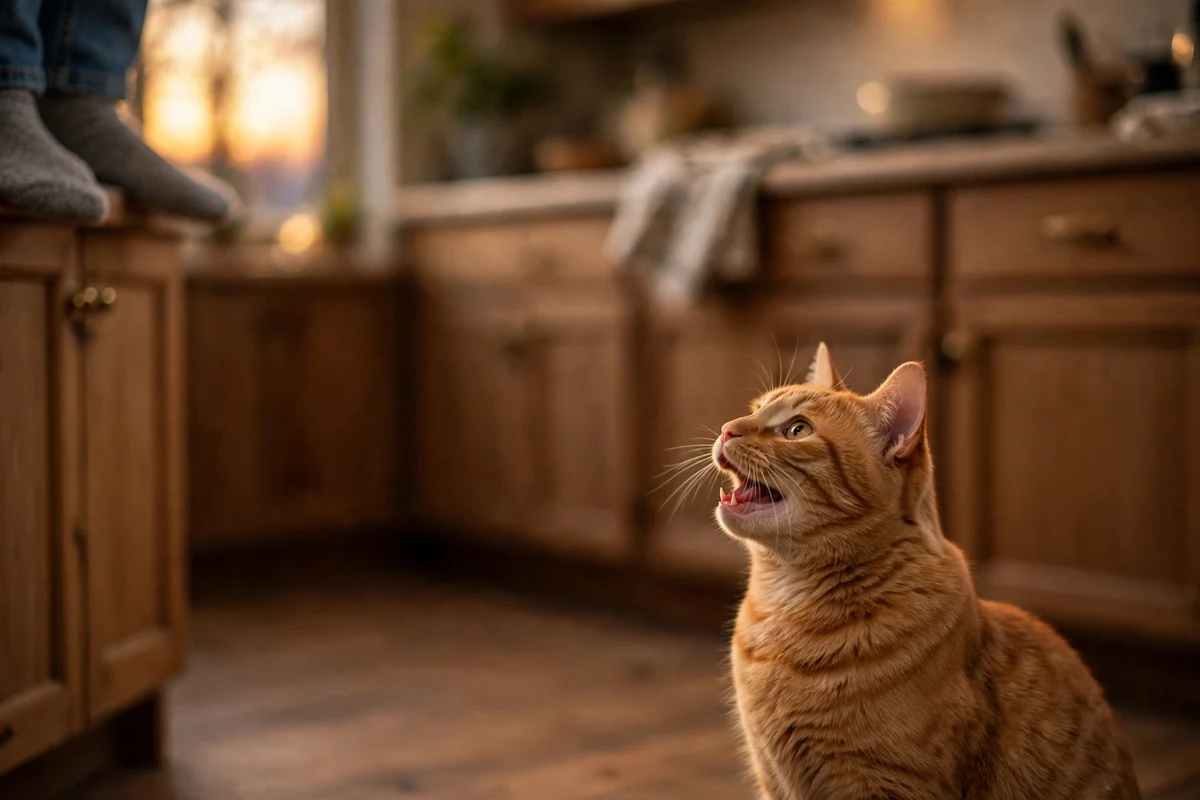
Your Cat Begs Because Begging Worked. Here Is How to Unteach It Gently
Most cat begging is not hunger. It is a habit, and it is usually a habit you built without noticing. Your cat learned that meowing, staring, pawing, or following you into the kitchen makes food appear, because at some point it did. The fastest way to find out which kind of begging you have is to weigh your cat. A cat begging for food all the time at a healthy weight is almost certainly a trained beggar. A cat that begs and is losing weight needs a vet, not a training plan. Start with the scales, then read on.

Hunger, habit, or something medical
Every begging cat falls into one of three groups, and the group decides the fix. A hungry cat needs more food, or better food, or food served differently. A habit cat needs the reward taken away. A medical cat needs a vet. Before you train anything, check that the cat is actually getting enough: weigh the food for a week, measure it against the packet guide, and check her weight against the vet record. A diet that digests quickly leaves the cat hungry sooner, and a cat on a weight loss plan will beg louder for the first weeks, which is the paradox that makes owners quit diets. VCA explains how excess weight builds up in cats and why measured portions are the starting point. A cat constantly hungry despite full meals may be medical: diabetes or hyperthyroidism can make a cat seem very hungry even when eating the normal amount, and most medical causes of begging also cause weight loss. Watch for the cluster, not a single sign: eating more but losing weight, drinking much more than usual, urinating more, vomiting, lethargy, or a sudden dramatic increase in begging all point the same way, to the vet.
The training course you already ran
Cats do not beg by instinct alone. They beg because begging worked. Kittens cry to their mothers for everything, and in a human home the owner becomes the mother. One piece of chicken from your plate feels kind in the moment, and it is the fastest way to build a beggar, because cat begging for human food starts with exactly that one piece. Boredom wears a hungry face too: a cat alone in a flat with nothing to do will beg because begging is something to do, and in a multi cat home some begging is not begging at all, it is theft, with one cat finishing her own bowl and then eating from her housemate’s. The fastest way to make begging worse is to give in sometimes. An owner who holds firm all week and then feeds the cat on Sunday because guests are coming has taught the cat that begging works if she keeps at it long enough. Cat meowing for food at 3am is the hardest version, because you are half asleep and the cat knows it. Do not feed her at 3am, and do not get up to play. Lie still, wait it out, and feed her at the normal morning time.
Fourteen days to a quieter kitchen
This is how to stop cat begging for food in a way you can measure. Feed the measured daily ration in three or four small meals, at the same times every day, and put the food down and walk away. Give no food from the table and no food between meals for fourteen days. Play with the cat before meals, not after begging, so play is never the reward for meowing. Count the begging episodes each day and write the number down. If the number is falling by day fourteen, the habit is breaking. If it is not falling, or the cat is losing weight, go back to the vet. The ASPCA guide to meowing and yowling explains why cats meow at people and how to answer it without feeding. This is general information only, not veterinary advice.
Your cat is not greedy. She is doing what worked, and she will stop doing it when it stops working. Hold the line for fourteen days, count what happens, and the kitchen gets quieter.