
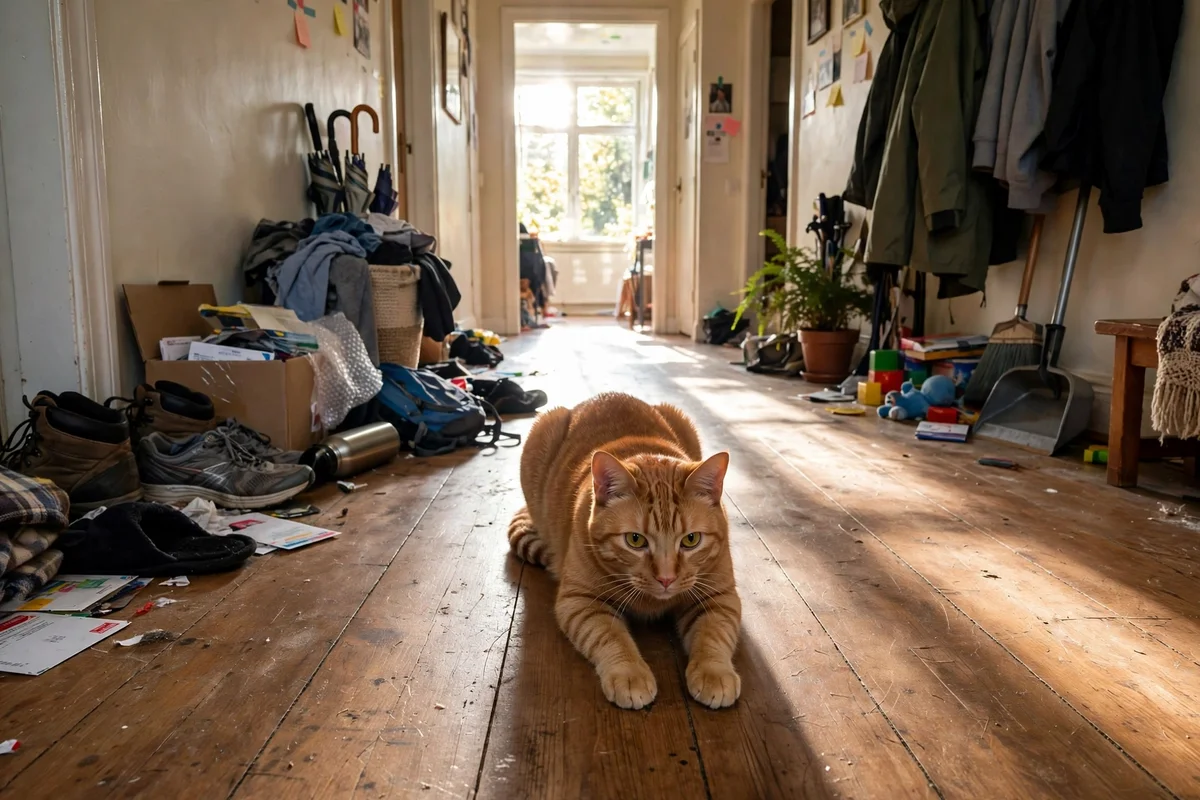
Why Does My Cat Stalk Me?
Your cat crouches behind the sofa, watches your ankles, and then launches. It is not trying to eat you, and it is not angry with you. The short answer is that stalking is normal predatory play. Your cat is rehearsing the hunt on the nearest moving target, and that target is usually you. The most likely reason is play, the second most likely is boredom, and the fix is scheduled play that ends with a catch and a meal, not punishment.
Stalking looks alarming, and it can hurt when it turns into an ankle ambush. But it is a species specific behaviour, which means it belongs to cats the way barking belongs to dogs. You cannot train it away completely. You can redirect it onto toys, drain the energy that drives it, and teach your cat that ankles are boring and wand toys are not.
This guide separates stalking from following, walks through the predatory sequence, gives you a test to find which stalker you have, covers the seven reasons, and ends with a seven day fix plan.
The information here is general information only and is not veterinary advice. If stalking is new, sudden, or getting worse, or it comes with a change in appetite, movement, or litter habits, contact your vet. If bites break the skin, clean the wound and seek medical advice for yourself as well.
Key Takeaways
- Stalking is a normal predatory sequence, not hatred and not a plan to eat you. Play is the top reason a cat stalks its owner.
- Hunting is independent of hunger. A well fed cat still hunts, because waiting until hungry could mean starvation given a low success rate per attempt.
- Stalking and following are two behaviours. Low crouch stalking with a pounce needs play redirection. Calm room to room following needs attention, food timing, or reassurance.
- Redirect early, before the stalk locks in. Redirecting mid stalk can reward the stalk.
- Never use hands or feet as toys, never punish, and never feed after an ankle attack. Any reaction, even a scold, can reward the behaviour.
- Play before feeding, twice a day, ending with a catch and a small snack, lets the cat complete the hunt, catch, kill, eat, groom, sleep cycle.
- See a vet if stalking starts suddenly, bites break skin, the cat hisses with flattened ears and a puffed tail, or the behaviour changes alongside appetite or movement changes.
Stalking Versus Following: Two Behaviours, Two Fixes
Every ranking page conflates two behaviours, and that is the first thing to fix. Low crouch stalking with a pounce is predatory play. Calm room to room following is companionship, attention seeking, food anticipation, or anxiety. They have different causes, different ages, and different fixes, and treating one like the other wastes your time.
| Sign | Stalking | Following |
|---|---|---|
| Body | Low crouch, ears forward, tail twitching, wide pupils, freeze mid step | Upright, relaxed, tail up, walks beside you or behind you |
| Movement | Slow approach with stops, then a sprint and a pounce | Steady walking, sits nearby, no pounce |
| Timing | Dawn, dusk, bedtime, and the same hallway at the same time each day | Mealtimes, when you move rooms, when you have been away |
| Age | Most common in kittens and cats under 2 years old | More common in older cats, who follow more because younger cats are busy exploring |
| What it wants | A hunt, a chase, a catch | Food, attention, company, or reassurance |
| Fix | Scheduled play before meals, redirect before the stalk starts | Reliable routine, puzzle feeding, calm attention on your terms |
This guide covers stalking first, because that is the question asked, and following where it overlaps, because many owners have both. If your cat mostly follows you calmly and rarely pounces, the food anticipation and attention sections are the ones that matter most to you.
The Predatory Sequence in Plain Language
Parade Pets gives the fullest sequence in five acts: staring and orienting, stalking, chasing, pounce and attack, kill bite and dissection. International Cat Care gives the most technical version: searching, stalking in a crouch with head outstretched, slow approach speeding to a sprint, tense pause, then a spring with one or both front paws. Purina adds the detail of stops on the approach, sometimes with one paw held in the air, and hind legs gathered under the body before the leap.
Your cat is an ambush hunter, not a chase hunter. Cats conserve energy because they do not chase prey over long distances. The stalk is the whole point: slow, silent, patient, then one explosive leap. Padded paws let the cat approach silently, and the sequence ends in a death bite on real prey. On your ankle, the sequence ends in a bite and a kick, which is why it hurts even though the cat is only playing.
The body language tells you where in the sequence the cat is. Ears forward, tail twitching, wide pupils, a crouch, and a freeze mean the stalk has started. Flattened ears, hissing, a puffed tail, and tail lashing mean fear or true aggression, not play.
| Signal | Play stalk | Fear or true aggression |
|---|---|---|
| Ears | Forward, swivelling to track you | Flattened back against the head |
| Eyes | Wide pupils, fixed on the target | Hard stare or narrowed eyes with a stiff body |
| Tail | Low twitch, slow swish of focus | Puffed up, lashing fast, or tucked tight |
| Body | Low crouch, loose, ready to spring | Stiff, arched, or frozen in fear |
| Sound | Silent, or a chirp of excitement | Hissing, growling, or yowling |
| After | Bounces away, ready for another round | Stays aroused, may stay threatening for hours |
Learn the pre stalking signs, because the fix works only if you act on them. Intense focus, slow movements, and ears swivelling forward are your window. Once the cat is sprinting, redirection is much harder, and any reaction can reward the pounce.
Which Stalker Is Yours? A Five Question Test
No ranking page gives a diagnostic test. Every page lists five to ten reasons and leaves the reader to guess. Use these five questions instead.
- What time does it happen. Dawn, dusk, and bedtime point to the hunting rhythm. Mealtimes point to food anticipation. All day, every time you move, points to attention or anxiety.
- What is the body language. Low crouch and pounce means play. Calm walking beside you means following. Flattened ears and hissing means fear or aggression.
- What happened just before. A quiet house and a moving ankle point to boredom. A new pet, a move, or a loud noise points to stress. A closed door and a food bowl point to hunger.
- What happens after. The cat eats and settles means food or a completed hunt. The cat wants fuss and stays close means attention or bonding. The cat hides or stays tense means anxiety.
- Does it stop when you feed, play, or leave the room. Stops after play means a play deficit. Stops after food means food anticipation. Stops when you leave means attention seeking. Stops for nothing means pain, stress, or a medical cause, and needs a vet.
Most cats fit one of four types. The play hunter stalks at dawn and dusk and needs scheduled play. The attention seeker stalks when you are busy and needs calm attention on your terms. The anxious shadow follows everywhere and panics when you leave, and needs routine and safe spaces. The food anticipator clusters around mealtimes and needs a reliable feeding routine and puzzle feeding.
The Seven Reasons, Each With Its Tell and Its Fix
1. Play and hunting rehearsal
Catster puts it first and simplest: the cat most likely only wants to play. Cats.com, Vet Desk, Parade, Purina, Petplan, and VCA all agree. Play in adult cats is not social wrestling the way it is in dogs. It is hunting rehearsal. Kittens learn the sequence by playing with littermates, and adult cats keep rehearsing it on toys, bugs, shadows, and ankles. Tell: low crouch, pounce, then the cat bounces away ready for more. Fix: scheduled interactive play before meals, ending with a catch and a snack.
2. Boredom and under stimulation
Named as a reason on Cats.com, Catster, Vet Desk, Parade, Adopt-a-Pet, Rover, Cats Protection, Purina, and VCA. Indoor only cats are singled out by Parade and Petplan: without outdoor hunting, the house becomes the hunting ground and the owner becomes the prey. Signs include restlessness, destructiveness, knocking things over, zoomies, and yowling. Fix: more play, more enrichment, puzzle feeders, climbing, perches, and a predictable routine. Our guide on why cats get the zoomies covers the same unspent energy from another angle.
3. Attention seeking and accidental training
Cats.com, Catster, Vet Desk, Parade, Adopt-a-Pet, Rover, and Cats Protection all list attention. Adopt-a-Pet adds the sharpest formulation: any interaction, positive or negative, rewards the behaviour, including a glance, a scold, or a shoo. Owners train the behaviour without noticing, by giving treats, fuss, play, or food every time the cat follows or stalks. Tell: the cat stalks, you react, the cat is satisfied. Fix: walk away, ignore, then reward calm settled behaviour. Rover adds a useful distinction: affection following is calm, intermittent, and quiet, while attention seeking following is loud and pushy, with nudging, pawing, head butting, and meowing.
4. Food anticipation
Adopt-a-Pet, Rover, Cats Protection, Vet Desk, and CatsChef all list it. The tell is timing: following clusters around mealtimes, dawn, and dusk. A hungry cat may walk to the food bowl and back to you repeatedly, or rub your legs and meow in a high pitched, determined way. Adopt-a-Pet claims a natural rhythm of five small meals a day, presented without a cited study, so treat that number as an editorial claim, not a verified figure. Fix: a reliable mealtime routine, slow feeders, puzzle toys, and not giving in to demands, because giving in reinforces the behaviour. Our guide on the best cat food explains what a balanced daily ration looks like.
5. Anxiety, insecurity, and stress
Cats.com, Catster, Vet Desk, Parade, Adopt-a-Pet, Rover, and LoveToKnow all list it. Triggers named across pages: moving home, a new pet, a new person, strangers, loud noises, new appliances, and any break in routine. Anxious cats follow to reassure themselves of your presence, and to feel more secure. Rover gives the clearest red flag cluster: distressed or excessive vocalization, restless movement, appetite change, hunched posture, and a swishing tail. Fix: identify the trigger, add safe elevated spaces, keep the routine steady, and use synthetic pheromone plug ins if your vet suggests them. Rover adds that medication is a last resort, not a first step.
6. Territory and surveillance
Cats.com, Adopt-a-Pet, Catster, CatsChef, and Vet Explains Pets list territory. Cats.com frames it as reaffirming or monitoring territory, more common in multi cat households. Adopt-a-Pet frames it with humour: the cat supervises you because you are large, clumsy, and walking around its house. Cats Protection gives the bathroom version: the cat is curious about a room it is often locked out of, plus water, sink naps, and shelves to climb. Tell: stalking clusters around resources, doors, and favoured spots, rather than following you everywhere. Fix: give each cat its own resources, resting places, and litter boxes, and do not block access to part of the territory by shutting a door.
7. Hunger is not the hunting drive
This is the point most owners get wrong, and the ranking pages agree on it. Catster states cats hunt even when satiated. International Cat Care explains why: a solitary hunter that waited until hungry could starve, given the low success rate per attempt. Purina cites International Cat Care for the figures: a cat would need to catch around 10 to 20 prey animals a day to sustain itself, and less than 50 percent of hunting attempts succeed. A well fed pet cat hunts around 3 hours each day, against around 12 hours for an unfed feral cat, according to International Cat Care. The practical consequence is that feeding more does not fix stalking. Food can still trigger following, because the cat has learned that you are the food source, but the hunting motor pattern runs on its own.
When Stalking Turns Aggressive
Most stalking is play. Three patterns turn it into aggression, and telling them apart matters, because the fix is different for each.
Play aggression
The most common escalation. VCA describes it as overly rambunctious play that includes stalk, pounce, and bite, and can be extremely intense. It is most common in kittens and cats under 2 years old, and in single cat households, because there is no littermate to wrestle with and learn bite inhibition from. Petfinder adds that it is most often seen where the cat is alone 8 to 10 hours a day. Tell: the cat stalks, pounces, bites, and kicks, then bounces away ready for more. Fix: scheduled play, never hands or feet as toys, and a toy tossed ahead of you before you pass an ambush spot.
Learned aggression
Petfinder gives the clearest example. A cat attacked toes at night, the owner bought it off with a predawn breakfast, and the cat learned that attacking pays. Catster and Adopt-a-Pet make the same point in general terms: if stalking earns a treat, play, or any reaction, the cat repeats it. Cats.com adds a behaviourist case where ankle attacks every morning and evening became a learned routine. Fix: stop paying the behaviour, reward calm behaviour instead, and keep the response identical every time.
Redirected aggression
Catster explicitly says this is not a well accepted consensus, presenting it as a theory that frustrated cats redirect aggression onto humans. VCA, WikiVet, Petfinder, and iHeartCats treat it as a distinct, recognized pattern: the cat is intensely aroused by a loud noise, another animal, or an unfamiliar person, then stalks and attacks whoever walks by. Petfinder states the cat can stay aroused and threatening for up to 6 hours. Tell: the stalk follows a clear external trigger, and the body language is defensive, with hissing, flattened ears, and a puffed tail. Fix: leave the cat alone, do not approach or touch it, and let it calm down in a quiet room. This is not ordinary play, and playing with the cat in this state will make it worse.
Medical Red Flags
Rover and Catster list medical causes, but no page gives a triage list. Here is one, built from Rover, Catster, VCA, and iHeartCats.
| Urgency | Signs |
|---|---|
| See a vet now | Bites that break skin with swelling, heat, or spreading redness; a cat that cannot be approached safely |
| See a vet this week | Sudden onset stalking in an adult cat; increasing intensity; hissing with pain on touch |
| See a vet this week | Behaviour change plus appetite, movement, or litter habit changes |
| See a vet this week | Restlessness, weight loss, and extra thirst together, which can point to hyperthyroidism |
| Mention at the next visit | An older cat that follows more, with hearing or vision loss, or signs of cognitive change |
Catster names hyperthyroidism as a medical cause of agitation and quick attacks. Rover adds thyroid problems, hearing or vision loss, and cognitive dysfunction in older cats. WikiVet, citing a study, states that 39 percent of cats showed some level of owner directed aggression, with stroking and play each involved in around 40 percent of cases. That figure comes from a veterinary wiki summary, so treat it as a cited figure with limits, not as a prevalence rate for stalking itself. No ranking page gives a prevalence figure for stalking, and this guide does not invent one.
The Seven Day Fix Plan
No ranking page gives a day by day plan. Here is one, built on the Hunt, Catch, Kill, Eat, Groom, Sleep cycle described by Jackson Galaxy in secondary sources, with timing from his public guidance.
| Day | What to do |
|---|---|
| Day 1 | Log the pattern: time, place, body language, what happened before, what stopped it |
| Day 2 | Add two play sessions, morning and evening, with a wand toy at arm’s length, ending with a catch and a small snack |
| Day 3 | Add puzzle feeding and treat hunts around the home, using part of the normal daily ration |
| Day 4 | Block the launch point: shut the gap under the bed, move the ambush chair, toss a toy ahead of you before you pass the hallway |
| Day 5 | Change the routine: play right before the scheduled meal, with the last meal around 90 minutes before bed |
| Day 6 | Review the log: fewer episodes, later start, or shorter stalks mean progress |
| Day 7 | Decide: if the pattern is unchanged or worse, call the vet; if it is improving, keep the routine for two more weeks |
The play dose in the ranking pages is thin. Only two sources quantify it: MDSPCA and Dial-a-Vet give 10 to 15 minutes per session, at least twice a day. Judge by the log, not by the clock. A cat that plays hard for ten minutes and then eats and grooms has had enough.
Night Stalking and Bed Attacks
iHeartCats and The Cat Chronicles mention feet under blankets, but no ranking page has a dedicated night section. The bed is a hunting ground for a simple reason: feet under blankets look and sound like small prey rustling in grass, and hallways, gaps under the couch, and the bottom of the stairs are predictable prey routes. The cat knows exactly where you will walk, and when.
The fix is the evening routine, not a night time response. Play hard in the evening, feed the last meal around 90 minutes before bed, then give no feeding, talking, or eye contact if the cat wakes you at night. Give it a week to 10 days. Feeding at 3am trains the behaviour. In the short term, wear enclosed slippers and thick socks, and keep a pocket toy ready to toss away from your path.
What Not to Do
- Do not use hands or feet as toys, and do not wiggle toes under blankets. The cat learns that skin is prey, and that lesson hurts more once the cat grows up.
- Do not squeal or jerk away. WikiVet notes that human shrieks and squeals increase arousal and intensify the behaviour. Stay still to break the prey sequence, then redirect calmly.
- Do not punish, hit, scruff, kick, or spray water. Every page agrees: punishment breaks the bond, causes fear, and can increase aggression.
- Do not feed after an ankle attack. Petfinder gives the classic example: a cat that attacked toes at night and was bought off with a predawn breakfast learned that attacking pays.
- Do not end laser play without a catch. Parade cites Kogan and Grigg from 2021: laser play is associated with frustration, stress, and compulsive behaviours because the cat never catches anything. End every laser session on a toy the cat can grasp.
- Do not expect to eliminate stalking. Parade and Catster are explicit: you cannot and should not expect to eliminate a species specific behaviour. The honest framing is management and redirection, not elimination.
Frequently Asked Questions
Does my cat think I am prey?
No. Your cat does not see you as food and is not plotting your death. The behaviour is rehearsal and play, redirected onto the nearest moving target. The hunting sequence is hard wired, and your ankles are simply the most available moving thing in the house.
Will my cat grow out of stalking me?
Partly. Play aggression peaks in kittens and cats under 2 years old, according to VCA and Cornell, and many cats calm down as they mature. But adult cats still stalk when bored or under stimulated, and the behaviour needs management at any age.
Why does my cat only stalk me and not my partner?
Usually because of routine. The cat has learned that you react, you feed, or you play, and your partner does not. It can also be timing: the cat stalks the person who walks the hallway at dawn, or the person who wears the rustling slippers. Change the routine, and the target often changes.
Why does my cat stalk me at night but not in the day?
Cats are crepuscular, most active at dawn and dusk, and the night is when the house is quiet and your feet are the only moving prey. The bed and the hallway are also predictable routes. An evening play session and a last meal around 90 minutes before bed moves the peak earlier.
Is stalking a sign my cat loves me?
Following can be a sign of trust and bonding. Stalking is usually play, not affection. The two often appear together in the same cat, which is why the test in this guide matters: calm following with a tail up means company, while a low crouch with a pounce means a hunt.
The Bottom Line
Your cat stalks you because it is a hunter with no prey, not because it dislikes you. Give it a hunt it can win: two play sessions a day, a catch at the end, a meal after, and a routine it can trust. Redirect before the stalk starts, reward calm behaviour, and never pay an ankle attack with food or fuss. If the stalking starts suddenly, breaks skin, or comes with a change in appetite or movement, see a vet. The goal is not a cat that never stalks. It is a cat that stalks a wand toy instead of your ankles.