
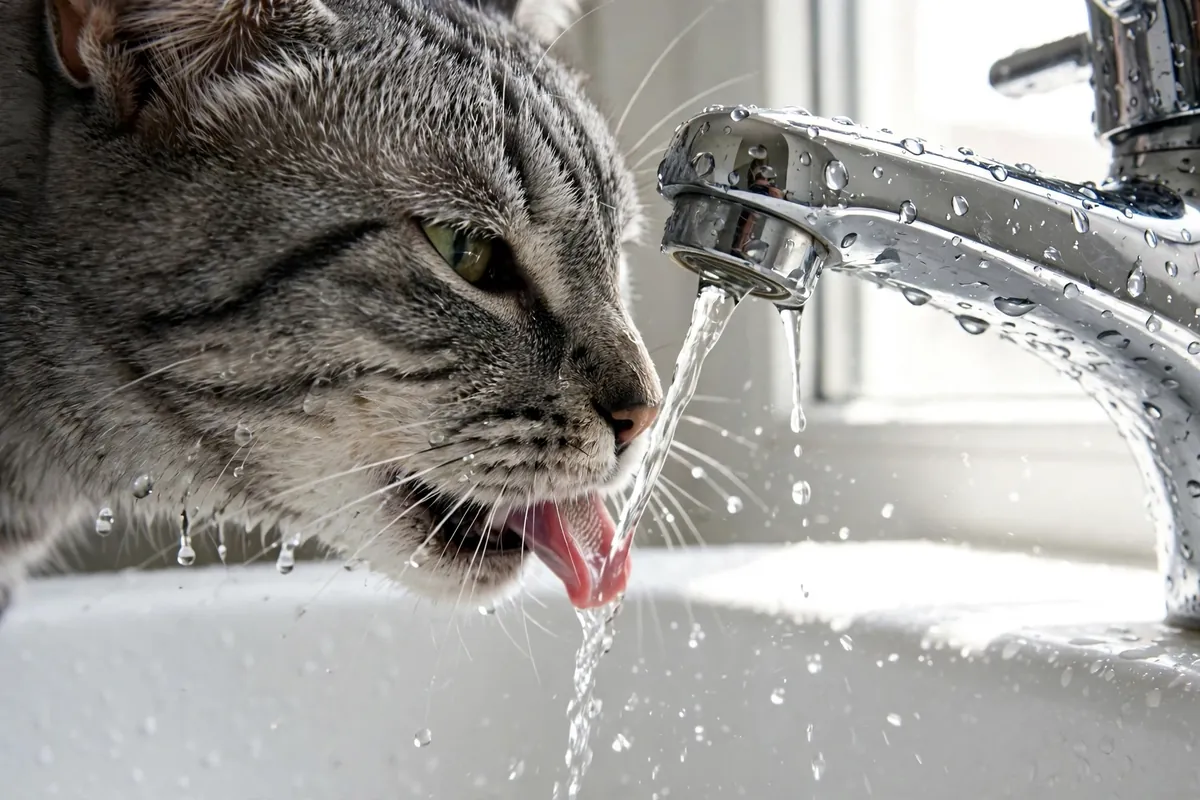
Why Does My Cat Drink From the Tap?
Your cat ignores a full water bowl, jumps onto the bathroom sink, and drinks from the tap the moment you turn it on. That is normal. Most cats that drink from the tap are not being difficult. They prefer running water because it looks fresher, sounds fresher, tastes cooler, and is easier for them to find. Worry when drinking changes suddenly, or rises sharply alongside weight loss, appetite change, or lethargy.
The information here is general information only and is not veterinary advice. If your cat suddenly drinks much more or much less than usual, stops drinking, or shows signs of illness, contact your vet.
Key Takeaways
- Drinking from the tap is normal for most cats, usually a preference for running water, not illness.
- Cats prefer running water because it moves, makes sound, looks cooler and fresher, and is easier to sense.
- Whisker fatigue, bowl placement, stale water, and a deep or narrow bowl often push a cat toward the tap.
- Tap water safe for people to drink is generally safe for a healthy cat. Some cats dislike the chlorine smell.
- Hard water has no established link to urinary stones, per the National Research Council.
- A cat needs about 50 ml of water per kg of body weight per day in total, including moisture in food.
- Drinking much more than usual, with more urination, can be an early sign of kidney disease, diabetes, or thyroid trouble.
- A water fountain gives your cat moving water while you control freshness and intake.
The Short Answer: Is Tap Drinking Normal?
Yes, for most cats it is. Domestic cats descend from desert dwelling wildcats that got most of their moisture from prey. Small rodents and birds are roughly 65 to 70 percent water, so a wildcat rarely needed to drink from a pool. When it did drink, flowing water was the safer choice. Still water in the wild is more likely to carry bacteria and parasites, while running water looks and smells fresher.
Three questions are worth separating. Does your cat simply prefer the tap? That is the most common case, and it needs no treatment, only a better water setup. Is something wrong with the bowl? That is the most fixable case, and the one most owners miss. Is your cat drinking far more than usual? That is the one case that needs a vet.
Why Running Water Wins: The 7 Reasons
No single reason explains every tap drinking cat. More than one of these is usually true at the same time.
1. Instinct: still water reads as risky
In nature, a still pool can hide bacteria, parasites, and dead matter, while a flowing stream is less likely to hold contamination. Catster notes this is unproven for domestic cats.
2. Sound and movement: the cat can find it
A tap gives a cat something a bowl never does: a signal. The trickle makes a sound, the stream moves, and the droplets catch the light. Dr Deb Greco, an internal medicine specialist quoted by Vetstreet, explains that cats can find running water by sound far more easily than they can find still water by sight.
3. Sight: still water is hard to see
Cats have good night vision and excellent motion detection, but their close up vision is poor, and they have a blind spot directly under the chin. A clear, still surface in a bowl at floor level is hard for a cat to judge.
4. Taste and temperature: cooler and more oxygenated
Tap water usually comes out cooler than water that has sat in a bowl all day, and it is more oxygenated, because movement mixes air into the water. Vets and behaviour writers agree that this makes tap water taste fresher to a cat.
5. Whisker fatigue: no rim to brush
Whisker fatigue is the term vets use for the discomfort cats may feel when their sensitive whiskers brush against the sides of a deep or narrow bowl. A tap stream has no rim and nothing to brush against, so drinking from it feels easier. Be careful with this one: it is cited on nearly every page about tap drinking, but the evidence behind it is thin.
6. Water depth and lapping: a stream is easier to drink from
Cats lap water inefficiently. They curve the tip of the tongue into a J shape and flick a small column of water up into the mouth. Research cited by Purina found that a single lap gives a cat only about 3/100 of a teaspoon of water. A deep bowl makes lapping harder: the cat must reach down, judge the depth, and avoid dunking its nose.
7. Play: some cats just enjoy it
Some cats drink from the tap because it is fun. They bat at the stream, splash water with a paw, and stick their head under the flow. This is more common in young cats and confident, playful adults. Play drinking still counts as drinking, but a playful cat can soak the bathroom and learn that the tap is a toy. A fountain with a gentle stream gives it the same game in a safer place.
Is It the Tap, or Is It the Bowl?
Before you buy anything, run a bowl audit. Most tap drinking cats have at least one bowl problem, and fixing it is free.
| Bowl fault | Fix |
|---|---|
| Deep or narrow bowl, whiskers brush the rim | Wide, shallow ceramic or stainless steel dish |
| Plastic bowl holding odour and bacteria | Switch to ceramic, glass, or stainless steel |
| Water beside food or litter box | Move water to a different room |
| Bowl in a corner, cat feels trapped | Move to an open spot with a clear exit |
| Stale water, dust and hair collect | Fresh water twice a day, wash the bowl daily |
| Only one water station, or one cat guards it | Two or three stations in different rooms |
Run the audit as a one week test and change one thing at a time so you know what worked. Start with fresh water twice a day, a clean wide shallow bowl, and a new location away from food and litter. Then add a second water station in another room.
Is Tap Water Safe for Cats?
For most homes, yes. If your tap water is safe for you to drink, it is generally safe for a healthy cat. That is the consensus across veterinary sources.
Chlorine and chloramine
Most municipal water is disinfected with chlorine or chloramine. The United States Environmental Protection Agency caps the residual at 4 mg/L, and the Centers for Disease Control and Prevention states that chlorine and chloramine at regulated levels will not affect cats, dogs, or birds. Most systems run well below the cap, usually around 0.5 to 2.0 mg/L.
Hard water: what the sources disagree on
Hard water is high in dissolved calcium and magnesium, and many owners worry it will cause urinary crystals or bladder stones. One side, represented by iHeartCats citing the American Animal Hospital Association, warns that hard or mineral heavy water may add to the mineral load relevant to bladder stones. The other side, represented by Nook Petdia and Meowant, cites the National Research Council, which found no established link between water hardness and urinary stones.
Lead and old plumbing
Lead is the one tap water risk every source treats seriously. In homes with very old plumbing, lead can leach from pipes into the water, and animals are more vulnerable to lead poisoning than humans. If your home has old lead pipes, or you are unsure what your pipes are made of, use filtered water and ask your vet and your local water supplier for advice.
The real risks of tap drinking
| Water source | Usually safe? | Main risk |
|---|---|---|
| Cold tap water | Yes, if safe for people | No way to measure intake |
| Bath or shower water | Usually the same tap water | Soap and shampoo residue in the tub |
| Toilet bowl | No | Cleaning chemicals and bacteria |
| Puddle or bird bath | No | Bacteria, parasites, antifreeze, toxic algae |
| Filtered tap water, bowl or fountain | Yes | Filter must be changed, fountain cleaned |
How Much Water Does a Cat Need?
A healthy cat needs about 50 ml of water per kg of body weight per day in total, including moisture in food, per National Research Council guidance. In everyday terms, that is roughly 3.5 to 4.5 oz per 5 lbs.
| Cat weight | Daily total, food plus drinking | Drinking needed, dry food only | Drinking needed, wet food only |
|---|---|---|---|
| 6 lbs (2.7 kg) | About 140 ml | About 130 ml | About 40 ml |
| 8 lbs (3.6 kg) | About 185 ml | About 170 ml | About 55 ml |
| 10 lbs (4.5 kg) | About 235 ml | About 220 ml | About 70 ml |
| 12 lbs (5.4 kg) | About 280 ml | About 260 ml | About 85 ml |
Food type changes the numbers more than most owners realise. A cat eating only dry food gets almost no moisture from its meals, so nearly all of its daily water must come from drinking. A cat eating only wet food gets most of its water with its meals.
When Tap Drinking Signals a Problem
Tap drinking on its own is not a warning sign. Tap drinking that is new, sudden, or much heavier than usual can be. Watch for a change from your own cat normal.
The 3 day measurement test
You can measure your cat drinking at home in three days. Fill every bowl and the fountain to a marked line each morning, and write down how much you put in, using a measuring jug. Each evening, measure what is left, write down how much is gone, and top up to the marked line again. Repeat for 3 days at the same times. Keep the tap off during the test if you can, but never leave a cat without water it will drink.
Thresholds vary by source, so treat them as warning bands, not hard lines. A Royal Veterinary College specialist, writing in WSAVA congress proceedings, says more than about 50 ml per kg per day is probably excessive.
The big three conditions, in plain words
Increased thirst and increased urination together have a name: polydipsia for the thirst, polyuria for the urination. Three conditions cause most cases, especially in older cats, and they are easier to manage when found early.
| Condition | How it raises thirst | Other signs | Main tests |
|---|---|---|---|
| Chronic kidney disease | Damaged kidneys cannot concentrate urine | Eating less, weight loss, lethargy, poor coat | Creatinine and SDMA blood tests, urine concentration |
| Diabetes mellitus | Sugar spills into urine and pulls water with it | Eating well but losing weight | Blood and urine glucose |
| Hyperthyroidism | Excess thyroid hormone raises metabolism | Big appetite with weight loss, restlessness | T4 thyroid hormone blood test |
Appetite is the fastest clue at home. Eating well but losing weight points more toward diabetes or hyperthyroidism. Eating less points more toward kidney disease. If your cat also hides more than usual, our guide on why cats hide explains what hiding usually means and when it needs a vet visit.
Emergency signs
Call your vet the same day if drinking has clearly increased and comes with decreased appetite, weight loss, or vomiting. Seek emergency veterinary care now if your cat strains in the litter box with little or no urine, collapses or is extremely weak, breathes with difficulty or with an open mouth, has repeated vomiting and cannot keep water down, has seizures, or shows profound dullness. If you are unsure whether a sign counts as an emergency, our guide on when to take a cat to the vet walks through same day signs and emergency signs so you can decide quickly.
Fountains vs Bowls: What Actually Works
A fountain is the honest replacement for the tap. The choice is about which one your cat will actually drink from.
Fountain benefits, honestly stated
Fountains help many cats drink more, but the size of the effect is often overstated. Small veterinary studies have found that cats drank slightly more from a fountain than from a bowl, with clear individual preferences. No fountain treats or prevents kidney disease or urinary crystals on its own.
How to choose a fountain
| Feature | Look for | Avoid |
|---|---|---|
| Material | Stainless steel or ceramic, easy to clean | Cheap plastic that scratches and holds odour |
| Flow style | Gentle stream for tap lovers, quiet bubbling for cautious cats | Tall, noisy spout that startles a nervous cat |
| Capacity | About 2 to 2.4 L for one cat, 3 to 3.2 L for 2 to 3 cats | Very large reservoir you will clean less often |
| Filter | Carbon plus foam or mesh pre filter, replacements easy to buy | Filters that are hard to find or expensive |
| Pump | Quiet pump, stable base | Loud or vibrating pump, or one that runs dry |
| Cleaning | Few parts, wide openings, dishwasher safe parts | Towers and tiny channels where slime can hide |
Buy for the cat you have. A tap loving cat usually prefers a gentle stream. A cautious cat usually prefers a quiet bubbling surface. If you are unsure, choose a model with more than one flow attachment.
How to Encourage Your Cat to Drink More
- Put out more water stations. Aim for two or three in different rooms, and follow the N plus 1 rule in a multi cat home: one more station than the number of cats.
- Use a wide, shallow bowl. Choose ceramic, glass, or stainless steel, at least 5 inches across, heavy enough not to slide, filled to near the brim.
- Keep water fresh. Rinse and refill bowls at least twice a day, wash them daily, and keep them out of direct sun and away from radiators.
- Try a fountain. A gentle stream or a quiet bubbling surface suits most tap loving cats, and it keeps water moving and filtered.
- Add wet food. Replacing even one dry meal a day with wet food makes a meaningful difference, because wet food is about 70 to 80 percent water. Our guide on the best cat food explains how to compare wet and dry options.
- Add water to food. One or two tablespoons of water stirred into wet food at each meal is an easy win, and most cats do not notice.
- Try a flavour nudge, carefully. A very small amount of low sodium, unseasoned chicken or fish broth in a separate bowl can tempt a reluctant drinker. Never use broth with onion, garlic, chives, or leek, all of which are toxic to cats.
The Tap Habit Loop, and How to Break It Gently
Tap drinking can become a habit loop, and the owner is usually part of it without realising. The cat asks at the sink, the person turns the tap on, the cat drinks and is rewarded, and the loop strengthens. Breaking the loop gently means replacing the reward, not removing it. Start a fountain in the same room as the tap the cat loves, and run it on a gentle stream. Then slowly reduce tap sessions: turn the tap on for a shorter time, then only at set times of day, then only when the cat has already visited the fountain. Never shut the tap off suddenly and leave the cat with a bowl it has never used. Like making biscuits, tap drinking is a comfort habit, and it fades fastest when the replacement feels just as good.
Seniors: When Drinking Changes Matter Most
Senior cats lose thirst drive and kidney function with age, and they are the group where a change in drinking matters most. A senior cat that suddenly drinks much more, or that stops drinking, needs a vet visit sooner rather than later.
Frequently Asked Questions
Why does my cat drink from the tap but not the bowl?
Because the tap gives the cat movement, sound, cooler water, and a stream with no rim to brush its whiskers against, while the bowl may be deep, narrow, stale, badly placed, or beside food or litter.
Is it safe for my cat to drink tap water?
Yes, in most homes. If your tap water is safe for people to drink, it is generally safe for a healthy cat. Chlorine at regulated levels up to 4 mg/L will not harm cats, though some cats dislike the smell. Lead from very old plumbing is the serious exception, so use filtered water and ask your vet if your pipes are old.
Should I stop my cat drinking from the tap?
No, not by force. Tap drinking on its own is harmless, and stopping it suddenly can leave your cat drinking less. Give the cat the same moving water from a fountain, improve the bowl, and let the tap become a treat rather than the main water source.
How much water should my cat drink each day?
About 50 ml per kg of body weight per day in total, including moisture in food. A 4 kg cat needs around 200 to 240 ml a day in total. A dry food cat must drink far more from a bowl than a wet food cat, because dry kibble is only about 8 to 10 percent moisture while wet food is about 70 to 80 percent.