
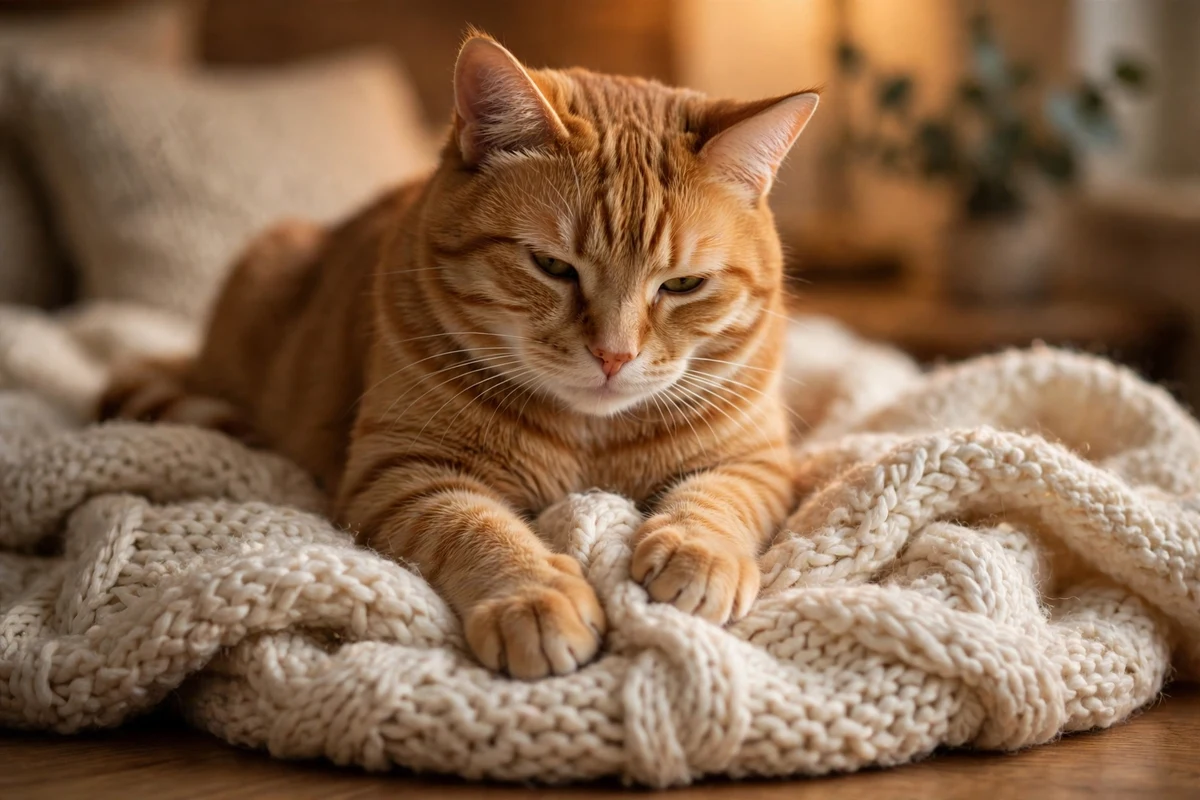
Why Do Cats Make Biscuits? (Kneading Explained)
Your cat settles on your lap, starts purring, and begins pushing its front paws into you, left, right, left, right, like a baker working dough. That is kneading, and cat owners call it making biscuits. It is one of the most recognisable cat behaviours there is, and it is almost always a good sign. Kneading starts in kittenhood, when kittens press their mother’s belly while nursing to help the milk flow. Many cats keep doing it for their whole lives, usually when they feel safe, comfortable, and relaxed. There is no single proven reason why every adult cat kneads, and honest answers say so, but the overlapping explanations tell a clear story: comfort, habit, scent, and trust.
The information here is general information only and is not veterinary advice. If your cat’s kneading changes suddenly, or comes with hiding, appetite change, or signs of pain, contact your vet.
Key Takeaways
- Kneading starts in kittenhood. Kittens press their mother’s belly while nursing to stimulate milk flow.
- Most adult kneading means comfort, relaxation, and trust.
- Cats also knead to prepare a resting spot, to stretch, and to leave scent from glands in their paws.
- Claws, drool, and suckling often come with kneading and are usually normal.
- Do not punish kneading. Redirect it to a thick blanket.
- Kneading does not prove a cat was weaned too early, and it is not a dominance display.
- A sudden change in kneading, or kneading alongside hiding or appetite change, is worth a vet conversation.
What Is Kneading?
Kneading is the rhythmic motion cats make when they push their front paws alternately into a soft surface. The left paw presses down, then the right, then the left again, in a slow, steady rhythm. The motion looks remarkably similar to kneading bread dough, which is why people call it making biscuits. Cats knead blankets, pillows, beds, laps, chests, and sometimes other cats. Some cats knead with their claws out, some with their claws in. Some purr while they do it. Some drool a little. Some close their eyes halfway and look like they are falling asleep standing up.
Most cats knead with their front paws only, though some use all four. The rhythm is usually slow and relaxed, about one press per second, and a session can last from a few seconds to several minutes. A cat that is kneading is usually a cat that has chosen to be where it is. Cats do not usually knead on people or animals they dislike, so a cat making biscuits on your lap is a strong sign it feels relaxed and secure in your company.
Where It Starts: Kittens and Nursing
The strongest explanation for kneading starts in kittenhood. Newborn kittens knead their mother’s belly while they nurse. The pressing helps stimulate milk flow, so the kittens get more milk. VCA Animal Hospitals explains that the sensation of kittens kneading along a mother’s mammary chain causes more milk to come down into the teats for hungry kittens, and that it is also thought to stimulate oxytocin, a hormone that plays a role in bonding between a cat and her kittens.
For a kitten, kneading is linked with food, warmth, and safety from the very first days of life. That link is powerful, and it stays with many cats for life. VCA notes that adult cats may knead to recreate the feel good hormones they got when nursing, and that usually when you see a kneading cat, it is feeling comfortable and relaxed. This nursing origin is the most widely accepted explanation for where kneading comes from, and it is the one veterinary sources agree on most strongly.
Because kneading is tied to nursing, it is sometimes called a retained juvenile behaviour. The technical word is neoteny, which means an animal keeps a behaviour from its young life into adulthood. The experience of nursing is pleasurable to cats, so kneading stays linked with pleasurable feelings. That does not mean an adult cat kneading on your lap thinks you are its mother. It means the motion feels good and familiar, and the cat has no reason to stop doing something that feels good.
Why Adult Cats Keep Making Biscuits
There is no single reason adult cats knead. Behaviourists point to a handful of overlapping explanations, and in any one session, more than one of them may be true. Here are the six reasons that come up most often, from the best supported to the most speculative.
1. Comfort and relaxation
This is the most common reason. Adult cats often knead when they are calm and happy, like when they settle on a soft blanket or a warm lap. Many experts think kneading brings back the comforting feelings of nursing. A kneading cat often purrs, half closes its eyes, and settles in, which is the body language of a cat that feels safe. If your cat kneads you, it usually means it feels secure with you.
2. Self-soothing when stressed or unwell
Kneading is not only a happy behaviour. Cats also knead to calm themselves when they are mildly stressed, anxious, or unwell. VCA notes that cats that are not feeling well may purr and knead as a form of self-soothing. PetMD notes the same thing: kneading can happen when cats are upset or scared, not only when they are happy. The context tells you which it is. A cat kneading on a soft blanket at bedtime is relaxing. A cat kneading constantly in a new home, after a move, or during a loud storm may be soothing itself. Neither is a problem on its own, but a cat that kneads far more than usual and seems tense deserves a closer look.
3. Preparing a resting spot
Wild cats knead soft grasses and bedding materials to prepare a comfortable resting spot, and domestic cats may have kept the habit. VCA describes kneading as part of a broader nesting ritual in which cats circle and pat down a resting area before lying down. If your cat kneads a blanket for a minute and then curls up on it and goes to sleep, it was probably making its bed. This is the reason that shows up most clearly in the timing: kneading right before sleep, on the exact spot the cat is about to lie on.
4. Marking with scent
Cats have scent glands in their paw pads, and kneading may be one way they leave their scent behind. Cornell Feline Health Center notes that cats deposit scent from glands in their cheeks and paws when they rub against surfaces. When your cat kneads you or its favourite blanket, it may be claiming that person or object as familiar and safe. Vets consider this a likely reason, though it is less proven than the nursing link. It is worth remembering that scent marking in this sense is not a dominance display. A relaxed cat marking a blanket it loves is not trying to own you. It is labelling a safe place.
5. Stretching the muscles
Kneading flexes the muscles in the paws, legs, and shoulders. Some cats knead after a nap, the way people stretch when they wake up. This is a small reason, and it rarely explains a long session on its own, but it is part of the picture. A cat that kneads briefly after waking, then walks away, was probably just stretching.
6. Bonding with a trusted person
Many cats only knead people they trust. If your cat makes biscuits on your lap, it is usually a sign it feels safe and bonded with you. Kneading is one of several ways cats communicate comfort and trust, alongside slow blinks, head butting, and purring. Our guide on what your cat is trying to tell you when it meows covers the other sounds and signals cats use, and kneading belongs in the same family of messages.
What We Know vs What We Guess
It is worth being honest about how much of this is proven. The nursing origin is well supported. The comfort link is widely observed. The resting spot and scent marking explanations are plausible and widely repeated by vets, but researchers have not proved that every instance of adult kneading serves exactly the same function. Cats Protection, a major feline welfare organisation, emphasises that the exact reason adult cats retain the behaviour remains uncertain. Some pages present a single reason as fact. The more careful answer is that kneading likely has several purposes, and that the purpose changes with the moment.
That uncertainty is useful, because it tells you how to read your own cat. Instead of asking for the one reason cats knead, ask what your cat is doing right now. A cat kneading a blanket before sleep is probably preparing a resting spot. A cat kneading your lap while purring with half closed eyes is probably comfortable and bonded. A cat kneading constantly in a new home may be self-soothing. The context and the cat’s overall body language are more informative than any single explanation.
How to Read One Kneading Session
Use the setting, the timing, and the body language together. Start with where the cat is kneading. On a blanket or bed, it is often comfort or bed preparation. On your lap, it is often bonding. On a new surface in a new place, it may be scent marking or self-soothing. Then look at when it happens. Before sleep, it is often nesting. After a nap, it may be stretching. During a storm, a vet visit, or a house move, it may be self-soothing. After a long cuddle, it is often contentment.
Then read the body. Relaxed ears, slow blinks, a loose body, purring, and half closed eyes all point to comfort. Dilated pupils, flattened ears, a tense body, a lashing tail, or kneading that will not stop all point to stress or discomfort. A cat that kneads and then settles down to sleep was comfortable. A cat that kneads and then hides was not. If the body language and the setting disagree, trust the body language. A cat kneading on a soft blanket with flattened ears and wide eyes is not relaxed, whatever the blanket suggests.
The Companions: Purring, Drool, Suckling, and Claws
Kneading rarely travels alone. Purring is the most common companion, and it usually means the same thing kneading means: comfort, or self-soothing when unwell. Drool is common too. Some cats dribble while they knead because they are anticipating the milk feed that kneading once predicted, essentially the feline version of mouth watering. A little drool on a relaxed cat is normal. A lot of drool, or drool with vomiting or mouth pain, needs a vet.
Some cats suckle while they knead, nosing and sucking at a blanket, a jumper, or a soft toy. This is also a nursing leftover, and it is usually harmless. It can damage fabric, and a cat that sucks on wool or string can swallow fibres, so give a suckling cat a safe blanket of its own and keep string and loose threads away. Suckling does not prove a cat was weaned too early, whatever you may read. It is a comfort behaviour, and many cats that were weaned normally do it.
Claws are the companion owners notice most, because they hurt. Cats naturally extend and retract their claws as part of the paw motion, so a relaxed kneader can hook into your leg or blanket without meaning to. This is not aggression. The cat is not trying to hurt you. It is simply doing the motion the way it has always done it. Keep the cat’s claws trimmed, put a thick folded blanket between paws and skin, and redirect the cat to the blanket rather than to bare skin.
Living With a Kneader
Most owners love kneading and only want it to hurt less. The thick blanket trick is the simplest fix. Keep a folded blanket on the sofa or on your lap, and when the cat starts kneading, slide the blanket under its paws. The cat gets the soft surface it wants, and you get a layer between claws and skin. Do not push the cat off or scold it. A cat that is punished for kneading learns that your lap is not safe, and the trust that made it knead there in the first place takes a knock.
Keep the claws trimmed. Short claws hook less, and a cat with trimmed claws can knead happily without hurting anyone. If you are not comfortable trimming claws yourself, ask your vet or a groomer to show you how. Never declaw a cat to stop kneading. Declawing is a serious surgery that removes the last bone of each toe, and it can cause lasting pain and behaviour problems. It is never the answer to a normal behaviour.
If the cat kneads at night and wakes you up, give it a blanket of its own on the bed and redirect it there. If the cat kneads your chest or stomach and it hurts, gently lift the cat onto the blanket beside you rather than pushing it away. The goal is to keep the behaviour and change the surface, not to stop the behaviour. A cat that is allowed to knead where it wants, on a surface that works, is a cat that will keep doing it happily for years.
Myths About Kneading
Three myths about kneading come up again and again, and all three are wrong. The first is that kneading proves a cat was weaned too early. It does not. Cats that were weaned normally knead too, and cats that were weaned early may never knead. The second is that a cat kneading on you thinks you are its mother. It does not. The cat is doing something that feels good and familiar, and it has chosen you because it trusts you. The third is that kneading is a dominance display, a cat claiming you as its territory. It is not. A relaxed cat marking a blanket it loves is not trying to dominate anyone. Territorial language is too broad to explain a relaxed social behaviour, and it misreads what the cat is doing.
When Kneading Is a Worry
Most kneading is ordinary behaviour, and most cats that knead are healthy and happy. There are a few times when it is worth a vet conversation. The first is a sudden change: a cat that never kneaded and suddenly starts, or a cat that kneaded gently and suddenly kneads constantly. The second is kneading alongside other changes, such as hiding, eating less, drinking more, vomiting, or seeming sore. The third is kneading that will not stop, or kneading that comes with circling, restlessness, or signs of pain. VCA warns that excessive circling before lying down can be associated with pain, including orthopedic or neurologic problems, so a cat that circles and kneads far more than usual deserves a check.
If your cat hides a lot of the time, our guide on why cats hide explains what hiding usually means and when it needs a vet visit. Hiding plus a change in kneading is a combination worth mentioning to your vet, because it can point to pain or stress that needs attention.
Frequently Asked Questions
Why does my cat knead on me and not on my partner?
Cats choose the person they feel safest with, and they often have a favourite lap. It may be your warmth, your smell, the way you sit still, or simply habit. It is a compliment, not a rejection of anyone else.
Why does my cat knead with its claws out?
Claws extend and retract naturally as part of the paw motion. A relaxed kneader can hook into skin or fabric without meaning to. Keep the claws trimmed and put a thick blanket between paws and skin.
Why does my cat drool when it kneads?
Some cats drool because they are anticipating the milk feed that kneading once predicted. A little drool on a relaxed cat is normal. A lot of drool, or drool with vomiting or mouth pain, needs a vet.
Do all cats knead?
No. Some cats knead every day, some knead rarely, and some never knead at all. All of that is normal. A cat that never kneads is not unhappy, and a cat that kneads constantly is not necessarily stressed. What matters is the change from that cat’s own normal.
Should I stop my cat from kneading?
No. Kneading is a normal, healthy behaviour, and stopping it would take away something that comforts your cat. Redirect it to a suitable surface instead, and keep the claws trimmed.