
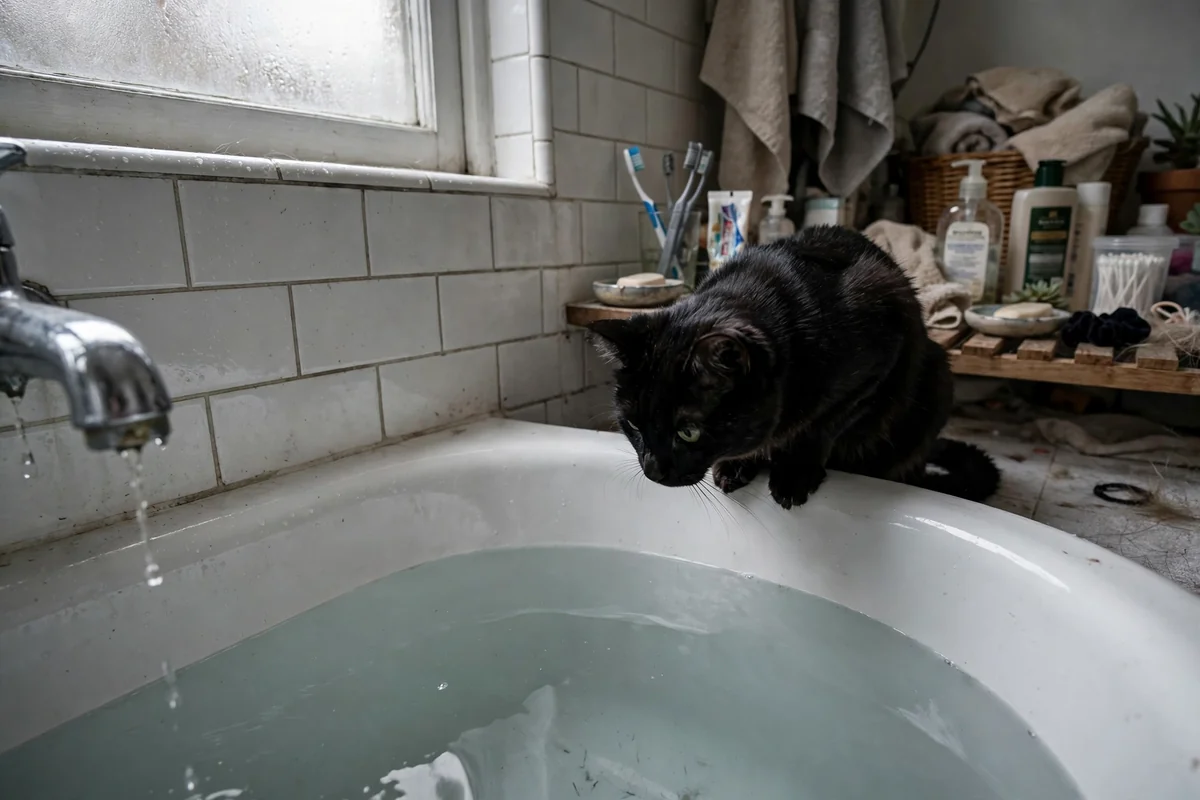
Why Do Cats Hate Water?
Most cats hate getting wet, but most cats do not hate water itself. A cat that bolts from a bath may happily bat at a dripping tap or drink from a running faucet. The problem is not the water. The problem is being soaked, cold, heavy, and out of control. There is no single proven reason why cats dislike getting wet, but the overlapping reasons tell a clear story: a coat that was never built for water, ancestors that lived far from it, senses that notice far more than ours do, and bad memories that stick.
The information here is general information only and is not veterinary advice. If your cat panics around water, stops grooming, hides, or shows signs of illness or pain, contact your vet.
Key Takeaways
- Most cats dislike getting wet, but they do not hate water itself. Many love playing with a tap or a dripping faucet.
- There is no single proven reason. The likely reasons stack: a heavy wet coat, cold, lost scent, lost control, sharp senses, and bad memories.
- Cat fur absorbs water, so a wet cat is heavier, colder, and slower to dry.
- Domestic cats descend from desert wildcats that rarely met large bodies of water.
- Not all cats dislike water. Turkish Vans, Maine Coons, and Bengals are the best known exceptions.
- Never force a cat into water. It makes fear worse, and it can damage the trust between you and your cat.
The Short Answer: Hate Is the Wrong Word
Hate is a strong word, and it is the wrong word for most cats. The same cat that hides from a running bath will sit on the edge of the sink and watch a tap drip for ten minutes. If cats truly hated water, none of that would happen.
PetMD puts it plainly: cats do not necessarily hate water, and they have no intrinsic feeling of hatred or fear of water itself. What they dislike, most of the time, is getting wet. A cat can be curious about water and entertained by water, while still wanting nothing to do with a bath. It helps to sort the feelings into four boxes: dislike, which is the most common, fear, indifference, and enjoyment, which is real but rarer. The fix depends on which box your cat is in.
| What you see | What it probably means | What to do |
|---|---|---|
| Cat walks away from a bath or a puddle | Dislike of getting wet | Respect it. |
| Cat panics, scrambles, hides after water | Fear, often from a bad experience | Never force it. |
| Cat ignores water completely | Indifference | Nothing. Leave the cat alone. |
| Cat paws at taps and plays in bowls | Curiosity or enjoyment | Let the cat play safely. |
Why Getting Wet Feels So Bad to a Cat
The coat problem
The biggest reason, and the one nearly every vet source repeats first, is the coat. A cat’s fur is not designed to repel water. It absorbs water instead. Molly DeVoss, a feline behaviour specialist quoted by Rover, puts it simply: a cat’s fur is not designed to repel water, so it takes a long time to dry and becomes heavy when wet.
Think about walking around in a soaked winter coat. Cats are built to be light on their feet, quick to jump, and ready to run. A heavy coat takes all of that away. Dr Eve Elektra Cohen, a vet quoted by Reader’s Digest, adds that a wet cat may feel a loss of control, because the water slows it down. Dog coats wick water away. A cat’s coat holds it.
The cold problem
Wet fur also steals warmth. Water pulls heat away from the body, and a wet coat loses much of its insulating power. PetMD warns that wet fur can lower a cat’s body temperature. A small cat loses heat faster than a large one, and a kitten or an older cat loses it faster still.
Cold water is a shock, and PetMD notes some cats may not like cold water but tolerate warm water. After the bath, the cat must warm itself up again, which is why towel drying matters so much.
The control problem
Underneath the coat and the cold sits something simpler: control. Cats like to choose where they go, and they like to be able to leave. A bath takes both away. The cat is picked up, placed in a slippery tub, and held still in water it did not choose. It cannot run or climb out easily.
PetMD’s second reason is exactly this: being forced into water is likely very scary for many cats because they have no control over the situation. Dr Sandra Mitchell, a vet quoted by PetMD, explains that stress hormone levels can rise if the cat does not like the experience, especially with a spray nozzle. At a tap, the cat is in charge. In a tub, it is not. The difference is not the water. The difference is who decides.
Where It Comes From: Desert Ancestors
Domestic cats descend from the African wildcat, Felis silvestris lybica, which lived in dry, desert environments in the Middle East and North Africa, with few rivers or lakes. It got most of the water it needed from the food it ate.
That history explains what you see in a modern house cat. Cats cope well in the heat and do not need to drink as much as other pets, and they have no built in habit of entering water. But Companion Animals New Zealand states plainly that the desert ancestry explanation remains unproven. Treat it as the most likely background, not as a proven fact.
The Senses: Smell, Sound, and Temperature
A bath is a sensory event, not just a wet one. Cats.com reports that cats have about forty times more scent receptors than humans, so they can detect chemicals in tap water that we cannot smell. Getting wet also washes the cat’s own scent away. Cats.com explains that cats have scent glands all over their bodies, and the pheromones they leave are unique to each cat. A bath removes those messages, which is disorientating.
Sound adds to it. PetMD lists the sound of a filling bathtub as a reason on its own. That is why bathing guides advise filling the tub before bringing the cat in. Temperature is the third sense. Water that feels pleasantly warm to your hand can feel cool to a cat, whose body runs warmer than ours.
Bad Experiences and the Fear That Sticks
Ancestry and coats explain why cats start out wary of water. Bad experiences explain why some cats become truly afraid of it. PetMD calls a bad past experience one of the primary reasons a cat may hate water. Dr Brittany Klesznyski gives the classic example: a cat that fell into the bathtub may try to avoid water going forward.
The list is longer than most owners realise: a kitten that falls into a bath, a cat caught in a thunderstorm, a cat squirted with a water gun, a first bath given too fast with cold water. Reader’s Digest adds that the fear can be made worse if owners have used a squirt gun or spray bottle to keep cats off counters. The cat does not learn that the counter is forbidden. It learns that water appears suddenly, with no warning. That is why forcing a frightened cat into water is so damaging.
Which Reason Is It for Your Cat?
There is no single answer for all cats, but there is an answer for your cat. Put a shallow dish of lukewarm water on the floor with a treat in it. A cat that dips a paw in is curious and in control. A cat that sniffs and walks away may dislike the smell or the temperature. A cat that freezes and runs may be afraid.
If your cat hides a lot of the time, that is a separate signal. Our guide on why cats hide explains what hiding usually means and when it needs a vet visit.
Why Cats Love the Tap but Hate the Tub
A cat that will not go near a bath will spend ten minutes batting at a dripping faucet. A tap and a tub are not the same experience. A tap gives the cat a small amount of moving water, entirely under the cat’s control. A tub gives a large amount of still water, entirely out of its control.
Movement is the first difference. Reader’s Digest quotes Dr Eve Elektra Cohen: the movement of the water, the noise it makes, and the light reflecting off it stimulates the cat’s strong prey drive. A drip moves like prey. Freshness is the second difference. In nature, still water can be stagnant, while running water is aerated and less likely to be contaminated. Control is the third difference, and it matters most. At a tap, the cat decides how close to get and when to leave. The tap is play. The tub is a trap.
Cats That Like Water
Not all cats dislike water. A few breeds are known for seeking water out, for two separate reasons: coat and personality. But breed is a tendency, not a promise. Cats.com warns that even most Turkish Van cats, nicknamed the swimming cat, do not usually enjoy taking a bath.
Turkish Van
The Turkish Van comes from the Lake Van region of Turkey and is nicknamed the swimming cat. Its coat is semi long, single layered, and often described as feeling like cashmere. It is naturally water resistant, so water beads up and rolls off instead of soaking through.
Maine Coon
The Maine Coon comes from Maine, with its harsh snowy winters and rugged coast, and it developed a dense, water resistant double coat with oily guard hairs that shed rain and snow. Maine Coons are also famously curious and dog like, and owners report them dipping paws into bowls and stepping into the shower.
Bengal
The Bengal was developed by crossing domestic cats with the Asian leopard cat, a wild cat that lives near water in Asia and is a capable swimmer. Bengals are high energy and intensely playful, and owners share stories of Bengals leaping into sinks and joining people in the shower. Not every Bengal is a water fan, but one is far more likely than an average cat to treat water as a toy.
Other breeds often named as water curious include the Norwegian Forest Cat, the Turkish Angora, the Siberian, the Savannah, and the Abyssinian. Litter-Robot estimates that only around 10 percent of domestic cats have a natural inclination towards water, but that figure is an estimate, not a measured fact.
Can Cats Swim?
Yes. Cats are not born with a fear of water, and they instinctively know how to swim. Dr Preston Turano, a vet quoted by Adopt a Pet, says cats naturally know how to swim in a pinch but will rarely want to. Knowing how to swim and enjoying swimming are different things. Some cats panic in water, and short legged breeds such as Munchkins are not efficient paddlers. Never put a cat in deep water, and never leave a cat unsupervised near a pool, a pond, or a full bath. PetMD advises shallow water the cat can stand in, with a way out on its own.
Do Cats Need Baths?
Most cats never need a bath. Cats are self groomers by nature. Cornell Feline Health Center and Texas A and M veterinary college both agree that the average healthy cat keeps itself clean. There are real exceptions. A cat that has rolled in something toxic or sticky needs to be cleaned promptly, because cats lick whatever is on their fur. A cat with a skin condition may need a medicated bath prescribed by a vet. A cat that cannot groom itself properly may need help. Our guide on cat grooming covers brushing, which does more for most cats than any bath will.
How to Bathe a Cat Gently
When a bath is truly needed, the goal is simple: a clean, safe cat that still trusts you afterwards.
Before the bath
Brush the coat first, while the cat is still dry, because wet mats tighten and become much harder to remove. If there is heavy matting, stop and contact a groomer or your vet first. Never bathe a matted cat. Set everything up within arm’s reach first: cat specific shampoo, two towels, a cup or a gentle sprayer, and a washcloth for the face.
Put a rubber non slip mat in the tub. Warm the room, and fill the tub with warm water before the cat arrives. The water should be shallow, about 6 to 8 inches, so the cat can stand firmly on all four feet. Use cat specific shampoo only. Human shampoo, including baby shampoo, has the wrong pH for cat skin.
During the bath
Lower the cat in slowly and keep a steady grip. Speak softly throughout. Wet the coat gradually with a cup or a gentle sprayer, working from the rear forward, and keeping water away from the face, eyes, and ears. Use a small amount of cat shampoo and lather gently, then rinse thoroughly until the water runs clear. Leftover shampoo irritates the skin and gets licked off. Watch the cat, not the clock. If the cat panics, stop. Do not hold the cat down and push through it. Try pet safe wipes instead.
After the bath
Dry the cat with a clean towel, absorbing as much moisture as you can. Most cats will not tolerate a blow dryer. Then put the cat in a warm room with a dry blanket and leave it alone to groom and settle.
- Do not bathe a cat that is struggling to breathe, seems weak, or is unwell. Contact your vet first.
- Do not bathe a cat that has been exposed to a chemical, oil, paint, or toxin without specific vet advice on what to do first.
- Do not bathe a heavily matted, very young, very old, or unwell cat without talking to your vet first.
- Do not use human shampoo, baby shampoo, or heavily scented products, and never spray water at the face.
- Do not leave a cat unsupervised in water, even shallow water.
If you are unsure whether your cat needs a bath, our guide on when to take a cat to the vet can help. When in doubt, ask the vet before the bath, not after it.
Can You Teach a Cat to Like Water?
You can teach most cats to tolerate water, you can teach some cats to enjoy playing with it, and you can teach almost no cat to love a full bath. That is fine, because tolerance is all you ever need.
Start young if you can. Reader’s Digest quotes Dr Jennifer Kasten on the kitten socialisation window of 3 to 16 weeks, while Catster gives about 4 to 10 weeks. The sources disagree, but the principle is the same: early, gentle, positive exposure builds tolerance, and late, sudden, forced exposure builds fear. Let a kitten investigate a shallow dish of lukewarm water on its own, with a treat or a floating toy to fish out. For an older cat, the same steps work, only slower.
Never force a cat to stay in water until it gives up struggling.
Myths About Cats and Water
Several myths come up again and again. All cats hate water: they do not. Most dislike getting wet, some do not mind it, and a few love it. Cats cannot swim: they can, instinctively, but most do not swim well or happily. A cat that likes water will like baths: it will not, necessarily, because a bath means being held still with no control and no exit. Cats hate water only because they are afraid of it: fear is one reason, but the coat, the cold, the scent, and the loss of control are all real reasons too.
You can fix a water hating cat by bathing it more often: you cannot, because forced baths make fear worse and damage trust.
When to Talk to Your Vet
Most water dislike is normal behaviour. Talk to your vet if your cat suddenly changes how it acts around water, drinking, or grooming, if it stops grooming itself, if it inhales water or struggles to breathe after getting wet, or if it needs a bath for a medical reason and you are not sure how to do it safely. Our guide on why cats make biscuits follows the same principle as this page: normal behaviour is usually a good sign, and a sudden change is the thing to watch.
Frequently Asked Questions
Do all cats hate water?
No. Most cats dislike getting wet, but some do not mind it and a few love it. Turkish Vans, Maine Coons, and Bengals are the best known exceptions.
Can cats swim?
Yes. Cats instinctively know how to swim, and a cat that falls in water will paddle to the edge. Most will not want to swim, so never leave a cat unsupervised near deep water.
Why does my cat play with water but hate baths?
Playing with a tap is the cat’s choice, with a small amount of moving water touching one paw. A bath is the opposite: still water, covering the whole body, with no control and no easy exit.
Do cats need baths?
Most cats never need a bath. They groom themselves. A bath is needed only for a real reason, such as a toxic substance on the coat or a medicated bath prescribed by a vet.
How can I bathe my cat without stressing it?
Use warm shallow water, about 6 to 8 inches, a non slip mat, and cat specific shampoo. Fill the tub first, keep the room quiet, rinse fully, and towel dry in a warm room. Stop if the cat panics.
Can I teach my cat to like water?
You can teach most cats to tolerate water, and some to enjoy playing with it, but almost no cat will learn to love a full bath. Go slowly, and stop whenever the cat shows stress. Never force a cat into water.