
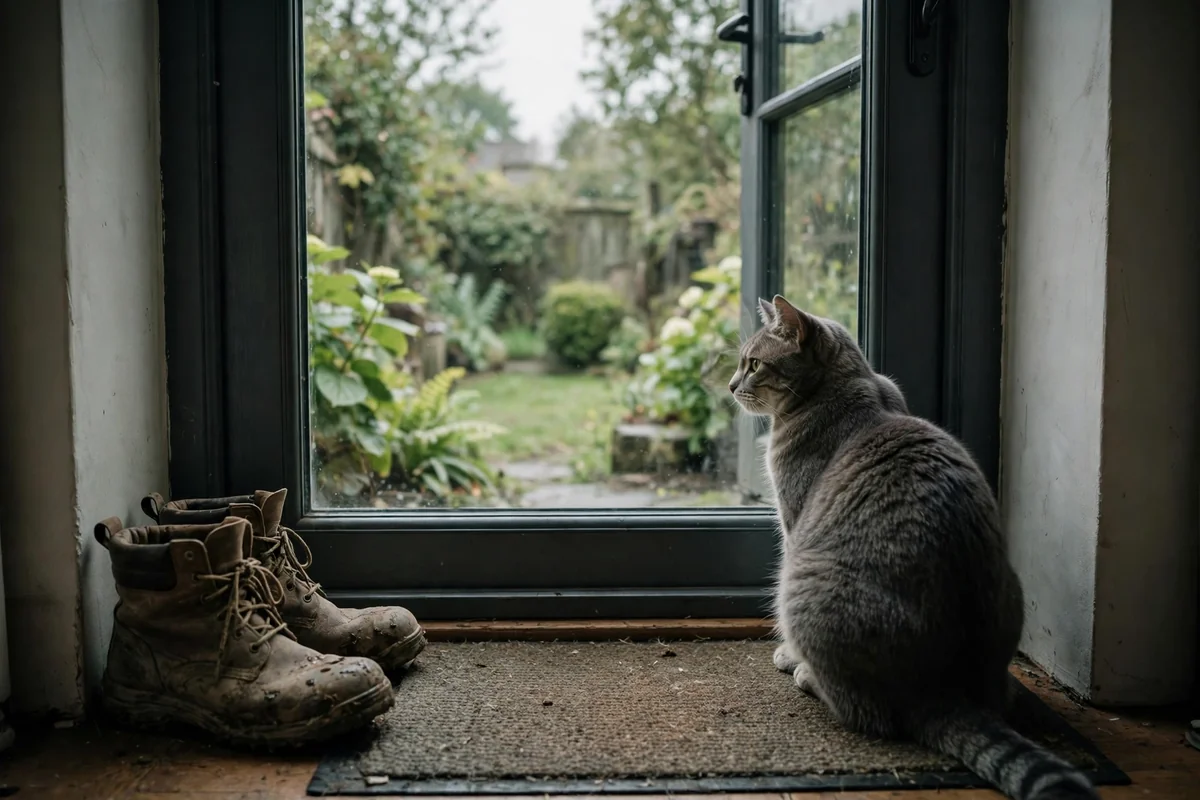
Why Does My Cat Want to Go Outside?
Your cat sits by the back door and meows. Then it meows louder. Then it throws itself at the door, or darts between your legs the second you open it. If your cat wants to go outside, it is not being difficult. It is a hunter, a patroller, and a creature of habit, and the world beyond the door smells of prey, other cats, sun, and fresh air. The question is not whether your cat wants out. It does. The question is how to give it what it needs without letting it roam free.
This article explains why cats want out, what the lifespan numbers really say, the risks of roaming, the safe ways to give a cat outdoor time, a week by week plan for moving a roaming cat to contained living, and how to stop the meowing and the door dashing.
The information here is general information only and is not veterinary advice. If your cat suddenly starts trying to escape far more than usual, or stops eating, hides, or shows signs of illness, contact your vet.
Key Takeaways
- Cats want out for hunting, territory, mating, boredom, curiosity, sun, and habit. Most cats have more than one reason.
- Cats are most active at dawn and dusk, which is why the begging peaks at night and early in the morning.
- Spaying or neutering is the one fix every source agrees on. It cuts roaming, yowling, and the urge to mate.
- Indoor cats live longer, but the gap is smaller than the old figures suggest. Newer research gives median ages of 9.43 years indoors and 7.25 years outdoors.
- Free roaming cats kill an estimated 6.3 to 22.3 billion small mammals and 1.3 to 4.0 billion birds a year in the United States.
- The safe compromise is a catio, a cat proofed garden, harness walks, or a stroller, in that order of safety.
- Moving a roaming cat to contained living takes a couple of months or more. It is a gradual switch, not a single day.
- Never reward the meowing. Giving in even once teaches the cat that persistence works.
The Short Answer: Why Does My Cat Want to Go Outside?
Your cat wants to go outside because outside is where its instincts live. Inside, there is food, warmth, and you. Outside, there is hunting, territory to patrol, other cats to meet or avoid, sun to lie in, and a thousand smells your cat can read like a newspaper. A cat is a hunter by design, and a home, however comfortable, cannot offer prey, fresh earth, or a fence post that needs marking.
That does not mean you should open the door and let it roam. Outdoor cats face cars, predators, fights, disease, parasites, and getting lost. The honest answer is a middle path: keep the cat contained, and bring the outside in, or take the cat out safely. The rest of this article shows how.
Why Your Cat Wants Out: 7 Reasons
Most cats have more than one reason. Work out which ones fit your cat, because the fix depends on the reason.
1. Hunting instinct
This is the deepest reason. Cats are obligate carnivores and built hunters. The stalk, crouch, pounce, grab, and bite sequence is hard wired, and it fires whenever a small moving thing appears. A well fed cat hunts just as much as a hungry one, because hunting is play and practice, not just hunger. Outside, there are mice, birds, moths, and lizards. Inside, there is a sofa. Our guide on why cats bring you dead animals explains what happens when that instinct succeeds, and what the catch on your doormat really means.
2. Territory patrol
A cat treats its home range as its own, and it patrols it, scent marks it, and checks it through the day. A cat that cannot get out cannot patrol, and that creates unease. Unneutered males roam furthest, looking for mates, and they spray and mark as they go. Even neutered cats patrol. The garden is not a luxury to a cat. It is part of its territory, and a closed door is a border it cannot cross.
3. Mating drive
An unneutered cat wants out most of all. Unneutered males roam far looking for females, and they fight other males they meet. Females in heat become restless, pace, yowl, and try every exit, cycling every 2 to 3 weeks in breeding season. Spaying or neutering is the one fix every source agrees on. It cuts roaming, yowling, spraying, and the urge to mate, and it lowers the risk of mammary cancer, testicular tumours, and pyometra, a womb infection. If your cat is not neutered, book the procedure before you try anything else.
4. Boredom indoors
An indoor cat with nothing to climb, chase, or watch will want out, because outside is interesting and inside is not. A cat that sleeps all day, then meows at the door all evening, is usually a bored cat, not a cat that hates your home. The fix is enrichment, not just confinement: vertical space, window perches, puzzle feeders, daily play, food hidden around the house, and safe plants such as cat grass and catnip. Bring twigs, leaves, and herbs indoors, so the cat has new smells to investigate without leaving the house.
5. Curiosity and the senses
Cats live by smell and hearing far more than we do. Outside, there are new smells every day: other cats, rain, soil, birds, a neighbour cooking. Inside, the smells are the same ones as yesterday. Curiosity is not a flaw. It is how a cat maps its world. A window perch, a catio, or a harness walk gives a cat new information without free roaming, and for many cats that is enough.
6. Sun and fresh air
Cats love sun. They seek warm spots, and a sunny windowsill or a patch of garden is a powerful draw. Fresh air carries smells, and a breeze on the whiskers is stimulation in itself. A cat that lies in the one sunny spot in the house all afternoon is telling you it wants more sun. A window perch in the sunniest window, or a catio with a sunny shelf, answers that want directly.
7. Habit and routine
A cat that used to go out will keep asking, because that is what it has always done. Cats are creatures of habit, and a door that used to open is a door that should open. This is the hardest reason to fix, because the cat is not asking for something new. It is asking for its old life back. Habit is also why giving in even once matters so much. If the door opens after an hour of meowing, the cat learns that an hour of meowing works, and next time it will meow for two hours.
Which Reason Fits Your Cat?
Use this table to find the cause. The fix follows the cause, not the other way round.
| Your cat | Likely reason | Fix first |
|---|---|---|
| A kitten, full of energy, climbing everything | Energy and curiosity | Daily play and vertical space indoors |
| An unneutered adult, yowling and pacing | Mating drive | Spay or neuter, then enrichment |
| A former stray or outdoor cat | Habit and territory | The week by week transition plan below |
| A senior cat, asking more than usual | Boredom, or a medical change | Vet check first, then enrichment |
| A cat in a flat, with no garden access | Boredom and lack of stimulation | Window perch, catio on a balcony, harness walks |
| A cat that only asks at dawn and dusk | Natural active hours | A play session before bed, and a morning play session |
The Lifespan Numbers, Explained Honestly
Every ranking page quotes a lifespan number, and almost every page picks a different one. Here are the two main figures, and why they differ, so you can judge for yourself.
The old figure comes from UC Davis, and it is quoted everywhere: 10 to 15 years indoors, against 2 to 5 years outdoors. The problem is that the 2 to 5 year figure mixes owned pet cats with feral cats, which live short, hard lives. It is not a fair comparison with a pet cat that goes out during the day and sleeps indoors at night.
Newer UC Davis research, covering 3,108 cats over 20 years, gives a fairer comparison: median age at death of 9.43 years for indoor cats, and 7.25 years for outdoor cats. The gap is real, and it is about 2 years, not 8 to 13 years. Indoor cats live longer, but the old numbers exaggerate the difference, and no page explains that honestly. Now you know both figures, and why they differ.
| Figure | Indoor cats | Outdoor cats | What it covers |
|---|---|---|---|
| Old UC Davis figure | 10 to 15 years | 2 to 5 years | Mixes owned pets with feral cats |
| Newer UC Davis medians, 3,108 cats over 20 years | 9.43 years | 7.25 years | Owned pet cats, fairer comparison |
The gap exists for real reasons. Outdoor cats face cars, predators, fights with other cats, disease such as FeLV and FIV, rabies, parasites, toxic plants, and getting lost or stolen. Outdoor cats are 2.77 times more likely to carry parasites, from a 2019 meta analysis of 21 studies across 19 pathogens. The risk is real, even if the old lifespan gap was overstated.
The Wildlife Cost of Roaming
There is a second cost, and it is not about your cat. Free roaming cats in the United States kill an estimated 6.3 to 22.3 billion small mammals and 1.3 to 4.0 billion birds every year, according to research published in Nature Communications. Most of that is unowned cats, not pets, but pet cats add to it. Keeping your cat contained is the single biggest thing you can do for local wildlife, and it costs your cat nothing if you replace roaming with safe outdoor time.
Safe Outdoor Access, Ranked by Safety
You do not have to choose between a bored indoor cat and a roaming cat. These four options give a cat outdoor time without free roaming, in order of safety.
1. A catio or enclosed run
A catio is an enclosed outdoor space, from a window box to a full garden run, fenced on all sides including the top. It is the safest option, because the cat gets sun, fresh air, and smells, but cannot roam, hunt, or meet traffic. A basic window box catio costs little. A large garden run costs more, and renters may not be able to build one. If you rent, a freestanding balcony enclosure or a window box is the renter friendly version.
2. A cat proofed garden or balcony
Cat proof fencing angles inward at the top, so a cat cannot climb out, and it keeps other cats from climbing in. It works well for gardens, and netting works for balconies. It is cheaper than a full catio, but it needs a garden, and it needs checking for gaps. A cat that can climb a fence can usually find the one weak spot.
3. Harness and leash walks
A harness walk gives a cat real outdoor time, with you in control. Start indoors, let the cat wear the harness for a few minutes at a time, then attach the leash indoors, then try a quiet garden. Five minutes a day is enough to start. No harness is escape proof, so use a well fitted harness, never a collar, and never tie the leash to anything. Some cats love walks. Some never accept a harness, and that is fine. Forcing it will only teach the cat to fear the harness.
4. A pet stroller or backpack
A stroller or a backpack carrier lets a nervous cat, a senior cat, or a kitten see the outside from safety. It is the best option for a cat that would panic on a leash, and it works for vet trips too. The cat gets the smells and the sun, and you get the control.
The 8 Week Transition Plan: From Roaming to Contained
No ranking page gives a week by week plan for moving a roaming cat to contained living, but the RSPCA says the switch takes a couple of months or more. Here is the plan, in eight weeks. Go slower if your cat struggles at any step.
- Weeks 1 and 2: Build the indoor life first. Add a tall cat tree, a window perch in the sunniest window, puzzle feeders, and a daily play session of 10 to 15 minutes. Start harness training indoors if you plan to walk the cat. Do not change outdoor access yet.
- Weeks 3 and 4: Shorten outdoor time. Bring the cat in earlier each evening, and keep it inside overnight. Feed the cat indoors, at fixed times, so coming home means food. Add a catio or a window box if you can.
- Weeks 5 and 6: Contain the day. Keep the cat inside during the day, with supervised outdoor time only, on a harness or in the catio. Play before the times your cat usually asks to go out, so the energy goes into play, not begging.
- Weeks 7 and 8: Full containment, with safe outdoor time. The cat stays inside or in the catio, with harness walks or stroller trips for outdoor time. Keep the routine fixed. Expect some protest for a few weeks after the switch. That is normal, and it fades.
Two warnings. First, do not try this with an unneutered cat. Neuter first, or the mating drive will undo the whole plan. Second, do not punish protest. Meowing, scratching, and pacing are not bad behaviour. They are a cat asking for its old life. Ignore the meowing, reward quiet behaviour, and keep the routine fixed.
How to Stop the Meowing and the Door Dashing
The meowing and the dashing are learned behaviours, and learned behaviours can be unlearned. The method is the same for both: never reward it, and reward the opposite.
- Ignore meowing completely, including eye contact. Do not look at the cat, do not talk to it, and do not open the door. The moment the cat is quiet, reward it with a treat or a stroke.
- Give in never, not even once. If the door opens after an hour of meowing, the cat learns that an hour of meowing works. Consistency is the whole method.
- Toss a treat into another room before you open the door. The cat runs for the treat, and you leave without a dash.
- Train a mat stay near the door. Reward the cat for lying on its mat while you open and close the door. This takes days, but it is the most reliable fix.
- Use a baby gate or a second screen door as a buffer, so a dash does not become an escape.
- A motion activated air canister near the door is a last resort. It startles the cat away from the door without you doing anything, but it can raise stress in an anxious cat, so ask a vet or behaviourist first.
Our guide on why cats get the zoomies explains the dawn and dusk energy burst that drives so much night time door begging. A play session before bed, ending with a small meal, copies the hunt, catch, eat, rest cycle, and a tired cat sleeps instead of meowing.
When the Urge to Escape Signals a Problem
Most door begging is normal. A sudden change is different. If your cat suddenly starts trying to escape far more than usual, or a cat that never wanted out suddenly does, check for a cause before you train the behaviour away.
- A house move, building work, a new pet, or a new person in the home. Stress makes cats seek escape routes.
- An unneutered cat coming into season, or a male cat smelling a female in heat nearby.
- Illness or pain. A cat that is unwell may hide, or it may try to leave. If the escape attempts come with eating less, hiding, vomiting, or toileting outside the tray, contact your vet.
If Your Cat Escapes and Does Not Come Back
No ranking page covers this, but every owner of an outdoor cat should know it. If your cat gets out and does not come back, act in the first hours, not the next day.
- Search at dawn and dusk, when cats are most active. Call calmly, and listen. A frightened cat may not answer at once.
- Put the litter tray, the cat’s bed, and an item of your clothing outside the door. The smell can guide a lost cat home.
- Ask neighbours to check sheds, garages, and outbuildings. Cats hide in the nearest covered spot, often very close to home.
- Contact your vet, local shelters, and your microchip company, and post in local lost pet groups with a clear photo.
- Do not put food out overnight, because it attracts other cats and wildlife, which can scare your cat away.
Our guide on why cats run away from their owners covers the fear side of this in more depth, including how to approach a frightened cat without scaring it further.
Frequently Asked Questions
Is it cruel to keep a cat indoors?
No, if the indoor life is enriched. The AAFP and ISFM Feline Environmental Needs Guidelines list five needs: a safe space, food and foraging, social contact, clean toileting, and outlets for natural behaviour. A cat with vertical space, play, puzzle feeders, and a window perch can live a full indoor life. A cat with nothing to do will be bored, and that is cruel, whether it is indoors or out.
Should I let my cat outside?
Most vet and welfare bodies recommend keeping cats indoors or contained, including the ASPCA, which recommends keeping cats indoors, and RSPCA Australia, which recommends containment to the property. The safe middle path is a catio, a cat proofed garden, harness walks, or a stroller. Free roaming is the riskiest option, for your cat and for wildlife.
How long do outdoor cats live?
The honest answer is that it depends on the source. The old figure is 2 to 5 years outdoors against 10 to 15 years indoors, but it mixes owned pets with feral cats. Newer research on 3,108 owned cats gives median ages of 9.43 years indoors and 7.25 years outdoors. Indoor cats live longer, by about 2 years on the newer figures.
How do I stop my cat meowing to go outside?
Ignore the meowing completely, including eye contact, and reward quiet behaviour. Never give in, not even once. Add enrichment, play before the begging hour, and a fixed routine. Expect weeks of protest before it fades, and longer for a former roaming cat.
Will neutering stop my cat wanting to go outside?
It will cut the mating drive, which is the strongest reason for roaming in unneutered cats, and it will cut yowling, spraying, and roaming distance. It will not remove hunting, territory, or curiosity, so you still need enrichment and safe outdoor time.
How do I transition an outdoor cat to indoor living?
Build the indoor life first, then shorten outdoor time week by week, then contain the day with supervised outdoor time only. The full switch takes about 8 weeks, and the RSPCA says a couple of months or more. Neuter first, never punish protest, and keep feeding and play times fixed.
The Bottom Line
Your cat wants to go outside because it is a hunter, a patroller, and a creature of habit, and outside is where all three instincts live. The answer is not to open the door and hope for the best, and it is not to lock the cat in a bare room. Build an indoor life worth staying in, give the cat safe outdoor time through a catio, a harness, or a stroller, and move a roaming cat to contained living over about 8 weeks. Neuter first, never reward the meowing, and keep the routine fixed. Your cat will still want out sometimes. That is normal. But it will have a life that answers the want, without the risks of roaming.