
Why Is My Cat Scared of the Vacuum Cleaner?
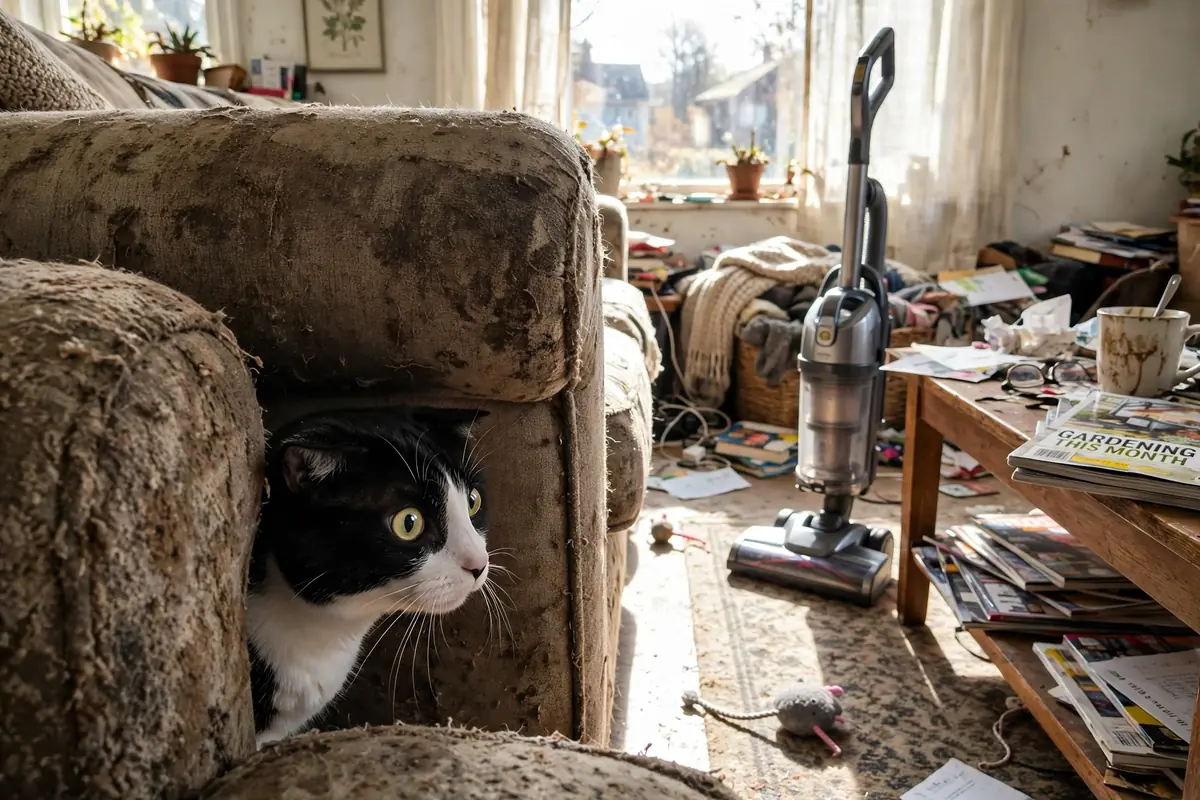
You switch on the vacuum, and your cat vanishes. Under the bed, behind the sofa, or out of the room in a single leap, and it stays hidden long after the noise stops. If your cat is scared of the vacuum cleaner, you are not imagining it, and your cat is not being silly. To a cat, the vacuum is five scares at once: loud, large, moving on its own, smelling strange, and shaking the floor. No wonder so many cats run.
This article explains why the vacuum is so frightening to cats, what cat hearing really hears, how to tell fear from annoyance, a step by step plan to get your cat used to the vacuum, a cleaning day routine that keeps your cat calm, and when a sudden fear means a vet visit.
The information here is general information only and is not veterinary advice. If your cat hides for hours, stops eating, over grooms, or avoids the litter tray after vacuuming, contact your vet.
Key Takeaways
- The vacuum is five scares at once: loud noise, large size, erratic movement, strange smell, and floor vibration.
- Cats hear far above the human range, up to about 64,000 Hz against about 20,000 Hz in humans, so they hear motor whines we cannot hear.
- A typical vacuum runs at 70 to 80 decibels, and upright models are the loudest.
- Kittens gently exposed to household sounds in the socialisation window are less likely to fear vacuums as adults.
- The fix is slow desensitisation plus counter conditioning: gradual exposure paired with treats, over days to weeks, never forced.
- Never chase a scared cat with the vacuum, force it to stay, or punish fear. Fear is normal survival behaviour, not disobedience.
- Give your cat a safe room with a bed, water, a litter tray, and hiding places before you start vacuuming.
- A cat that used to cope with the vacuum and suddenly does not may have a medical cause, and deserves a vet check.
The Short Answer: Why Is My Cat Scared of the Vacuum Cleaner?
Your cat is scared of the vacuum cleaner because it is loud, large, and moves on its own, and cats are both predator and prey. A prey animal treats a large loud object that moves unpredictably as a threat until proven otherwise, and a vacuum never proves otherwise. It roars, it advances, it changes direction, and it smells of hot dust and warm plastic. Your cat cannot predict it, cannot fight it, and cannot understand it, so the only sensible response is to run and hide.
That is normal. Fear is survival behaviour, not disobedience, and it can be eased. The rest of this article shows how, step by step, and how to tell the difference between a cat that is scared, a cat that is annoyed, and a cat whose sudden fear is a warning sign.
The Vacuum Is 5 Scares at Once
Most loud things are only one scare. A thunderstorm is noise. A stranger is a sight. The vacuum is five scares stacked on top of each other, and that is why it beats almost every other household object for frightening cats.
1. Loud noise
A typical vacuum runs at 70 to 80 decibels, and upright models are the loudest. That is about as loud as a busy road. It is not loud enough to damage hearing in a short session, but it is loud enough to startle, and it is constant while the machine runs. There is no pause, no warning, and no way for the cat to turn it down.
2. Sounds you cannot hear
Human hearing tops out near 20,000 Hz. Cats hear up to about 64,000 Hz, so they pick up high motor whines that people cannot hear at all. The vacuum you hear is only part of the sound your cat hears. To your cat, the machine is louder and sharper than it is to you, and it may include frequencies that are actively unpleasant.
3. Large size, moving on its own
To a cat, the vacuum is a large object that moves without legs, changes direction without warning, and comes towards the cat. Cats are both predator and prey, so a large moving object reads as a possible threat. A robot vacuum is smaller and quieter, at roughly 55 to 70 decibels, but it still scares some cats, because it moves alone and can corner a nervous cat in a small room.
4. Strange smell
A vacuum smells of dust, warm plastic, electrical parts, and scented cleaners. Cats live by smell, and a new strong smell in their territory is a warning signal. The smell changes as the machine warms up, which makes it even harder for the cat to predict.
5. Floor vibration
The vacuum shakes the floor, and cats feel that vibration through their paws and whiskers. The cat feels the machine coming before it sees it, which adds to the sense that something large and unstoppable is approaching. Five senses, five warnings, all at once. That is why the reaction is so strong.
Why Some Cats Fear It More Than Others
Not every cat runs from the vacuum. Some sleep through it. The difference comes down to four things.
Socialisation as a kitten
Kittens gently exposed to household sounds in the socialisation window are less likely to fear vacuums as adults. Sources disagree on the exact window: 2 to 7 weeks, 2 to 8 weeks, and 2 to 9 weeks all appear in reputable sources. The point is the same in all of them: gentle, early, low level exposure builds tolerance, and a kitten that never heard a vacuum until adulthood is more likely to fear it.
One bad experience
A single frightening incident can create lasting fear. A vacuum that was pushed towards a kitten, a cat that was cornered by a robot vacuum, or a vacuum that fell over with a crash can all leave a memory that lasts for years. Cats learn fast from fear, and they do not forget quickly.
Personality
Bold, confident cats cope better. Timid, nervous cats fear more, and they fear for longer. A cat that startles at a dropped spoon will startle at a vacuum. That is temperament, not a flaw, and it means the desensitisation plan needs to go slower for that cat.
Mother cat modelling
Kittens watch their mother. If the mother cat fled from the vacuum, the kittens learn that the vacuum is something to flee from. If the mother ignored it, the kittens are more likely to ignore it too. This is one reason shelter kittens, whose mothers may have had no vacuum exposure, can be more fearful of household noise.
Scared or Just Annoyed? How to Tell
Almost no ranking page separates fear from annoyance, but the difference matters, because a scared cat needs the full desensitisation plan, and an annoyed cat just needs you to finish faster.
| Sign | Scared | Annoyed |
|---|---|---|
| Body | Crouched low, tail tucked or puffed, ears flat | Sitting upright, tail flicking, ears forward |
| Eyes | Pupils wide, staring at the vacuum | Normal pupils, looking away |
| Movement | Runs, hides, freezes, trembles | Walks away calmly to another room |
| Afterwards | Hides for hours, eats less, avoids the litter tray | Back to normal within minutes |
| What to do | Full desensitisation plan below | Vacuum while the cat is in another room |
Stress Signs: Obvious and Subtle
Some stress signs are easy to spot. Others are subtle, and most ranking pages miss them. Learn both lists, because the subtle signs are often the first ones to appear.
The obvious signs are hiding, flattened ears, dilated pupils, a crouched body, a tucked or puffed tail, trembling, hissing, freezing, and running. If you see these, your cat is frightened, and you should stop and give it space.
The subtle signs are feigned sleep, whiskers pinned back, a visible third eyelid, lip licking, over grooming in one spot, appetite loss, litter tray avoidance, hiding for hours after the noise stops, and picking fights with other cats in the house. A cat that grooms one spot raw, or stops eating after vacuuming day, is telling you the vacuum is a bigger problem than you thought. Our guide on why cats run away from their owners covers more of these fear signals, including how to approach a frightened cat without scaring it further.
The 7 Step Desensitisation Plan
Desensitisation plus counter conditioning is the standard method, and every reputable source agrees on it. It means gradual, low intensity exposure paired with treats, so the cat learns that the vacuum predicts good things, not danger. It takes days to weeks. One small site promises results in 7 days, but every behaviourist source says weeks, and the honest timeline is weeks.
- Leave the vacuum out, switched off. Put it in the room where the cat lives, switched off and still. Let the cat sniff it, rub against it, and walk past it. Reward calm behaviour with a treat. Do this for several days.
- Feed near the vacuum. Move the food bowl a little closer to the switched off vacuum each day, until the cat eats happily beside it. If the cat will not eat, you moved too fast. Move the bowl back.
- Play a recording, very quietly. Play vacuum sound from a phone, very quietly, in another room, while the cat eats or plays. Raise the volume a little each day, only if the cat stays relaxed. This step is barely mentioned on ranking pages, but it is the gentlest way to introduce the sound.
- Switch it on in another room. With the cat in its safe room and the door closed, switch the vacuum on in another room for 30 seconds. Give the cat a treat afterwards. Build up to a few minutes over several days.
- Switch it on in the same room, at a distance. With the cat free to leave, switch the vacuum on at the far end of the room. Do not move it. Let the cat watch from a safe distance, and reward calm behaviour. Keep sessions short.
- Move it slowly. Once the cat stays relaxed with the vacuum on, move it slowly, in short bursts, always leaving the cat a clear escape route. Never move it towards the cat.
- Vacuum normally, in short sessions. Build up to a normal cleaning session, room by room, with the cat free to leave at any time. Keep the safe room open throughout.
Two rules run through every step. First, never force the cat to stay, never chase it, and never punish fear. If the cat runs, let it run. Second, if the cat shows stress signs at any step, go back one step and stay there for a few more days. Going backwards is not failure. It is the method working.
One contested point: whether comforting a scared cat reinforces fear. Some vets advise against picking the cat up during a fright, while other sources say a calm presence helps. The safe middle path is to stay nearby, speak softly, and let the cat come to you. Do not grab the cat, and do not force cuddles.
Cleaning Day Routine: The Safe Room Protocol
While you work through the plan, use this routine every time you vacuum. It keeps your cat calm, and it works from day one.
- Before you start, put your cat in its safe room: a quiet room with a bed, water, a litter tray, and hiding places, with the door closed.
- Vacuum the rest of the house first, then let the cat out and vacuum the safe room while the cat is in another room.
- Keep feeding and litter areas as robot vacuum no go zones, so the cat is never cornered by a machine while eating or toileting.
- In a multi cat home, vacuum while the cats are together in the safe room, or separate them if one cat bullies the other when stressed.
- When you finish, let the cat out, and give it a treat. The end of vacuuming should predict something good.
Vacuum Types Compared
No authority page compares vacuum types properly, so here is the comparison. The quietest machine is not always the least frightening, because movement and unpredictability matter as much as noise.
| Type | Noise | What scares cats | Verdict |
|---|---|---|---|
| Upright | 70 to 80 decibels, loudest | Noise, size, pushed towards the cat | Most frightening for most cats |
| Canister | Quieter than upright | The hose moves separately, which is unpredictable | Better than upright, still loud |
| Stick or cordless | Quieter, often 60 to 70 decibels | Smaller, but still moves towards the cat | A good compromise |
| Robot | About 55 to 70 decibels | Moves alone, can corner a nervous cat | Quieter, but the movement scares some cats more |
If you are buying a new vacuum and your cat is fearful, a quiet stick model is usually the best choice. For a robot vacuum, run it while the cat is in its safe room, and set no go zones around the feeding and litter areas.
Sudden Fear: When a Cat That Used to Cope Stops Coping
This is the biggest gap in the ranking pages, and it matters most. A cat that used to cope with the vacuum and suddenly does not is telling you something changed. Work through this list before you restart the desensitisation plan.
- A new vacuum. A new model has a different pitch, and a higher whine can be far more frightening than a lower roar. Go back to step 1 of the plan with the new machine.
- A startling incident. The vacuum fell over, the cat was cornered by it, or a loud crash happened while it was running. One bad experience can undo months of tolerance.
- A house move, a new pet, or building work. Stress stacks. A cat that is already stressed by a change will cope worse with the vacuum.
- Pain. Arthritis in seniors makes a cat less able to run and hide, so the vacuum feels more threatening. A cat in pain is also less tolerant of noise in general.
- Ear infection or hearing change. An ear infection can make sounds painful, and a change in hearing can make familiar sounds strange.
- Hyperthyroidism or cognitive decline. Both are named as possible causes of new noise fear in older cats, and both need a vet to check.
If your cat’s fear started suddenly, and you cannot find a cause on this list, book a vet visit before you try training. Our guide on when to take your cat to the vet explains the warning signs that mean a vet visit should not wait, including sudden behaviour change, appetite loss, and hiding.
What NOT to Do
- Do not chase your cat with the vacuum, even as a joke. It teaches the cat that the vacuum hunts, and the fear will get worse, not better.
- Do not force the cat to stay in the room while you vacuum. A cat with no escape route panics, and a panicking cat can injure itself or you.
- Do not punish fear. Shouting, spraying, or scolding a frightened cat damages trust and makes the fear stronger.
- Do not vacuum a sleeping cat. Waking to a roaring machine is the fastest way to create a lasting fear.
- Do not skip steps in the desensitisation plan. Going too fast is the most common reason the plan fails, and it usually makes the fear worse than before.
- Do not believe a promise of a fix in 7 days. Behaviourist sources agree the timeline is weeks, and a rushed plan is a failed plan.
Frequently Asked Questions
Why is my cat suddenly scared of the vacuum?
Work through the causes in order: a new vacuum with a different pitch, a startling incident, a house move or a new pet, pain, an ear infection, hyperthyroidism, or cognitive decline in a senior cat. If you cannot find a cause, book a vet visit before you try training.
How do I get my cat used to the vacuum?
Use slow desensitisation: leave the vacuum out switched off, feed near it, play a recording quietly, switch it on in another room, then in the same room at a distance, then move it slowly. Pair every step with treats, and go back a step if the cat shows stress. Expect weeks, not days.
Are robot vacuums better for cats?
They are quieter, at about 55 to 70 decibels, but they move alone and can corner a nervous cat. Some cats cope better with a robot. Some cope worse, because the movement is unpredictable. Run it while the cat is in its safe room until you know which kind your cat is.
Should I comfort my scared cat?
Stay nearby, speak softly, and let the cat come to you. Do not grab the cat or force cuddles. Some vets advise against picking a frightened cat up, while others say a calm presence helps. The safe middle path is calm company, on the cat’s terms.
Can a vacuum damage a cat’s hearing?
A normal vacuum at 70 to 80 decibels is unlikely to damage hearing in a short session, but cats hear far higher frequencies than people, up to about 64,000 Hz, so the sound is sharper and more unpleasant for them than for you. The exact damage threshold is not settled, and a vet should be asked if you are worried.
How long does desensitisation take?
Days to weeks, depending on the cat. A confident cat may cope in a week or two. A timid cat, or a cat with a bad experience, may need a month or more. If the cat shows stress signs at any step, go back one step and stay there for a few more days.
The Bottom Line
Your cat is scared of the vacuum because the vacuum is loud, large, moving, smelly, and shaking the floor, all at once, and your cat hears parts of it that you cannot hear. That is not silliness. It is a prey animal doing its job. The fix is slow and patient: leave the machine out switched off, pair it with treats, introduce the sound gently, and never force the cat to stay. Use a safe room on cleaning day while you train. And if a cat that used to cope suddenly does not, see the vet first, because sudden fear can be a medical sign. Weeks of patience will get you a cat that watches the vacuum with mild suspicion, instead of a cat that vanishes under the bed.