
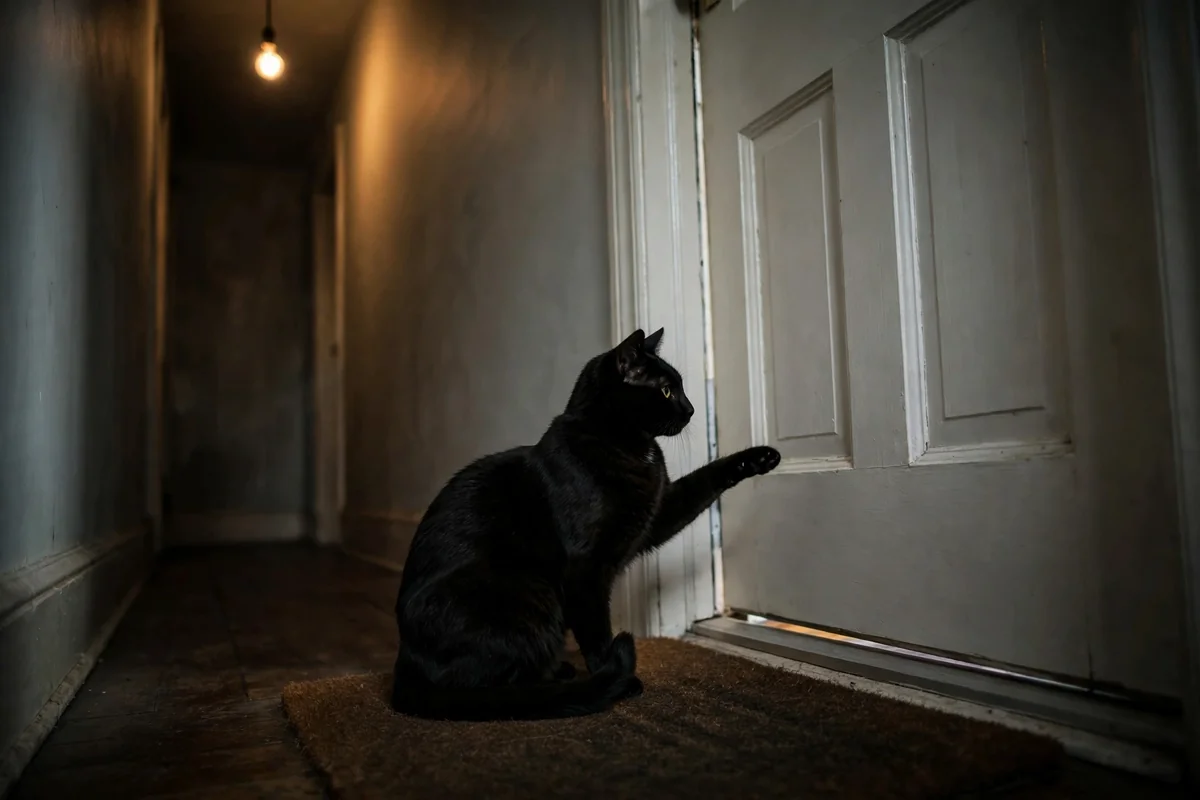
Why Do Cats Hate Closed Doors?
You close the bedroom door, and within minutes there is a paw under it. Then a meow. Then scratching, louder and louder, until you open the door just to get some sleep. Your cat walks in, looks around, and walks straight back out again. If your cat hates closed doors, you are not alone, and your cat is not being spiteful. A closed door breaks three things a cat needs: its territory, its choice, and its company. And it does it at exactly the time of night when a cat is most awake.
This article explains why cats hate closed doors, how to tell curiosity from anxiety, the in then immediately out paradox, what to do about night time scratching, how the fix differs for kittens, seniors, and multi cat homes, and which door solution actually works.
The information here is general information only and is not veterinary advice. If your cat suddenly starts crying at night, soils the house, over grooms, or stops eating, contact your vet.
Key Takeaways
- A closed door cuts a cat off from part of its territory, and cats patrol, scent mark, and monitor their whole home range.
- The cat usually does not want the room. It wants the option to enter and leave. Choice and control are a core need, named in the 2013 AAFP and ISFM guidelines.
- Meowing at a door is usually aimed at a human, because adult cats rarely meow at each other.
- If meowing or scratching has ever opened the door, even some of the time, the cat has learned the move works, and irregular rewards make the habit harder to break.
- Cats are most active around dawn and dusk, so door protest peaks in the early hours.
- True separation anxiety is rarer than door protest. A 2020 study estimated about 13 percent of sampled cats showed a separation related behaviour.
- The fix is a cat flap, a door prop, or a latch, plus play and a small meal before bed, and never rewarding the scratching.
- Sudden night crying in a cat over about 10 years old can point to a medical cause, and deserves a vet check.
The Short Answer: Why Do Cats Hate Closed Doors?
Cats hate closed doors because a closed door takes away territory, choice, and company all at once. A cat treats the whole home as its range, and it patrols and scent marks that range through the day. A closed door is a border it cannot cross, and a room it cannot check. The cat may not want to stay in the room. It wants the option to enter and leave, and that option matters more to a cat than the room itself.
Add curiosity, because a closed door hides sounds, smells, and light, and add social attachment, because the cat wants to be near you, and add the fact that cats are most active at dawn and dusk, exactly when you want to sleep. That is why the scratching starts at 3 in the morning. It is not spite. It is a cat doing what cats do, aimed at a door.
6 Reasons Cats Hate Closed Doors
1. Territory and patrol
A cat treats the whole home as its range, and it patrols it, scent marks it, and checks it through the day. A closed door cuts off part of that range, and the cat cannot be sure what is happening behind it. The room might hold another cat, a smell, or nothing at all, but the cat cannot check, and not knowing is the problem. This is the deepest reason, and it is why a cat can be calm about a door it has never seen open, but frantic about a door that used to be open.
2. Choice and control
The cat usually does not want the room. It wants the option to pass. The 2013 AAFP and ISFM Feline Environmental Needs Guidelines name choice and control over the environment as a core need for cats. A closed door removes choice completely, and that loss of control is stressful in itself. This is also why the in then immediately out paradox happens: the cat wants the door open, not the room. Open the door, and the cat walks in, confirms it can leave, and walks straight back out again.
3. Curiosity
Sounds, smells, and light under a door raise interest, and a cat’s curiosity does the rest. A door that is always closed, and holds nothing rewarding, usually loses its pull over time. But a door that sometimes opens onto food, people, or another cat stays interesting forever, because the cat never knows what is behind it this time. Curiosity is the reason a cat paws at a bathroom door while you are inside, and then loses interest the moment it sees an empty room.
4. Social attachment
Cats want to be near their people. A 2019 study in Current Biology by Vitale, Behnke, and Udell found most tested cats showed secure attachment to their owners, similar to the way children attach to parents. Meowing at a door is usually aimed at a human, because adult cats rarely meow at each other. Your cat is not meowing at the door. It is meowing at you, through the door. Our guide on why cats sit on laptops covers the same attachment logic: the cat wants to be where you are, and on the thing you are looking at.
5. Learned behaviour
If meowing or scratching has ever opened the door, even some of the time, the cat has learned the move works. Irregular rewards make the habit harder to break than regular ones, because the cat never knows which meow will be the one that works, so it keeps trying. This is the same logic as a slot machine. If you have ever opened the door just to get some sleep, you have paid the cat for scratching, and the cat will collect the payment again tomorrow night.
6. Night time activity
Cats are most active around dawn and dusk, which is why door protest peaks in the early hours. A closed bedroom door removes company at exactly the time the cat wakes up, full of energy, ready to hunt, play, and patrol. Our guide on why cats get the zoomies explains the dawn and dusk energy burst in full. A cat that scratches at 3 in the morning is often a cat that has slept all evening and is bursting with energy at the wrong hour.
The Predator and Prey Angle No Page Explains
Only one ranking page touches this, yet it explains both halves of the problem. Cats are both predator and prey, and a closed door threatens both sides of that nature.
As a predator, a cat needs to see and reach its hunting ground. A closed door blocks the hunt, the patrol, and the check for prey. As a prey animal, a cat needs an escape route. A closed door removes the exit, and a cat in a room with one door, now closed, has nowhere to run if something frightening appears. The cat is not just curious about the room. It is also uneasy about being shut in, or shut out, with no way through.
This is why a cat can be calm in a room with an open door and frantic in the same room with a closed door. Nothing in the room changed. The escape route did. If you must close a door, give the cat a way through, a flap or a gap, and the panic usually falls away, even if the cat never uses the gap.
Curiosity, Anxiety, Hunger, or Habit? A Quick Diagnostic
No ranking page gives a simple way to tell the causes apart, but the answer changes the fix. Use this table, and watch your cat for three nights before you decide.
| Check | Curiosity | Anxiety | Hunger | Learned habit |
|---|---|---|---|---|
| What time? | Any time, often daytime | When you leave, or at night | Before mealtimes, early morning | Same time every night |
| Does opening the door end it? | Yes, at once, cat walks in and leaves | No, cat stays distressed | Yes, cat goes to the food bowl | Yes, until the next night |
| Other signs? | None, cat is relaxed | Over grooming, house soiling, not eating while alone | Meowing at the kitchen, food seeking | None, cat is calm once the door opens |
| Fix first | A flap or a prop, so the cat can check | Vet or behaviourist, routine, safe hiding places | Feed on a fixed schedule, puzzle feeder before bed | Never reward the scratching, and give a flap |
The In Then Immediately Out Paradox
You open the door, and your cat walks in, looks around, and walks straight back out again. Then it meows to come back in. This is the paradox, and it confuses every owner, but it makes perfect sense once you know the cat wants the option, not the room.
The cat wanted the door open so it could choose. Once the door is open, it has the choice, and it exercises it by leaving. Then it wants to come back in, because the choice includes coming back. The cat is not being awkward. It is using the door exactly as intended, as a choice, not a destination. The fix is not to keep the cat in or out. The fix is to leave the choice open, with a flap or a prop, so the cat stops asking you to make the choice for it.
Multi Cat Homes: When a Door Separates Two Cats
No ranking page covers this, but it is common. A door that separates two cats can cause problems that have nothing to do with curiosity.
- Door guarding. One cat can guard a doorway, sitting in front of it so the other cat cannot pass. The guarded cat may start meowing, scratching, or toileting outside the tray.
- Resource guarding. If food, water, or a litter tray is behind the closed door, the cat that cannot reach it is stressed, and the cat that controls the door is in charge of a resource. Give each cat its own food, water, and litter tray, on different sides of the door if needed.
- A new cat behind the door. A new cat kept behind a closed door for introductions will meow, and the resident cat will answer. That is normal during introductions, and it fades once the cats meet properly. Do not rush introductions because of the noise.
In a multi cat home, the rule is one more of everything than the number of cats: one more food bowl, one more water bowl, one more litter tray, and one more route through every doorway, so no cat can block another.
Door Solutions Compared
No ranking page compares door solutions side by side, so here is the comparison. The right one depends on your home, your cat, and whether you rent.
| Solution | Cost | Best for | Downside |
|---|---|---|---|
| Door prop or door stop | Free | A quick test, to see if an open door ends the protest | Blocks draughts poorly, and the cat can push it shut |
| Door latch or gap latch | Low | Keeping a cat sized gap, about 10 centimetres, day and night | Less private, and a clever cat can widen the gap |
| Interior cat flap | Low to medium | A permanent fix for one door | Needs a hole cut in the door, so not renter friendly |
| Microchip cat flap | Medium to high | Multi cat homes, where only one cat should pass | Needs power, and some cats need training to use it |
Renters should start with a prop or a gap latch, which need no changes to the door. Owners can fit an interior flap, which is the most reliable long term fix. Whichever you choose, introduce it gradually: prop the door fully open for a few days, then narrow the gap, then fit the flap, so the cat learns the route before the door starts closing.
The Night Plan: 7 Steps to a Quiet Bedroom Door
Night scratching is the most common complaint, and it has a practical fix. Follow these steps in order, and give them at least two weeks before you judge them.
- Play before bed. A 10 to 15 minute play session with a wand toy, ending with a small meal, copies the hunt, catch, eat, rest cycle. A tired cat sleeps instead of scratching.
- Feed a small meal at bedtime. A puzzle feeder by the bedroom door gives the cat something to do at the hour it usually starts scratching.
- Leave a flap, a prop, or a gap. Give the cat a way through the door, so the choice stays open all night.
- Set up the cat’s night base outside your room. A warm bed, a window perch, and a scratching post near the bedroom door give the cat a place to be that is not your door.
- Never open the door for scratching. This is the hardest step, and the most important. If scratching opens the door, even once in a while, the cat will scratch for longer next time. Use earplugs for the first few nights if you need to.
- Ignore the meowing completely. Do not talk through the door, do not shout, and do not get up. Any response is a reward.
- Keep the routine fixed. Same bedtime, same play, same meal, every night. Cats settle fastest when the routine never changes.
Kittens and Seniors Need Different Fixes
Kittens and seniors are lumped together on ranking pages, but their door problems are different.
Kittens need confinement training, not freedom. A kitten that scratches at a closed door is usually a kitten that wants company, play, or food. Give the kitten a safe room of its own at night, with a bed, food, water, a litter tray, and toys, and let it learn that the safe room is a good place. Kittens settle faster than adults, usually within a week or two, because they have not yet built a strong habit.
Seniors need a vet check first. Sudden night crying in a cat over about 10 years old can point to hyperthyroidism, high blood pressure, or cognitive decline, and the figures quoted for cognitive dysfunction are unsourced on ranking pages, so they should not be repeated as fact. If your senior cat suddenly starts crying at night, or crying at doors it never cared about before, book a vet visit before you try training. A medical cause needs medical treatment, not a flap.
What NOT to Do
- Do not punish scratching or meowing. Shouting, spraying, or scolding damages trust and makes an anxious cat more anxious. The behaviour is communication, not disobedience.
- Do not use sticky tape on the door as a deterrent without asking a vet first. Deterrent advice conflicts between ranking pages: one recommends double sided sticky tape, while another reports that Feline Veterinary Medical Association guidance advises against it. The safe choice is to ask a vet or behaviourist before using any deterrent.
- Do not label your cat as having separation anxiety. True separation anxiety is rarer than door protest, and it shows as distress tied to departure, with signs such as house soiling on the owner’s things, over grooming, and not eating while alone. Only a pattern around departure supports that label, and only a vet or behaviourist should make it.
- Do not open the door sometimes and not others. Irregular rewards make the habit stronger, not weaker. Decide the rule, and keep it every night.
- Do not move the cat’s food, water, or litter tray behind a closed door. A cat that cannot reach a basic need will become stressed, and the stress will show as scratching, meowing, or toileting outside the tray.
Frequently Asked Questions
Why does my cat meow at a closed door at 3am?
Cats are most active around dawn and dusk, so 3 in the morning is a natural waking hour for a cat that slept all evening. The cat wants territory, choice, company, or food, and the closed door blocks all four. A play session and a small meal before bed, plus a flap or a gap in the door, is the usual fix.
Why does my cat want in, then want out immediately?
The cat wants the option to pass, not the room itself. Once the door is open, it has the choice, and it exercises it by leaving. This is normal. The fix is to leave the choice open with a flap or a prop, so the cat stops asking you to make the choice for it.
How do I stop my cat scratching the door at night?
Play before bed, feed a small meal, give the cat a flap or a gap, and never open the door for scratching. Expect at least two weeks before the habit fades. If the scratching started suddenly in a senior cat, book a vet visit first.
Is my cat’s door crying separation anxiety?
Probably not. True separation anxiety is rarer than door protest, and it shows as distress tied to departure, with signs such as house soiling, over grooming, and not eating while alone. A 2020 study estimated about 13 percent of sampled cats showed a separation related behaviour. Door protest is usually curiosity, habit, or a wish for company, not anxiety.
Should I get a cat flap for an interior door?
Yes, if you own the door. An interior cat flap is the most reliable long term fix, because it gives the cat choice without you having to open the door. Renters should use a prop or a gap latch instead, which need no changes to the door.
Why does my cat sit outside the bathroom door?
The same reasons: territory, curiosity, and attachment. The bathroom door is closed, you are behind it, and the cat cannot check what you are doing. It is also a door that opens and closes often, which keeps it interesting. A flap, or leaving the door ajar, usually ends it.
The Bottom Line
Your cat hates closed doors because a closed door takes away its territory, its choice, and your company, at exactly the hour it is most awake. The cat usually does not want the room. It wants the option to pass. Give it that option with a flap, a prop, or a gap, play before bed, feed a small meal, and never open the door for scratching. Kittens need a safe room of their own. Seniors with sudden night crying need a vet first. And if your cat walks in and straight back out again, do not be annoyed. It just used the door exactly as intended, as a choice, not a destination.