12 Things That Hurt Your Cat’s Feelings
Your cat will not tell you that you hurt its feelings. It will walk away, hide under the bed, stop greeting you at the door, or start avoiding the room where it happened. None of that is spite. It is a cat protecting itself from something that felt bad, and remembering it.
One honest note before the list. Cats do not process feelings the way people do, and this article does not claim they sit around nursing a grudge. What the twelve items below have in common is simpler and better supported: each one stresses a cat, breaks trust, or takes away something a cat needs to feel safe. The result looks a lot like hurt feelings from the outside, and the fix is the same either way.
Stop doing the thing, and give the cat a reason to trust you again.
The information here is general information only and is not veterinary advice. If your cat’s behavior changes suddenly, hides constantly, stops eating, or avoids the litter box, contact your vet. A behavior change can be a health problem first and a feelings problem second.
Key Takeaways
- Sudden loud noises and shouting startle cats and teach them that people are unpredictable.
- A dirty litter box is one of the fastest ways to push a cat toward toileting outside the box.
- Waking a sleeping cat, especially from deep sleep, breaks trust and can earn you a startled bite or scratch.
- Grabbing a cat or holding it against its will turns affection into a trap the cat will avoid next time.
- Teasing with food or a toy and never letting the cat catch it builds frustration, not fun.
- A slow blink is a real signal. A 2020 study found cats blink back and approach people who slow blink at them first.
- Strong smells from cleaners and perfumes overwhelm a nose that is far more sensitive than yours.
- A long, unblinking stare reads as a threat to a cat. Look away and blink slowly instead.
- When a cat clearly asks for play and gets ignored, it learns that asking does not work, and stops asking.
- Leaving a cat alone for too long, even with full bowls, teaches it that company and routine cannot be counted on.
- A home with nothing to hunt, climb, or explore turns a born hunter into a bored cat that invents its own entertainment.
- Taking away a favorite toy or blanket removes the familiar scent that tells a cat it is home and safe.
The 12 Things, One by One
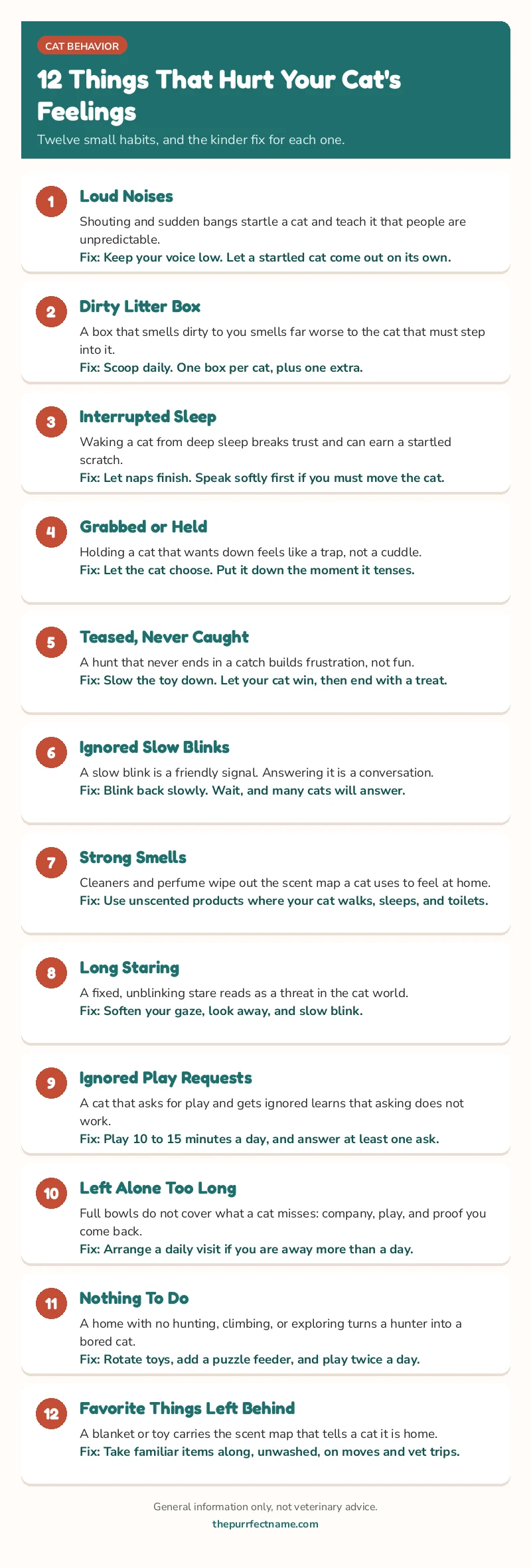
1. Making Sudden Loud Noises or Shouting
Cats hear far better than people do, and a sudden shout, a slammed door, or a raised voice in an argument lands much harder on them than it does on you. A startled cat does not think about who was right in the argument. It learns that the room can turn loud without warning, and it starts watching you the way it watches a storm.
Shouting at a cat never teaches it anything either. Behavior guides agree that cats do not connect punishment with the thing they did minutes earlier, so the shout only adds fear to a lesson that was never learned.
Do this instead. Keep your voice low around your cat, especially when you are frustrated. If a loud noise happens by accident, stay calm, let the cat come out of hiding on its own, and do not chase it to apologize. A quiet house with a predictable voice is the fastest way to earn a nervous cat back.
2. Not Cleaning the Litter Box Often Enough
A cat’s sense of smell is far sharper than yours, and a box that smells dirty to you smells far worse to the cat that has to step into it. Cats are clean animals by instinct, and most will put up with a dirty box for a while, then quietly start using a corner of a room, a rug, or a pile of laundry instead.
Owners often read that as revenge. It is not. It is a cat choosing the cleaner option in front of it, because the box stopped being one.
Do this instead. Scoop at least once a day, and keep one box per cat plus one extra. Use unscented litter, since strong fragrances bother a sensitive nose, and wash the box when you change the litter. A clean box is the cheapest trust you can buy.
3. Interrupting Their Sleep
Most adult cats sleep 12 to 16 hours a day, and much of that sleep is light dozing from which they can wake in a second. Deep sleep is different, and a cat woken suddenly from it can lash out before it is fully awake, the same way a startled person might. Waking a cat again and again for a photo, a cuddle, or a laugh teaches it that sleep is not safe around you, so it starts sleeping in harder to reach places, or sleeping less deeply.
Our guide to cat sleeping positions explains which poses are light rest and which are deep sleep, so you can tell the difference before you reach out.
Do this instead. Let a sleeping cat finish its nap. If you need to move it, speak softly first and give it a moment to wake up on its own. The cuddle can wait ten minutes, and it will be a better cuddle for it.
4. Grabbing Them or Holding Them Against Their Will
Picking a cat up and holding it while it struggles feels like affection to a person and like being trapped to a cat. Cats are both predator and prey animals, and being held with no escape route triggers the prey half. The cat that squirms, scratches, or goes limp is not being ungrateful. It is saying, in the only language it has, that it wants down.
Cats that are grabbed often also stop coming near people at all, because the approach is what leads to being caught.
Do this instead. Let the cat choose. Sit on the floor, keep your hands still, and let it come to you. If you do pick a cat up, support its body, keep it brief, and put it down the moment it tenses or pushes away. A cat that knows it can leave is a cat that stays.
5. Teasing Them With Food or Toys and Not Letting Them Catch It
A wand toy dragged just out of reach is a game for the first minute and a frustration after that. Play is hunting practice for a cat, and a hunt that never ends in a catch leaves the hunting sequence unfinished. The same applies to food teasing: holding a treat where the cat can see it but never reach it teaches the cat that your hands are unreliable, not generous.
Some cats give up and walk away. Others get overexcited and grab at hands, which owners then blame on the cat.
Do this instead. Let your cat win. Slow the toy down, let it catch the feather or the mouse, and end the session with a small treat so the hunt finishes the way a real one would. A caught toy is the whole point of the game.
6. Ignoring Their Slow Blinks
A slow blink, half closed eyes held for a beat and then opened again, is one of the clearest friendly signals a cat has. It is sometimes called a cat kiss, and the name is not just cute. In a 2020 study at the University of Sussex, published in Scientific Reports, cats were more likely to slow blink back at owners who slow blinked at them first, and more likely to approach a stranger who slow blinked than one who kept a neutral face.
Ignoring a slow blink does not harm a cat, but answering it is one of the easiest ways to say, in cat language, that you are safe.
Do this instead. When your cat slow blinks at you, blink back slowly, hold your eyes closed for a second, and open them again. Do it once and wait. Many cats will answer, and some will come closer. It costs nothing and it is the closest thing to a conversation cats offer.
7. Using Strong Smelling Cleaning Products or Perfumes
A cat lives in a world of smell in a way people do not. Scent marks its territory, identifies its people, and tells it whether a room is safe. Strong cleaners, air fresheners, scented litter, and heavy perfume do not just smell strong to a cat. They wipe out the scent map the cat uses to feel at home, and they can irritate a sensitive nose enough that the cat avoids the cleaned area entirely.
Some cats stop using a freshly cleaned litter box for exactly this reason: it smells like chemicals, not like their territory.
Do this instead. Clean with unscented products where your cat walks, sleeps, and toilets. Save strong scents for rooms the cat does not use, and let a cleaned area air out before the cat goes back in. If you wear perfume, put it on away from the cat and let it dry before you pick the cat up.
8. Staring at Them for Too Long Without Blinking
A fixed, unblinking stare is a challenge in the cat world. Between cats it can be enough to stop the other cat reaching food or the litter box, and a direct stare from an unfamiliar person can read as a threat too. The Sussex slow blink researchers even changed their own control condition during pilot trials, because a direct unbroken stare from a stranger seemed to unsettle the cats.
Your cat is not being dramatic when it looks away from a stare or leaves the room. It is doing the polite thing in its own language, and hoping you do the same. Our guide to cat tail language covers the rest of the warning signs, so you can read the whole cat instead of guessing from the eyes alone.
Do this instead. Soften your gaze, look slightly away, and slow blink. If you catch yourself staring at your cat, that is your cue to blink and look elsewhere for a moment. Your cat will notice the difference the same day.
9. Not Playing With Them When They Clearly Ask for It
Cats ask for play in plain language once you learn to read it: a toy dropped at your feet, a chirp at the toy box, a crouch by the wand toy, or a sudden burst of energy aimed at your ankles. Ignoring that ask once is nothing. Ignoring it every day teaches the cat that asking does not work, and the cat either stops asking and gets bored, or finds its own entertainment in curtains, cables, and 3 a.m. sprints down the hallway.
Boredom in an indoor cat is not a small problem. It shows up as overgrooming, restlessness at night, and tension with other pets. If you are not sure what your cat is asking for, our guide to why cats meow walks through the sounds cats use when they want something from you.
Do this instead. Play for 10 to 15 minutes once or twice a day, and answer at least one play request a day even when you are busy. A short session with a wand toy before dinner does more for a cat than an expensive toy left untouched on the floor.
10. Leaving Them Alone for Too Long
Cats have a reputation for independence, and it is mostly earned. A healthy adult cat handles a normal workday on its own without trouble. The problem starts when alone stretches from hours into days. Food and water in bowls do not cover what a cat misses: company, a played game, a clean litter box, and the simple proof that you come back when you say you will.
Guides that cover this agree on the shape of the limit even when they disagree on the exact hour. Most put a normal workday of 8 to 12 hours as fine for a healthy adult cat, and 24 hours as the point where a check-in from a person is needed. Kittens and seniors need company sooner, and no cat should be left alone for days with only an automatic feeder for company.
The signs show up when you return, or in the mess you come home to. A cat that meows far more than usual when you walk in, toilets outside the box, eats less, hides, or grooms one spot raw may be struggling with the time apart. Those signs are not proof of loneliness on their own, and a vet should rule out a medical cause first, but a pattern that starts every time you go away is worth taking seriously.
Separation anxiety is real in cats, even if it is less common and less studied than in dogs, and a cat that panics when left alone is not being difficult. It is asking, in the only way it can, for the absence to be shorter.
Do this instead. For anything longer than a day away, arrange for a person to visit at least once a day, to feed, scoop, play for a few minutes, and simply be there. Leave a worn item of your clothing where the cat sleeps, keep the feeding and play routine the same, and do not make a big fuss when you leave or return. A calm goodbye and a calm hello teach the cat that departures are ordinary and returns are certain.
11. Not Giving Them Enough to Do
This is different from item 9. Item 9 is a cat asking for play and being ignored. This is a house that offers nothing to ask about in the first place. A cat is built to spend much of its day hunting, climbing, scratching, hiding, and sniffing out new things. An indoor life that skips all of that, two bowls of food and a sofa and nothing else, leaves a hunter with no job. The energy has to go somewhere, and it usually lands on your curtains, your cables, your ankles, or your sleep at 3 a.m.
The AAFP and ISFM environmental needs guidelines describe the same five basics every cat should have: a safe place, separate resources, a chance to play and hunt, scratching and climbing, and respectful human contact. A home that provides none of them is not a restful home. It is an empty one.
A bored cat is easy to misread, because the signs overlap with stress, pain, and illness. Knocking things off shelves, ambushing feet, crying at closed doors, sleeping all day and gaining weight, or licking one spot until the fur thins can all point to under stimulation, and all of them can also point to something medical. That is why the honest version of this item comes with a condition: if the behavior is new or sudden, or comes with bald patches or sores, see a vet before you assume the cat is simply bored.
Once health is ruled out, the fix is usually small. Two short play sessions a day, a food puzzle instead of a bowl, a rotating set of toys rather than the same ten on the floor, a window perch, and something to climb turn the same rooms into a place with things to do.
Do this instead. Give your cat one new thing to do each day, not ten new things once a month. Hide a few pieces of kibble for the cat to hunt, move a cardboard box to a new corner, swap which toys are out, and play a short hunting game morning and evening. Fifteen minutes of your day, split into short sessions, is enough for most cats, and a cat with a job to do is a cat that stops inventing jobs for itself.
12. Leaving Their Favorite Toys or Blankets Behind
To a person, a blanket is a blanket and a toy mouse is a toy mouse. To a cat, both are pieces of home. Cats map their territory by scent, rubbing their cheeks and bodies on furniture, doorframes, beds, and blankets until the whole place smells like safety. A favorite blanket or toy carries that scent map in concentrated form, which is why moving guides from Cats Protection and other welfare charities all say the same thing: set up the new room with the familiar bed and blanket, the familiar toys, and something that smells of you, and do not wash any of it before the move.
The unwashed scent is the point. Wash it and you have removed the one thing that told the cat this strange new room is still theirs.
The same mistake happens on a smaller scale. A cat taken to the vet in a bare carrier, a cat left with a sitter in a new apartment without its own bed, or a favorite blanket thrown out during a cleanout all lose the same anchor. The cat does not miss the object. It misses the smell of home and of itself, and without it the new place reads as unfamiliar territory that has to be survived rather than settled into.
The result is usually hiding, refusing food, or toileting outside the box for the first days, which owners often read as stubbornness when it is really a cat with no familiar ground to stand on.
Do this instead. Pack the favorite blanket and the favorite toy first, unwashed, whenever the cat travels, moves, or stays somewhere new. Line the carrier with the familiar blanket for vet trips, and set up one small room at the new place with the bed, blanket, toys, litter box, and food before the cat arrives. Familiar scent is the cheapest comfort you can give a cat, and it costs nothing to keep.
How to Rebuild Trust After a Bad Day
Every owner on this list has done at least one of these things, usually without meaning to. Cats are forgiving in a practical way: they watch what happens next. The repair is not a grand gesture. It is a quiet week. Keep your voice low, scoop the box daily, let the cat choose when to come close, play once a day, and answer slow blinks when they come. Do not chase the cat to make up, and do not force cuddles as an apology.
A cat that is allowed to approach on its own terms will usually do so within days, and that approach is worth more than any apology a person could offer.
If the distance lasts more than a week, or comes with hiding, eating less, or toileting changes, stop treating it as a feelings problem and call your vet. Trust returns quickly when the cause was a habit. It does not return on its own when the cause is pain or illness.
Frequently Asked Questions
Do cats really have feelings?
Cats feel fear, stress, comfort, and contentment, and they remember which people and places caused each one. What they do not do is process those feelings the way people do, with stories and grudges. The twelve items in this article are best read as stressors that damage trust, which is the honest version of hurt feelings.
Can a cat hold a grudge against you?
Not in the human sense. A cat that avoids you after a bad experience is avoiding the situation, not punishing you for it. Change the situation, keep it changed for a few days, and most cats come back on their own.
Why does my cat stare at me without blinking?
Sometimes it is curiosity or a request, and sometimes it is a warning. Read the rest of the cat: relaxed ears and a soft body mean interest, while flattened ears, a tense body, and a swishing tail mean back off. If you are the one staring, blink slowly and look away first.
How do I know if my cat trusts me?
Slow blinks, a tail held high when it greets you, sleeping near you or on you, and showing you its belly are all trust signals. The simplest test is choice: a cat that chooses to be near you when it could be anywhere else is a cat that trusts you.
The Bottom Line
None of the twelve things on this list makes you a bad owner. They make you a normal owner who did not know what a cat hears, smells, and remembers. Now you do. Pick the one you recognized in yourself, fix it this week, and let your cat notice. A cat that feels safe is a cat that greets you at the door, sleeps on your lap, and slow blinks at you across the room, and that is a better review than any list could give you.