
6 Things You Should Never Do to Your Cat
Most of the worst things owners do to cats are done with good intentions. A shout to stop a cat scratching the sofa. A tap to teach it not to bite. A sudden change because the new sofa arrived today. None of it is cruelty in the owner’s mind, and all of it fails in the cat’s mind, because cats do not learn the way people think they learn.
Cats are not small dogs and they are not stubborn children. They do not have a pack hierarchy to submit to, they cannot connect a punishment now with something they did minutes ago, and they remember the person who frightened them far longer than they remember the lesson. The six items below are the ones behavior guides keep warning about, and each one comes with something better to do instead. That is the whole point of this article: not a list of guilt, but a list of replacements.
The information here is general information only and is not veterinary advice. If your cat suddenly becomes aggressive, hides constantly, stops eating, or starts toileting outside the box, contact your vet first. A sudden behavior change can have a medical cause, and no training advice fixes a health problem.
Key Takeaways
- Yelling at a cat teaches it to fear you, not to stop the behavior. Cats do not connect a shout with what they did earlier.
- Hitting or physically punishing a cat increases fear, stress, and aggression, and damages trust that takes weeks to rebuild.
- Cats thrive on routine. Sudden changes, a new pet, moved furniture, a new home, need to be introduced gradually.
- Sleeping with you is a preference, not a rule. Some cats want to sleep on you and some do not, and both are normal. Shutting out a cat that seeks closeness is what hurts.
- Spraying water is punishment too, and it fails the same way yelling does.
- Punishing a cat minutes after the act has zero training value. Cats live in the moment and cannot make the connection.
The 6 Things, One by One
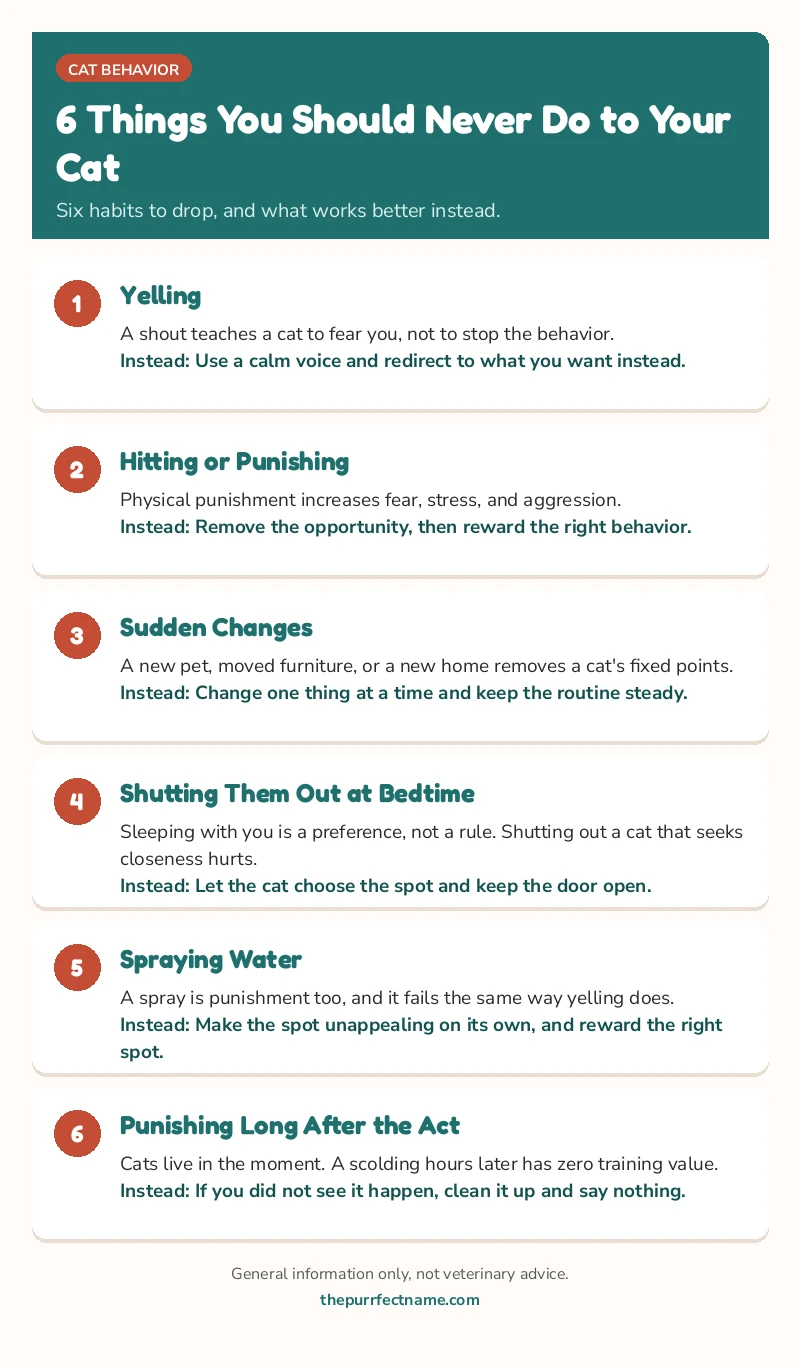
1. Yelling at Your Cat
Yelling feels like a correction to the person doing it. To the cat it is a sudden loud noise from a large animal it trusts, with no explanation attached. Behavior guides are consistent on why this fails: cats do not associate punishment with the behavior the way people do, and they associate the bad experience with the person delivering it instead. The result is a cat that is more fearful, more stressed, and more likely to hide, scratch, or bite, while the original behavior carries on exactly as before.
Yelling also teaches the cat that people are unpredictable, which is the opposite of what trust needs. Our guide to cat tail language shows the stress signals a yelled at cat gives off, flattened ears, a tucked tail, a tense body, so you can see the effect instead of guessing.
Do this instead. Use a calm, low voice and redirect. If the cat is on the counter, lift it down gently and put it where you want it, then reward it for staying there. If the cat is scratching furniture, put a scratching post next to the spot and reward the post. The replacement matters more than the interruption.
2. Hitting or Punishing Your Cat
This is the clearest line in the whole article, and every behavior authority draws it in the same place. Hitting, tapping, swatting, or any physical punishment does not teach a cat anything except fear. Veterinary behavior research consistently finds that punishment based approaches fail with cats and often make behavior worse, because fear and stress increase the very behaviors owners want to stop: aggression, hiding, and toileting outside the box.
Cats are not pack animals, so there is no dominance to assert and no submission to win. There is only a small animal that has learned its person can hurt it, and a relationship that now has to be rebuilt from scratch.
Do this instead. Remove the opportunity, then reward the alternative. Food on the counter goes away, a scratching post appears next to the sofa, a closed door keeps the cat out of the room you care about. Positive reinforcement, rewarding the behavior you want, is the method behaviorists recommend, and it works on cats of any age. If a behavior is dangerous or persistent, ask your vet or a certified behavior professional for help rather than escalating the punishment.
3. Making Sudden Changes
Cats love routine the way people love a quiet morning. Feeding times, play sessions, the layout of the rooms, the smell of the house: these are the fixed points a cat navigates by. A sudden change, a new cat, a new baby, moved furniture, a house move, a new work schedule, removes those fixed points all at once, and the cat’s response is stress. The signs are familiar: hiding, overgrooming, eating less, toileting outside the box, or sudden irritability.
None of that is the cat being difficult. It is a cat that has lost its map and is trying to cope. Our guide to indoor versus outdoor cats makes the same point for lifestyle changes: moving a long-term outdoor cat indoors has to be treated as a project with enrichment added first, not as a door closing, and the same patience applies to any big change.
Do this instead. Introduce changes one at a time and keep the rest of the routine steady. New furniture goes in while the cat’s bed, food, and litter stay exactly where they were. A new pet is introduced by scent first, over days, not by opening a door. A house move starts with one safe room that smells familiar. Slow is not indulgent. Slow is how cats adjust.
4. Shutting Them Out When They Want to Sleep With You
Here is the honest version of the fourth item, because the short version in circulation is wrong. Sleeping with you is not a rule, and it is not something every cat wants. Some cats sleep on their owner’s chest every night. Others sleep at the foot of the bed, in another room, or on top of the wardrobe, and all of those cats are normal.
What hurts is not the sleeping arrangement itself. It is shutting a cat out when it is actively seeking closeness, closing a bedroom door on a cat that has slept with you for years, or pushing a cat away every time it settles beside you. That cat is offering trust, and being refused repeatedly teaches it to stop offering. Our guide to why cats sleep on you explains what that choice usually means: warmth, your familiar scent, and security in one place.
Do this instead. Let the cat choose the spot, and keep the door open if that is what it has always known. If you need the bedroom closed for allergies or for a baby, make the change gradually, give the cat a warm bed just outside the door, and keep a piece of your worn clothing in it. A cat that can still smell you nearby settles far faster than one shut out overnight with no warning.
5. Spraying Them With Water
Spraying water looks gentler than hitting, so owners treat it as the acceptable option. Cats do not agree, and neither do behavior guides. It is the same mechanism as yelling: an unpleasant surprise the cat connects with you, not with the behavior, delivered too late to teach anything. A sprayed cat learns to do the thing when you are not watching, to avoid you when you are holding a bottle, and to associate your hands with unpleasant surprises.
Some cats also develop a fear of water in general, which makes baths, vet visits, and wet weather harder than they need to be.
Do this instead. Make the unwanted spot unappealing without involving yourself at all: double-sided tape on a surface, foil on a counter, a closed door. Then reward the cat for using the right spot. The cat should never be able to trace the correction back to you, because the moment it can, trust takes the hit.
6. Punishing Them Long After the Act
A cat knocks a plant over at noon. You find it at six, point at the mess, and scold the cat. The cat has no idea what you are talking about, and that is not a guess, it is how cat learning works.
Cats live in the moment and cannot connect actions with consequences that happen minutes or hours later. Behavior guides put it bluntly: delayed responses have zero training value. Rubbing a cat’s nose in a mess, dragging it back to the scene, or scolding it after the fact only teaches the cat that you are sometimes angry for no reason it can see, which makes it warier of you in general.
Do this instead. If you did not see it happen, clean it up and say nothing. Prevention is the only lesson that works after the fact: move the plant, secure the vase, close the door. If you do catch the cat in the act, a calm interruption and a redirect to the right behavior, rewarded at once, is the whole training session. It takes seconds, and it is the only timing that works.
What to Do When You Have Already Done One of These
Almost every cat owner has yelled, or shut a door too fast, or punished a cat after the fact before learning better. The repair is the same for all six: a quiet, predictable week. Keep your voice low, keep routines steady, let the cat approach you, play once a day, and reward the behaviors you want the moment they happen. Do not chase the cat to apologize and do not force affection. A cat watches what happens next, and a calm week is a convincing answer.
If the behavior that led to the punishment keeps happening, or the cat stays fearful for more than a week, ask your vet or a certified behavior professional. Some problems have a medical cause, some need a structured plan, and none of them get better with a louder voice.
Frequently Asked Questions
Is it ever okay to shout at a cat?
No, not as a training method. A sharp noise to interrupt a dangerous moment, a cat about to touch a hot stove, is different from shouting as a lesson, and even then the interruption should be followed by a calm redirect, not a scolding.
Will my cat forgive me for hitting it?
Cats do not forgive the way people do, but they do relearn trust from consistent calm behavior. Stop the punishment entirely, keep routines steady, let the cat approach you, and give it weeks, not days. If the fear does not fade, ask a behavior professional for help.
How do I introduce a new cat without stressing the old one?
By scent first, over days: swap bedding, feed on opposite sides of a closed door, then allow brief supervised meetings. Keep the resident cat’s food, litter, and sleeping spots exactly where they were through the whole process.
Should I let my cat sleep in my bed?
That is a preference, not a rule. If your cat wants to sleep with you and you are happy with it, let it. If you need the bedroom closed, change it gradually and give the cat a warm bed nearby with something that smells like you.
The Bottom Line
Cats do not need a perfect owner. They need a predictable one, who does not shout, does not hit, does not change everything at once, and does not shut them out when they come looking for closeness. The six items in this article are all fixable this week, and every one of them has a replacement that works better than the habit it replaces. Drop the punishment, keep the routine, and let the cat choose to be near you. That choice is the whole relationship.