
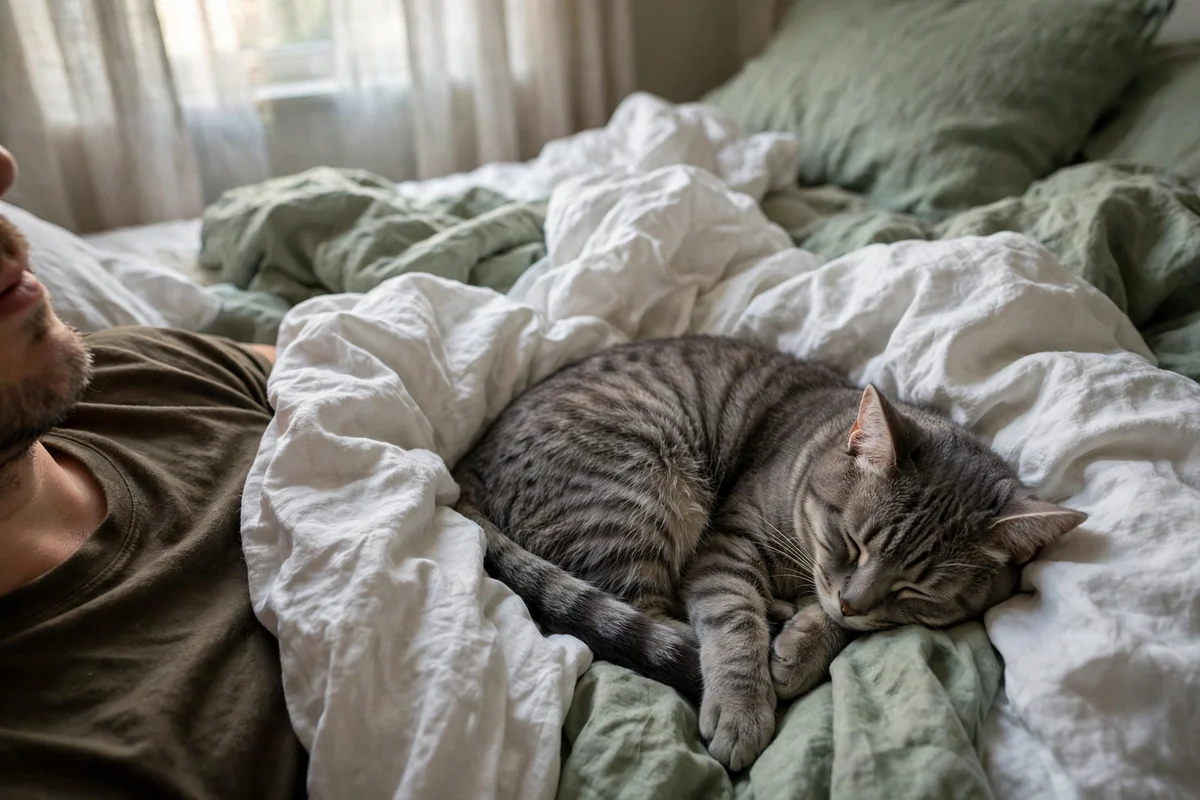
Why Does My Cat Sleep on Me? (All the Favorite Spots)
Your cat walks across the bed, turns in a tight circle on your chest, and settles down with a deep sigh and a purr. It could have picked the sofa, the spare bed, or the warm spot by the radiator. It picked you. That choice is the short answer to why cats sleep on people: you are warm, you smell like home, you are still for hours at a time, and your cat trusts you enough to fall asleep in its most defenceless state on top of you. Where your cat sleeps adds one more layer of meaning.
The information here is general information only and is not veterinary advice. If your cat’s sleeping habits change suddenly, or the change comes with hiding, appetite change, or signs of pain, contact your vet.
Key Takeaways
- Cats sleep on people for warmth, trust, scent, bonding, heartbeat rhythm, routine, and claiming. No single reason explains every cat.
- Normal cat body temperature is about 100.5 to 102.5 degrees Fahrenheit.
- Where your cat sleeps matters. Chest means closest contact, head means scent and stillness, feet mean affection with an exit route, and between your legs means a warm den.
- A cat that sleeps beside you but not touching you still shows trust. Proximity alone counts.
- For most healthy adults, bed sharing is generally safe with vaccines, flea and tick control, and a clean litter box. Cats should never share a bed with babies or very young children.
- A sudden increase or sudden stop in sleeping on you, paired with hiding, appetite change, or lethargy, is worth a vet visit.
- You can move a cat to a nearby spot in 7 to 14 days with a warm bed on your bed.
The Short Answer
Cats sleep on people because people are warm, familiar, and still. A cat sleeps 12 to 16 hours a day, and sleep is the time a cat is least able to defend itself. Choosing to spend that time pressed against a person is a strong sign of trust.
Your body holds a steady temperature through the night, your scent is the most familiar smell in the house, and your breathing and heartbeat give a slow, regular rhythm that many cats find soothing. Most cats are getting both at once, and that is why the habit is so hard to break. Some cats want the closest contact they can get. Some want warmth with a quick exit. The spot finder below lets you jump straight to your cat’s favorite place.
Find Your Cat’s Spot Fast
Find your cat’s usual spot in the table, then read the full section for that spot further down. Trust and warmth are rated from low to very high.
| Spot | Trust | Warmth | Closeness | Exit ease |
|---|---|---|---|---|
| On your chest | Very high | Very high | Closest | Hard |
| On your head or pillow | Very high | High | Very close | Easy |
| On your stomach | High | Very high | Very close | Medium |
| On your neck | Very high | High | Very close | Hard |
| Between your legs | High | Very high | Close | Medium |
| On your back | High | High | Close | Easy |
| On your lap | High | High | Close | Easy |
| At your feet | Moderate to high | Moderate | Arm’s length | Very easy |
| Beside you, not touching | Moderate to high | Low | Near | Very easy |
Why Cats Sleep on People: The 7 Real Reasons
Vets and behaviourists cited by Purina, Luve Ur Pet, A-Z Animals, Adoptapet, and Nexgard agree on these seven reasons.
1. Warmth
Cats run hotter than people, with a normal body temperature of about 100.5 to 102.5 degrees Fahrenheit. They lose heat through thin coats and small bodies, so they chase warm surfaces all day: sunny windowsills, radiators, laptops, and you.
2. Trust and safety
A sleeping cat is a defenceless cat. In the wild, cats rest in high, hidden, or defended spots because sleep leaves them open to attack. A cat that sleeps on you has decided you are safe enough to guard it while it cannot guard itself. A cat on your chest, belly exposed and body pressed against yours, shows more trust than a cat at the foot of the bed.
3. Scent and family smell
Scent is how cats understand the world. Cats have scent glands on their cheeks, paws, flanks, and head, and they use them to mark what belongs to their social group. Your skin, hair, and bedding are saturated with your smell, and after a while, with theirs too. Sleeping on you tops up that shared family scent. Our guide on why cats make biscuits explains kneading, the same comfort behaviour you see at bedtime.
4. Bonding and social sleep
Cats that live together and get along sleep in a heap. Behaviourists call it pillowing: bonded cats share warmth, scent, and companionship by sleeping pressed together. When your cat curls up on you, it is including you in that inner circle. Sleeping together is social behaviour, not just heat seeking.
5. Heartbeat and breathing rhythm
The slow rhythm of a resting human’s heartbeat and breathing calms cats. It recalls kittenhood, curled against a mother and littermates, and it gives a steady sound to fall asleep to. This is one reason the chest is such a popular spot, and why cats often start purring the moment they settle there.
6. Routine and habit
Cats love predictability. If you go to bed at the same time each night and stay still for eight hours, you have become the most dependable sleeping spot in the house. The cat learns the pattern, arrives before you do, and returns to the same spot night after night.
7. Claiming you
In a multi cat or multi person household, the cat that sleeps on you may be making a point. Sleeping on a resource is a quiet way of saying mine, and to your cat, you are a resource: warmth, food, safety, and affection all in one. It is most obvious when two cats compete for the same place on the bed.
Is It Love or Just Warmth? A Simple Test
Most pages say it is both love and warmth and leave it there. Run this one night test instead. Put a heated cat bed or a warm blanket on the bed beside you, at the same height as your body. Go to bed as usual and watch where your cat settles. Then check the signs below. The more signs you see, the more the answer leans toward bonding rather than warmth alone.
- Your cat picks you over the heated bed, even though the heated bed is warmer.
- Your cat purrs, kneads, or headbutts you before settling, not just when it arrives.
- Your cat stays on you after you shift position, instead of moving to the warm blanket.
- Your cat follows you to other rooms to sleep near you during the day, not only at bedtime.
- Your cat greets you when you come home and seeks contact while you are awake, not only when you are still and warm.
If your cat picks the heated bed most nights, that is not a rejection. It means warmth was doing most of the work.
What It Means Where Your Cat Sleeps on You
Each spot below gives the usual meaning and a sleep tip. Read your cat’s spot, and skip the rest.
On Your Chest
The chest is the closest, warmest, and most intimate spot a cat can pick. Your torso is warm, it rises and falls with your breathing, and it carries the steady thump of your heartbeat. A cat on your chest is choosing maximum contact and maximum trust. If the weight wakes you, try a thick folded blanket across your chest.
On Your Head or Pillow
The head and pillow spot is about warmth, stillness, and scent. Your head moves less than your arms and legs when you sleep, so a cat there gets a stable platform. Hair and scalp carry a strong, familiar scent. Some pages claim cats pick the head because it loses the most heat, but no rival cites a source for that.
On Your Feet
Feet are the most popular spot for cats that want affection with an exit route. A cat at your feet is close enough to touch you and share your warmth, but it can leave in one jump without climbing over you. If your cat attacks your feet at night, run a short play session before lights out.
Between Your Legs
Between your legs is the warmest enclosed spot on the bed, and cats that pick it are usually after heat and security in equal measure. Your legs form a den on both sides, and the cat can press against you on two sides at once.
On Your Stomach
The stomach is a warm, breathing platform, much like the chest but lower and flatter. Cats that pick it are usually confident that you will not toss them off, because the stomach moves with every breath and shifts when you turn.
On Your Back
A cat sleeping on your back or spooned against it is treating you as part of the colony. In a pile of bonded cats, cats sleep back to back so each one guards a different direction. Your back gives shared warmth and safety, and a cat that can watch the room while you face the other way.
On Your Neck
The neck is a warm, close spot right next to your heartbeat and breathing, and cats that pick it are usually seeking the strongest possible closeness. It is a very high trust spot, because the cat is pressed against your throat and face with nowhere to go if you roll.
On Your Lap
The lap is the daytime version of the chest. It is about comfort, attention, and warmth while you are awake and still. A cat on your lap is choosing you over every other seat in the house.
Why Your Cat Picks One Person and Not the Other
Cats often pick one favorite person, and the reasons are practical rather than personal. The favorite is usually the warmest person, the stillest sleeper, the person who feeds them, and the person who lets the cat approach on its own terms. A partner who tosses and turns will lose the bed to the partner who lies still. If you are the partner losing out, be the person who feeds the cat in the evening and plays with the cat before bed. Lie still when the cat approaches, and do not pick the cat up once it settles.
Kittens, Adults and Seniors Sleep on You Differently
Kittens
Kittens learn to sleep in a pile with their mother and littermates, and they carry that habit straight into a new home. A kitten that sleeps on you is doing what it did in the nest: finding the warmest, safest body in the room and pressing against it. Kittens also sleep more than adults, up to 20 hours a day in very young kittens.
Adult cats
Adult cats settle into a pattern. The spot they pick becomes their spot, and they return to it night after night out of habit as much as warmth. Adults are also the most likely to rotate spots through the night: chest at bedtime, feet at midnight, the warm spot you just left at dawn. That rotation is the cat managing its own temperature through the night.
Senior cats
Senior cats often seek more warmth and more contact. That can reflect a cat that feels the cold more, has arthritis that aches in cool air, or has lost weight and with it some insulation. A new lap obsession in a senior cat is worth a vet check, especially if it comes with other changes like eating less, drinking more, or moving stiffly. Our cat age calculator can help you work out your cat’s life stage.
Breed Differences Worth Knowing
Breed is not destiny, and any cat of any breed can be a lap sleeper or a loner. Ragdolls are famous for going limp in your arms and sleeping on people. Sphynx cats have no fur to keep them warm, so they seek body heat constantly. Burmese, Tonkinese, and Siamese cats are social breeds that often follow their people and sleep close.
Why Your Cat Suddenly Started or Suddenly Stopped Sleeping on You
A change in where your cat sleeps is information, not a verdict. Use the table to read it, and watch for the other symptoms in the last column.
| What changed | Likely cause | When to worry |
|---|---|---|
| Started sleeping on you suddenly | Cold weather, feeling unwell, stress, or a new pet | With hiding, appetite change, or lethargy, see a vet |
| Stopped sleeping on you suddenly | Hot weather, a new partner, a new pet, pain, or a fright | With hiding, eating less, or less grooming, see a vet |
| Moved from chest to feet | Warmer weather or wanting an easier exit | Usually normal, unless it comes with other changes |
| Moved from feet to chest | Colder weather, illness, or anxiety | If it comes with clinginess all day, see a vet |
| Senior cat suddenly clingy | Cold, arthritis, or weight loss | Book a vet check, especially with eating or movement changes |
A sudden increase is often innocent, but it can also be the first sign of illness, because cats that feel unwell often seek warmth and contact. A sudden stop is often environmental: the weather warmed up, a new person or pet arrived, or something scared the cat. Pain can also do it. Cats are crepuscular, most active at dawn and dusk, so a cat that leaves the bed at 2 a.m. and returns at dawn is following a normal pattern.
Our guide on why cats get the zoomies explains the midnight crazies. If a sleep change comes with hiding, appetite change, vomiting, lethargy, or less grooming, book a vet visit. Our guide on why cats hide explains what hiding usually means.
Is It Healthy to Let Your Cat Sleep on You?
For most healthy adults, letting a cat sleep in bed is generally safe, and many owners sleep better with a cat nearby. Co-sleeping can also disturb sleep through movement, play, meowing, and early waking. People with asthma, severe allergies, or a weakened immune system should think twice about bed sharing. Keep the cat up to date on vaccines and flea and tick control, keep the litter box clean, and wash bedding regularly. Cats should never share a bed with babies or very young children, because of the suffocation risk from a cat near a baby’s face or head. This is the one hard rule on bed sharing.
How to Move Your Cat to a Nearby Spot in 7 to 14 Days
If you love the cat but need your chest back, do not shut the cat out of the bedroom. That usually makes the cat meow at the door all night. Move the cat to a nearby spot instead.
- Days 1 to 3: put a warm cat bed on your bed, beside your pillow or at the foot of the bed, with a worn shirt of yours in it so it smells like you. When the cat settles on you, gently lift it onto the bed beside you and stroke it there.
- Days 4 to 7: place the cat directly on the bed when it arrives, before it climbs onto you. Reward it with a treat or a stroke when it stays on the bed.
- Days 7 to 14: move the bed a little further from you each night, toward the foot of the bed or onto a chair beside the bed. Most cats will settle in the bed on their own by day 14.
If the plan fails, manage the spot instead: a blanket on your chest, a spare pillow for the head sleeper, and a play session before bed.
Frequently Asked Questions
Why does my cat sleep on my chest?
Your chest is warm, it rises and falls with your breathing, and it carries your heartbeat.
Why does my cat sleep on my feet?
Feet mean affection with an exit route. A cat at your feet is close enough to touch you and share your warmth, but it can leave in one jump.
Why does my cat sleep on me and not my partner?
Your cat picks the warmest, stillest person who feeds it and lets it approach on its own terms. The fix is to feed the cat, play before bed, lie still, and let the cat come to you.
Why did my cat stop sleeping on me?
Usually the weather warmed up, the bed changed, a new person or pet arrived, or something scared the cat. If the stop comes with hiding, eating less, or grooming less, book a vet visit.
Does my cat sleeping on me mean it loves me?
It means your cat trusts you, wants your warmth, and counts you as part of its group. No single spot proves love on its own.
The Bottom Line
Your cat sleeps on you because you are warm, familiar, still, and trusted. The spot adds the detail: chest for closest contact, head for scent and stillness, feet for affection with an exit. None of it needs fixing unless it disturbs your sleep or changed suddenly with other symptoms. If it is disturbing your sleep, move the cat to a nearby spot over 7 to 14 days, not out of the room. If it changed suddenly with hiding or appetite change, call your vet. Otherwise, enjoy it.