
11 Things That Cause Stress to Your Cat
Your cat does not need a disaster to get stressed. It needs a Tuesday that does not look like Monday. A chair moved to the other side of the room, a new pet through the door, a visitor who stays for dinner, a different food in the bowl. Small changes, to a person. Big changes, to an animal that builds its whole sense of safety out of familiarity.
Cats rely on three things to feel safe: routine, territory, and choice. Routine means the same feeding times, the same play times, the same quiet hours. Territory means a home that smells like them and looks the way it looked yesterday. Choice means they can walk away from what bothers them.
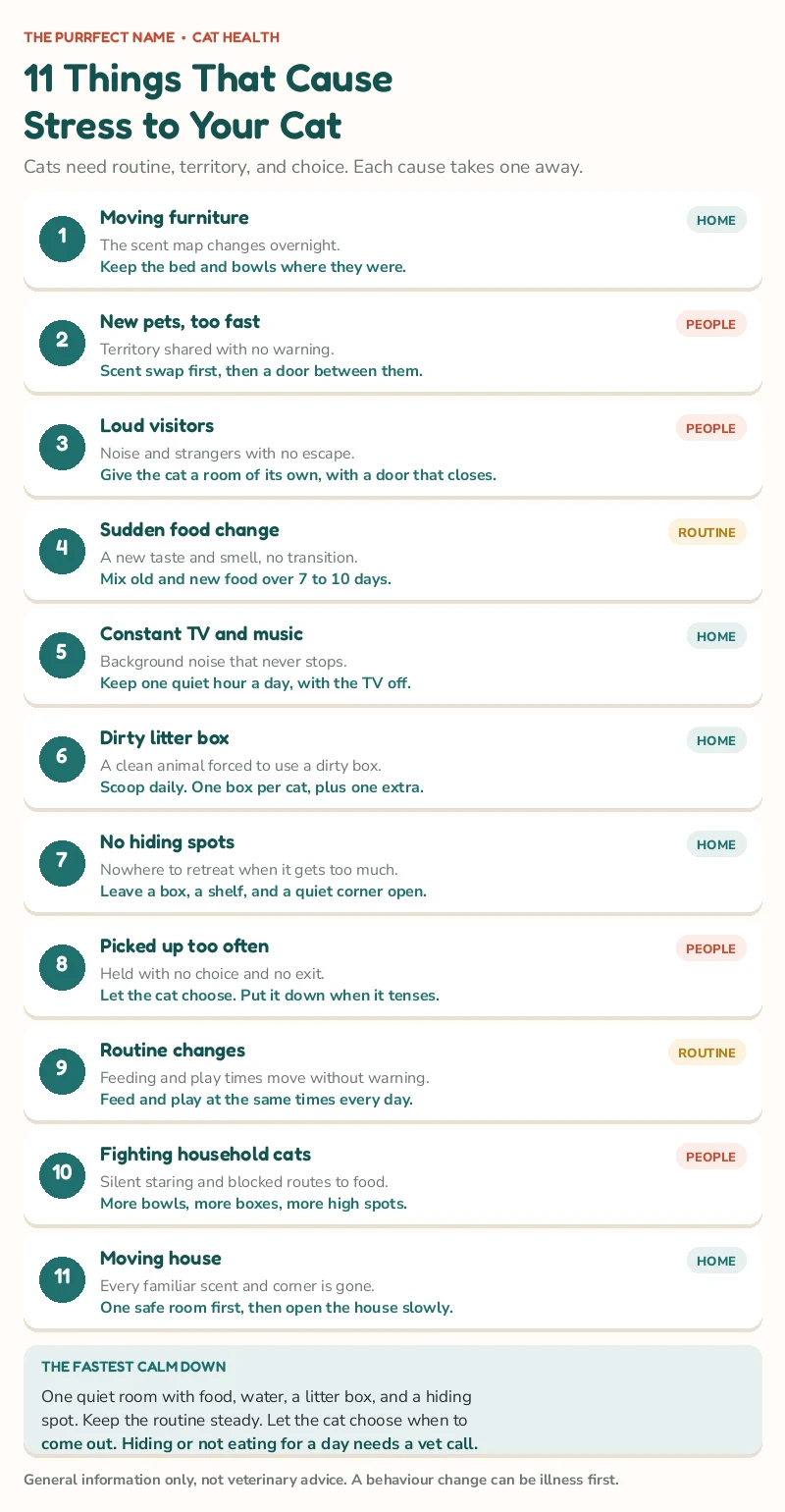
Every one of the eleven causes below takes away at least one of those three, and most take away two. That is why the fix is almost always the same shape: give one of the three back.
This article is about causes, not signs. Signs are how stress shows, and they have their own guide. Causes are what creates it, and causes are the part you can actually change. The information here is general information only and is not veterinary advice.
If your cat hides constantly, stops eating, or avoids the litter box, contact your vet. A behaviour change can be a health problem first and a stress problem second.
Key Takeaways
- Stress in cats is usually a loss of routine, territory, or choice, not a single bad event.
- Moving furniture and moving house are the biggest home changes, because they wipe out the scent map.
- New pets must be introduced by scent first, then through a door, over days or weeks, never all at once.
- A dirty litter box and no hiding spots are the two causes owners can fix the same day.
- Most fighting between household cats is silent: staring, blocking, and guarding, not yowling.
- One quiet room with food, water, a litter box, and a hiding spot is the fastest calm down for almost every cause on this list.
The 11 Causes, One by One
1. Moving Furniture Around the House
A cat navigates its home by scent as much as by sight. It has rubbed its cheeks on the corners, slept in the same spots, and built a map of where everything is and where it is safe.
Move the sofa, swap the chairs, or shift the cat tree to the other wall, and that map is wrong overnight. The room looks the same to you and different to the cat, and the cat has to rebuild its sense of the place from scratch.
Do this instead. Change one thing at a time, and keep the cat’s own things where they were: its bed, its bowls, its scratching post, and its favourite sleeping spot.
If you are redecorating a whole room, shut the cat out of it until the work is done, then let it explore the finished room on its own terms. A cat that can investigate a change at its own pace will accept it far faster than a cat that wakes up inside one.
2. Bringing New Pets Home Suddenly
To you, a new pet is a happy event. To your resident cat, it is a stranger that has just moved into its territory, and it is now expected to share its home, its resources, and its familiar spaces with that stranger.
Cats are territorial, and suddenly having to share creates uncertainty and tension. Introducing cats too quickly makes it worse, and it is the most common mistake owners make with a new pet.
Do this instead. Introduce by scent first. Swap bedding between the animals for a few days so each learns the other’s smell before they ever meet. Then let them meet through a closed door or a screen, with food on both sides so the meeting is paired with something good. Then short supervised meetings, building up over days or weeks.
If your cat starts meowing more than usual during the introduction, our guide to why cats meow explains the sounds cats use when they want something from you, and a new pet is one of the commonest reasons. Never throw two cats together and hope they sort it out. They will sort it out by fighting, and the loser will hide for weeks.
3. Loud Visitors Staying for Too Long
Visitors are two stressors at once: noise and strangers. A short visit from a quiet person is usually fine. A long visit from loud people, especially people who want to pick the cat up, is not.
The cat has no escape from the noise, no control over who approaches it, and no way to know when the visit ends. Children are the hardest version of this, because they move fast, speak loudly, and chase.
Do this instead. Give the cat a room of its own before the visitors arrive, with the door closed, food, water, a litter box, and a hiding spot inside. Tell visitors the rule before they come in: do not chase the cat, do not pull it out of hiding, and let it approach them.
A cat that chooses to come out and investigate a visitor is a cat that feels safe. A cat that is dragged out is a cat that will hide for the rest of the day.
4. Changing Their Food Without Warning
A new food is a new taste, a new smell, and a new texture, all at once, and a cat that is used to one food may refuse the new one entirely.
Some cats will go hungry rather than eat something unfamiliar, and a cat that eats nothing for a day is a cat that needs a vet call, not a standoff. A sudden food change can also upset the stomach, which adds a bad experience to a new food and makes the cat more suspicious of the next change.
Do this instead. Mix the old food and the new food together, starting with mostly old food and a little new, and shift the ratio over 7 to 10 days. If the cat refuses, go back a step and move more slowly. Keep the feeding place and the feeding times the same, so the only thing changing is the food itself.
And if the change is forced, because the old food is discontinued or the vet has prescribed a new diet, ask your vet how to make the transition, because a prescribed diet change has its own rules.
5. Constant TV or Music Noise
This one needs care, because no source claims an ordinary television stresses every cat. What the sources do say is that sudden or ongoing loud noise is a stressor, and that cats find changes in sound stressful. A television at normal volume in a room the cat can leave is usually fine.
A television at high volume all day, or loud music with no quiet hours, in a small flat where the cat cannot escape it, is not. It is the volume and the constancy that matter, not the television itself.
Do this instead. Keep the volume moderate, keep one quiet hour a day with the television and music off, and make sure the cat always has a quiet room it can retreat to.
If the cat starts sleeping in the quietest corner of the house, or leaves the room every time the music starts, it is telling you the noise is too much. Listen to that before you turn it up again.
6. Dirty Litter Boxes for Days
Cats are clean animals by instinct, and a cat’s sense of smell is far sharper than yours. A box that smells dirty to you smells far worse to the cat that has to step into it.
Most cats will put up with a dirty box for a while, then quietly start using a corner of a room, a rug, or a pile of laundry instead. Owners often read that as revenge. It is not. It is a cat choosing the cleaner option in front of it, because the box stopped being one.
Do this instead. Scoop at least once a day, and keep one box per cat plus one extra. Use unscented litter, since strong fragrances bother a sensitive nose. Wash the box when you change the litter.
In a multi cat home, spread the boxes around the house rather than lining them up in one room, so no cat can guard them all. A clean box is the cheapest stress fix on this list, and it is the one owners skip most often.
7. Lack of Indoor Hiding Spots
A cat that cannot hide is a cat with no way to cope. When something frightening happens, a cat’s first instinct is to run and hide, not to confront it. If there is nowhere to hide, the cat stays exposed, and the stress has nowhere to go.
Losing access to a favourite hiding place is listed by PDSA as a stressor in its own right, which is why blocking off the wardrobe top or shutting the bedroom door can upset a cat that used to sleep there.
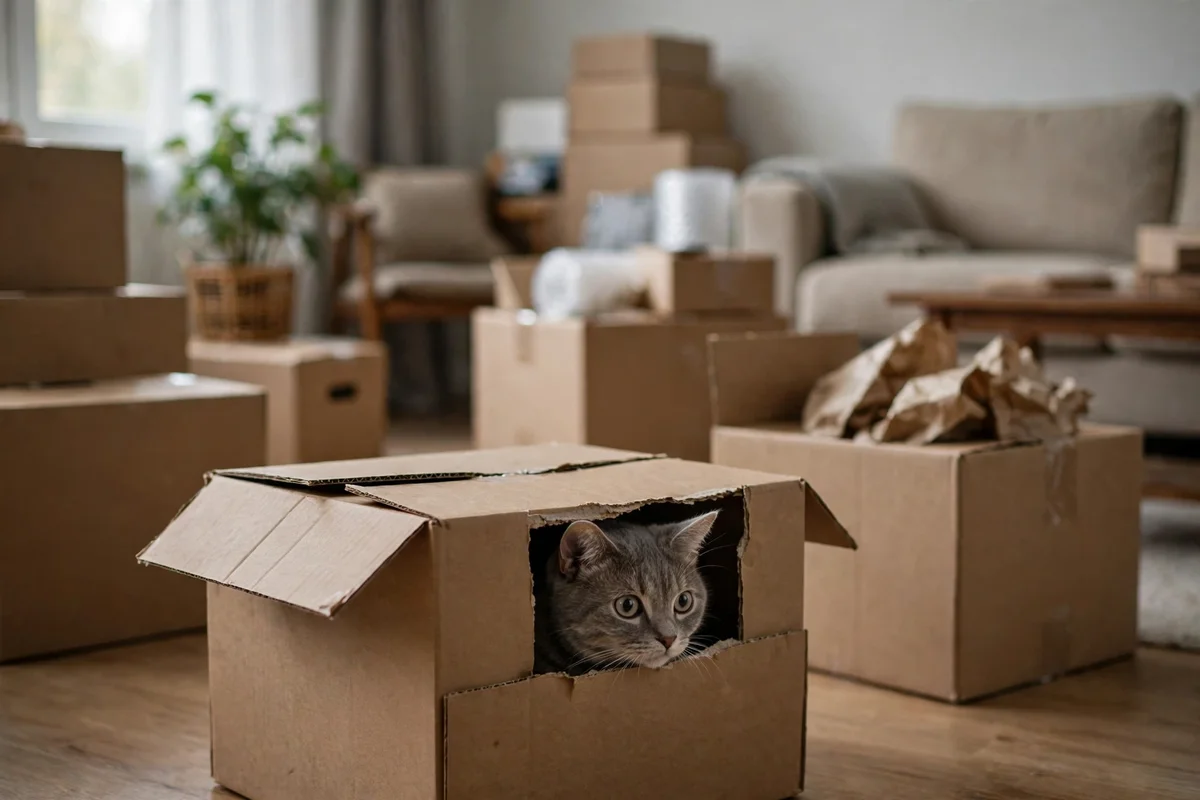
Do this instead. Leave hiding spots open in every room the cat uses: a cardboard box with a hole cut in it, a shelf it can reach, a quiet corner behind the sofa, a bed under a table. Our guide to cat sleeping positions explains why boxes and tight spaces are a cat’s idea of a safe room, and the same logic applies here.
A 2014 study at Utrecht University found that shelter cats given a hiding box adapted to a new environment faster and showed lower stress than cats without one. Never pull a cat out of hiding, and never block its way back in. A hiding cat is a cat coping. Let it cope.
8. Being Picked Up Too Often
Picking a cat up and holding it while it struggles feels like affection to a person and like being trapped to a cat. Cats are both predator and prey animals, and being held with no escape route triggers the prey half. The cat that squirms, scratches, or goes limp is not being ungrateful.
It is saying, in the only language it has, that it wants down. Cats that are grabbed often also stop coming near people at all, because the approach is what leads to being caught.
Do this instead. Let the cat choose. Sit on the floor, keep your hands still, and let it come to you. If you do pick a cat up, support its body, keep it brief, and put it down the moment it tenses or pushes away.
Children need this rule most, because they pick cats up more often and hold them longer. A cat that knows it can leave is a cat that stays, and a cat that is picked up ten times a day is a cat that will start hiding from hands.
9. Sudden Changes in Daily Routine
Cats rely on familiarity, routine, and a sense of control to feel comfortable. That is the sentence every major source on this subject agrees on, and it is the reason routine changes are the most common cause of stress in cats. Feeding times, waking and sleeping times, work patterns, playtime, and even cleaning routines all matter.
A new job that changes when you leave and come home, a holiday that changes who feeds the cat, or a new baby that changes when the house is quiet, all break the pattern the cat has learned to trust.
Do this instead. Keep the anchors steady even when the rest of life changes: feed at the same times, play at the same times, and keep the cat’s quiet hours quiet.
If a change is coming and you know about it, start the new routine a week early, in small steps, so the cat meets the change gradually rather than all at once. If the change is a new baby, set up the nursery early and let the cat investigate it before the baby arrives. Routine is the cheapest reassurance a cat can get, and it costs nothing but consistency.
10. Fighting With Other Household Cats
Most fighting between cats that live together is silent, which is why owners miss it. There is no yowling, no fur flying, no obvious fight.
There is a stare across the room, a cat sitting in the doorway so the other cat cannot pass, a cat guarding the food bowl or the litter box, and a cat that stops eating or starts toileting outside the box because the route there is blocked. That silent conflict is still conflict, and it stresses both cats.
Do this instead. Give each cat its own resources, in different places: separate food bowls, separate water bowls, separate litter boxes in separate rooms, separate resting spots, and separate high places to escape to. If you can, give each cat its own territory within the house, with a door between them at first. Learn to read the warning signs before they become a fight.
Our guide to cat tail language covers the tail positions that mean tension, and a fixed stare with a low tail is the signal to separate the cats calmly, not to shout at them. Shouting at fighting cats only adds fear to a conflict that was already stressful.
11. Moving to a New House or Apartment
Moving house is the biggest version of every cause on this list at once. Every familiar scent is gone, every corner is new, the furniture is in different places, the sounds are different, and the cat has no map of the place at all. Every major source lists moving house as one of the top causes of stress in cats, and the advice is the same everywhere, because it works.
Do this instead. Give the cat one safe room at each end of the move. Before the movers arrive, put the cat in a quiet room with food, water, a litter box, a hiding spot, and something that smells like home, and shut the door.
Move the cat last, in its carrier, to the new house, and put it in the safe room there before anything else is unpacked. Keep it in that room until the rest of the house is quiet, then open the door and let it explore one room at a time, over days.
Keep the feeding times and the routine the same, and use a pheromone diffuser in the safe room if your vet suggests one. Most cats settle in two to four weeks. Some take longer, and that is normal. What matters is that the cat always has one room that is safe, and one routine it can rely on, while the rest of the house becomes familiar.
What Stress Looks Like, Briefly
This article is about causes, so this section is short on purpose. The full signs guide is a separate article. The signs to watch for after any cause on this list are hiding more than usual, overgrooming, eating less or more, toileting outside the box, and a change from the cat’s normal behaviour. One sign on its own, for a day, is usually nothing.
Several signs together, or one sign that lasts more than a few days, is a pattern, and a pattern is worth a vet call. Stress is also linked to bladder inflammation in cats, which is one reason a stressed cat that strains in the litter box needs a vet the same day, not next week.
How to Calm a Stressed Cat Down
Whatever the cause, the calm down is the same. One quiet room with food, water, a litter box, and a hiding spot. The routine kept steady. The cat allowed to choose when to come out. No chasing, no pulling out of hiding, no forced cuddles as an apology. A cat that is allowed to approach on its own terms will usually do so within days.
Do not reach for medication or supplements on your own. Never give a cat human medication, and do not change any dose without consulting your vet first.
If the stress lasts more than a few weeks, or comes with hiding, eating less, or toileting changes, stop treating it as a behaviour problem and call your vet. Pain and illness cause the same changes as stress, and they need ruling out before any behaviour plan can work.
Frequently Asked Questions
What is the most common cause of stress in cats?
A sudden change in environment or routine. Moving house, moving furniture, a new pet, a new baby, or a change in work hours are the triggers every major source names first. Cats build their sense of safety out of familiarity, so anything that breaks the familiar pattern is a stressor until the cat learns the new pattern.
How long does it take a cat to get over a stressful change?
After a short scare, a few hours. After a move or a new pet, often two to four weeks, and some cats take longer. A steady routine and safe hiding spots speed it up. If the stress lasts more than a few weeks, or comes with hiding, eating less, or toileting changes, call your vet.
Can a dirty litter box really stress a cat?
Yes. Cats are clean animals with a far sharper sense of smell than people, and a dirty box is one of the fastest ways to push a cat toward toileting outside the box. Scoop at least once a day, keep one box per cat plus one extra, and use unscented litter.
Do cats fight silently?
Yes, and that is why owners miss it. Most conflict between household cats is a fixed stare, a blocked doorway, or a guarded food bowl, not a loud fight. If one cat stops eating or starts toileting outside the box, check whether the other cat is blocking the route there before you blame the cat that stopped.
The Bottom Line
None of the eleven causes on this list is a disaster on its own. They are ordinary life: furniture, visitors, new pets, new food, noise, a dirty box, a closed door, a changed schedule, a move. What makes them stressful is that they take away routine, territory, or choice, and a cat with none of the three left has no way to cope. The fix is almost always the same shape, and it is almost always in your hands.
Change one thing at a time. Introduce the new thing slowly. Keep the feeding times steady. Leave a hiding spot open. Let the cat choose. Do those five things and most of the stress on this list never happens, and the stress that does happen passes in days instead of weeks.