
How to Handle Your Cat (Without Getting Scratched)
Most scratches happen in the few seconds when a cat is picked up or put down, not during the hold itself. A cat that feels unsupported, squeezed or trapped will push off with its back legs, and those claws are what catch your arms. The fix is rarely strength or speed. It is reading the cat first, lifting with both hands, supporting the back legs the whole time, and setting the cat down the moment it asks to go. That sequence works for a confident lap cat, a nervous rescue and a wriggling kitten, with small changes for each.
Handling is also a trust issue. Cats are not carried by other cats to show affection, so being lifted is not a natural behaviour for them. Some cats learn to enjoy it, many tolerate it for a short while, and some never like it at all. All three are normal. The goal is not to force a cat into enjoying being held. It is to handle the cat safely when handling is needed, for a vet visit, a carrier trip, grooming or a move around the house, and to build tolerance slowly so those moments get easier over time. Our guide to keeping your cat calm at vet visits covers the wider stress picture, and the steps below focus on the lift itself.
Why Cats Scratch When You Pick Them Up
A scratch is usually a cat solving a problem. It feels its back legs dangle with nothing under them, so it kicks to find footing. It feels squeezed around the ribs, so it twists to get free. It is lifted suddenly from behind, so it panics before it knows what is happening. Or it was already overstimulated from petting and the lift was the last straw. In each case the cat is reacting to the handling, not plotting against you, which means changing the handling changes the result.
Breed and history play a part, but they are only a rough guide. Ragdolls and Persians are often relaxed about being held, while active breeds such as Siamese and Bengals are often affectionate yet would rather sit beside you than be held still. How much a cat was gently handled as a young kitten matters at least as much as its breed. Kittens learn to accept people and touch mainly between about 2 and 7 weeks of age, and cats that missed gentle handling then often stay wary of being lifted, although patient reward based handling can still help a lot. A cat that used to accept being held and now cries out, hisses or bites when lifted may be in pain, and that change is worth a vet visit rather than a training plan. Arthritis is common in older cats and often shows up as a cat that stops jumping onto furniture or flinches when its back end is lifted.
Read the Cat Before You Touch It
The lift starts before your hands move. A cat that wants to be picked up looks relaxed and settled. It rubs its body against you, its tail is still and not bushy, its ears face forward, its eyes are soft with normal sized pupils, and it is quiet. A cat that does not want to be picked up gives clear warnings too. Its tail twitches or puffs up, its ears flatten, its pupils widen, it growls or hisses, or it moves away. Picking up a cat that is showing those signs is how most scratches happen, so the right move is to wait and try again later.
Give the cat a short introduction first. Hold out one finger or the back of your hand at nose height and let the cat come forward to sniff it. If the cat rubs its cheek against your hand, that is a good sign. If it stays relaxed, stroke its head, the back of its ears and its cheeks gently and watch the reaction. This slow start matters most with a new cat or a cat you do not know well. Our guide to introducing a new cat to your home uses the same slow approach for the first days together.
Approach From the Side, Slowly and Low
Approach the cat from its side rather than head on or from behind. A head on approach can feel confrontational to a cat, and an approach from behind can startle it. Crouch down to the cat’s level instead of looming over it, move slowly, and speak softly. Keep your movements smooth and predictable, because sudden gestures are what trigger a flinch or a swat.
Face the same direction as the cat when you crouch beside it. This puts your body alongside the cat rather than towering over it, and it makes the lift a short sideways scoop instead of a reach across the cat’s body. If the cat walks away at this point, let it go. Chasing a cat that has already said no only teaches it that your approach means trouble, and the next attempt will be harder.
The Two Hand Lift, Step by Step
Use both hands every time, for every cat, whatever its size. One hand alone cannot support a cat’s weight safely, and a cat held by one hand will twist to find balance. The steps below are the standard two hand lift used by vets and behaviourists.
Step 1: One hand under the chest
Slide one hand under the cat’s chest, just behind the front legs, with your palm cradling the ribcage. Do not grab the front legs, and do not lift by the armpits. Your hand should feel the weight of the chest resting on it, not the legs dangling from it.
Step 2: The other hand under the back legs
Place your other hand or forearm under the cat’s back legs and bottom, scooping the hindquarters up so the back legs are fully supported. This is the step people skip most often, and it is the step that prevents most scratches, because a cat whose back legs are supported has no reason to kick out.
Step 3: Lift smoothly to your chest
Lift slowly and smoothly, bringing the cat against your chest as you rise. Keep the cat upright with its head above its body, and let most of its body touch yours so it feels held rather than hanging. Stand still or sit down once you are holding the cat, because walking around with a cat in your arms adds movement it did not ask for.
Step 4: Hold loosely, not tightly
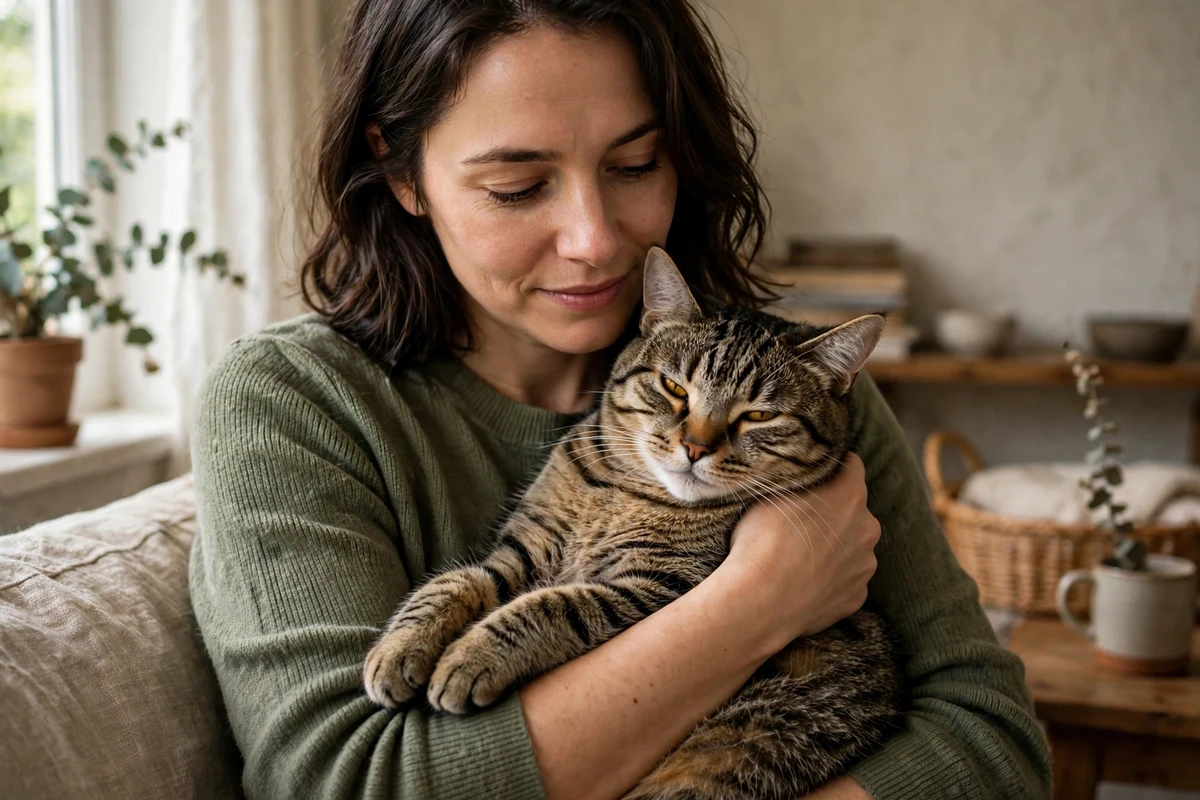
Hold the cat close but do not squeeze. A tight grip makes a cat feel trapped, and a trapped cat will fight to escape. Let the front paws rest comfortably against you, keep the back legs supported on your arm, and keep watching the cat’s body language the whole time you hold it. Some cats are happy to be held for several minutes, others will only tolerate a short hold, and both are fine.
Step 5: Put the cat down as soon as it asks
When the cat starts to shift, squirm, meow or try to escape, it is time to set it down. Crouch until the cat’s paws are close to the floor, then let all four paws touch down at the same time before you release your hands. Do not drop the cat from standing height, because a cat that has to leap down will let its claws out on the way, and a cat that lands awkwardly may be hurt. A calm ending teaches the cat that being held ends safely, which makes the next lift easier.
Holding Positions That Work
Once the cat is up, a few positions suit most cats. The chest hold is the default: cat upright against your chest, one hand under the chest, the other supporting the back legs. The shoulder perch suits confident cats that like height, with the cat’s front paws on your shoulder and its back legs supported on your arm, but only try it with a cat that is balanced and calm. The lap hold suits quiet moments: sit down and let the cat settle in your lap with one hand resting lightly on it for support.
One position to avoid is cradling a cat on its back like a baby. Most cats feel vulnerable belly up and may panic, bite or scratch to get free. A few cats tolerate it, but it should never be the first position you try with a cat you do not know well. The same goes for holding a cat by the scruff of the neck. Mother cats carry very young kittens that way, but an adult cat that goes still when scruffed is usually frightened, not calm. The 2022 AAFP and ISFM Cat Friendly Veterinary Interaction Guidelines now advise vets against scruffing as well, and recommend towels and gentle minimal restraint instead.
What Never to Do
A short list of never rules covers most handling injuries. Never lift a cat by the scruff, the front legs, the tail or the belly. Never hold a cat with one hand. Never let the back legs dangle. Never squeeze a cat tightly or hug it hard. Never pick up a cat that is frightened, stressed or showing warning signs. Never approach from behind without letting the cat know you are there. Never hold a cat against its will once it is clearly asking to be put down. Each of these rules exists because breaking it is how cats and people get hurt.
Children need the same rules in simpler form. Have young children sit on the floor and let the cat climb into their lap instead of carrying it around, and always supervise. Small hands can squeeze too tightly or drop a cat by accident, and a frightened cat may scratch in self defence. Teach children to watch the tail and ears and to put the cat down gently the moment it squirms.
Kittens, Older Cats and Injured Cats
Kittens are easier to lift because they are small, but they are also fragile and wriggly. Use both hands, one under the chest and the other cupping the bottom, and hold them low over a sofa or the floor in case they slip free. Keep handling sessions short, gentle and frequent. Kittens handled kindly from a young age usually grow into cats that are much easier to pick up, so these early sessions are an investment.
Older or arthritic cats need a slower lift with full support under the hips and back legs. Never lift an older cat by the belly or under the front legs only, because that puts weight on joints that may already hurt. If an older cat that once enjoyed being held now resists, ask your vet about pain before assuming it is a behaviour problem.
An injured cat is a different case entirely. A cat in pain may bite even its own family, so do not hug it or lift it by hand. Gently slide a towel or blanket under it, lift it on the towel into a carrier, and call your vet. The towel keeps your hands away from teeth and claws and gives the cat a stable surface to lie on.
The Towel Wrap for Necessary Handling
When a cat must be handled for medicine, nail care or a vet visit and will not tolerate a normal lift, a towel wrap is the safest option. Lay a large towel flat, place the cat in the middle, and fold the towel snugly around the body with only the head, or the one paw you need, exposed. This is often called the burrito method. It limits kicking, keeps claws covered, and gives the cat a sense of being held firmly without being squeezed. Keep the wrap loose enough for the cat to breathe easily, and never wrap a cat that is struggling to breathe or overheating.
A towel wrap also helps with nail trims. Place the cat in your lap or on a flat surface, wrap it loosely, and extend one paw at a time. Keep one arm gently against the cat’s chest for steadiness. If the cat becomes distressed, stop and try again another day rather than pushing through. Our guide to playing with your cat covers the same short session and reward approach for building trust through play.
Building Tolerance Over Time
A cat that hates being held can often learn to tolerate it, but the change takes weeks, not a single afternoon. Keep each handling session very short, a few seconds at first, and end while the cat is still calm. Pair every lift with something the cat likes, a treat or a favourite game, given the moment its paws touch the floor again. Over days and weeks, lengthen the hold a little at a time. If the cat tenses up, go back to a shorter hold rather than pushing on.
Practice the lift itself as a game, not only when you need to move the cat. Pick the cat up, hold it for five seconds, put it down gently, and give a treat. Repeat that a few times a week and the cat starts to expect a calm ending and a reward, instead of expecting to be carried somewhere it does not want to go. Never punish a cat for scratching during handling. Punishment teaches the cat to fear your hands, which makes the next attempt worse.
Some cats will never enjoy being held, and that is a result to accept rather than a problem to fix. A cat that will sit beside you, sleep near you and greet you at the door is showing affection in its own way. For those cats, focus on the handling you actually need, vet visits and carrier trips, and let the rest of the bonding happen on the floor. Our guide to harness training uses the same slow, reward based method for another skill cats do not take to naturally.
When to Call a Vet
Some changes in handling tolerance are medical, not behavioural. Call your vet if your cat used to tolerate being held but now cries out, hisses or bites when lifted, if it limps, walks stiffly or no longer jumps onto furniture, or if it flinches or growls when you touch its back, belly or hips. These signs can point to pain, and handling a cat in pain will only make it worse.
Also seek medical advice promptly if you are bitten and the bite breaks the skin. Cat bites become infected easily, so clean the wound and see a doctor the same day rather than waiting to see if it heals on its own. Scratches are usually minor, but wash them with soap and water and watch for redness or swelling over the next day or two.
Frequently Asked Questions
Do cats like being picked up?
Being picked up is not a natural behaviour for cats, and many do not enjoy it. Some learn to like it, many tolerate it briefly, and some never do. Watch the individual cat rather than expecting all cats to behave the same way.
Is it OK to hold a cat like a baby?
Most cats dislike being cradled on their back and may panic, bite or scratch. Keep the cat upright against your chest with its back legs supported instead.
How do I pick up a cat without getting scratched?
Wait until the cat is relaxed, approach from the side, slide one hand under the chest behind the front legs, support the back legs and bottom with your other hand, lift slowly to your chest, and put the cat down as soon as it starts to squirm.
Why does my cat scratch me when I pick it up?
Usually because it feels unsupported, squeezed or startled. Dangling back legs are the most common cause, so supporting the hindquarters fully prevents most scratches.
Should I scruff my cat to pick it up?
No. Scruffing an adult cat can cause pain and fear, and current veterinary guidelines advise against it. Use the two hand lift or a towel wrap instead.
How long should I hold my cat?
Only as long as the cat stays relaxed. Some cats are happy for several minutes, others for a few seconds. Set the cat down gently the moment it shifts, squirms or tries to escape.