
Outdoor Access for Indoor Cats (Catios, Fences, Leashes)
Your indoor cat stares out of the window for hours. It chatters at birds, tracks leaves, and sprints for the door every time it opens. The instinct is real, and so is the dilemma: the outdoors is the most interesting place your cat will ever see, and also the most dangerous. Free roaming cats live dramatically shorter lives than indoor cats, with indoor cats typically living 12 to 18 years against 2 to 5 years for cats that roam freely, a gap driven by traffic, predators, fights, disease, and poison rather than by anything indoor life adds. The answer is not to choose between a bored cat and a dead cat. It is controlled access: catios, cat proof fencing, harness walks, and supervised yard time that give your cat sun, air, and hunting practice while keeping the risks on your side of the fence.
The Short Answer
Give your indoor cat outdoor time, but never free roaming. A catio is the best option for most homes: an enclosed patio, window box, or yard run with sturdy mesh, shade, water, and climbing shelves. Harness and leash walks suit confident cats that enjoy them, trained indoors first in short sessions. Cat proof fencing with inward tilting toppers works for secure yards, always supervised. Whatever you choose, keep vaccinations, flea and tick prevention, and microchip details current, use a breakaway collar with an ID tag, and bring the cat in before dark.
Disclosure: this article contains affiliate links. If you buy through them, we may earn a commission at no extra cost to you.
Why Free Roaming Costs So Much
The numbers are stark enough to settle the question before the options begin. Indoor cats typically live 12 to 18 years, and many reach their early twenties. Outdoor only cats average just 2 to 5 years, according to research from UC Davis tracking thousands of cats. The RSPCA states the same gap in plainer terms: a cat kept safely at home lives, on average, a full ten years longer than one allowed to roam. The causes are not mysterious. Road traffic is the leading cause of traumatic death in outdoor cats, accounting for the majority of such cases, with most cats hit by a car not surviving. Fights with other cats transmit feline immunodeficiency virus and feline leukaemia virus, both incurable, and a 2019 meta-analysis pooling 21 studies found cats with outdoor access were 2.77 times more likely to be infected with parasites than indoor only cats.
There are quieter costs too. Roaming cats get lost, stolen, trapped in garages and sheds, poisoned by slug pellets and antifreeze, and injured by dogs and wildlife. They also kill wildlife: a roaming cat is a very effective hunter, and the birds and small mammals it catches are a real ecological cost as well as a source of parasites for the cat. None of this means outdoor time itself is bad for cats. It means unsupervised, unbounded outdoor time is a bad trade, and the whole point of this guide is to keep the good half of the trade while removing the bad half. Supervised outdoor access, through a catio or a leash, shows no significant lifespan drop in the UC Davis data, which is the result that matters: your cat can have the outdoors without paying the roaming price.
Option 1: The Catio, the Best Default
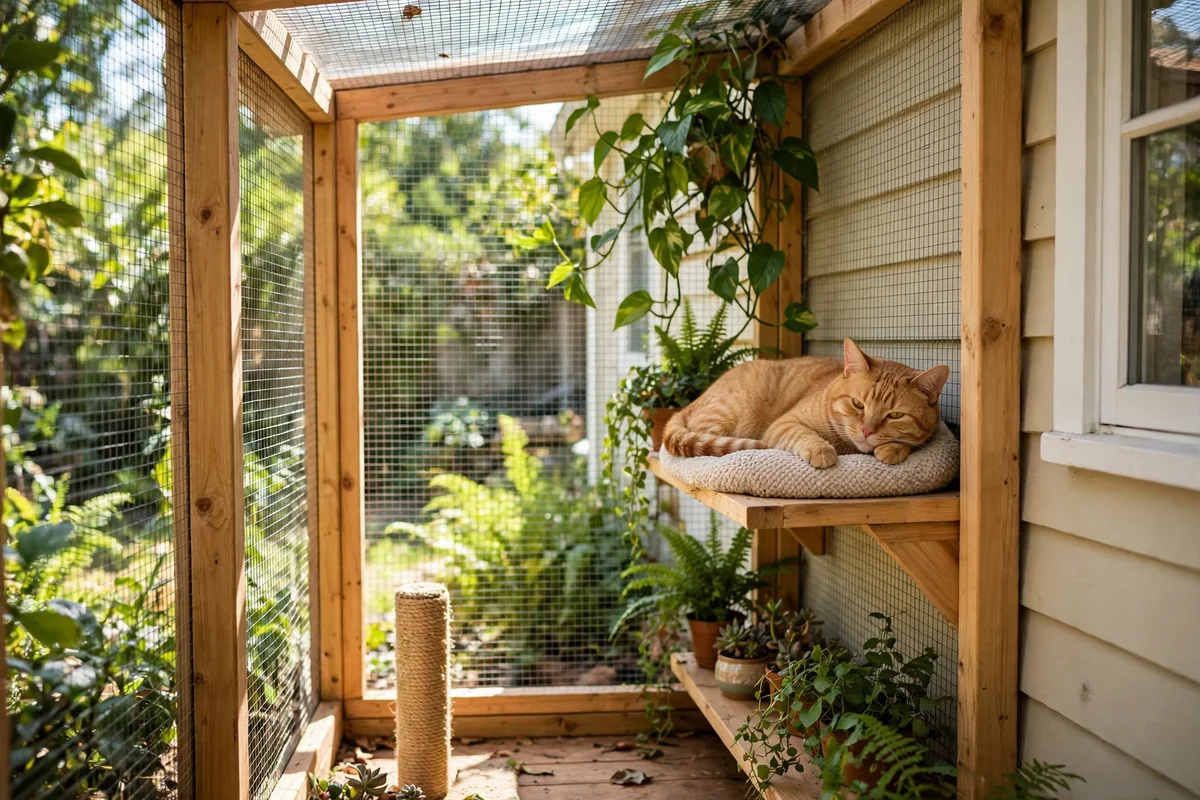
A catio, short for cat patio, is an enclosed outdoor space that lets your cat enjoy sun, breeze, grass smells, and bird watching without any chance of escape or of another animal getting in. It is the option most vets and welfare organisations recommend first, because it needs no training, works for nervous cats as well as bold ones, and can be used every day without you standing guard. The International Cat Care guidance and the Ontario SPCA both describe catios as the simplest safe compromise, and the TICA guidance on safe outdoor time lists them first among the controlled options.
Catios come in four shapes. A window box catio hangs outside a window and suits flats and small homes. A balcony enclosure screens an existing balcony with mesh. A patio or garden run is a freestanding or house attached structure with room for shelves, a scratcher, and a litter area. A tunnel system connects the house to a run further out in the garden, which is the most ambitious version and the one cats tend to love most, since it adds a journey to the destination. Portable pop up catios exist too, and they are a good way to test whether your cat enjoys enclosed outdoor time before you build anything permanent.
Build or buy with a short checklist. The frame must be rigid and fixed on all sides, with claw resistant mesh rather than chicken wire, which cats can chew through and predators can tear. The latch must lock from the outside and must not be openable by a paw from inside. Include vertical space, shelves at two or three heights, a sisal scratching post, shade for hot days, and weather protection for rain. Place water and a litter area inside, since a cat that has to come indoors to drink will not stay out long. Check the mesh and the fixings every month, because a single loose corner is an escape route. And put the catio where the action is: a view of birds, a patch of sun, and a breeze matter far more to a cat than square metres.
Option 2: Harness and Leash Walks
Leash walks are the most flexible option and the one that most divides cats. Some cats take to a harness in a week and start waiting by the door. Others lie flat on the floor and refuse to move, and no amount of patience changes their mind. Both responses are normal, and the test costs nothing but a harness and a few short sessions. If your cat hates it, stop and use a catio instead. A walk your cat dreads is not enrichment.
Training follows a slow ladder, and every step is rewarded, never forced. First, let the cat sniff the harness, then lay it near the food bowl for a day or two. Next, put it on indoors for a few minutes at a time, paired with treats, and let the cat walk around the house wearing it with no leash attached. Then attach a lightweight flat leash and follow the cat around indoors, never pulling, rewarding curiosity. Only when the cat moves freely indoors do you step outside, into a quiet spot close to home, for five minutes. Build up gradually from there. The TICA guidance recommends a well fitted H style or vest harness, with one finger fitting under the straps, and a lightweight flat leash rather than a retractable, which gives you no control if the cat bolts.
On a walk, the cat leads and you follow. Cats do not heel like dogs, and a walk that drags the cat along is a walk that teaches the cat to fear the harness. Choose quiet routes away from dogs and traffic, watch for dogs off lead, and pick the cat up or head home if it crouches, flattens its ears, or tries to bolt. Never attach a leash to a collar: a frightened cat can slip a collar or injure its neck, and a harness spreads the force across the chest. Always use a breakaway collar with an ID tag as well, and make sure the microchip details are current before the first outdoor step. If you want a fuller treatment of the indoor side of the bargain, our guide to indoor versus outdoor cats covers the middle ground in detail.
Option 3: Cat Proof Fencing and Supervised Yard Time
If you have a fenced yard, cat proof fencing can turn it into a safe outdoor room. The principle is simple: cats climb up and over ordinary fences, so the top of the fence must defeat the climb. Inward angled toppers, roller bars that spin when a paw touches them, and mesh overhangs that curve back into the yard all work on the same idea, that the cat cannot get a grip on the last stretch. Purpose made systems exist, and a determined owner can also fit netting or toppers to an existing fence. Walk the perimeter before every session at first, and block the escape routes cats test first: gate gaps, corner step ladders made of stacked pots or furniture, low branches that overhang the fence, and any spot where digging under the fence is possible, which a buried strip of hardware cloth can stop.
Supervised yard time is the honest name for this option, because a fence is a deterrent, not a guarantee. Stay in the yard with the cat, especially at first, and watch how it tests the boundary. Some cats never test it. Some test it within minutes, and those cats need a catio instead. Keep sessions short at first and always bring the cat in before dark, when traffic, predators, and other cats are at their most active. Provide shaded rest areas and water, and remember that a fenced yard keeps your cat in but does not keep everything else out: other cats, dogs, and wildlife can still enter over the same fence your cat cannot leave over, so supervision is the real safety layer and the fence is only the second one.
Option 4: Small Spaces and Small Budgets
Not every home has a yard, and not every budget stretches to a built catio. The smaller options still count, because for a cat the value of outdoor time is sensory, not spatial. A window perch with a properly fitted screen gives sun, breeze, and bird watching from inside, and a sunny window with a view is the single cheapest piece of outdoor enrichment there is. A screened balcony, even a small one, is a catio by another name if the mesh is secure and the cat cannot slip through a gap or fall from a height. A pet stroller suits timid, elderly, or recovering cats that want the sights and smells without walking, and it is a genuine option rather than a novelty: the cat is enclosed, you control the route, and the cat still gets the air.
Whatever the scale, the same rules apply. Screens and mesh must be fitted, not draped, because a cat leaning on a loose screen can push it out of a window frame. Balconies above ground level need netting that closes the gap to the floor, since cats do fall from balconies, and a fall from height is one of the injuries vets see most in flats. Keep the space stocked with a rotating toy or a puzzle feeder so the cat has something to do out there, not just something to look at. And remember that outdoor access changes the parasite picture: the Cornell Feline Health Center notes fleas as the most common external parasite in cats, and outdoor exposure increases flea and tick risk, so keep prevention current even if the cat only sits in a window box.
Safety Checklist Before the First Trip Out
Run through this list before any outdoor access begins, whichever option you choose. Vaccinations should be current, including rabies where it is required, because outdoor cats meet other cats and wildlife. Flea and tick prevention should be current, since even a catio cat meets the fleas that ride in on other animals and on your shoes. The microchip details should be checked, not assumed, and the breakaway collar should carry an ID tag with a phone number that is answered. The cat should be spayed or neutered before outdoor access, since an unneutered cat will work much harder to escape and will fight and roam far more.
Check the weather and the clock. Cats overheat in enclosed spaces on hot days, so a catio needs shade and water and should not be used as a sun trap in a heatwave. Cold matters too: our guide to keeping outdoor cats warm in winter covers shelters and cold weather care for cats that spend real time outside. Bring the cat in before dark, check the cat on return for ticks, burrs, and small wounds, and watch for the signs that outdoor time is not suiting the cat: hiding on return, refusing to go out, overgrooming, or a sudden change in appetite. Any of those means pause the outings and ask your vet.
One more responsibility belongs on the list: the wildlife. Keep the cat in at dawn and dusk when birds are most active, fit a bell to the breakaway collar if your cat hunts, and consider that the early morning hours are when both hunting success and traffic danger peak. A cat that hunts less is a cat that brings home fewer parasites, and a cat that is indoors at dawn is a cat that is not on the road when commuters are. Our new cat owner starter kit covers the rest of the first year basics, including ID, vaccinations, and the supplies a new outdoor cat needs. Start small, watch your cat, and let the cat’s response choose the option. The right answer is the one your cat actually enjoys, used every day, not the most ambitious build in the catalogue.
Frequently Asked Questions
Should indoor cats be allowed outside at all?
Yes, through controlled access. Free roaming cuts a cat’s expected life from 12 to 18 years down to 2 to 5 years, but supervised access through a catio, a harness walk, or a fenced yard shows no significant lifespan drop in the UC Davis data. The goal is to give the cat the sun, air, and stimulation without the traffic, fights, disease, and predators.
What is a catio and is it the best option?
A catio is an enclosed outdoor space, a window box, balcony enclosure, patio run, or garden run, built with a rigid frame and claw resistant mesh. It is the best default for most homes because it needs no training, works for nervous cats as well as bold ones, and can be used daily without supervision. It must have shade, water, climbing shelves, and a latch a paw cannot open.
Can I walk my cat on a leash?
Many cats can, and some love it, but not every cat will. Train indoors first: let the cat wear the harness for short rewarded sessions, then attach a lightweight flat leash and follow the cat without pulling, and only then step outside for five minutes in a quiet spot. Use a well fitted H style or vest harness, never a leash on a collar, and let the cat lead. If the cat lies flat and refuses to move after several patient sessions, stop and use a catio instead.
Will cat proof fencing keep my cat in the yard?
It can, if the top of the fence defeats the climb. Inward angled toppers, roller bars, and mesh overhangs all work by denying the cat a grip on the last stretch. But a fence is a deterrent, not a guarantee, so supervise yard time, walk the perimeter for gaps, gate openings, and climbable furniture near the fence, and bring the cat in before dark.
Do indoor cats that go outside need extra vet care?
Yes, a little more than a strictly indoor cat. Keep vaccinations and flea and tick prevention current, check microchip details, and use a breakaway collar with an ID tag. Outdoor access roughly triples parasite risk, with a 2019 meta-analysis finding cats with outdoor access 2.77 times more likely to be infected with parasites than indoor only cats. Check the cat for ticks and small wounds after outings.
What if my cat hates the harness and ignores the catio?
Then the cat has voted, and the answer is indoor enrichment instead. A sunny window perch with a fitted screen, puzzle feeders, climbing shelves, and daily play sessions give much of the same stimulation. Not every cat wants to go outside, and a cat that is calm and busy indoors is not missing out. Revisit the catio in a different spot or season, but do not force outdoor time on a cat that finds it stressful.